In This Article
Right. Let’s talk about the elephant in the room — or rather, the elephant that won’t fit in your room.
Traditional cable crossover machines are magnificent beasts. They’re also roughly the size of a small lorry. Most measure over 2.5 metres wide, demand a dedicated room, and weigh enough that your kitchen ceiling would cave in if you moved one upstairs. For the average UK home — whether that’s a terraced house in Sheffield, a first-floor flat in Bristol, or a semi-detached in outer Manchester with a garage the size of a broom cupboard — a full commercial crossover is simply not a realistic option.
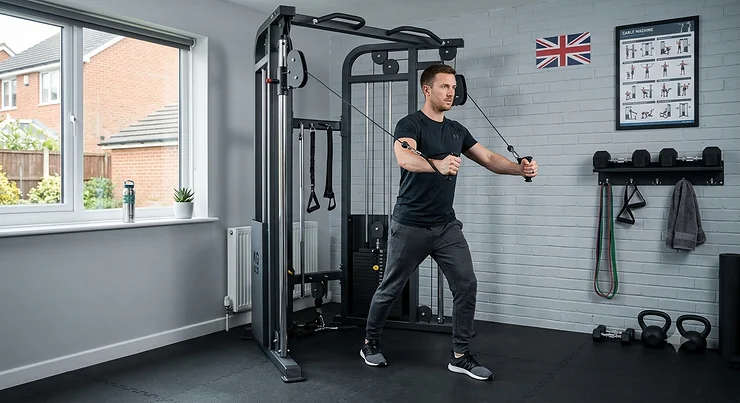
Enter the compact cable crossover machine. This is the category that’s quietly exploded over the last few years, driven partly by the post-pandemic home gym boom and partly by some rather clever engineering. A compact cable crossover machine is, at its core, a dual-pulley resistance training system designed to deliver the full functional versatility of a crossover station without demanding the floorspace of a small nightclub. We’re talking wall-mounted units that fold flush against a garage wall, slim freestanding frames with integrated weight stacks, and plate-loaded designs that slot into the corner of a spare bedroom.
The practical upside is substantial. Unlike a barbell rack or bench-and-dumbbell set-up, a good compact cable crossover machine lets you hit chest flyes, lat pulldowns, seated rows, tricep pushdowns, bicep curls, face pulls, and cable crunches — essentially a full-body gym session — from a single piece of kit. If you’re working with under five square metres of usable floor space (which, honestly, describes most UK spare rooms and garages), that kind of exercise density is remarkable.
In this guide, I’ve researched and reviewed seven real, currently available compact cable crossover machines on Amazon.co.uk, spanning budget through to premium, wall-mounted through to freestanding. Whether you’re a beginner equipping their first home gym or an experienced lifter looking to finally ditch the gym membership, there’s something here for you.
Quick Comparison: Top Compact Cable Crossover Machines at a Glance
| Product | Type | Max Resistance | Adjustable Positions | Best For | Price Range |
|---|---|---|---|---|---|
| SPORTNOW Wall Mount (15-Pos) | Wall-mounted | 120 kg | 15 | Budget beginners | Under £200 |
| XS Sports Cable Crossover | Wall-mounted | 80 kg (plate-loaded) | Adjustable | Compact spaces | £300–£400 |
| XS Sports Cable Crossover XL | Wall-mounted | 90 kg (plates incl.) | Adjustable | Mid-range value | £400–£500 |
| Wall Mount Crossover 18-Pos | Wall-mounted | 250 kg | 18 | Serious lifters | £250–£350 |
| K-Sport Cable Crossover | Freestanding/wall-anchor | Plate-loaded (unlimited) | Fixed high/low | Garage gyms | £300–£450 |
| Strongway Cable Crossover 75KG | Freestanding | 75 kg (incl.) | 11 | Flat/spare room | £350–£500 |
| SPORTNOW Lat Pull Down Crossover | Wall-mounted (slim) | 100 kg (plate-loaded) | High/low | Minimal footprint | £150–£250 |
The wall-mounted options clearly dominate the space-saving end of this market — and for good reason. Once secured to a solid wall, they leave your floor entirely free. The freestanding units from Strongway and K-Sport, however, are worth considering if you’re renting (no drilling required) or want the option to reposition your kit. The 18-position wall crossover punches well above its price point for those who take their training seriously and want maximum exercise variety. Budget buyers should note that lower price points often mean plate-loaded rather than weight-stack designs — which is actually fine, provided you already own Olympic plates or plan to invest in them.
💬 Just one click — help others make better buying decisions too! 😊
✨ Don’t Miss These Exclusive Deals!
🔍 Take your home training to the next level with these carefully selected compact cable crossover machines. Click any highlighted product name to check current pricing and availability on Amazon.co.uk. Whether you’re after a budget-friendly wall-mounted unit or a premium freestanding functional trainer, these picks cover every need!
Top 7 Compact Cable Crossover Machines: Expert Analysis
1. SPORTNOW Wall Mount Cable Machine — 15 Positions Dual Pulley System
If you want genuine cable crossover functionality without spending more than a few hundred pounds, the SPORTNOW Wall Mount is about as good an entry point as this market currently offers. It mounts directly to your wall (top and bottom anchor points for added stability), measures a tidy 62 cm × 60 cm × 200 cm when installed, and supports up to 120 kg of total resistance — more than enough to challenge most intermediate lifters.
The 15 adjustable positions are the real headline here. That level of adjustment means you can genuinely replicate the high-to-low and low-to-high cable paths that define cable crossover training — something cheaper single-position lat towers simply cannot do. In practice, this translates to cable chest flyes, cable crunches, facepulls, upright rows, and unilateral work, all from a unit that takes up roughly the wall space of a large flat-screen television.
It’s honest about its limitations, too. The cable tolerance is rated to 120 kg total — fine for most home users, but competitive powerlifters or those training with very heavy resistance may eventually find themselves at the upper limit. UK buyers should also factor in that this is a plate-loaded system, so you’ll need to purchase weight plates separately unless you already own them.
UK customer feedback is broadly positive: buyers particularly praise the stability once wall-mounted (use rawl bolts into brick for best results — timber frame walls require specialist fixings) and the relatively swift assembly. One recurring note is to check your wall type before ordering, as the included hardware is designed for solid masonry walls.
✅ 15-position adjustment for genuine crossover training
✅ Compact 62 cm wall footprint — ideal for UK garages and spare rooms
✅ Good build quality for the price point
❌ Plate-loaded — plates not included, add cost
❌ 120 kg max may limit heavier lifters long-term
Price range: under £200. Solid value for those starting out.
2. XS Sports Cable Pulley Crossover Machine — Adjustable Dual Pulley (Wall-Mounted)
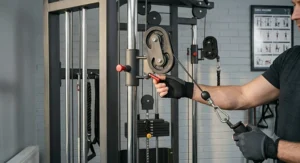
XS Sports is a UK-based brand with over two decades in the home fitness market, and it shows in the quality of this wall-mounted crossover. The standard model measures 201 cm × 61 cm × 65 cm — notably slimmer in depth than many competitors — and accepts up to 80 kg of standard Olympic plates per side when loaded with the included stack.
What makes this stand out from similarly-priced wall units is the commercial-grade cable system with heavy-duty sealed bearings. In plain terms: the cable moves smoothly throughout the full range of motion, doesn’t judder or bind, and won’t develop that horrible grinding sensation that plagues cheaper rollers after six months of British garage humidity. That kind of reliability matters more than most buyers initially appreciate. A rough cable path subtly changes exercise mechanics, and over time, it’s not kind to your joints.
This is the machine I’d most confidently recommend to someone furnishing a dedicated training space in a terraced house with a converted garage. It’s compact enough to leave room for a barbell and Olympic plates on one side of a standard single garage, yet versatile enough to handle the majority of upper and lower body cable work. The unit requires proper wall-mounting (concrete or brick; check your wall type), but once secured, it’s reassuringly solid.
UK customers have noted the straightforward assembly and responsive after-sales support from XS Sports’ UK-based team — a meaningful advantage over some international brands that treat warranty queries as an endurance test.
✅ UK brand with local customer support
✅ Sealed-bearing pulley system — smooth operation long-term
✅ Slimline depth — only 65 cm from wall
❌ Weight plates not included in base model
❌ Requires masonry wall mounting — not suitable for all UK home types
Price range: £300–£400. A well-built mid-range choice from a trusted UK name.
3. XS Sports Cable Pulley Crossover Machine XL — 90kg Weight Stack Included
The XL variant from XS Sports is essentially the standard model with an important upgrade: a full 90 kg weight plate stack is included in the box. For buyers who don’t own a pile of Olympic plates already — which, to be fair, is most people setting up their first serious home gym — this is a meaningful saving and a much simpler out-of-the-box experience. You mount it, load it, and train.
The frame dimensions are comparable to the standard version, maintaining that pleasingly slim wall profile. The weight stack gives you up to 90 kg of total resistance, which is comfortably sufficient for virtually all beginner and intermediate training goals across every upper-body exercise. It’s worth noting that because the included plates are standard rather than Olympic, the loading system may differ slightly from plate-loaded bars you might already own — check compatibility before assuming interchangeability.
The dual pulley design allows for simultaneous bilateral training (both arms working together, as in cable chest flyes) or independent unilateral work, which is particularly valuable for correcting strength imbalances — something that’s far easier to develop than most people realise when training primarily with barbells. The XL also benefits from the same heavy-duty cable construction as its sibling, so long-term smoothness and reliability are baked in.
For a UK buyer equipping a home gym from scratch who wants to buy once and be done with it, the XL represents strong all-in value. Prime-eligible on Amazon.co.uk means you can have it delivered within days.
✅ 90 kg weight stack included — genuinely ready to train from day one
✅ Dual pulley for bilateral and unilateral work
✅ Same reliable cable system as the standard model
❌ Total resistance capped at 90 kg — strong lifters will want more eventually
❌ Requires solid wall mounting; not suitable for drywall
Price range: £400–£500. The best all-in package for beginners buying their first serious crossover.
4. Wall Mounted Cable Crossover — 18 Positions, 250 kg Capacity, Linear Motion Carriages
This is the unit for people who arrive at cable training with some prior experience and very clear ideas about what they want. Eighteen adjustable pulley positions across a double bar track system means you can fine-tune your cable angle with a precision that goes well beyond the basic “high, middle, low” of cheaper units. The linear motion bushing carriages — rather than basic pivot bolts — mean each position adjustment is smooth and consistent, not a battle with a stiff pin-and-hole mechanism.
The 250 kg total weight capacity is, frankly, the standout specification in this price bracket. That headroom means you’ll never outgrow this machine regardless of how strong you become, and it adds a structural confidence to every set. The unit is plate-loaded, so you supply your own resistance, but for anyone already owning Olympic plates, this is an advantage — you’re not paying for a weight stack you might eventually exceed anyway.
UK buyer feedback highlights genuine satisfaction with the build quality given the relatively modest price range. One customer noted it as “a must have for any home gym” that “covers every type of resistance exercise” while barely intruding on available floor space. That’s not a bad summary. Yes, the assembly requires careful attention to the instructions (a few buyers have mentioned missing bolts in their orders — worth checking your hardware bag thoroughly before you begin), but the end result is a robust, professional-feeling station.
For the serious UK home gym builder who wants near-commercial versatility in a wall-mounted format, this is arguably the best value-per-position in the market right now.
✅ 18 adjustment positions — outstanding exercise variety
✅ 250 kg total capacity — future-proof for even strong lifters
✅ Linear motion carriages for smooth, precise adjustment
❌ Plate-loaded — you need to source your own weight plates
❌ Assembly requires patience; check hardware bag before starting
Price range: £250–£350. Exceptional versatility for the price — a genuine competitor to units costing twice as much.
5. K-Sport Cable Crossover Machine — Plate-Loaded, Olympic, with Pull-Up Bar
K-Sport is a German-designed fitness brand available on Amazon.co.uk and through Decathlon UK, with a reputation for engineer-first design rather than marketing-led spec inflation. The Cable Crossover Machine is a freestanding, plate-loaded unit that can also be anchored to a wall and floor for added stability — a genuinely versatile mounting option that suits UK renters who may need to move kit.
The Olympic weight-loading system accepts any standard Olympic plates, so if you already have a barbell set, you’re bringing your own progressive resistance without additional investment. The high and low pulley positions cover the fundamental cable movement patterns effectively, and the included e-book provides a structured training programme — a small touch that actually matters for people who aren’t sure where to begin once the machine is assembled.
The rubber buffer detail at the end of each cable pull is a thoughtful engineering inclusion. It means that if you release the handles abruptly mid-set (which happens, especially when training to fatigue), the cable doesn’t whiplash and the carriage stays safely in position. These are the kinds of details that separate considered design from a me-too product. The centrally mounted pull-up bar adds structural rigidity and opens up an entirely different exercise modality — bodyweight training — within the same footprint.
For a garage gym in a rural or suburban UK property where permanent wall mounting isn’t practical, this is a strong contender.
✅ Freestanding or wall/floor-anchored — flexible for renters
✅ Olympic plate loading — compatible with existing barbell set
✅ Rubber buffer safety detail and pull-up bar included
❌ Fixed high/low pulley positions only — less adjustability than some rivals
❌ No weight stack included — requires Olympic plates to use
Price range: £300–£450. A thoughtfully designed freestanding option with genuine build quality.
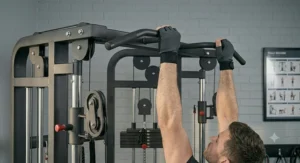
6. Strongway® Cable Crossover with 75 KG Weights Stack and Pull Up Bar
Strongway is a UK-based gym equipment brand (Stratford-upon-Avon, as it happens), and the 75 KG Cable Crossover is their compact freestanding entry — the one to consider if you want a weight stack included without committing to the larger 150 KG model. At its dimensions, it occupies a reasonable footprint for a freestanding unit and comes with 11 adjustable pulley positions, a pull-up bar, and dual stirrup handles included.
The 11-position adjustment range covers a comprehensive set of cable angles — more than enough for beginners and intermediate lifters to explore the full range of cable training movements. The included 75 KG stack (split across both sides) gives you a practical working resistance that will serve most users throughout the majority of their training programme. The commercial-grade cable system is consistent with Strongway’s other products: smooth, well-tensioned, and designed to remain that way with minimal maintenance.
What’s particularly useful about a freestanding unit in a UK context is the flexibility it offers people in rented properties. No wall drilling, no structural concerns, no awkward conversations with your landlord about the garage. The machine stands, trains, and can be repositioned or sold on without leaving a trace. Assembly is reportedly straightforward — most buyers report completing it solo within two hours — and Strongway’s UK-based customer service is responsive, which genuinely matters when a bolt is missing or a cable needs replacement.
✅ UK brand with strong domestic customer support
✅ 75 KG weight stack included — no additional purchases needed
✅ Freestanding — ideal for rental properties
❌ 75 KG total resistance is on the lighter end for experienced lifters
❌ Larger footprint than wall-mounted alternatives
Price range: £350–£500. A freestanding pick that suits UK renters and first-time home gym builders equally well.
7. SPORTNOW Wall Mounted Lat Pull Down Machine with High & Low Crossover Pulleys
At the budget end of the wall-mounted range, this SPORTNOW unit earns its place through an unusually slim profile: 75 cm wide and just 16 cm deep when flush against the wall. That is genuinely remarkable. In practical terms, it means this machine can mount in spaces where literally nothing else would fit — the end of a narrow hallway, the side wall of a single garage, even a utility room with ambitions above its station.
It’s primarily a single-column machine rather than a traditional dual-arm crossover, which means you won’t get simultaneous bilateral cable work (proper crossover flyes require two independent pulley arms). What you will get is lat pulldowns, seated cable rows, high cable extensions, low cable curls, and a surprisingly complete range of unilateral pulling and pushing movements. The 103 cm handle bar and 89 cm travel distance ensure full range of motion on pulldowns, which matters more than many beginners appreciate.
The plate-loaded design accepts standard 2.5 cm standard plates (clips included), and the weight holders support up to 100 kg — more than sufficient for most users. The unit mounts to concrete, brick, or solid wood walls and is recommended to install at least 20 cm from the floor for full range of motion at the bottom position.
For a UK buyer with very limited space who wants a robust cable training solution at a modest price, this is the honest, practical choice. It won’t do everything, but what it does, it does well.
✅ 75 cm × 16 cm wall footprint — smallest in this list
✅ Up to 100 kg plate capacity — honest headroom for most users
✅ Prime-eligible on Amazon.co.uk — fast UK delivery
❌ Single column — no bilateral crossover exercises possible
❌ Standard plates only (2.5 cm bore) — check compatibility with your existing plates
Price range: £150–£250. The best option when space constraints are genuinely severe.
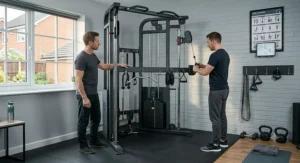
How to Set Up Your Compact Cable Crossover Machine: A Practical UK Guide
Buying the machine is the easy part. Setting it up properly — particularly in a typical UK home — is where most people make avoidable mistakes, and where a good experience diverges sharply from a frustrating one.
First, sort your wall. This matters enormously for wall-mounted units and is where UK buyers face the most variable conditions. Victorian and Edwardian terraced houses typically have solid brick or lime-render walls — generally excellent for mounting. Post-war semi-detacheds may have cavity brick walls, which are fine with appropriate long rawl bolts. Modern construction from the 1990s onwards increasingly uses timber-stud or metal-stud partitions with plasterboard, which are not suitable for direct fixing without wall plates that spread the load across multiple studs. If in any doubt, consult a builder or use a stud finder before drilling.
Clear your training zone. Cable crossover exercises — especially chest flyes and rotational core work — require clear lateral space on both sides. A good rule of thumb: allow at least 1.5 metres of clear space in each direction from the centre of the machine. Measure this before assembly, not after.
Cable tension checks. Before your first session, run each cable through its full range of motion at light resistance. A new cable may feel slightly stiff in the first few sessions — this is normal and will ease. If you hear cracking or feel sudden resistance changes, stop and inspect the pulley; this occasionally indicates a cable seated incorrectly during assembly.
Damp garage storage? This is a very British problem. Steel cables and pulleys left in an unheated, poorly ventilated UK garage through a wet winter will corrode. A light spray of dry PTFE lubricant on the pulleys every two to three months, combined with a weatherproof cover over the machine when not in use, will extend the working life significantly. It’s not glamorous maintenance advice, but it’s the difference between a five-year machine and a one-year machine.
First 30-day common errors: Overloading resistance in the first sessions (start lighter than you think you need — cable exercises challenge stabiliser muscles you haven’t trained this way before), skipping the assembly instruction manual (yes, all of it), and not retightening all bolts after the first 48 hours of use. Everything settles slightly in those initial sessions.
Which Compact Cable Crossover Machine Suits Your Home? Real UK Scenarios
Different homes, different needs. Here are three realistic UK user profiles matched to specific recommendations.
Profile 1 — The Renting Professional in North London. Mid-30s, one-bedroom flat in Islington, small second room used as a study that also needs to function as a workout space. Cannot drill walls under the tenancy agreement. Wants to train chest, back, and arms three times a week. Budget: around £500 all-in. Best match: Strongway 75 KG. It’s freestanding, no wall fixings required, comes with the weight stack included, and can be moved if they relocate. The UK-based customer support is also reassuring when you’re managing everything remotely.
Profile 2 — The Suburban Garage Gym Builder in Leeds. Early 40s, owns a standard semi-detached, brick-built single garage (approximately 5.5 m × 2.5 m) currently shared with a car, lawnmower, and assorted camping gear. Wants a cable machine that leaves room for everything else. Budget: up to £350. Best match: Wall Mounted Crossover 18-Position, 250 KG. Mounts to the brick end wall, leaves the floor completely clear, offers 18-position adjustment for genuine versatility, and the 250 KG capacity means it won’t be outgrown. Money left over for a good set of Olympic plates.
Profile 3 — The Experienced Lifter in Edinburgh. Late 20s, owns a tenement flat with a large cellar converted into a gym. Already owns Olympic plates and a barbell. Wants to add cable training to complement existing compound lifting. Ceiling height is good; floor space is generous but the walls are original stone. Budget: flexible, prioritises quality. Best match: K-Sport Cable Crossover. The Olympic plate compatibility means no additional expenditure on resistance. The wall/floor anchoring option works well with stone walls (appropriate fixing hardware is needed — consult a local builder). The German engineering and thoughtful details will appeal to someone who’s been around gym equipment long enough to notice the difference.
How to Choose a Compact Cable Crossover Machine in the UK: 6 Criteria That Actually Matter
Choosing the right compact cable crossover machine comes down to six practical questions — not the ones the product listings want you to focus on, but the ones that actually determine whether you’re happy with the purchase six months later.
1. Wall or freestanding? If you own your home and have a solid masonry wall available, wall-mounted is almost always the better choice for space efficiency. If you rent, or if your available walls are stud-framed, go freestanding or choose a unit that can anchor to the floor without wall fixings.
2. Weight stack or plate-loaded? Stack-included units cost more upfront but are genuinely more convenient — no scrabbling around for plates, no loading and unloading between sets. Plate-loaded units are cheaper at point of purchase and offer unlimited resistance ceiling, but only make economic sense if you already own compatible plates.
3. How many adjustment positions? Fewer than 10 positions limits your exercise variety quite significantly. The sweet spot for most users is 11–18 positions. Anything above 18 is generally more precision than most home gym users will ever need.
4. Weight capacity ceiling. A beginner might only ever use 40 kg on a cable; an experienced lifter doing heavy lat pulldowns may use 90–100 kg. Buy for where you’re going, not where you are. A 120 kg rated unit is honest headroom for most people; if you’re already strong, prioritise 200 kg+ capacity.
5. What’s your wall made of? Genuinely, find out before ordering a wall-mounted unit. Brick and concrete — excellent. Timber stud — requires specialist fixings not always included. Solid stone (common in Scottish, Welsh, and older English properties) — strong but may require masonry anchors designed for dense stone.
6. Space for accessories. Most compact crossover machines require third-party attachments — rope handles, ankle cuffs, straight bars — for a full exercise library. Budget an additional £30–£50 for quality cable attachments if they’re not included.
Common Mistakes When Buying a Compact Cable Crossover Machine
Buying on price alone. The cheapest cable machines are, almost universally, let down by their pulleys. Nylon pulleys with basic sleeve bearings feel fine initially but degrade quickly — especially in the damp, temperature-variable conditions of a British garage. Spend a little more for sealed steel bearings if the machine will live anywhere other than a heated indoor room.
Ignoring the depth dimension. Width and height get all the attention in spec sheets, but it’s depth — measured from the wall out into the room — that actually determines whether you can train properly in the available space. A machine that sticks 60 cm out from the wall needs 60 cm plus your arm span of clear space on the training side. Measure your room in all three dimensions before buying.
Buying US-voltage models. This is less common on Amazon.co.uk than it was pre-Brexit, but motorised resistance systems occasionally turn up listed in the UK that are designed for 110V US supply rather than the UK standard 230V/50 Hz with Type G plugs. The mechanical cable machines reviewed in this guide don’t have this problem — they’re unpowered — but if you’re ever considering a smart or motorised cable system, double-check the voltage specification explicitly.
Overlooking assembly requirements. Several of these units arrive in boxes weighing 50+ kg with up to 50 individual parts. If you’re solo, plan assembly time accordingly (often two to three hours) and consider whether a helper would make the process safer. Rushing assembly is the primary cause of wobbly machines that become genuinely dangerous under load.
Features That Actually Matter (And Those That Don’t)
Matters: Pulley material and bearing quality. The difference between sealed steel bearings and basic nylon sleeves is the difference between a machine that still feels smooth after two years of use and one that sounds like a rusty gate hinge by autumn. When reviewing specs, look for “heavy-duty bearings” or “sealed bearings” in the product description; treat the absence of this information as a mild warning sign.
Matters: Cable quality and coating. A galvanised or vinyl-coated steel cable will last significantly longer in the damp conditions of a UK garage than a bare steel cable. This is rarely mentioned prominently in listings, but UK buyers should ask the question if the product description is silent on it.
Matters: Anchor points and installation hardware. Quality machines include multiple wall/floor anchor points with hardware appropriate for masonry walls. Budget units sometimes include only minimal fixings and rely on top-only wall mounting, which puts significantly more stress on that single point. More anchor points equals more stability equals safer training.
Doesn’t matter (as much as marketed): Claimed weight capacity headline. “250 kg rated machine!” sounds impressive, but the meaningful number is the actual weight you’ll ever use. For most home gym users, that ceiling is 80–120 kg. Don’t pay a premium purely for capacity headroom you’ll never touch.
Doesn’t matter: Number of included attachments. Most included attachments with budget machines are mediocre quality — thin bar ends, flimsy rope, clips that fail under load. You’re better off buying three or four quality attachments separately (a good rope, D-handles, and a lat bar from any reputable brand costs around £30–50 on Amazon.co.uk) than paying extra for a package of eight low-quality ones.
Long-Term Cost & Maintenance in the UK
Here’s the honest total cost of ownership picture, because the sticker price is rarely the whole story.
A wall-mounted unit in the £200–£350 range will likely need its cable inspected at the 18-month mark and potentially replaced at two to three years, depending on usage frequency. Cable replacements typically cost £15–£30 for a quality aftermarket cable from Amazon.co.uk. Pulley lubricant (PTFE spray or light machine oil) costs under £10 and a single can lasts two to three years. Budget these in from the start rather than being surprised.
The total cost of ownership for a compact cable crossover machine over five years typically looks something like this: initial machine cost (let’s say £300) + weight plates if needed (£80–£150 for a starter set) + quality attachments (£40) + cable replacement (£25) + lubricant (£10) = roughly £455–£525 over five years. Compare that to a gym membership in a UK city at £30–£50 per month: that’s £1,800–£3,000 over the same period, before you factor in travel time, peak-hour crowding, and queuing for the cable station behind someone doing bicep curls in the squat rack.
The break-even point — where your home compact crossover machine has paid for itself versus a gym membership — is typically 10 to 15 months. After that, every training session is, in effect, free. For the average UK gym-goer who trains three to four times per week, that arithmetic is rather compelling.
For further guidance on safe home gym setup and equipment standards in the UK, the NHS guidance on physical activity and resources from UK Active are worth consulting alongside product specifications.
FAQ
❓ What is a compact cable crossover machine?
❓ Is a wall-mounted cable machine safe to install in a UK home?
❓ Do I need planning permission to install a cable crossover machine in my UK home?
❓ Can I use a compact cable crossover machine to replace a full gym membership?
❓ How much space do I need for a wall-mounted compact cable crossover machine?
Conclusion: The Right Compact Cable Crossover Machine Is Out There for Your Home
The compact cable crossover machine market in the UK has matured considerably. Where a few years ago the choice was largely between expensive professional units and flimsy cheap alternatives, today’s Amazon.co.uk selection includes genuinely impressive mid-range options that would have felt like commercial quality not long ago.
The headline recommendation is simple: if you’re mounting to a solid wall and want maximum exercise versatility per pound spent, the Wall Mounted Crossover with 18 Positions and 250 KG capacity is outstanding value in its price bracket. If you want a trusted UK brand with after-sales support you can actually reach, XS Sports or Strongway are the sensible choices. If you’re working with truly minimal space, the ultra-slim SPORTNOW Lat Pull Down Crossover is the honest pick.
Whatever you choose, the maths on home gym investment versus gym membership is difficult to argue with — especially once you factor in the particular British luxury of training at 6 AM in your own garage, without a four-mile round trip, a £1.80 car park charge, and a queue for the squat rack.
Train smart. Buy once. Buy right.
✨ Ready to Find Your Perfect Machine?
🔍 Click on any product highlighted in this guide to check current pricing and availability on Amazon.co.uk. Prices and stock change regularly — checking now ensures you don’t miss the current best deals. These picks will help you build a genuinely capable home gym in the space you actually have.
Recommended for You
- Best Commercial Cable Crossover Machines UK 2026: 7 Expert Picks
- Best Cable Crossover Machine UK 2026: 7 Top Picks Reviewed
- Best Dual Stack Home Gym Machine UK 2026: 7 Top Picks Reviewed
Disclaimer: This article contains affiliate links. As an Amazon Associate, I earn from qualifying purchases. If you purchase products through these links, we may earn a small commission at no additional cost to you.
✨ Found this helpful? Share it with your mates! 💬🤗
