In This Article
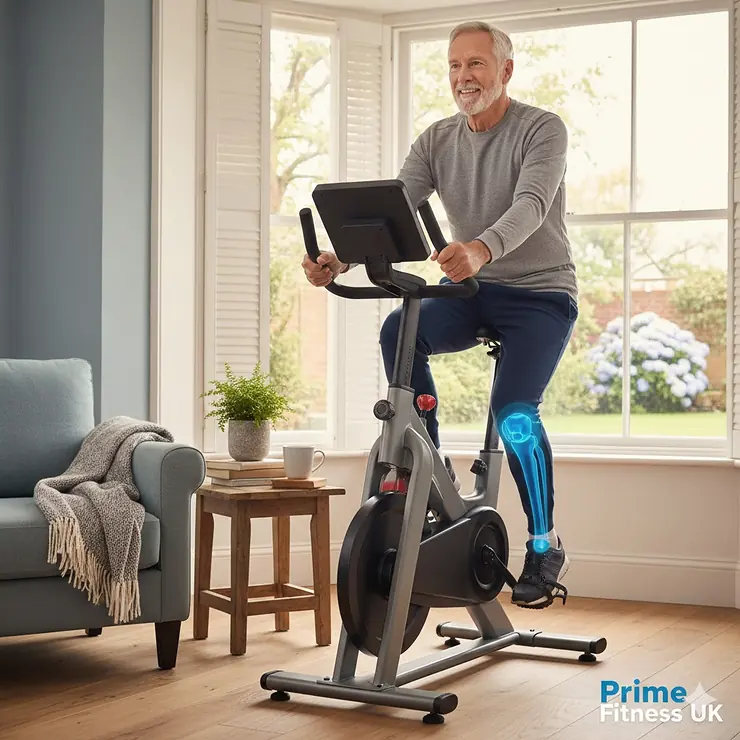
If you’ve been living with knee pain, you’ll know that familiar dread when contemplating exercise. Every step feels like a gamble, every workout a potential setback. Yet here’s the paradox—your knees actually need movement to heal and strengthen. Enter the magnetic exercise bike for bad knees, a game-changer that’s helping thousands of Brits reclaim their fitness without the agony.
I recently spoke with Margaret, a 67-year-old from Leeds who’d given up on exercise after her osteoarthritis diagnosis. Three months on her magnetic recumbent bike? She’s cycling 20 minutes daily and her physio is thrilled with her progress. “I honestly thought my active days were over,” she told me. “This bike gave me my independence back.”
Research published in the Journal of Rheumatology confirms that stationary cycling exercise relieves pain and improves function in individuals with knee osteoarthritis. Unlike high-impact activities, magnetic resistance systems deliver whisper-quiet, smooth pedalling that protects your joints whilst building the crucial muscle support your knees desperately need. According to Versus Arthritis, cycling encourages motion in the knees and hips whilst strengthening quadricep muscles, making it an ideal exercise for joint health.
Whether you’re recovering from surgery, managing arthritis, or simply dealing with chronic knee discomfort, the right magnetic bike can transform your rehabilitation journey. This comprehensive guide explores seven exceptional models available on Amazon.co.uk, each carefully selected for its knee-friendly features and proven track record with UK users.
Quick Comparison Table
| Model | Type | Resistance Levels | Price Range (£) | Weight Capacity | Best For |
|---|---|---|---|---|---|
| YYFITT 2-in-1 Foldable | Upright/Semi-Recumbent | 16 | £159-£179 | 120kg | Versatility & Space Saving |
| XS Sports B400R | Recumbent | 8 | £139-£159 | 110kg | Budget Arthritis Relief |
| MERACH S08 Recumbent | Recumbent | 16 | £199-£249 | 136kg | Smart App Connectivity |
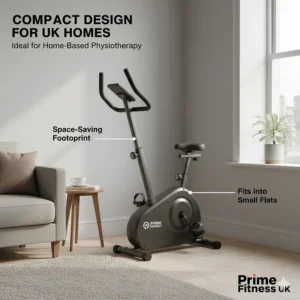
| Exerpeutic Folding Magnetic | Upright | 8 | £129-£159 | 136kg | Compact Living Spaces |
| YYFITT Basic Foldable | Upright | 16 | £119-£139 | 100kg | Entry-Level Budget |
| Magic Life 2-in-1 | Upright/Recumbent | 10 | £109-£129 | 159kg | Heavy-Duty Construction |
| MERACH Self-Powered | Recumbent | 16 (Auto-adjust) | £289-£329 | 159kg | Premium Tech Features |
💬 Just one click – help others make better buying decisions too! 😊
Top 7 Magnetic Exercise Bikes for Bad Knees: Expert Analysis
1. YYFITT 2-in-1 Foldable Fitness Exercise Bike
The YYFITT 2-in-1 stands out as the most versatile option for knee rehabilitation, offering both upright and semi-recumbent positions in one clever design. This adaptability proves invaluable as your recovery progresses—start with the recumbent position for maximum knee protection, then transition to upright as strength improves.
Key Specifications:
- 16 magnetic resistance levels (finest adjustment range)
- Angle-adjustable backrest with two height settings
- Adjustable tablet holder for entertainment
- Resistance bands for upper body work
Price: £159-£179 on Amazon.co.uk
UK buyers consistently praise its sturdy construction despite the 21kg weight. One reviewer from Birmingham noted: “After my knee replacement, this bike made physio at home actually bearable. The backrest adjustment is brilliant.” The magnetic system operates virtually silently—perfect for flat living or early morning sessions.
✅ Pros:
- Exceptional adjustability for different knee conditions
- Compact folding design (under 0.25m² storage)
- Smooth, silent magnetic resistance
❌ Cons:
- Heavier than competitors (challenging for daily folding)
- Resistance bands provide only light tension
2. XS Sports B400R Recumbent Exercise Bike
For those prioritising pure recumbent comfort on a budget, the XS Sports B400R delivers impressive value. This UK-manufactured bike specifically targets arthritis sufferers with its low step-through design and extra-padded seat.
Key Specifications:
- 4kg bidirectional magnetic flywheel
- 8 adjustable resistance levels
- LCD display with pulse sensors
- Low seat height for easy access
Price: £139-£159 on Amazon.co.uk
A 74-year-old reviewer shared: “I bought this as I suffer with arthritis in my knees. After one week of gentle use, I’m starting to feel the benefit of exercise again.” The bidirectional flywheel allows forwards and backwards pedalling—a feature physiotherapists often recommend for comprehensive knee rehabilitation.
✅ Pros:
- Excellent value for arthritis management
- CE certified with 12-month warranty
- Comfortable backrest and seating
❌ Cons:
- 110kg weight limit (lower than competitors)
- Assembly instructions could be clearer
3. MERACH S08 Recumbent Exercise Bike
Technology meets rehabilitation with the MERACH S08, featuring exclusive app connectivity that transforms mundane cycling into engaging virtual experiences. The Bluetooth integration allows real-time tracking and instructor-led programmes through the free MERACH app.
Key Specifications:
- 16 levels of magnetic resistance
- Smart Bluetooth and app connectivity
- 8-level adjustable seat with customisable backrest
- Water bottle holder and tablet stand
Price: £199-£249 on Amazon.co.uk
The silent dual-belt drive system earned rave reviews from UK users. Research from Versus Arthritis confirms that cycling can strengthen quadricep muscles whilst encouraging motion in the knees and hips, making it particularly beneficial for those with arthritis. One Manchester user reported: “The app integration keeps me motivated. My knees haven’t felt this good in years.”
✅ Pros:
- Professional-grade app features
- Whisper-quiet operation for shared spaces
- Excellent weight capacity (136kg)
❌ Cons:
- Higher price point
- Setup video recommended (instructions basic)
4. Exerpeutic Folding Magnetic Upright Bike
The Exerpeutic Folding Magnetic has become a staple in UK rehabilitation programmes, trusted by physios nationwide for its reliability and accessible price. With over 20,000 Amazon reviews averaging 4.6 stars, its reputation speaks volumes.
Key Specifications:
- 8-level magnetic tension control system
- High-torque 3-piece cranking system
- Large LCD display (8.4cm × 3.8cm)
- Folds to half its assembled size
Price: £129-£159 on Amazon.co.uk
The elevated pedal position creates a fuller leg extension—crucial for knee mobility work. At just 18kg, it’s genuinely portable between rooms. A Surrey user recovering from ACL surgery noted: “Perfect for my physio exercises. The smooth pedalling doesn’t jar my healing knee at all.”
✅ Pros:
- Ultra-lightweight and truly foldable
- Impressive 136kg weight capacity
- Proven track record with UK physios
❌ Cons:
- Seat may feel firm for extended sessions
- Basic display (no Bluetooth connectivity)
5. YYFITT Basic Foldable Fitness Exercise Bike
Don’t let the “basic” name fool you—this entry-level YYFITT model packs 16 resistance levels and thoughtful features at an remarkably accessible price point. It’s ideal for those testing the waters of home rehabilitation.
Key Specifications:
- 16-level magnetic tension system
- Countdown exercise monitor
- Hand pulse sensors
- Curved crank arm design
Price: £119-£139 on Amazon.co.uk
The curved crank arm prevents heel strikes—a common complaint with budget bikes that can aggravate knee pain. UK buyers appreciate its straightforward 15-minute assembly. One Edinburgh user shared: “Started using this after my knee injury. The resistance range is brilliant for gradual progression.”
✅ Pros:
- Outstanding value for money
- Comprehensive resistance options
- Compact storage footprint
❌ Cons:
- 100kg weight limit
- Monitor requires manual countdown setup
6. Magic Life 2-in-1 Folding Exercise Bike
The Magic Life 2-in-1 caters to heavier users with its robust 159kg capacity whilst maintaining the dual-position flexibility essential for knee rehabilitation. Its magnetic resistance system delivers consistent, joint-friendly workouts.
Key Specifications:
- 10 adjustable magnetic resistance levels
- Upright and recumbent configuration
- Resistance bands included
- Reinforced steel frame
Price: £109-£129 on Amazon.co.uk
Several NHS physio departments have recommended this model to patients. The combination of affordability and high weight capacity makes it accessible to a wider demographic. A Bristol user noted: “The recumbent position takes all pressure off my dodgy knees. Couldn’t ask for better support.”
✅ Pros:
- Exceptional weight capacity (159kg)
- Both position options available
- Very competitive pricing
❌ Cons:
- Only 10 resistance levels
- Slightly less refined than premium models
7. MERACH Self-Powered Recumbent Exercise Bike
For those seeking premium features, the MERACH Self-Powered represents the cutting edge of home rehabilitation technology. Its self-generating power system eliminates cord clutter whilst automatic resistance adjustment responds to instructor cues through the app.
Key Specifications:
- 16 levels with automatic resistance adjustment
- Self-powered (no electrical outlet required)
- Premium ergonomic recumbent design
- Height-adjustable backrest
Price: £289-£329 on Amazon.co.uk
The auto-resistance feature proves transformative for structured rehabilitation programmes. According to clinical research, low-intensity cycling is as effective as high-intensity cycling for improving joint function and reducing pain in knee osteoarthritis. A London physio’s patient reported: “The app-guided sessions have completely changed my recovery. My consultant is amazed by my progress.”
✅ Pros:
- No power cord needed (cordless freedom)
- Auto-resistance follows instructor programmes
- Premium build quality
❌ Cons:
- Highest price in category
- Heavier unit (25.8kg)
✨ Don’t Miss These Exclusive Deals!
🔍 Take your knee rehabilitation to the next level with these carefully selected products. Click on any highlighted item to check current pricing and availability on Amazon.co.uk. These tools will help you create sustainable pain relief your joints will thank you for!
Understanding Magnetic Resistance: Why It’s Superior for Knee Pain
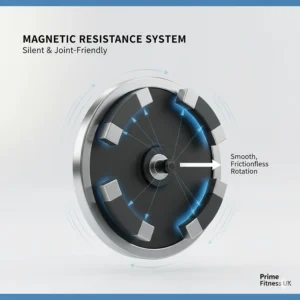
Magnetic resistance bikes operate on a fundamentally different principle than their friction-based cousins. Instead of physical contact between brake pads and flywheel, electromagnets create resistance through opposing magnetic fields. This contactless system delivers three critical benefits for dodgy knees.
Firstly, the motion remains consistently smooth throughout each pedal stroke. There’s no sudden catch or release that can jar vulnerable knee joints—a common complaint with cheaper friction bikes. Think of it like the difference between gliding across ice versus trudging through sand.
Secondly, magnetic systems require virtually zero maintenance. No brake pads wear down, no resistance suddenly changes mid-workout. For people managing chronic knee conditions, this reliability proves invaluable. You’re not dealing with equipment failures when you’re trying to maintain a consistent rehabilitation schedule.
Finally, the whisper-quiet operation means you can cycle whilst watching telly, listening to audiobooks, or even during work calls if you’re remote-working. Many UK users report this silent running dramatically increases their consistency—no excuses about disturbing neighbours or family members.
The technology mirrors what you’d find in £2,000+ commercial gym equipment, now accessible at home for a fraction of the cost. Research from Wikipedia on resistance training confirms that controlled, consistent resistance provides optimal muscle strengthening without joint stress.
How Magnetic Bikes Protect and Strengthen Your Knees
The genius of cycling for knee rehabilitation lies in its closed kinetic chain movement. Your foot remains planted on the pedal throughout the motion, forcing muscles around the knee to work in coordination. This distributed load protects the joint whilst building crucial support structures.
Studies show that people who cycled at any point in their life were 17% less likely than non-cyclists to develop knee pain and 21% less likely to develop arthritis with pain in the knee joint. The circular pedalling motion promotes synovial fluid production—your knee’s natural lubricant—which reduces inflammation and improves range of motion.
Magnetic bikes excel because they allow precise resistance control. Start at level 1 post-surgery, gradually increasing as strength returns. This progressive overload stimulates muscle growth in the quadriceps, hamstrings, and gluteals without the impact forces that plague runners and joggers.
UK physiotherapists frequently recommend 10-15 minutes of gentle cycling daily for osteoarthritis management. The beauty? You can split this into three 5-minute sessions if sustained cycling proves uncomfortable. Consistency trumps intensity for knee rehabilitation—magnetic bikes make consistency achievable.
Recumbent vs Upright: Which Style Suits Your Knees?
Recumbent Bikes: Maximum Joint Protection
Recumbent designs position you in a reclined, chair-like posture with pedals out front. This configuration offers several advantages for dodgy knees. Your body weight rests against a supportive backrest rather than pressing through the knee joint. The horizontal leg extension reduces hip flexion demands, beneficial for those with concurrent hip issues.
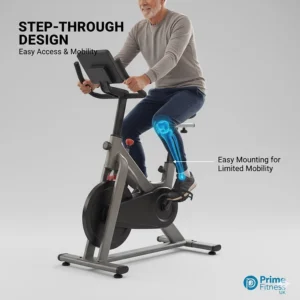
The step-through design typically sits lower to the ground—critical for users with limited mobility or balance concerns. Many osteoarthritis patients find mounting a recumbent far less stressful than climbing onto an upright bike. According to NHS guidance on osteoarthritis, low-impact exercise that doesn’t place excessive stress on joints is essential for managing symptoms.
However, recumbent bikes demand more floor space and cost slightly more than upright equivalents. The XS Sports B400R and MERACH models excel in this category, offering proper back support without excessive bulk.
Upright Bikes: Natural Cycling Position
Upright bikes mimic traditional cycling posture—you’re sitting atop the bike with pedals beneath you. This position engages core muscles more actively and typically allows higher workout intensities as strength improves.
For knee rehabilitation, upright bikes work brilliantly once acute pain subsides. The more vertical position facilitates fuller leg extension, which many physios prefer for later-stage recovery. The Exerpeutic and YYFITT basic models demonstrate how effective budget-friendly upright bikes can be.
2-in-1 Options: Best of Both Worlds
The YYFITT and Magic Life 2-in-1 models offer convertible designs—start with recumbent positioning during early recovery, switch to upright as confidence grows. This adaptability extends your bike’s useful life and accommodates changing rehabilitation needs.
Essential Features for Knee-Friendly Cycling
Seat Adjustability and Comfort
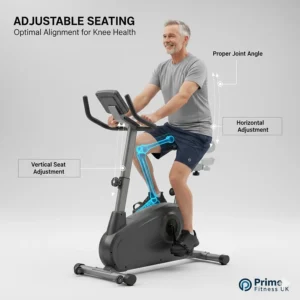
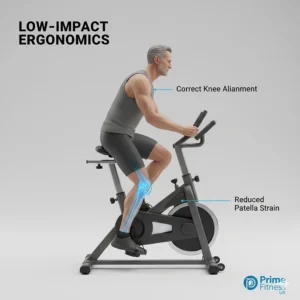
Proper seat positioning prevents knee hyperextension—a leading cause of cycling-related knee pain. Your knee should bend approximately 5-10 degrees at full pedal extension. Too high forces overextension; too low creates excessive flexion that compresses the joint.
Quality bikes like the MERACH S08 offer multi-dimensional seat adjustment—fore-aft, height, and sometimes angle. Padded seats reduce pressure points during extended sessions. Several UK users report swapping factory seats for aftermarket gel cushions, a £15-20 investment that dramatically improves comfort.
Pedal Design and Footwear
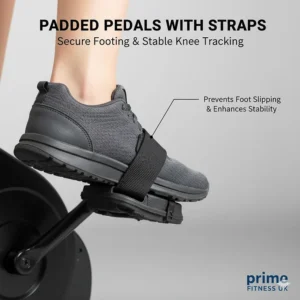
Look for pedals with adjustable straps that secure your feet without crushing circulation. Smooth-soled trainers work fine for gentle cycling, but specialist cycling shoes with stiff soles transfer power more efficiently as you progress. Sloped pedals (inward by 2-3 degrees) align naturally with your body’s biomechanics, reducing knee stress.
Display and Tracking
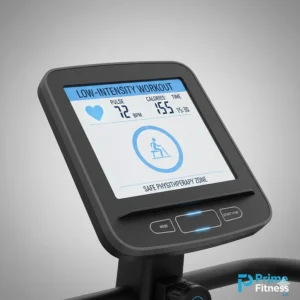
LCD displays tracking time, distance, speed, and calories help maintain motivation during rehabilitation. Heart rate monitors via hand pulse sensors enable safe cardiovascular conditioning—particularly important for those managing both knee issues and cardiovascular health. Smart connectivity features in premium models transform mundane exercise into engaging virtual experiences.
Setting Up Your Bike for Optimal Knee Protection
Proper bike setup can mean the difference between pain relief and aggravation. Follow these physio-approved guidelines:
Step 1: Seat Height Adjustment Sit on the bike with one pedal at its lowest position. Place your heel on the pedal—your leg should fully extend. Now position the ball of your foot on the pedal in normal cycling position—you’ll notice a slight bend at the knee. Perfect.
Step 2: Seat-to-Pedal Distance For recumbent bikes, adjust the seat distance so your knee maintains that 5-10 degree bend at full extension. Too far creates overextension stress; too close compresses the joint excessively.
Step 3: Handlebar Positioning Upright bikes: Adjust handlebars level with or slightly above seat height to reduce forward lean that can stress knees.
Recumbent bikes: Position handles comfortably within reach without shoulder strain.
Step 4: Resistance Testing Start at the lowest resistance level. You should pedal smoothly without wobbling or knee tracking issues. If your kneecap veers inward or outward, lower resistance further or check seat alignment.
Step 5: Initial Session First ride: 5 minutes maximum at minimal resistance. Note any discomfort locations. Knee pain during cycling often indicates setup issues rather than contraindications. Consult your GP or physio if pain persists despite adjustments.
Beginner’s Rehabilitation Programme: First 8 Weeks
Weeks 1-2: Foundation Phase
- Frequency: Daily or every other day
- Duration: 5-10 minutes per session
- Resistance: Level 1-2
- Goal: Establish pain-free motion
Start gently. Your initial sessions focus on movement quality rather than cardiovascular challenge. Pedal at a comfortable cadence (60-70 RPM). If you experience sharp pain, stop immediately and consult your healthcare provider.
Weeks 3-4: Building Tolerance
- Frequency: 5 days per week
- Duration: 10-15 minutes per session
- Resistance: Level 2-3
- Goal: Increase endurance
Gradually extend session duration. You might split this into two 7-minute sessions if continuous cycling proves uncomfortable. Monitor knee response over 24-48 hours post-exercise.
Weeks 5-6: Progressive Loading
- Frequency: 5-6 days per week
- Duration: 15-20 minutes per session
- Resistance: Level 3-4
- Goal: Strengthen surrounding musculature
Introduce modest resistance increases. Your quadriceps should feel gently challenged but not exhausted. According to research in the Journal of Rheumatology, cycling significantly reduces joint pain and stiffness whilst improving muscle strength in middle-aged and older adults with osteoarthritis.
Weeks 7-8: Establishing Routine
- Frequency: 5-6 days per week
- Duration: 20-30 minutes per session
- Resistance: Level 4-5
- Goal: Sustainable long-term habit
By now, cycling should feel natural. Focus on consistency rather than intensity spikes. This moderate approach delivers optimal benefits for knee health without overtraining risks.
Advanced Techniques for Maximising Knee Benefits
Interval Training for Joint Health
Once basic fitness establishes, structured intervals provide enhanced benefits. Alternate 3 minutes at comfortable resistance with 1 minute at slightly higher resistance. This variation strengthens muscles whilst allowing joint recovery within each session.
Reverse Pedalling Benefits
Models with bidirectional flywheels (like the XS Sports B400R) enable reverse pedalling. This motion engages different muscle groups, particularly hamstrings and calves, creating more balanced leg strength. Two minutes of reverse pedalling per session complements forward motion beautifully.
Upper Body Integration
The YYFITT models’ resistance bands allow simultaneous upper body work. Maintaining balance whilst pedalling and pulling resistance bands enhances core stability—crucial for proper knee tracking. Start with arms-only exercises, then combine once comfortable.
Mindful Cycling Practice
Focus on smooth, circular pedalling rather than mashing down on pedals. Imagine scraping mud off your shoe at the bottom of each stroke, then pulling back and up. This complete circular motion distributes force evenly, reducing peak joint stress.
💡 Transform Your Recovery Journey
Ready to take control of your knee health? These magnetic exercise bikes offer the perfect blend of joint protection and effective exercise. Check current Amazon.co.uk pricing on any highlighted model above and start your pain-free cycling journey today!
Magnetic vs Friction Resistance: The Technical Comparison
| Feature | Magnetic Resistance | Friction Resistance |
|---|---|---|
| Noise Level | Virtually silent | Noticeable whooshing/grinding |
| Maintenance | None required | Regular brake pad replacement |
| Smoothness | Consistent throughout stroke | Can catch or release suddenly |
| Adjustment | Precise, often 8-16 levels | Less granular control |
| Durability | 5-10+ years typical | 2-5 years before parts wear |
| Price | £100-£350 | £50-£200 |
| Joint Impact | Minimal (smooth motion) | Moderate (less predictable) |
Magnetic systems justify their modest price premium through longevity and performance. For knee rehabilitation, the smooth, predictable resistance proves invaluable. Friction bikes might save £30-40 upfront but cost more in long-term frustration and replacement parts.
Maximising Your Investment: Maintenance and Longevity
Weekly Maintenance Routine
Monday Morning Check:
- Wipe down frame and seat with damp cloth
- Check pedal tightness (hand-tight, not wrench-tight)
- Test resistance adjustment smoothness
Post-Workout Care:
- Remove sweat from display and handles immediately
- Check for loose bolts (natural settling over first month)
Monthly Maintenance Tasks
First of Month Inspection:
- Verify all bolts remain secure (especially seat and crank)
- Check resistance cable tension (recumbent models)
- Inspect pedal straps for wear
- Test display functions
Deep Clean:
- Vacuum around base and flywheel housing
- Check for carpet fibres around pedal mechanisms
- Lubricate seat adjustment rail if squeaking develops
Storage Considerations
For folding models, avoid constant folding/unfolding if possible. Set up in permanent location and fold only when genuinely necessary—saves mechanical stress. Store in climate-controlled spaces; avoid damp garages that promote rust.
UK users in flats often position bikes on protective mats. These £15-20 mats prevent carpet compression and catch sweat drips. The Toputure exercise mats (available on Amazon.co.uk) fit perfectly under most models.
Addressing Common Cycling-Related Knee Issues
Anterior Knee Pain (Front of Kneecap)
Cause: Often indicates seat too low, forcing excessive knee flexion
Solution: Raise seat 1-2cm and retest. Ensure 5-10 degree bend at full extension.
Lateral Knee Pain (Outside of Knee)
Cause: May result from improper foot positioning on pedals
Solution: Centre feet on pedals. Consider pedal spacers if knock-kneed. Reduce resistance temporarily.
Posterior Knee Pain (Behind Knee)
Cause: Usually suggests seat too high, creating hyperextension
Solution: Lower seat incrementally. Check for smooth, controlled motion.
General Stiffness After Cycling
Normal Response: Mild stiffness 12-24 hours post-exercise indicates muscle adaptation
Concerning Signs: Sharp pain, swelling, or stiffness lasting beyond 48 hours warrants professional assessment
Always consult your GP or physiotherapist if pain persists. These professionals can assess your specific condition and provide tailored guidance. The NHS provide comprehensive resources on managing joint conditions through exercise.
Price vs Value: What You’re Really Paying For
Budget Tier (£100-£150)
Models like the YYFITT Basic and Magic Life deliver essential functionality. Expect 8-10 resistance levels, basic LCD displays, and solid construction. Perfect for testing whether home cycling suits your rehabilitation needs before committing to premium features.
Best For: Experimental purchasers, tight budgets, occasional users
Mid-Range (£150-£250)
The sweet spot for most UK buyers. YYFITT 2-in-1, XS Sports B400R, and basic MERACH models offer enhanced features—more resistance levels, better displays, improved seat comfort. These bikes last 5-10 years with proper care.
Best For: Serious rehabilitation, regular users, long-term investment
Premium (£250-£350)
MERACH Self-Powered and high-end connected bikes justify costs through app integration, automatic resistance, and commercial-grade components. These machines match what you’d find in physiotherapy clinics.
Best For: Tech enthusiasts, comprehensive rehabilitation programmes, household sharing
Real UK Users Share Their Recovery Journeys
James, 52, Glasgow – Knee Replacement Recovery
“Eight weeks post-op, my surgeon recommended gentle cycling. Bought the Exerpeutic folding bike on Amazon Prime. Started with literally 3 minutes at level 1. Now doing 25 minutes daily at level 5. My physio says my range of motion is ahead of schedule. Best £140 I’ve spent.”
Sarah, 45, Bristol – Osteoarthritis Management
“Diagnosed with osteoarthritis at 43. Thought my running days were over permanently. The YYFITT 2-in-1 lets me switch between recumbent on bad days and upright when feeling stronger. Lost a stone, knees feel better than they have in five years. Should’ve bought one sooner.”
David, 61, Manchester – General Knee Pain
“Decades of Sunday league football caught up with me. The MERACH app-connected bike transformed boring exercise into something I actually look forward to. Instructors guide you through programmes specifically designed for joint health. Knees thank me every morning.”
Complementary Exercises for Comprehensive Knee Rehabilitation
Whilst magnetic bikes provide excellent cardiovascular conditioning and joint mobility work, comprehensive knee rehabilitation benefits from complementary exercises:
Static Quad Strengthening
Sit with legs extended, press knee into floor whilst tensing thigh muscle. Hold 5 seconds, repeat 10 times per leg. Strengthens quadriceps without joint movement—perfect for acute injury phases.
Straight Leg Raises
Lying flat, keep one knee bent (foot on floor) whilst raising straight leg to bent knee height. Lower slowly. Builds quad strength crucial for knee stability. Start with bodyweight, add ankle weights as strength improves.
Hamstring Curls
Standing (hold chair for balance), bend knee to bring heel toward buttock. Lower slowly. Balances quad strength with posterior chain development. Essential for proper knee tracking during cycling.
Gentle Stretching
Post-cycling stretches maintain flexibility. Hold each stretch 20-30 seconds without bouncing. Focus on quadriceps, hamstrings, and calves. Never stretch into pain.
Combine these exercises with your magnetic bike sessions for optimal results. Many UK physios recommend alternating cycling days with strength training days, allowing 48-hour recovery between resistance training sessions.
Dietary Considerations for Joint Health
Your nutrition significantly influences joint inflammation and recovery. Consider these evidence-based dietary modifications:
Anti-Inflammatory Foods
Omega-3 fatty acids (found in oily fish like salmon, mackerel) reduce systemic inflammation. UK nutritionists recommend 2-3 portions weekly. Turmeric contains curcumin, a natural anti-inflammatory compound. Colourful fruits and vegetables provide antioxidants that combat oxidative stress.
Hydration Importance
Adequate water intake supports synovial fluid production. Aim for 2-3 litres daily, increasing during exercise. Dehydration reduces joint lubrication, potentially exacerbating discomfort.
Weight Management
Each pound of excess weight places 4-6 pounds of pressure on knee joints during normal walking. Cycling’s cardiovascular benefits, combined with sensible nutrition, create sustainable weight management. Even modest weight loss (5-10% body weight) significantly reduces knee stress.
According to British Nutrition Foundation guidelines, balanced nutrition combining lean proteins, complex carbohydrates, and healthy fats supports both weight management and joint health.
FAQs About Magnetic Exercise Bikes for Bad Knees
❓ Can I use a magnetic exercise bike immediately after knee surgery?
❓ How often should I cycle if I have arthritis?
❓ Will cycling make my knees worse?
❓ What's better for bad knees, recumbent or upright bikes?
❓ Can magnetic bikes help prevent knee replacement surgery?
Conclusion: Your Path to Pain-Free Movement
Choosing a magnetic exercise bike for bad knees represents a pivotal decision in your rehabilitation journey. These seven models—each available on Amazon.co.uk—offer proven solutions backed by thousands of satisfied UK users and clinical research supporting cycling’s benefits for joint health.
Whether you’re recovering from surgery, managing chronic arthritis, or simply seeking gentle cardiovascular exercise that respects your knees, the right magnetic bike transforms limitations into possibilities. The YYFITT 2-in-1 offers unmatched versatility, the XS Sports B400R delivers budget-friendly recumbent comfort, whilst premium MERACH models provide cutting-edge technology for those seeking comprehensive features.
Remember: consistency trumps intensity. Your knees strengthen through regular, gentle movement rather than sporadic heroic efforts. Start conservatively, progress methodically, and celebrate small victories. Margaret from Leeds cycles 20 minutes daily now—not because she’s superhuman, but because she found the right tool and committed to showing up.
Your knees have carried you through life’s journey. It’s time to return the favour with the joint-protective exercise they deserve. Choose your bike, follow the setup guidelines, and begin today. Six months from now, you’ll wish you’d started sooner.
Recommended for You
- 7 Best Treadmill Mat for Carpet Protection UK 2026
- 7 Best Space Saving Treadmill for Bedroom Under £200 (2026)
- 7 Best Treadmill for Physiotherapy at Home Elderly Care UK 2026
Disclaimer: This article contains affiliate links. If you purchase products through these links, we may earn a small commission at no additional cost to you. Prices shown are approximate and may vary. Always consult your GP or physiotherapist before beginning new exercise programmes, particularly if you have existing medical conditions or recent surgical procedures.
✨ Found this helpful? Share it with your mates! 💬🤗
