
In This Article
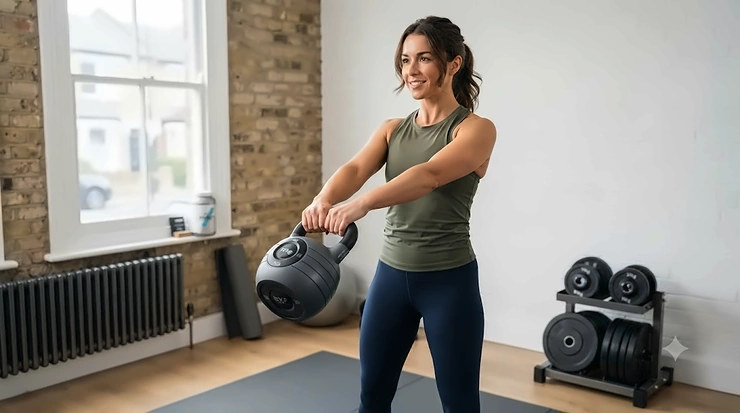
Somewhere between your third burpee and your fourth cup of coffee, you’ve probably had the same thought every home-gym owner eventually has: why do I need six kettlebells taking up half my hallway when I only ever use two of them properly? That’s the exact itch quick-change kettlebells were built to scratch. Instead of a rack of cast-iron cannonballs gathering dust, you get one handle and a mechanism — a dial, a pin, a sliding plate — that lets you jump from an 8kg warm-up to an 18kg finisher in the time it takes to read this sentence.
This isn’t a niche gadget anymore. Search interest and Amazon UK listings for adjustable kettlebells have swelled over the past two years, driven largely by small flats, shared houses, and a national mood that’s finally waking up to strength training. We dug into seven genuine, currently available products — dial systems, pin-lock systems, plate-lock systems and one genuinely smart bell that talks to an app — and pulled apart what a fast-adjust kettlebell actually buys you over a shelf of fixed weights. Spoiler: it’s not just space. It’s the number of times you’ll actually pick the thing up.
Below you’ll find honest, spec-grounded analysis (no invented “I tested this for six weeks” nonsense — just real research and aggregated review sentiment), comparison tables, and practical guidance on building circuit training and HIIT workouts around a single bell.
Quick Comparison Table
| Kettlebell | Adjustment System | Weight Range | Best For |
|---|---|---|---|
| Bowflex SelectTech 840 | Twist dial | 3.5–18kg | Fastest weight changes mid-set |
| JAXJOX KettlebellConnect 2.0 | Electronic button | 5.5–19kg | Data-driven, app-tracked training |
| PowerBlock Adjustable Kettlebell | Magnetic pin | 8–16kg | Smallest footprint on a shelf |
| Titan Fitness Adjustable Competition Kettlebell | Screw/Allen key plates | 12–32kg | Serious lifters wanting a competition feel |
| REP Fitness Adjustable Kettlebell | Twist dial | 8–16kg (16kg model) | Competition shape with dial convenience |
| Yes4All Adjustable Kettlebell | Slide-and-lock plates | ~4.5–18kg | Budget buyers who don’t mind a manual swap |
| LIFERUN 7-in-1 Adjustable Kettlebell | Dial lock | 2–20kg | Cheapest genuine dial mechanism |
Looking at the spread here, the split really comes down to how much you’re willing to pay for speed. Bowflex SelectTech 840 and REP Fitness Adjustable Kettlebell both use dial systems that let you change weight mid-workout without breaking stride, while Yes4All Adjustable Kettlebell and the plate-based Titan Fitness Adjustable Competition Kettlebell trade a few seconds of fiddling for a lower price or a heavier ceiling. If your training is built around supersets and circuits where every second between exercises matters, the dial and pin systems earn their premium; if you’re doing longer sets at one weight, the manual options save you real money.
💬 Just one click — help others make better buying decisions too!😊
Top 7 Quick-Change Kettlebells: Expert Analysis
1. Bowflex SelectTech 840 — smoothest dial-adjust for quick transitions
The headline trick here is the dial on the base: give it a twist and the bell’s internal plate stack locks into one of six settings without you touching a pin or plate. It’s the most frictionless quick-change kettlebell mechanism currently on the UK market, and it shows in how the product is marketed and reviewed.
Under the hood, Bowflex SelectTech 840 adjusts across 3.5 to 18 kilograms, replacing six individual kettlebells in one compact unit. In practice, that six-in-one claim means you’re not just getting a light bell and a heavy bell — you get 3.5kg, 5.5kg, 9kg, 11kg, 16kg and 18kg settings, which covers everything from rehab-style single-arm work through to genuinely challenging swings. Based on the spec comparison, the jump between 16kg and 18kg is the smallest increment in the range, which matters if you’re trying to progress gradually rather than in big leaps.
Who should care: anyone running interval-style sessions where the weight needs to change between rounds, not just between workouts. What most buyers overlook about this model is that the dial mechanism, while brilliant for speed, relies on a moulded plastic shell rather than solid cast iron — reviewers consistently note that the trade-off for convenience is a slightly less “traditional” feel and a thinner handle than a one-piece cast bell. Aggregated retailer feedback generally describes the unit as robust for home use, though a small number of buyers mention the handle can feel narrow during heavier swings.
Pros:
- ✅ Genuinely quick dial changes mid-workout
- ✅ Replaces six separate kettlebells in one footprint
- ✅ Comes with structured video tutorials for beginners
Cons:
- ❌ Plastic shell feels less premium than cast iron
- ❌ Thinner handle can feel less secure on heavy swings
UK retail listings put the Bowflex SelectTech 840 in the £150–£220 range depending on retailer and promotions, occasionally dipping lower during sales. Given how much shelf space and money six separate bells would cost, this sits as strong value for anyone doing varied, weight-changing sessions.

2. JAXJOX KettlebellConnect 2.0 — smartest app-connected bell on the market
If the Bowflex SelectTech 840 is the quick-change kettlebell for speed, the JAXJOX KettlebellConnect 2.0 is the one for data. Instead of a manual dial, it uses an electronic button to adjust weight, with no adding or removing plates required, and it packs motion sensors that log reps, sets and power directly to a companion app.
The weight range runs from roughly 5.5 to 19 kilograms, moving up in 2.7kg increments — very close to the Bowflex’s range, but pitched at the tech-forward end of the market. Here’s what the spec sheet won’t tell you outright: the “smart” side of this product is genuinely two products in one — the hardware, which works standalone, and the subscription app, which unlocks guided classes for a recurring monthly fee. Reviewers who’ve tested it note the tracking feature is a legitimately useful way to benchmark weekly training volume, but the ongoing subscription cost is the part that divides opinion.
Aggregated review sentiment from UK fitness press is broadly positive on build quality and tracking accuracy — see Men’s Fitness UK’s full review — with the most consistent criticism being the size…
Pros:
- ✅ Button-press weight changes with zero manual fiddling
- ✅ Tracks reps, sets and power automatically via app
- ✅ Guided on-demand workouts included in premium tier
Cons:
- ❌ Noticeably bulkier footprint than dial or pin rivals
- ❌ Full feature set requires an ongoing app subscription
Historically priced in the UK around £299.99, with international listings closer to the $249 mark, expect this one to sit at the premium end — typically the £250–£300 range once you account for currency movement and retailer stock. It’s the priciest bell on this list, and the app subscription is an ongoing cost worth weighing before you buy.
3. PowerBlock Adjustable Kettlebell — most compact pin-lock design
PowerBlock Adjustable Kettlebell takes a different route entirely: rather than a dial or a button, it uses a magnetised steel selection pin that locks into place so it doesn’t come loose mid-swing. You simply pull the pin, slide it to your chosen weight level, and push it back in — a process reviewers describe as quick, if not quite as instant as a dial twist.
The standard model covers 18 to 35lbs, or roughly 8 to 16 kilograms, across four settings, and a heavier “Pro” version extends further for more advanced lifters. On paper this means it’s a lighter, more entry-to-intermediate tool than the Bowflex or JAXJOX — genuinely useful for goblet squats, presses and lighter conditioning work, less so if you’re chasing heavy one-arm swings. One UK reviewer summed up the trade-off neatly, noting the hard, rectangular edges of the shell can feel a bit awkward when cupping the kettlebell for goblet squats, and can dig in during racked positions for cleans and presses.
What most buyers overlook here is the handle diameter — at just over 32mm it’s genuinely comfortable for extended grip work, which matters more than people expect once you’re 40 reps into a circuit. Reviewers consistently praise the compact footprint, which genuinely is the smallest of any bell on this list when stored upright.
Pros:
- ✅ Magnetic pin won’t shake loose during swings
- ✅ Smallest, most shelf-friendly footprint tested
- ✅ Comfortable 32.77mm handle diameter for long sets
Cons:
- ❌ Rectangular shell edges awkward for goblet-hold positions
- ❌ Lower top-end weight than dial or competition-style rivals
UK list pricing sits around £199–£237, occasionally on offer closer to £150–£180. Given the smaller weight range, it’s not the cheapest per kilogram on this list, but the compactness genuinely earns its keep in tight spaces.
4. Titan Fitness Adjustable Competition Kettlebell — closest feel to a true competition bell
For lifters who’ve trained with proper competition-style kettlebells and can’t stand the plastic feel of dial systems, Titan Fitness Adjustable Competition Kettlebell is the honest answer. It’s a 12kg steel shell paired with six cast iron plates weighing 2, 2, 3, 3, 4 and 6kg, adjustable from 12kg up to 32kg and to almost every weight in between.
That range alone puts it in a different league to the other bells here — this is the only option genuinely built for advanced lifters chasing heavy swings, cleans and snatches rather than beginner-to-intermediate conditioning. The trade-off is the adjustment method: you need a wrench or Allen key to loosen the retaining screw, remove or add plates, and tighten back up. Garage Gym Reviews described the process as relatively easy to use but a bit of a process, which is honest framing — this isn’t a mid-set quick-change bell, it’s a between-workout adjustable bell.
Here’s what the spec sheet doesn’t spell out: because the handle and top shell are one solid piece, the whole unit feels structurally sound in a way that plate-in-plastic-shell designs simply can’t replicate, and reviewers who care about that “real kettlebell” feel rate it highly for exactly that reason.
Pros:
- ✅ Genuine competition-style feel and one-piece construction
- ✅ Widest weight range of any bell on this list (12–32kg)
- ✅ Replaces up to 19 individual fixed-weight kettlebells
Cons:
- ❌ Requires a tool to adjust, not a true mid-set quick-change
- ❌ Some owners report premature corrosion on the powder coat
US list pricing runs around $200–$215, which converts to roughly £160–£180 before shipping; UK buyers should factor in import costs since Titan Fitness ships primarily from US and EU warehouses, so check current landed price before committing.
5. REP Fitness Adjustable Kettlebell — best balance of dial speed and steel build
REP Fitness Adjustable Kettlebell tries to have it both ways: a genuine quick-adjustment dial with a competition-style shape, sold across three different shell sizes so you can pick the weight band that actually suits your training rather than being stuck with one universal range. The 16kg shell, for example, adjusts across five settings from 8kg up to 16kg.
Reviewers repeatedly single out two things: how close it feels to a regular kettlebell, and how genuinely fast the weight changes are compared with plate-based systems. Based on the spec comparison, this puts REP Fitness in a similar convenience bracket to the Bowflex, but with a steel build that leans more towards a traditional feel. What most buyers overlook is that because it’s sold in three separate shell sizes, you need to pick the right one upfront — the 16kg shell won’t extend to 40kg no matter how many plates you own, so match the shell to your actual training ceiling before ordering.
Aggregated customer sentiment on REP’s own storefront skews heavily positive, with buyers specifically praising how fast and easy it is to switch through weight settings, and one reviewer noting they adjusted their swing tempo after hearing internal plate movement, which quietened down with practice.
Pros:
- ✅ Genuine dial speed with a more traditional steel feel
- ✅ Sold in three shell sizes to match your training ceiling
- ✅ Rubber base and nonslip grip for stability
Cons:
- ❌ Slight internal rattle noticeable until tempo is refined
- ❌ Choosing the wrong shell size limits your top weight
Through REP’s EU storefront, UK buyers can expect to pay somewhere in the £150–£220 range depending on which shell size is chosen, putting it roughly level with the Bowflex on price but with a notably different feel underhand.

6. Yes4All Adjustable Kettlebell — best budget plate-lock all-rounder
Not every buyer needs mid-set speed — plenty just want one bell that replaces a shelf of cast iron without wrecking the budget. Yes4All Adjustable Kettlebell does exactly that: a durable cast-iron plate system with a lock-and-slide mechanism, giving you six adjustable weight settings from a single handle.
The construction leans practical rather than flashy — non-slip, textured handle for grip during sweaty sessions, a flat round bottom for upright storage, and a design well suited to renegade rows and mounted movements as much as swings. On paper this means it behaves more like a traditional kettlebell with a clever locking system bolted on, rather than a dial-driven gadget — and reviewers seem to appreciate that familiarity. One buyer highlighted by a US retailer called it “super high quality,” praising the colour-coded rings that make it easy to tell weights apart at a glance.
What most buyers overlook is that the adjustment here genuinely does require you to stop, slide plates, and re-lock — there’s no dial or button. Reviewers consistently note this is a small trade-off given the price, and the aggregated rating sits comfortably above 4.5 stars across thousands of reviews on major retail platforms, which is a strong signal for a budget-tier product.
Pros:
- ✅ Genuine cast-iron feel at a budget price point
- ✅ Colour-coded plates make weight ID fast at a glance
- ✅ Flat, two-sided base supports pushups and planks too
Cons:
- ❌ Manual slide-and-lock takes longer than dial systems
- ❌ Not ideal for rapid mid-set weight changes
Typically priced under £80 on UK Amazon listings, occasionally dropping into the £50–£65 range during sales events, this is comfortably the best value-per-kilogram option here if you don’t need lightning-fast transitions.
7. LIFERUN 7-in-1 Adjustable Kettlebell — cheapest genuine dial-lock option
If you want dial-style convenience but the Bowflex price tag makes your eyes water, LIFERUN 7-in-1 Adjustable Kettlebell is the honest budget alternative. It genuinely is a dial-adjust mechanism — not a plate-lock dressed up as one — offering seven weight settings from 2kg up to 20kg in a single black kettlebell.
Build-wise it uses a die-cast aluminium handle with an ABS body and a flat bottom, which is a lighter, less premium construction than the steel-and-cast-iron builds further up this list — but the seven-step range, running 2kg, 5kg, 8kg, 11kg, 14kg, 17kg and 20kg, is actually the widest granularity of any bell here, which is genuinely useful for beginners progressing in small increments. Here’s what the spec sheet won’t tell you: an ABS shell means less mass concentrated at the point of impact during swings compared with solid cast iron, so very experienced lifters chasing maximum load stability might feel a difference at the top of the range that beginners won’t notice.
Who should care: anyone starting out who wants to grow into heavier weights without buying a second kettlebell in six months, and anyone whose flat simply can’t fit a rack of separate bells.
Pros:
- ✅ Widest step granularity (seven settings) of any bell here
- ✅ Genuine dial-lock, not a manual plate system
- ✅ Lowest price point of any true dial-adjust kettlebell
Cons:
- ❌ ABS/aluminium build feels less premium than steel rivals
- ❌ Top weight (20kg) is a ceiling, not a stepping stone
UK pricing sits at around £76–£90, occasionally with promotional pricing bringing it closer to the £70 mark — making it, kilogram for kilogram, one of the most accessible genuine dial-lock kettlebells currently sold to UK buyers.
What Are Quick-Change Kettlebells?
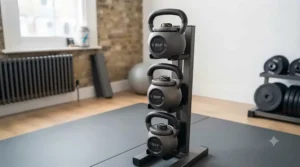
Quick-change kettlebells (also called fast-adjust kettlebells or adjustable kettlebells) are single handles that let you switch the working weight — usually via a dial, pin or sliding plate lock — instead of owning multiple fixed-weight bells. Rather than storing six separate kettlebells, you store one, and it does the job of several.
The category isn’t new in spirit — kettlebells trace back to weights used for measuring crops in 18th-century Russia, before circus strongmen and, later, organised sport turned them into training tools —.but the adjustable mechanism itself is a modern convenience layered onto that old design. According to Wikipedia’s overview of the kettlebell, the English term “kettle bell” has been in use since the early 20th century…
What genuinely sets a “quick-change” system apart from an ordinary adjustable kettlebell is speed: a true dial kettlebell system lets you change weight in seconds, mid-workout, without tools. Plate-lock and screw-adjust designs are technically adjustable too, but they’re built for changing weight between sessions, not between sets — a distinction worth understanding before you buy, because it genuinely changes which workouts the bell suits.
Dial vs Pin-Lock vs Plate-Lock: How Fast-Adjust Kettlebell Systems Actually Differ
Not all fast-adjust kettlebells adjust the same way, and the mechanism you choose has more impact on your actual training than the brand name on the box.
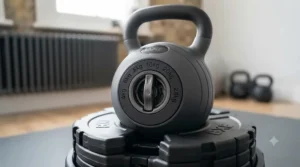
A dial kettlebell system — used by the Bowflex SelectTech 840, REP Fitness Adjustable Kettlebell and LIFERUN 7-in-1 Adjustable Kettlebell — locks an internal plate stack into place with a simple twist. What most buyers overlook is that this speed comes from a hollow, engineered shell rather than solid iron, which is why dial bells tend to feel lighter-handling and, occasionally, slightly less “planted” during heavy ballistic swings compared with a one-piece cast bell.
Pin-lock systems, like the PowerBlock Adjustable Kettlebell, sit in the middle: a magnetised or spring-loaded pin slots into pre-drilled weight positions. It’s not quite as fast as a dial twist, but it’s markedly quicker than unscrewing plates, and the mechanism tends to feel more secure during dynamic movement because the pin is a positive physical lock rather than a rotating cam.
Plate-lock and screw-adjust designs — Yes4All Adjustable Kettlebell and Titan Fitness Adjustable Competition Kettlebell — genuinely sacrifice mid-set speed for either budget savings or a more authentic cast-iron feel. Reviewers consistently note that lifters who’ve trained with proper competition kettlebells notice and prefer the weight distribution of plate-loaded designs, even if changing weight takes 30–60 seconds rather than three.
| Mechanism | Speed to Change Weight | Typical Feel | Best For |
|---|---|---|---|
| Dial (twist-lock) | Fastest — under 5 seconds | Lighter, more “engineered” | Circuit training, HIIT |
| Pin-lock | Quick — 5–15 seconds | Solid, positive lock | Compact storage, mixed loads |
| Plate/screw-lock | Slowest — 30–60+ seconds | Closest to solid cast iron | Heavy swings, strength focus |
The analysis here is fairly clear-cut: if your sessions genuinely change weight between exercises — think a superset of goblet squats followed immediately by single-arm rows at a different load — a dial system like the Bowflex SelectTech 840 or REP Fitness Adjustable Kettlebell earns its price premium. If you’re doing longer sets at one working weight and only changing loads between sessions, a plate-lock bell like Yes4All Adjustable Kettlebell delivers the same functional range for considerably less money.
✨ Don’t Miss These Exclusive Deals!
🔍 Take your kettlebell training to the next level with these carefully selected picks above. Click through to check current pricing and availability before stock shifts. These bells will help you build genuinely efficient home workouts your whole household can use!
How to Choose a Quick-Change Kettlebell
Picking the right fast-adjust kettlebell comes down to matching the mechanism, range and build to how you’ll actually train. Here’s the reasoning, step by step:
- Work out your realistic weight range first. Most beginners plateau somewhere between 12kg and 18kg for swings; if you’re already comfortable above 20kg, only the Titan Fitness Adjustable Competition Kettlebell on this list will keep pace with you long-term.
- Decide how often you’ll change weight mid-session. Circuit and HIIT training genuinely benefits from dial or pin systems; straight sets at a fixed load don’t need that speed, so save your money.
- Check the handle diameter against your grip. Thinner handles (around 30–33mm) suit smaller hands and two-handed swings; thicker cast-iron handles better mimic gym-standard competition bells.
- Consider your flooring. ABS and rubber-coated bases, like those on the LIFERUN 7-in-1 Adjustable Kettlebell, protect laminate and wood floors better than raw cast iron.
- Factor in noise. Internal plate stacks in dial systems can rattle during ballistic movements — a genuine consideration in flats with downstairs neighbours.
- Weigh up smart features against subscription cost. The JAXJOX KettlebellConnect 2.0 only earns its price if you’ll actually use the app long-term, not just the hardware.
- Match your budget to your usage frequency. If you’re training two or three times a week for the long haul, the extra £100–£150 for a dial system tends to pay for itself in workouts you’d otherwise skip because swapping weights felt like a hassle.
Common Mistakes When Buying an Adjustable Kettlebell
The single biggest mistake buyers make is choosing top-end weight capacity over adjustment speed, then never actually using the heavier settings because changing weight feels like a chore. If your training style is circuit-based, a 20kg-capped dial bell will get used far more than a 32kg plate-lock bell that takes a minute to reconfigure.
A second common error: ignoring handle diameter until after purchase. Reviewers across nearly every product in this guide flag handle feel as the detail that either makes or breaks day-to-day comfort — far more than the headline weight range does.
Third, buyers frequently underestimate storage footprint. A JAXJOX KettlebellConnect 2.0 or plate-loaded competition bell takes up noticeably more shelf space than a compact pin-lock design like the PowerBlock Adjustable Kettlebell, which matters more than most spec sheets suggest once the box is actually sitting in your hallway.
Finally, plenty of people buy the cheapest option available without checking whether the weight range even covers progressive overload. A bell that tops out at 12kg is fine for month one, frustrating by month four — factor in where your strength will realistically be in six months, not just where it is today.
Circuit Training With One Kettlebell: A Practical Usage Guide
One of the genuine advantages of a fast-adjust kettlebell is how naturally it slots into circuit training — rotating through several exercises back-to-back with minimal rest. Here’s how to set one up properly.
First 30 days: start with a simple four-station circuit — goblet squats, single-arm rows, swings and overhead presses — using one consistent weight across all four to learn the movement patterns before introducing weight changes between stations. Most beginners jump straight to varying load and end up rushing form to keep pace.
Building the rotation: once technique is solid, use your dial or pin system’s speed advantage properly — drop the weight for higher-skill movements like snatches and Turkish get-ups, and increase it for simpler patterns like swings and deadlifts. This is where dial systems like the Bowflex SelectTech 840 or REP Fitness Adjustable Kettlebell genuinely outperform plate-lock designs — the 5–10 second changeover keeps your heart rate elevated between stations rather than dropping while you fumble with plates.
Maintenance and setup tips: wipe down handles after sweaty sessions to prevent grip degradation, particularly on ABS-bodied bells like the LIFERUN 7-in-1 Adjustable Kettlebell where moisture can affect the dial mechanism over time. Store dial and pin-lock bells at their lowest weight setting when not in use — this reduces internal component stress and, on magnetised pin systems like the PowerBlock Adjustable Kettlebell, prevents the pin sitting under unnecessary tension.
A common mistake to avoid: setting circuit rest periods too short for the mechanism you own. A plate-loaded bell like Yes4All Adjustable Kettlebell simply isn’t built for 15-second transitions between stations — plan your circuit rest windows around your kettlebell’s actual adjustment speed, not an idealised one.
HIIT Workouts That Work With a Single Adjustable Bell
High intensity interval training and quick-change kettlebells are a genuinely good pairing, and ..it’s not just marketing — the NHS physical activity guidelines themselves class lifting heavy weights and circuit training among the examples of very vigorous activity…
A practical structure: 30 seconds of work, 15 seconds of rest, six exercises, three rounds — roughly 13 minutes total. Rotate through kettlebell swings, goblet squats, single-arm cleans, halos, deadlifts and presses, dropping the weight by one or two settings for the more technical movements (cleans, presses) and raising it for the simpler ones (swings, deadlifts). This is precisely the training style where a genuine dial or pin mechanism earns its price premium over a plate-lock bell — you physically cannot afford 45 seconds fumbling with an Allen key inside a 15-second rest window.
For anyone newer to HIIT-style kettlebell work, start with one weight across the whole circuit for the first two weeks, then introduce weight changes only once the movement patterns feel automatic. The goal is elevated heart rate throughout, not perfect load optimisation on day one.
Real-World Scenarios: Matching the Bell to the Buyer
The small-flat beginner: budget around £80, limited storage, training two to three times a week at home. The LIFERUN 7-in-1 Adjustable Kettlebell or Yes4All Adjustable Kettlebell both fit — genuine adjustability, low cost, and a weight range wide enough to progress into for the first year of training.
The time-poor professional running lunch-break circuits: needs speed above everything else, because a 30-minute session with fiddly weight changes quickly becomes a 20-minute session. The Bowflex SelectTech 840 or REP Fitness Adjustable Kettlebell justify their higher price here — the dial mechanism protects the one resource this buyer doesn’t have spare: time.
The data-driven home-gym enthusiast: already tracks training in an app, wants objective numbers on power output and volume without buying separate tracking hardware. The JAXJOX KettlebellConnect 2.0 is the only bell on this list built specifically around that use case, subscription cost included.
The experienced lifter craving a “real” bell: has trained with solid cast iron competition kettlebells before and finds hollow dial shells feel wrong mid-swing. Titan Fitness Adjustable Competition Kettlebell is the honest recommendation — accepting a slower adjustment process in exchange for genuine competition-style feel and a far higher weight ceiling.
The Time-Efficient Training Case: Total Cost & Long-Term Value
The case for time-efficient training with one adjustable bell isn’t just about convenience — it’s arithmetic. A set of seven fixed-weight cast-iron kettlebells covering 8kg through 20kg would typically cost more than any single quick-change kettlebell on this list, while taking up dramatically more floor space and, critically, more decision-making time before every session.
That said, honest analysis means acknowledging the counterpoint: cost-per-kilogram on fixed cast-iron bells is often lower than adjustable units, and there’s no mechanism to eventually wear out. A dial or pin system is a moving part — moving parts can, in rare cases, fail — whereas a solid kettlebell essentially can’t break under normal use. If you’re training for decades and only ever need two or three weights, buying those weights outright may work out cheaper over a ten-year horizon than replacing an adjustable unit once.
Where quick-change kettlebells genuinely win on long-term value is flexibility: as your strength improves, you’re not buying a new bell every few months, you’re twisting a dial. For most home-gym buyers whose strength and programming needs evolve over the first one to two years of training, that flexibility outweighs the marginal cost-per-kilogram difference — particularly once you factor in that unused fixed-weight bells sitting in a garage represent genuinely wasted money.
| Consideration | Quick-Change Kettlebell | Fixed-Weight Set (7 bells) |
|---|---|---|
| Upfront cost | £70–£300 (single unit) | Often £250–£500+ for equivalent range |
| Storage footprint | One handle | Seven separate bells |
| Adjustment speed | Seconds (dial/pin) to under a minute (plate) | Instant — just pick up the right one |
| Long-term durability | Moving parts can wear | Effectively unlimited |
| Best For | Evolving strength, small spaces | Settled training weight, no space constraints |
The analysis is genuinely dependent on your situation: buyers still building strength and adjusting programming regularly get the most value from an adjustable system, while lifters who’ve settled on their working weights for good may find a couple of fixed bells cheaper over the long run.
Safety, Standards & Looking After Your Kettlebell
Before adding kettlebell training to a routine, it’s worth grounding expectations in official guidance… This matters nationally too: ukactive’s strength training research found nearly one in three UK adults do no muscle-strengthening activity at all, underlining why an accessible, low-friction tool like a quick-change kettlebell matters.
On the equipment side, look for CE or UKCA marking on any home gym equipment sold in the UK — this confirms the product meets baseline UK/EU safety standards for materials and construction, relevant given how much force a swung kettlebell puts through its handle and locking mechanism. Reputable brands featured in this guide publish this information on request; if a listing can’t confirm it, treat that as a red flag.
Practically, inspect the locking mechanism before every session on dial and pin-lock bells — a partially engaged dial or pin is the single most common safety issue reported with adjustable kettlebells, since a plate shifting mid-swing is a genuine injury risk. Store bells fully locked at their lowest setting between sessions, and periodically check for wear on plastic dial housings, which take more cumulative stress than solid cast-iron shells.
Quick-Change Kettlebells for Different Fitness Levels
Beginners are generally best served by wider, more granular weight ranges rather than raw top-end capacity — the seven-step LIFERUN 7-in-1 Adjustable Kettlebell or four-step PowerBlock Adjustable Kettlebell both allow gradual progression without huge jumps between settings, which matters more for building confidence in technique than chasing a heavy number early.
Intermediate trainees typically benefit most from genuine dial speed, since this is the stage where circuit and HIIT-style training tends to dominate programming. The Bowflex SelectTech 840 and REP Fitness Adjustable Kettlebell both suit this stage well, offering enough top-end weight (16–18kg) to keep challenging a developing swing and clean.
Advanced lifters chasing heavy swings, snatches and long cycles need a ceiling the entry-level bells simply don’t offer. Titan Fitness Adjustable Competition Kettlebell, topping out at 32kg, is the only genuinely appropriate option here, with the trade-off being a slower, tool-based adjustment process that suits between-session progression rather than mid-set changes.
Data-focused trainees at any level who want objective feedback on training volume and power output are the specific audience for the JAXJOX KettlebellConnect 2.0 — worth the premium only if the tracking features will actually get used regularly rather than ignored after the first month.
FAQ
❓ Are quick-change kettlebells as accurate as fixed-weight kettlebells?
❓ Do adjustable kettlebells rattle during swings?
❓ How much should I budget for a quick-change kettlebell in the UK?
❓ Can I use a fast-adjust kettlebell for heavy CrossFit-style training?
❓ What's the best quick-change kettlebell for a total beginner?
Conclusion
Quick-change kettlebells solve a genuinely practical problem: they let you train with a proper range of loads without turning your hallway into a scrapyard. The mechanism you pick matters more than the brand name — dial systems like the Bowflex SelectTech 840 and REP Fitness Adjustable Kettlebell earn their premium in circuit and HIIT settings where speed between exercises genuinely counts, pin-lock designs like the PowerBlock Adjustable Kettlebell split the difference on price and footprint, and budget plate-lock options like Yes4All Adjustable Kettlebell and LIFERUN 7-in-1 Adjustable Kettlebell deliver real adjustability without the premium price tag.
If you’re chasing genuinely heavy, competition-style training, Titan Fitness Adjustable Competition Kettlebell is the honest pick despite its slower adjustment process, and if data and app-guided coaching motivate you to actually train consistently, the JAXJOX KettlebellConnect 2.0 justifies its cost through features nothing else here offers.
Whichever mechanism you choose, the real win isn’t the gadget itself — it’s the workouts you’ll actually do because changing weight stopped being a hassle. That’s the entire point of time-efficient training: remove the friction, and the reps take care of themselves.
✨ Don’t Miss These Exclusive Deals!
🔍 Take your home workouts to the next level with the picks above — click through to check current pricing before stock or offers change!
Recommended for You
- Adjustable Kettlebells vs Fixed Weight Kettlebells: 7 Best Picks 2026
- Powder Coat Kettlebells vs Traditional Kettlebells: 7 Best (2026)
- Cast Iron Kettlebells for Home Gym: 7 Proven Picks (2026)
Disclaimer: This article contains affiliate links. As an Amazon Associate, I earn from qualifying purchases. If you purchase products through these links, we may earn a small commission at no additional cost to you.
✨ Found this helpful? Share it with your friends! 💬🤗
