In This Article
Rep eighteen. Forearms on fire, palms slick, and a lump of iron that has developed ambitions of leaving your hand. What separates that moment from a clean set often isn’t grip strength. It’s paint, or more precisely whatever finish sits between your skin and the iron. The debate over powder coat kettlebells vs traditional kettlebells is really a debate about what your hand touches for twenty minutes at a stretch. It’s also one of the most overlooked decisions in a UK home gym.
The kettlebell is old kit. Wikipedia describes it as a cast-iron or cast-steel ball with a handle, used mainly for ballistic movements that blend cardio, strength and mobility work. The shape has barely changed. The finish has. Today the choice usually splits into two camps: a textured, baked-on powder coat, or a more conventional painted, enamel or bare-steel surface.
This guide weighs powder coat vs traditional kettlebells using published specifications, aggregated review sentiment and plain-speaking analysis of seven real bells sold on amazon.co.uk. I haven’t tested them in a garage with a stopwatch, so you won’t find invented lab results here, just reasoning you can check against the spec sheets.
What Is the Difference Between Powder Coat Kettlebells vs Traditional Kettlebells?
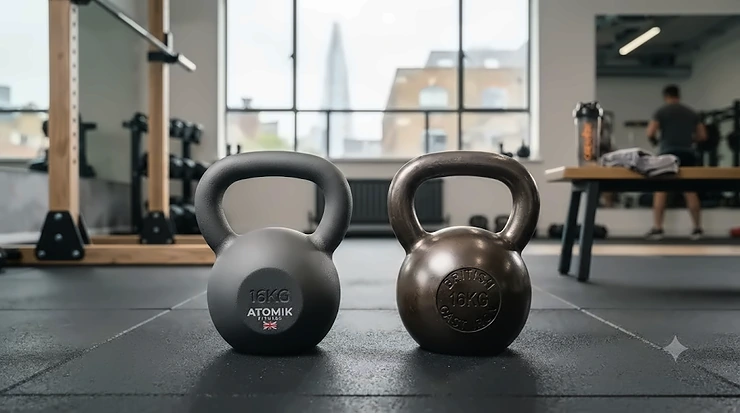
Powder coat kettlebells are cast-iron bells finished with a baked-on, slightly textured dry-powder coating that grips bare hands and holds chalk. Traditional kettlebells use a conventional painted, enamel or bare-steel finish. It’s smoother and easier to wipe clean, but often slicker once sweat arrives. Same iron underneath; very different handle.
Quick Comparison: Powder Coat Kettlebells vs Traditional Kettlebells at a Glance
Here’s the whole field on one screen before we get into the detail.
| Kettlebell | Finish type | Weight range | Best For |
|---|---|---|---|
| Yes4All Powder Coated Kettlebells | Powder coat | 4–32kg | Budget-friendly grip |
| FORZA Pro Cast Iron Kettlebells | Powder coat | 4–48kg | Long-term progression |
| NORTHERN Cast Iron Kettlebells | Matte powder-coated finish (per brand) | 2–28kg | Building a set in stages |
| Amazon Basics Cast-Iron Kettlebell | Painted | Multiple weights from 6kg | Low-rep, low-cost training |
| Chase Fitness Cast Iron Kettlebell | Heavy-duty finish (type not specified) | 4–40kg | Large hands, thick handles |
| Athlyt Cast Iron/Neoprene-Coated Kettlebells | Neoprene coating | 2–20kg | Flats and laminate floors |
| NORTHERN Steel Competition Kettlebell | Painted body, bare-steel handle | 4–28kg | High-rep, sport-style sets |
Reading across the table, the split is clearer than the marketing suggests. The powder-coated trio (Yes4All Powder Coated Kettlebells, FORZA Pro Cast Iron Kettlebells and NORTHERN Cast Iron Kettlebells) targets lifters who want texture without thinking about it. The Amazon Basics Cast-Iron Kettlebell is the value benchmark, while the Athlyt Cast Iron/Neoprene-Coated Kettlebells and NORTHERN Steel Competition Kettlebell solve very different problems (floors and long sets respectively).
💬 Just one click — help others make better buying decisions too!😊
Top 7 Kettlebells Compared: Powder Coat Kettlebells vs Traditional Kettlebells (Expert Analysis)
Prices below are ranges only and were checked at the time of research, so always check current pricing on Amazon before you buy.
1. Yes4All Powder Coated Kettlebells — best-selling budget powder coat
The big draw is weight of evidence. At the time of research this range averaged 4.7 stars across roughly 4,700 ratings on amazon.co.uk, a sample large enough to trust more than a handful of glowing comments.
The UK listing covers 4–32kg in solid one-piece cast iron, with a wide, smooth, slightly textured handle, colour-coded rings and a flat base. In practice, the colour coding saves you squinting at stamped numbers between circuit stations. The flat base lets you park a bell upright, or use it for renegade rows, without a wobble.
Here’s the honest take. Yes4All says the finish makes grip chalk unnecessary, which is a manufacturer claim best read as “less necessary” rather than “never”. A powder coated kettlebell grip beats a glossy paint job bare-handed, but long sweaty swing sets may still call for a dab of chalk. One UK roundup ranked it as the “upgrade” over plain cast iron, noting that powder coat also feels less icy in an unheated garage. It suits beginners and intermediates who want the finish without a premium bill.
Roundups describe consistently positive reviews from serious users. I couldn’t verify individual Amazon review text, so lean on the star average rather than any single comment.
Pros:
- ✅ Textured finish gives bare-hand bite
- ✅ Huge review base and strong average rating
- ✅ Colour-coded rings speed up weight selection
Cons:
- ❌ Weight tolerance looser than competition-grade bells
- ❌ Range stops at 32kg
Price: from the low £20s for lighter bells, rising with weight. That’s excellent value for a powder coated option, but check the current price.

2. FORZA Pro Cast Iron Kettlebells — powder coat that scales up to 48kg
Most budget powder coated bells run out of road at 32kg. This range keeps going to 48kg, which matters more than it sounds if you plan to progress for years rather than months.
According to the brand, the bells are one-piece cast iron with colour coding, a flat base and a handle that thickens from about 29mm on the lightest to about 38mm on the heaviest. That’s classic cast-iron behaviour: the bigger the bell, the fatter the handle. It gives two-handed swings plenty of room but can feel chunky in one-handed snatches if your hands are small.
The listing promises a powder-coated finish that holds chalk well, and textured coats generally do. The brand also calls it easy to clean, which deserves a raised eyebrow, because chalk-hungry textures tend to cling to residue. Treat that as relative, not absolute.
On amazon.co.uk the listing showed 4.9 stars from only 16 ratings, so the average is encouraging but statistically thin. Reviews on the brand’s own store mostly mention value and quick delivery, and one marketplace reviewer flagged courier scuffing rather than a product fault.
Pros:
- ✅ Range extends to 48kg for long-term progression
- ✅ Chalk-retaining powder-coated finish
- ✅ Handle scales sensibly with bell size
Cons:
- ❌ Small Amazon review sample so far
- ❌ Thick handles on heavy bells suit larger hands
Price: around the low £30s for lighter bells, climbing with weight. That’s fair value if you’ll use the heavier weights; check the current price.
3. NORTHERN Cast Iron Kettlebells — best for building a set in stages
Popularity first. At the time of research this listing sat in the top five of the amazon.co.uk kettlebell best sellers with a 4.7-star average, and it’s sold as 2–28kg singles and multi-bell sets.
The Amazon listing highlights a rust- and chip-resistant finish, a flat base, stamped weights and colour bands. The brand’s own site describes a matte black powder-coated finish and a wide handle that grows from about 2.85cm on a 4kg bell to 3.5cm on a 10kg. In practice, that means a handle that keeps pace with your hand as the weights climb.
The analytical point is the set option. Buying, say, an 8, 12 and 16kg trio together removes the guesswork about progression. At the time of research, sets ran from roughly £75 for a light trio to around £155 for a heavier one. One retailer describes the surface as smooth, which suggests the lighter-texture end of powder coat. If bare-hand bite is your priority, compare the FORZA Pro Cast Iron Kettlebells first.
That 4.7 average is strong, and customers on the brand’s own store mention a solid feel, fast delivery, a comfortable handle size and a stable base.
Pros:
- ✅ Sold as singles and multi-bell sets
- ✅ Handle widens with bell weight
- ✅ Strong rating and sales rank
Cons:
- ❌ Top weight is 28kg
- ❌ Surface reads smoother than some rivals
Price: sets in the roughly £75–£155 range depending on weights. Good value for progressive builders; check current pricing.
4. Amazon Basics Cast-Iron Kettlebell — the painted benchmark everyone measures against
If powder coat is the challenger, this is the reigning champion of the traditional camp. At the time of research it averaged 4.8 stars across more than 13,000 ratings and ranked third in the amazon.co.uk kettlebell best sellers.
The listing describes single-piece cast iron with no welds or seams, a painted surface, a curved, wide, textured handle and a flat base for storage. Paint is the cheapest way to protect iron, and it wipes clean easily. The trade-off, according to finish guides, is that basic paint is more prone to wear and damage over time. Glossier paint can also turn slippery as sweat builds.
That makes it a superb first bell. Goblet squats, presses and get-ups don’t ask much of a handle finish. High-rep swings and snatches, where the hand slides on every pass, are what push painted bells toward their limits. One UK roundup flags that the coating may chip if the bell is dropped or struck, which is fair for any coated iron.
By average rating, sentiment is overwhelmingly positive. I couldn’t verify individual comments, so treat the numbers as the signal.
Pros:
- ✅ Enormous review base and top-tier average rating
- ✅ Affordable entry into cast iron
- ✅ Painted surface wipes clean easily
Cons:
- ❌ Painted handles may slick up in long sweaty sets
- ❌ Coating can chip on hard drops
Price: from the high £10s for lighter bells up to the mid-£30s for heavier ones. It’s arguably the best entry-level value here; check current price.
5. Chase Fitness Cast Iron Kettlebell — thick-handle iron from 4kg to 40kg
If you have big hands or hate the pinched feeling of narrow handles, look here. The brand describes a thicker handle style, ranging from 3.5 to 5cm, well beyond the 33–35mm competition norm.
The listing highlights heavy-duty finished cast iron designed to resist chipping, raised weight numbers in kg and lb, and a protective bag. Raised numbering helps you identify a bell at a glance in a rack of near-identical black iron. A thick handle spreads pressure across the palm, which many two-handed swingers like. It also demands more grip effort in one-handed snatches, so the finish matters even more, because there’s more handle to slip over.
Crucially, the listing doesn’t state powder coat, so treat it as a traditional finish of unknown texture until you check the images or ask the seller. At the time of research it held 4.5 stars from 64 ratings: a modest sample, moderately positive, and I couldn’t verify the review detail.
Pros:
- ✅ Wide 4–40kg range for progression
- ✅ Roomy handle suits large hands
- ✅ Raised kg and lb markings
Cons:
- ❌ Finish type isn’t clearly specified
- ❌ Thick grip tires hands in one-handed high-rep sets
Price: roughly £30–£55 depending on weight. Average value; check current price.
6. Athlyt Cast Iron/Neoprene-Coated Kettlebells — floor-safe coating for flats and spare rooms
Not every home gym has a concrete garage floor. If yours is laminate, or the neighbours sit inches away, a neoprene shell changes the equation.
Athlyt lists a cast-iron core with a neoprene coating, a flat base, a wide grip handle and a 2–20kg range. Neoprene cushions landings, dulls noise and protects floors. What it may not do is help your hands. Independent guides on vinyl-coated bells note that the coating doesn’t take chalk and can turn slippery in high-rep sets. I couldn’t find an independent test of this specific neoprene, so its sweat behaviour is unproven either way.
My reading: it suits light-to-moderate conditioning, mobility flows and beginners who want a forgiving surface. It’s less convincing for sweaty snatch sets or heavy progression, since the range tops out at 20kg. At the time of research it held 4.5 stars from 60 ratings, which is positive but thin.
Pros:
- ✅ Floor-friendly, quieter coating
- ✅ Flat base and wide handle
- ✅ Approachable entry price
Cons:
- ❌ Chalk may not bond to the coating
- ❌ Range caps at 20kg
Price: from around £29 for lighter bells. Fair value if floor protection is the priority; check current price.
7. NORTHERN Steel Competition Kettlebell — bare-steel handle built for long sets
Competition bells flip the traditional design. Every weight is the same size, so moving from 12kg to 16kg doesn’t change where the bell sits on your forearm.
The brand lists steel construction, uniform dimensions across weights, stamped weights, colour coding and a flat bottom, in sizes from 4kg to 28kg. On its 8kg page it explains that the colour paint stops at the handle, where bare steel takes over and is grippier. That’s a useful clue about finish philosophy: rather than texture the coating, competition bells remove it from the contact zone.
One buyer’s guide notes that bare or pitted steel absorbs chalk fastest, which suits high-rep single-arm work. The trade-off is less hand room for two-handed swings and goblet squats, and bare metal deserves a wipe-down after sweaty sessions. The product page I found displayed no reviews, and I couldn’t verify Amazon reviews for the exact variant, so check the specific listing before buying.
Pros:
- ✅ Same size at every weight
- ✅ Bare-steel handle for chalk and sweat
- ✅ Suits snatch, clean and sport-style work
Cons:
- ❌ Less hand room for two-handed exercises
- ❌ Review evidence hard to verify
Price: lighter bells sat in the low £20s to mid-£30s on the brand’s own site at the time of research. Check the Amazon listing for current pricing.
Side-by-Side Verdict: Top 7 Kettlebells
| Kettlebell | Finish | Handle feel | Range | Rating snapshot | Price range | Best For |
|---|---|---|---|---|---|---|
| Yes4All Powder Coated Kettlebells | Powder coat | Wide, slightly textured | 4–32kg | 4.7 (approx. 4,700 ratings) | From low £20s | Budget powder coat |
| FORZA Pro Cast Iron Kettlebells | Powder coat | 29–38mm, scales with weight | 4–48kg | 4.9 (16 ratings) | From low £30s | Heavy progression |
| NORTHERN Cast Iron Kettlebells | Matte powder coat (per brand) | Wide, scales with weight | 2–28kg | 4.7 (best-seller rank) | Sets approx. £75–£155 | Building a set |
| Amazon Basics Cast-Iron Kettlebell | Painted | Wide, textured | From 6kg | 4.8 (13,000+ ratings) | High £10s–mid-£30s | Casual, low-rep work |
| Chase Fitness Cast Iron Kettlebell | Unspecified heavy-duty | Thick, 3.5–5cm | 4–40kg | 4.5 (64 ratings) | Approx. £30–£55 | Large hands |
| Athlyt Cast Iron/Neoprene-Coated Kettlebells | Neoprene | Wide, coated | 2–20kg | 4.5 (60 ratings) | From around £29 | Floor protection |
| NORTHERN Steel Competition Kettlebell | Painted body, bare-steel handle | Uniform competition size | 4–28kg | Not verified | Low £20s–mid-£30s (brand site) | High-rep sport sets |
The pattern is worth noticing. The three powder-coated bells cluster at the high-grip end. The Amazon Basics Cast-Iron Kettlebell wins on price and sheer review volume. The FORZA Pro Cast Iron Kettlebells justify a slight premium only if you’ll actually use the heavier weights. The Athlyt Cast Iron/Neoprene-Coated Kettlebells and Chase Fitness Cast Iron Kettlebell trade grip certainty for floors or hand-fit, so choose them for those reasons alone.
✨ Don’t Miss These Carefully Selected Picks!
🔍 Take your kettlebell training to the next level with the bells above. Click any highlighted product name to check current pricing and availability. The right finish will help you build the grip your high-rep sessions demand!
Kettlebell Handle Finish Care: A Practical Setup and Maintenance Guide
A finish is only as good as its upkeep, and product listings say little about that. This routine works across both camps.
First-use checks. Run a fingertip along the handle and seam lines for casting flash or coating drips, because a rough spot can chew skin. Warnings on comparable listings advise inspecting the handle before each session and retiring the bell if chipped coating exposes sharp bare metal. It’s a habit worth adopting.
The first 30 days. Powder-coated handles are grippy by design. One buyer’s guide warns that new lifters can build calluses faster on them, and that overly aggressive coats can tear callused hands. Start with moderate sets, file down hard calluses rather than letting them rip, and stop when your palms feel hot.
Chalk maintenance. Powder coat holds grip chalk stubbornly. Brush the handle with a dry nylon brush after sessions, then wipe it with a barely damp cloth and dry it. Caked chalk keeps moisture against the surface, and moisture is iron’s enemy.
Storage. In an unheated UK garage, condensation can do more damage than sweat. Keep bells on a rubber mat rather than bare concrete, wipe them after sweaty sessions, and keep any bare-steel handle dry. Never drop a coated bell on concrete, because chips start the rust story.
Common first-month mistakes: over-chalking, storing bells damp, scrubbing with abrasive pads, and swapping bells without checking for chips.
Real-World Scenarios: Which Kettlebell Handle Finish Fits Your Training?
Specs only mean something when they meet real life. Here are four hypothetical profiles (not customer stories) and the finish logic for each.
The garage regular. Three sessions a week in an unheated garage, hundred-swing finishers, a total budget of perhaps £100–£150 for two bells. The reasoning points to powder coat: the Yes4All Powder Coated Kettlebells for cost, or the FORZA Pro Cast Iron Kettlebells for a higher weight ceiling. NHS guidance suggests muscle-strengthening work on at least two days a week, taken to the point where another repetition would be difficult. This profile easily exceeds that, so grip durability compounds.
The flat-dweller. Laminate floor, thin walls, two 30-minute conditioning sessions weekly. The finish decision is about landings, not grip. The Athlyt Cast Iron/Neoprene-Coated Kettlebells, or the Amazon Basics Cast-Iron Kettlebell on a thick mat, make sense at light-to-moderate weights.
The sport-curious snatcher. Wants ten-minute snatch sets. Uniform size and a bare-steel handle favour the NORTHERN Steel Competition Kettlebell, provided hand-fit and the exact listing check out.
The set builder. Wants a clear progression path and hates reordering. The NORTHERN Cast Iron Kettlebells in a multi-bell set fit neatly.
Decision shortcut: if you chalk and swing a lot, choose powder coat. If floors and noise dominate, choose neoprene. If you’re testing the water cheaply, choose painted. If you’re eyeing sport, choose steel.

How to Choose Between Powder Coat Kettlebells vs Traditional Kettlebells
Choosing well comes down to seven checks:
- Match the finish to your rep range. Sets of ten or more swings or snatches reward texture or bare steel, while five goblet squats barely test a finish.
- Check the handle diameter. Cast-iron handles typically grow with weight (roughly 29–38mm on the FORZA Pro Cast Iron Kettlebells), whereas competition bells hold a fixed size.
- Decide whether you’ll use grip chalk. One buyer’s guide says lifters who won’t use chalk often prefer powder coat, because smoother e-coat can slip on dry, sweaty hands.
- Consider your floor and storage. A garage tolerates hard finishes; a flat may need neoprene.
- Think about cleaning tolerance. Powder coat holds chalk residue, while smoother finishes wipe cleaner.
- Plan for progression. Ceilings differ: 20kg, 28kg, 32kg, 40kg or 48kg across the seven bells above.
- Read the listing for the finish. The Chase Fitness Cast Iron Kettlebell listing doesn’t name its coating type, so ask before you assume.
Kettlebell Handle Finish Compared: Powder Coat, Paint, Neoprene and Bare Steel
The kettlebell handle finish decides how the bell behaves when hands turn wet, which is why this table matters more than the weight stamped on the side.
| Finish | Texture | Chalk behaviour | Cleaning | Best For |
|---|---|---|---|---|
| Powder coat | Textured matte | Holds chalk longest | Chalk residue lingers | Garage lifters: Yes4All Powder Coated Kettlebells, FORZA Pro Cast Iron Kettlebells, NORTHERN Cast Iron Kettlebells |
| Painted / enamel | Smooth to lightly textured | Accepts chalk, less bite without it | Wipes easily | Low-rep training: Amazon Basics Cast-Iron Kettlebell |
| E-coat | Smooth semi-gloss | Accepts chalk, wipes off fast | Easiest | Shared studios (none of the seven) |
| Bare-steel handle | Raw, slightly porous | Absorbs chalk fastest | Wipe and dry to avoid rust | High-rep sport sets: NORTHERN Steel Competition Kettlebell |
| Neoprene / vinyl | Soft, smooth | Chalk doesn’t bond | Wipe clean | Floor-friendly conditioning: Athlyt Cast Iron/Neoprene-Coated Kettlebells |
| Unspecified heavy-duty | Check listing | Unknown | Unknown | Thick-handle fans: Chase Fitness Cast Iron Kettlebell |
The table makes the trade-off plain. Powder coat maximises bite and chalk retention but costs you cleaning time. Paint and e-coat are easier to live with but demand more from your hands, and neoprene protects floors at the expense of chalk compatibility. Bare steel is the specialist option, brilliant for long single-arm sets and unforgiving of damp storage.
Powder Coated Kettlebell Grip: What the Texture Really Does
A powder coated kettlebell grip works on micro-texture. The coating goes on as dry powder, is electrostatically attracted to the iron, then cured into a slightly bumpy shell. Those bumps do two jobs. They give skin something mechanical to bite into, and they create tiny pockets that hold grip chalk. A glossy finish has neither, so a film of sweat turns it into a slip-and-slide.
Handle diameter modifies everything, though. One roundup notes that a slimmer 33mm competition handle seats deeper in the palm, which reduces skin shear in high-rep sets. Thicker cast-iron handles spread load but need a bigger hand span.
The trade-off is your skin. Buyer’s guides note that texture can speed up callus formation and that an over-aggressive coat can tear callused hands. That’s why “grippy” isn’t a single setting. The FORZA Pro Cast Iron Kettlebells promote a chalk-retaining texture, while the NORTHERN Cast Iron Kettlebells may sit at the smoother end, judging by one retailer’s description. Match the texture to the hands you actually have.
Sweat-Resistant Kettlebells: What Actually Keeps Your Hands Dry?
Let’s be blunt: no kettlebell is sweat-proof. “Sweat-resistant kettlebells” is best read as bells whose finish keeps working when wet, and it covers two separate jobs. One is how the finish behaves against damp skin. The other is how well it protects the iron from sweat and UK humidity.
On skin, friction research summarised in a US university thesis suggests a little moisture can actually increase friction, but once there’s enough to form a lubricating film, friction falls. That’s the tipping point around rep twenty. Textured surfaces tend to break that film up, while glossy ones let it spread.
On the iron side, sweat is salty water, and a chipped finish invites rust. A UK garage roundup warns that vinyl coatings can chip and crack with temperature swings, and favours cast iron or powder-coated cast iron for uncontrolled environments.
So a sweat-resistant setup is a finish plus habits: a textured bell such as the Yes4All Powder Coated Kettlebells, plus a wipe-down after every session. Neoprene on the Athlyt Cast Iron/Neoprene-Coated Kettlebells protects floors, but its sweat-grip performance remains unproven.
Grip Chalk: Friendly Helper or Unnecessary Faff?
Grip chalk is magnesium carbonate, the oldest trick in the book for damp hands. On powder-coated bells it’s a natural partner: the texture holds the powder, so a light dusting lasts. Bare steel absorbs chalk fastest, while buyer’s guides note it doesn’t bond to vinyl-type coatings.
Does it actually work? The science is more interesting than the folklore. A study on rock climbers found no measurable difference in friction coefficient with chalk, yet participants hung on longer afterwards, with reported averages of roughly 63 seconds with chalk against 49 without. It’s a small study, and climbing isn’t kettlebell swinging. Still, the takeaway travels: chalk’s benefit may come from dry, comfortable skin as much as raw friction.
Practical rules: use grip chalk sparingly, reapply between sets rather than mid-set, and brush it off afterwards so it doesn’t hold moisture against the finish. Some commercial gyms restrict loose chalk, but your own garage is your call. If you dislike the mess, a smoother finish plus a towel may suit you better.
High-Rep Kettlebell Training: Where the Finish Matters Most
High-rep kettlebell training is where the finish stops being cosmetic. Twenty swings barely test a handle, but two hundred across a session, or a ten-minute snatch set, turn every square millimetre of surface into a variable. A competition-versus-cast-iron roundup notes that in sets of ten or more, chalk lowers grip effort and callus formation, and handle diameter begins to decide whether skin shear becomes the limiter.
Three practical patterns:
- Hardstyle swing volume: textured powder coat suits it, such as the Yes4All Powder Coated Kettlebells, FORZA Pro Cast Iron Kettlebells or NORTHERN Cast Iron Kettlebells.
- Single-arm snatch and sport-style work: uniform size and a bare-steel handle, as on the NORTHERN Steel Competition Kettlebell.
- Mixed circuits at lighter loads: painted or neoprene finishes such as the Amazon Basics Cast-Iron Kettlebell or Athlyt Cast Iron/Neoprene-Coated Kettlebells are perfectly adequate.
Pace yourself. Swap hands often, chalk lightly between sets, and treat rising palm heat as a stop sign. A finish can help your grip, but it can’t rescue skin you’ve already worn through.
FAQ
❓ Will powder coated kettlebells tear my hands?
❓ Can I keep powder coat kettlebells in an unheated UK garage?
❓ Are powder coat kettlebells safe on wooden or laminate floors?
❓ Is a powder coated kettlebell worth paying more for than a painted one?
❓ What weight kettlebell should a beginner buy first?
Conclusion
So, powder coat kettlebells vs traditional kettlebells: who wins? It depends on what your hands are doing. If your training involves sweaty swing volume, chalk and a garage, powder coat is the safer bet. The Yes4All Powder Coated Kettlebells lead on budget and review depth, the FORZA Pro Cast Iron Kettlebells on weight range, and the NORTHERN Cast Iron Kettlebells on set-building flexibility.
If your sessions are lighter and lower-rep, the Amazon Basics Cast-Iron Kettlebell remains a remarkably sensible traditional choice. The Chase Fitness Cast Iron Kettlebell suits big hands, provided you confirm the finish. The Athlyt Cast Iron/Neoprene-Coated Kettlebells solve the floor problem, and the NORTHERN Steel Competition Kettlebell rewards lifters chasing long single-arm sets.
Whichever finish you pick, the best kettlebell is the one that gets used regularly. UK health guidance recommends adults do strengthening and balance activities at least twice a week alongside aerobic exercise, and a bell your hands trust makes that easier to sustain.
✨ Ready to Find Your Grip?
🔍 Take your kettlebell training to the next level with these carefully selected options. Click any highlighted product to check current pricing and availability, and build a home gym your hands will actually enjoy using!
Recommended for You
- Cast Iron Kettlebells for Home Gym: 7 Proven Picks (2026)
- Fractional Plates for Powerlifting: 7 Best Picks UK (2026)
- Weight Plate Set for Home Gym: 7 Best UK Picks (2026)
Disclaimer: This article contains affiliate links. As an Amazon Associate, I earn from qualifying purchases. If you purchase products through these links, we may earn a small commission at no additional cost to you.
✨ Found this helpful? Share it with your friends! 💬🤗
