In This Article
Building a proper home gym in the UK comes with unique challenges that American or continental European lifters rarely face. Between compact living spaces in terraced housing, damp garages that accelerate equipment corrosion, and the reality that most of us can’t dedicate an entire room to fitness kit, choosing the right olympic weight bench becomes absolutely critical.
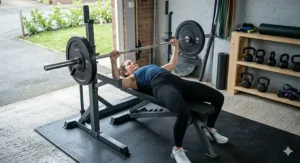
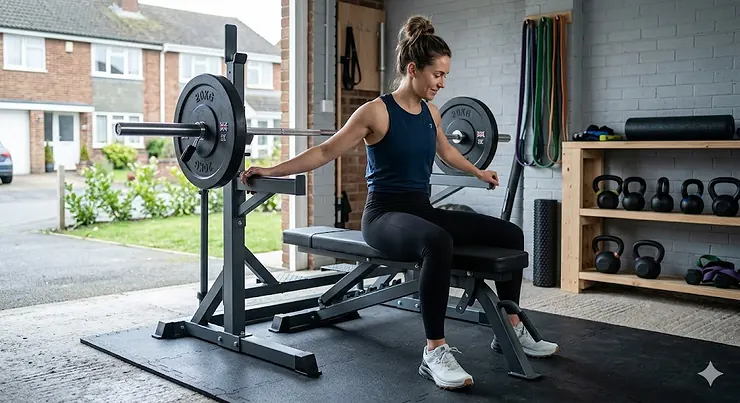
An olympic weight bench isn’t just a padded surface with a barbell rack — it’s the foundation of serious strength training. The “Olympic” designation refers to compatibility with 7-foot Olympic barbells and 2-inch diameter weight plates, the global standard for commercial gyms and competitive lifting. Unlike standard benches designed for lighter, 1-inch plates, olympic benches must handle substantially heavier loads whilst maintaining rock-solid stability. In practical terms, this means reinforced frames, commercial-grade upholstery, and load capacities that typically start around 135 kg and extend well beyond 300 kg for professional models.
What most buyers overlook when browsing Amazon.co.uk is that load capacity figures represent total weight — your body weight plus the barbell plus all loaded plates. A 16-stone lifter pressing 100 kg actually needs a bench rated for roughly 200 kg minimum, yet many budget benches barely meet this threshold. Moreover, British homes present storage challenges that American garage gym enthusiasts don’t face. A foldable olympic weight bench that collapses for storage becomes genuinely valuable when you’re working in a spare bedroom in Birmingham or a damp garage in Glasgow, rather than a luxurious bonus feature.
This guide examines seven olympic weight benches currently available on Amazon.co.uk, each verified for UK delivery, proper voltage compatibility where applicable, and genuine suitability for British conditions. We’ll explore commercial weight bench options, heavy duty adjustable bench models, and the professional weight bench specifications that separate marketing fluff from legitimate performance credentials.
Quick Comparison: Top Olympic Weight Benches at a Glance
| Model | Load Capacity | Key Feature | Price Range | Best For |
|---|---|---|---|---|
| Marcy Eclipse BE3000 | 135 kg rack / 135 kg user | Squat rack integration | £350-£400 | Multi-exercise training |
| V-fit Olympic Bench Set | 100 kg included weights | Complete starter package | £370-£420 | Beginners with space |
| Marcy MD-879 | 272 kg total capacity | Leg developer attachment | £280-£350 | Full-body workouts |
| BodyMax IG3 Leverage | 150 kg user weight | Leverage chest press | £230-£270 | Compact home gyms |
| Weider Platinum Olympic | 230 kg user capacity | 7 bench positions | £170-£220 | Budget-conscious lifters |
| Marcy CB 729 | 135 kg rack / 135 kg user | Ultra-compact footprint | £160-£200 | Limited space |
| Aceshin 660lb Olympic | 300 kg total capacity | Foldable design | £200-£260 | Storage-focused buyers |
Looking at this comparison, the Marcy Eclipse BE3000 and V-fit package dominate the mid-range with comprehensive features, whilst the Weider Platinum and Marcy CB 729 provide genuine budget options that don’t sacrifice safety. The Aceshin model bridges the gap with impressive load capacity at a reasonable price, though UK buyers should note longer delivery times compared to Marcy’s established distribution network. What’s particularly telling is that every bench listed uses 14-gauge steel tubing as a minimum — anything thinner simply won’t survive British damp conditions or serious lifting sessions. The V-fit stands out for including 100 kg of weights, eliminating the separate purchase hassle that trips up many first-time buyers.
💬 Just one click — help others make better buying decisions too!😊
Top 7 Olympic Weight Benches: Expert Analysis for UK Buyers
1. Marcy Eclipse BE3000 Olympic Bench & Squat Rack
The Marcy Eclipse BE3000 represents what most experienced lifters actually need in a home olympic weight bench — versatility without complexity. This integrated bench and squat rack system accommodates the three fundamental barbell movements (bench press, squat, overhead press) that form the backbone of strength programming, eliminating the need for separate equipment purchases.
Load capacity sits at 135 kg for both the rack and user weight, which translates to roughly 21 stone per component. For the typical UK home lifter, this means comfortable headroom — a 13-stone individual can safely press 80-90 kg without approaching limits. The adjustable bench angles to upright, incline, flat, and decline positions, targeting different regions of the chest and shoulders with precision. What separates the BE3000 from cheaper alternatives is the quick-release slotted back support system that locks angles securely rather than relying on friction pins that loosen over time.
The integrated leg developer attachment deserves particular attention for British buyers. Unlike bolt-on afterthoughts, this bio-mechanically aligned unit targets quadriceps and hamstrings without the knee stress that plagues poorly designed leg extensions. Given that separate leg press machines cost £400-£600 and occupy twice the floor space, this integration provides genuine value for home gym builders working within typical UK room dimensions.
Marcy’s established UK distribution network means replacement parts ship from British warehouses rather than international suppliers, a consideration that matters when upholstery inevitably wears or adjustment knobs strip threads after years of use. Customer feedback consistently mentions sturdy construction and straightforward assembly, though taller users (over 6’2″) note the rack height occasionally requires standing on tiptoes to rerack after overhead presses.
Pros:
✅ Integrated squat rack eliminates separate equipment purchases and saves precious floor space
✅ Bio-mechanically aligned leg developer provides lower body training without additional machines
✅ Established UK parts availability means repairs don’t require international shipping
Cons:
❌ Rack height suits average-height lifters but challenges those over 6’2″
❌ 135 kg total capacity adequate for intermediate lifters but limits advanced progression
Around £350-£400 makes the BE3000 competitive against purchasing separate bench and rack components, particularly when factoring in the integrated leg station value.
2. V-fit Olympic Weight Bench & 100kg Olympic Weight Set
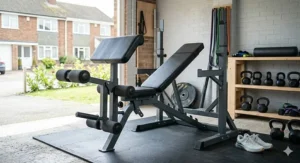
The V-fit Olympic Weight Bench & 100kg Olympic Weight Set solves the coordination headache that frustrates first-time home gym builders — matching compatible components. This complete package includes a proper Olympic bench, 7-foot Olympic barbell, 100 kg of 2-inch diameter weight plates, and quick-release collars, eliminating the research paralysis around plate sizes, barbell compatibility, and collar types.
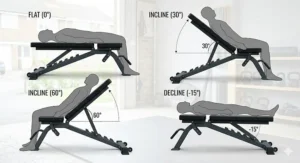
The bench itself features an adjustable incline backrest with visible angle indicators (flat to 60-degree incline), removing the guesswork that plagues benches with unmarked positions. At 60 degrees, you’re hitting upper chest fibres that flat pressing barely touches — critical for balanced development but often neglected in budget equipment. The padded seat adjusts to four positions, maintaining proper spine alignment as the backrest angle changes, whilst the incorporated leg unit accepts both Olympic 2-inch and standard 1-inch weights via included adapters.
What British buyers particularly appreciate is the height-adjustable barbell stands with a two-position safety catcher system directly below. In a damp garage in Manchester or a spare bedroom in Bristol, training alone becomes the norm rather than exception. These safety catchers mean a failed rep drops onto steel rather than your ribcage — unglamorous but potentially life-saving equipment that distinguishes serious benches from decorative furniture.
The 100 kg weight set breaks down across various plate denominations, providing programming flexibility from light warm-up sets to challenging working weights. For reference, 100 kg total weight allows a male beginner to bench press around 60-70 kg for working sets whilst leaving plates for squats and overhead work. Intermediate lifters will eventually need additional plates, but the included barbell and collars remain usable indefinitely.
V-fit’s foldable design addresses the British home gym’s greatest enemy — spatial constraints. After training, this unit collapses for vertical storage against a wall or in a cupboard, reclaiming floor space in homes where every square metre matters. The quick-release folding mechanism operates smoothly according to customer reports, though the unit weighs roughly 60 kg fully assembled, requiring two people for safe repositioning in most cases.
Pros:
✅ Complete package eliminates compatibility confusion and multiple purchase coordination
✅ Visible angle indicators on backrest prevent incorrect positioning during different exercises
✅ Dual safety catcher system provides fail-safe protection for solo training sessions
✅ Foldable design reclaims floor space in compact British living environments
Cons:
❌ 100 kg weight set adequate for beginners but intermediate lifters need supplementary plates within 6-12 months
❌ 60 kg total weight requires two-person handling for repositioning after folding
The £370-£420 price range positions this as exceptional value when calculating separate component costs — Olympic barbell (£80-£120), 100 kg plates (£150-£200), collars (£15-£25), and bench (£200-£250) would total £445-£595 individually.
3. Marcy Adjustable Olympic Weight Bench MD-879
The Marcy MD-879 achieves something remarkable in the crowded olympic weight bench market — genuine versatility without the structural compromise that usually accompanies multi-function designs. With a 272 kg total capacity (roughly 43 stone), this bench handles serious progressive overload whilst incorporating preacher curl, leg developer, and chest fly attachments that typically require separate stations.
The 8-position adjustable back pad ranges from 58-degree incline through flat to -13 degrees decline, covering the complete spectrum of pressing angles. Decline positions often get overlooked in budget benches, yet they’re essential for complete chest development and particularly effective for lifters who struggle with shoulder impingement during standard flat pressing. The padded seat coordinates with back angles across four positions, maintaining proper lower back support regardless of incline choice.
Marcy’s bio-mechanically aligned leg developer deserves specific mention because most bench-mounted leg attachments feel like afterthoughts bolted onto frames designed primarily for pressing. The MD-879’s leg unit features a roller lock that converts the developer into a stable anchor point for ab crunches, transforming it from single-purpose to dual-function without tool requirements. For UK home gyms where every piece of kit must justify its floor space, this dual functionality matters.
The adjustable preacher arm curl pad accommodates three height positions, ensuring proper arm alignment across different body proportions. Preacher curls isolate biceps whilst eliminating momentum cheating, but only when the pad aligns correctly with your armpit — too high or low ruins the movement pattern. Having three adjustment positions rather than the single fixed height found on cheaper alternatives makes this attachment genuinely usable rather than decorative.
Customer feedback from UK buyers consistently highlights the ToughFold design that enables rapid collapse without compromising structural integrity in extended position. Two large pins release to fold the bench in half, yet in extended position these same pins support the structure rather than creating potential failure points. This addresses the common folding bench paradox where storage convenience usually means stability sacrifices.
Assembly complexity represents the MD-879’s primary criticism from British buyers. Marcy provides written instructions but no assembly video, leaving customers to interpret diagrams whilst matching unlabelled parts. YouTube contains user-created assembly guides that fill this gap, but companies charging £300+ should include professional video instruction as standard.
Pros:
✅ 272 kg capacity provides headroom for advanced progression beyond intermediate lifting stages
✅ Decline positioning expands exercise variety and accommodates lifters with shoulder mobility limitations
✅ Leg developer roller lock enables ab crunch functionality without additional equipment
✅ ToughFold design achieves genuine collapse convenience without structural compromise
Cons:
❌ Assembly instructions lack video support, frustrating buyers unfamiliar with fitness equipment construction
❌ Preacher curl pad positioning occasionally interferes with bench press rack clearance during setup
Around £280-£350 makes the MD-879 competitive against purchasing separate bench, preacher curl station, and leg developer, particularly factoring in the floor space consolidation value.
4. BodyMax IG3 Leverage Weight Bench
The BodyMax IG3 takes an entirely different approach to olympic weight bench design — instead of accommodating free-weight Olympic barbells, it incorporates a lever arm chest press mechanism that operates independently. This creates a unique position in the UK market for buyers who want chest pressing capability without the coordination challenges of balancing a loose barbell.
The leverage system provides a fixed pressing path, eliminating the stability demands that make free-weight bench pressing challenging for beginners. For British home gym users training alone without spotters, this fixed path means pressing to genuine failure without requiring safety catchers or the coordination to guide a wobbling barbell back to hooks. The trade-off, as experienced lifters recognise, is reduced stabiliser muscle activation compared to free weights — you’re building pressing strength without the supporting musculature that transfers to real-world pushing movements.
Load capacity sits at 150 kg user weight, accommodating lifters up to roughly 23.5 stone. The compact 150 x 158 x 77 cm footprint fits British spare bedrooms and garage corners where full Olympic setups demand excessive floor space. For context, the IG3 occupies roughly 2.4 square metres compared to 3-4 square metres for traditional benches with extended barbell rack clearance zones.
The bench adjusts across multiple positions for incline and flat pressing, though lacks the decline positioning found in more versatile models. BodyMax’s UK-based customer service responds quickly to parts requests and warranty claims according to buyer feedback, important given that lever mechanisms contain more moving parts than simple barbell racks.
What the IG3 particularly suits is buyers transitioning from machine-based gym memberships to home training who aren’t ready for free-weight coordination demands. The lever system provides a bridge experience — heavier than dumbbells but safer than unguided barbells. Eventually, most lifters outgrow this middle ground and crave free-weight progression, but for 12-18 months of skill development, the IG3 serves its purpose.
Pros:
✅ Leverage mechanism enables pressing to failure without spotter assistance or safety equipment
✅ Compact 2.4 square metre footprint suits British spare bedrooms and garage corners
✅ UK-based BodyMax customer service provides responsive parts support and warranty handling
Cons:
❌ Lever system reduces stabiliser muscle activation compared to free-weight pressing
❌ Lacks decline positions that enable complete chest development angles
❌ Limited progression ceiling as lever resistance becomes inadequate for advanced strength
The £230-£270 range positions the IG3 as a transitional option rather than lifetime investment — expect 12-24 months of productive use before outgrowing the lever system’s limitations.
5. Weider Platinum Olympic Weight Bench
The Weider Platinum Olympic demonstrates that budget pricing doesn’t necessarily mean budget performance — it means stripped features and basic construction rather than structural compromise. With 230 kg user capacity (roughly 36 stone), this bench handles serious loading despite its sub-£200 pricing, achieving this through intelligent engineering rather than premium materials.
Seven bench positions cover decline through multiple incline angles, providing exercise variety that rivales benches costing twice the price. The adjustable arms improve lifting safety by accommodating different torso lengths — critical for preventing shoulder strain when unracking heavy weights. Too many budget benches force users into biomechanically compromised positions because rack width suits average dimensions only.
The integrated leg developer trains quads, hamstrings, glutes, and hip flexors without requiring separate machines. Whilst not as sophisticated as dedicated leg press stations, for home gym builders working within £200-£300 total budgets, having leg training capability rather than exclusively upper body work justifies the bench choice. The stylish stitched vinyl seat cleans easily after sweaty sessions — more important in British climate where garage training means temperature swings and condensation rather than climate-controlled American basement gyms.
Weider provides an exercise chart illustrating proper form across different movements, valuable for beginners who haven’t developed kinesthetic awareness of correct positioning. This seems trivial until you watch novice lifters arch their backs dangerously or flare their elbows excessively because nobody taught them proper mechanics and they’re too embarrassed to ask gym staff.
Customer feedback from UK buyers consistently mentions easy assembly and solid stability, though several note slight wobble in the adjustable backrest connection point. This wobble doesn’t compromise safety — the bench remains stable under load — but creates psychological unease for cautious lifters. Tightening adjustment bolts periodically eliminates this issue according to user-posted solutions.
The bench’s 7-foot Olympic barbell compatibility means standard 6-foot bars leave inadequate clearance for pressing with proper hand spacing. UK buyers often purchase 6-foot bars due to space constraints, then discover head clearance problems during bench pressing. The Weider requires commitment to proper 7-foot Olympic barbells or accepting cramped hand positioning with shorter bars.
Pros:
✅ 230 kg user capacity provides genuine load headroom despite budget pricing under £200
✅ Seven bench positions enable exercise variety rivalling premium alternatives
✅ Exercise chart inclusion supports proper form development for beginner lifters
✅ Tear-resistant vinyl upholstery handles British garage condensation and temperature swings
Cons:
❌ Adjustable backrest connection shows slight wobble requiring periodic bolt retightening
❌ Requires 7-foot Olympic barbell for proper hand spacing clearance during pressing movements
Around £170-£220 makes the Weider Platinum exceptional value for budget-conscious buyers willing to accept basic construction in exchange for legitimate load capacity and exercise variety.
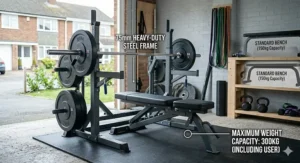
6. Marcy CB 729 Olympic Weight Bench
The Marcy CB 729 achieves something increasingly rare in modern fitness equipment — genuine space efficiency without feature compromise. At 170 cm length x 114 cm width x 127 cm height assembled, this bench squeezes into British spare rooms, garden sheds, and garage corners that couldn’t accommodate traditional Olympic setups, yet maintains 135 kg rack capacity and 135 kg user weight limits.
The compact nature shouldn’t suggest reduced capability. That 135 kg rack capacity accommodates a 13-stone lifter pressing 60-70 kg comfortably, covering the working weight range for most home gym users. Advanced lifters pressing bodyweight or beyond need heavier-duty alternatives, but the CB 729 serves beginner through intermediate progression admirably. The 14-gauge thick solid steel frame provides rock-solid stability despite compact dimensions — Marcy achieved space savings through intelligent geometry rather than material downgrades.
The adjustable bench angles to upright, incline, flat, and decline positions via a slotted back support system that locks securely without play. The multi-height rack adjusts across four positions, crucial for accommodating different torso lengths during pressing and different exercise types (bench press versus shoulder press require dramatically different rack heights). The bio-mechanically aligned leg developer integrates without extending the overall footprint, using vertical space rather than horizontal floor area.
Customer feedback particularly praises the powder-coated chip-resistant finish that survives British garage conditions where cheaper painted frames rust within months. The 2.5-inch thick box-stitched upholstery provides adequate padding for extended sessions, though several reviewers mention replacing it after 2-3 years of heavy use — standard wear rather than premature failure.
Assembly requires socket wrenches beyond the included Allen keys for efficient construction. Marcy’s decision to include only Allen wrenches whilst designing bolt connections that demand sockets frustrates buyers who discover this mid-assembly. Having a basic socket set ready before starting eliminates this annoyance.
The CB 729 particularly suits UK buyers in flats, terraced housing, or homes where fitness equipment must share space with other uses. Setup takes roughly 15 minutes, making it practical to assemble for training sessions then partially disassemble for storage if absolutely necessary, though most users leave it assembled given the modest footprint.
Pros:
✅ 170 cm x 114 cm x 127 cm dimensions fit British spare rooms and garden sheds impossible for standard benches
✅ 135 kg dual capacity serves beginner through intermediate progression without premature obsolescence
✅ Powder-coated finish resists British garage rust better than painted alternatives
✅ Bio-mechanically aligned leg developer integrates without footprint expansion
Cons:
❌ Socket wrench required despite Marcy only including Allen keys in package
❌ 2.5-inch upholstery adequate but thinner than premium alternatives, showing wear after heavy use
Around £160-£200 makes the CB 729 exceptional value specifically for space-constrained British buyers who need Olympic capability without traditional floor space demands.
7. Aceshin 660lb Olympic Weight Bench
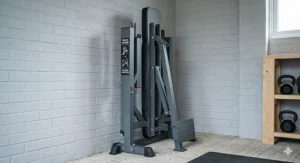
The Aceshin 660lb (approximately 300 kg) weight bench targets British buyers who prioritise storage convenience alongside serious load capacity. The foldable frame collapses for wall storage, under-bed positioning, or cupboard placement, then extends for training sessions without tools or complicated mechanisms. This convenience typically costs structural integrity, yet the Aceshin maintains 300 kg total capacity through reinforced steel tubing and strategic brace positioning.
Four-level height-adjustable uprights accommodate different exercises and body proportions, whilst the backrest adjusts for flat and incline positions (decline functionality notably absent). The preacher curl attachment, leg extension, and leg curl capabilities consolidate multiple training stations into one foldable unit — impressive engineering that suits British homes where fitness equipment competes with other uses for limited floor space.
The covered breathable leather upholstery and soft foam padding resist British garage moisture better than cheaper vinyl alternatives that crack in cold conditions. Aceshin’s construction uses powder-coated steel tube rather than painted frames, extending lifespan in damp environments where rust becomes the primary failure mode rather than structural weakness.
Customer feedback reveals the Aceshin’s primary challenge — assembly complexity. The bench arrives with numerous parts and instructions that assume mechanical familiarity. Multiple UK buyers mention spending 60-90 minutes on initial assembly compared to 30-45 minutes for simpler Marcy alternatives. However, once assembled, the thickened steel stand provides free-standing stability without wall anchoring or additional bracing.
The 300 kg capacity deserves sceptical examination. This figure likely represents maximum static load under ideal positioning rather than dynamic pressing forces with off-centre loading. Conservative users should treat this as roughly 200 kg practical capacity during actual training — still impressive for a foldable design, just not the literal 300 kg marketing suggests.
Delivery times from Aceshin to UK addresses occasionally extend beyond Amazon Prime’s standard next-day service, with some buyers reporting 5-7 day waits. For buyers needing immediate equipment, established UK-distributed brands like Marcy and BodyMax ship faster. However, for those planning ahead, the delivery wait trades against potential cost savings and unique feature combinations.
Pros:
✅ 300 kg rated capacity (conservative 200 kg practical) provides substantial headroom for progression
✅ Foldable design enables wall storage or under-bed positioning in space-constrained homes
✅ Consolidated preacher curl, leg extension, and leg curl eliminates separate equipment purchases
✅ Powder-coated steel resists British garage rust better than painted alternatives
Cons:
❌ 60-90 minute assembly complexity exceeds simpler alternatives, requiring mechanical familiarity
❌ Delivery times to UK occasionally extend beyond Prime’s standard service (5-7 days reported)
❌ Decline positioning absent despite multiple incline angles available
Around £200-£260 makes the Aceshin competitive for buyers specifically needing foldable storage with high capacity, though traditional fixed benches deliver better value when storage flexibility isn’t paramount.
Understanding Olympic Bench Specifications: What British Buyers Actually Need
Manufacturers love quoting impressive numbers across product listings — 800 lb capacity! 10 positions! Commercial grade! — but these specifications mean nothing without context for British conditions and realistic home gym usage. Let’s decode what matters versus marketing fluff.
Load capacity represents the most misunderstood specification. That advertised figure typically describes maximum static weight under perfect centred positioning, not dynamic pressing forces with natural asymmetry. A bench rated for 300 kg doesn’t safely accommodate a 100 kg person pressing 200 kg — dynamic forces during lowering and pressing generate substantially higher peak loads than simple addition suggests. Conservative buyers should apply a 25-30% safety margin, treating a 300 kg rated bench as practically supporting around 210-225 kg during actual training.
Moreover, manufacturers don’t distinguish between rack capacity (weight the barbell supports can handle) and bench capacity (what the padded surface withstands). Some benches feature 200 kg racks attached to 100 kg benches — fine for rack pulls and overhead pressing but inadequate for heavy bench pressing where the combined load stresses both components. Quality manufacturers like Marcy specify both figures separately rather than quoting the higher number ambiguously.
Frame gauge thickness directly determines longevity in British conditions. Steel tubing thickness gets measured in gauge numbers where lower numbers mean thicker steel (14-gauge exceeds 16-gauge). Budget benches use 16-gauge or thinner tubing that flexes under load and corrodes faster in damp environments. Quality olympic weight benches start at 14-gauge minimum, with commercial models using 12-gauge or thicker. In practical terms, 14-gauge steel resists the flex that makes heavy pressing feel unstable whilst surviving British garage moisture without structural rust for 5-10 years. Thinner tubing might last 2-3 years before flex becomes noticeable or rust compromises joints.
The upholstery thickness and material matters more in Britain than marketing suggests. Thin vinyl padding (under 2 inches) compresses quickly, creating pressure points during heavy pressing that distract from the actual lift. Quality benches use 2.5-3 inch high-density foam wrapped in durable synthetic leather rather than vinyl. In damp British conditions, genuine leather alternatives resist mould growth and temperature-induced cracking better than basic vinyl that becomes brittle in unheated garages.
Adjustment mechanisms separate quality from cost-cutting. Pin-based systems that slide through pre-drilled holes provide secure locking with zero play — essential for safety when hundreds of kilograms rest overhead. Friction-based systems that rely on knobs tightening against smooth surfaces loosen over time as threads strip or surfaces wear. If adjustment requires significant force to shift positions, the mechanism likely uses secure pins. If positions adjust easily with minimal pressure, expect loosening during training sessions within 6-12 months.
Footprint dimensions deserve careful measurement before purchasing. A bench listing as 170 cm length actually needs roughly 220-240 cm clearance when accounting for barbell extension during setup. Width requirements similarly expand — the bench might measure 120 cm wide, but arms flaring during pressing plus safety margin demand 180-200 cm minimum. British spare rooms rarely exceed 3 metres in any dimension, making actual spatial requirements critical rather than manufacturer-listed bench dimensions alone.
Finally, foldability sounds wonderful until you experience the reality. Folding mechanisms add weight (hinges, pins, additional bracing) that ironically makes the bench harder to move. A 60 kg foldable bench requires two people to reposition safely, whilst a 45 kg fixed bench allows one-person movement despite not folding. Moreover, frequent folding and unfolding wears adjustment mechanisms faster than leaving equipment assembled. Foldability provides genuine value when storage absolutely demands it, but creates more problems than benefits for buyers with permanent floor space available.
The HSE’s manual handling guidelines note that objects over 25 kg pose injury risks without proper technique, yet most olympic weight benches weigh 50-70 kg assembled. British buyers should plan two-person delivery acceptance and assembly rather than attempting solo handling that risks back injury before training even begins.
Commercial Weight Bench vs Home Models: When to Invest in Professional Grade
The term “commercial grade” appears throughout olympic weight bench marketing, yet few buyers understand what separates genuine commercial equipment from home models wearing commercial labels. True commercial weight benches meet substantially different design criteria than home equipment, reflected in both pricing (£800-£2,000+ versus £150-£400) and construction specifications.
Commercial benches use 12-gauge or thicker steel tubing compared to 14-16 gauge in home models. This thickness increase seems minor — roughly 1.5 mm additional wall thickness — but translates to dramatic stiffness improvements under load. A commercial bench flexes minimally when a 120 kg athlete presses 160 kg, whilst home benches show noticeable spring that experienced lifters immediately feel as instability.
The upholstery follows similar upgrade patterns. Commercial padding uses 3-4 inch high-density foam wrapped in commercial-grade synthetic leather designed for hundreds of users weekly rather than single-family use. This upholstery resists sweat absorption that leads to bacterial growth and odour in standard materials. British gyms operating in Victorian buildings with limited climate control particularly value moisture-resistant upholstery that survives humid conditions without mould development.
Commercial benches feature continuous welded construction rather than bolted assemblies. Welds eliminate the play and eventual loosening that affects bolted connections after months of use. Adjustment mechanisms use sealed bearings rather than exposed pins, preventing corrosion in British garage environments where condensation attacks exposed metal surfaces. Safety catches integrate into the frame structure rather than bolting on as afterthoughts, positioned to catch failed reps reliably rather than decoratively.
Load capacity increases from 250-350 kg in quality home benches to 500-750 kg in commercial models. This dramatic increase serves two purposes: actual heavy loading for elite athletes, and longevity through over-engineering. A commercial bench rated for 600 kg but regularly loaded to 200 kg will outlast a 300 kg home bench loaded to its full rating because stress levels remain well below maximum specifications.
For British home gym buyers, commercial equipment makes financial sense only in specific circumstances. If you’re a competitive powerlifter or strongman athlete regularly pressing 140+ kg, commercial stability and capacity justify the investment. If you’re training clients in a garage-based personal training business, commercial durability and warranty coverage protect against heavy usage and liability exposure. If you’re simply an enthusiast lifter working in the 60-100 kg range, home models provide adequate capability whilst saving £500-£1,200 for other equipment or plate purchases.
The intermediate category — “semi-commercial” or “light commercial” benches — attempts bridging this gap. These models use 12-13 gauge tubing, reinforced padding, and commercial-style adjustment mechanisms but price around £400-£600. For serious home gym enthusiasts who train 5-6 days weekly and plan long-term progressive overload, semi-commercial represents the sweet spot between home model limitations and full commercial overkill.
UK suppliers like GymSets, BlackBear Fitness, and UK Gym Equipment specialise in this semi-commercial category, often offering products unavailable on Amazon.co.uk but worth exploring for buyers prioritising longevity over immediate convenience. Their commercial adjustable benches feature 250-450 kg capacities, lifetime frame warranties, and UK-manufactured construction that supports local industry whilst ensuring rapid parts availability.
How to Choose the Right Olympic Weight Bench for Your UK Home Gym
Selecting an olympic weight bench demands honest assessment of five critical factors that British buyers often overlook whilst fixating on price and aesthetics.
1. Realistic load capacity needs: Calculate your current bodyweight plus your working weight for bench pressing, then add 25% safety margin. A 14-stone (89 kg) lifter pressing 70 kg needs minimum 200 kg capacity (89 + 70 + 40 margin = 199 kg). Buying a 250-300 kg bench provides progression headroom, whilst 135-160 kg benches force premature replacement. Track your progression monthly — if you’re adding 2-5 kg to working weights each month, extrapolate 12-24 months forward to ensure your bench won’t become obsolete before you’ve recovered the investment cost.
2. Available floor space with clearance margins: Measure your designated training area, then subtract 50 cm from all dimensions for actual usable space. A 3 metre x 3 metre spare bedroom provides roughly 2.5 metre x 2.5 metre working area after accounting for walls and movement clearance. Compare this against manufacturer dimensions PLUS barbell extension (add 100-120 cm to listed length for 7-foot barbell clearance). Buyers often discover too late that listed dimensions describe the bench alone whilst actual spatial requirements include barbell, your body positioning, and safety margins.
3. Primary exercises you’ll actually perform: Budget benches advertising “10 functions” typically excel at 2-3 whilst providing mediocre performance for the rest. Identify your core three movements — perhaps bench press, incline press, and leg extensions — then evaluate whether advertised functions genuinely serve these or create complexity without utility. A bench with exceptional bench pressing stability but poor preacher curl positioning outperforms a bench that attempts both mediocrely. British buyers working in limited spaces particularly benefit from specialisation rather than jack-of-all-trades compromises.
4. Storage versus permanent placement: Foldable benches cost more, weigh more, and introduce mechanical complexity compared to fixed alternatives. Only choose foldability if you genuinely need the floor space for other purposes daily. If the bench will remain assembled 90% of the time, fixed construction delivers better value and longevity. British buyers should honestly assess whether they’ll actually fold and unfold regularly or whether the feature becomes unused after initial enthusiasm wanes.
5. Climate control in your training environment: Unheated British garages experience dramatic temperature swings (5-30°C annually) and persistent moisture from condensation. These conditions demand powder-coated steel rather than painted frames, sealed bearings rather than exposed pins, and moisture-resistant upholstery. Conversely, climate-controlled spare bedrooms allow cheaper materials that would fail in harsher environments. Match your bench specification to actual conditions rather than ideal aspirations — a garage gym in Glasgow demands different equipment than a heated spare room in London.
Beyond these five factors, test stability through reviews rather than manufacturer claims. Multiple customer reports of wobbling, flex during heavy pressing, or loosening adjustment mechanisms indicate structural inadequacy regardless of impressive load capacity specifications. Established brands like Marcy, Weider, and BodyMax accumulate hundreds of verified UK customer reviews that reveal real-world performance versus marketing promises.
Warranty coverage matters more than most buyers recognise. Quality manufacturers offer lifetime frame warranties, 3-year parts warranties, and 1-year padding warranties — reflecting confidence in construction quality. Budget alternatives typically provide 90-day or 1-year coverage across all components, anticipating failure rates that require self-protective warranty limitations. For equipment expected to survive 5-10 years, warranty length indicates manufacturer confidence better than marketing copy.
Common Mistakes When Buying Olympic Weight Benches in the UK
British buyers repeatedly make predictable errors when purchasing olympic weight benches, wasting hundreds of pounds and months of training time through easily avoidable miscalculations.
Underestimating total weight capacity requirements tops the mistake list. Buyers calculate bodyweight plus working weight but forget to add the barbell (typically 20 kg for Olympic bars) and account for dynamic loading forces. A 13-stone lifter pressing 80 kg generates substantially more than 169 kg load during eccentric lowering and concentric pressing — dynamic forces amplify static weights by 20-30%. This lifter needs minimum 230 kg capacity, yet commonly purchases 200 kg benches that seem adequate on paper but flex noticeably under actual use.
Ignoring British electrical and structural standards causes problems for buyers purchasing EU or US-origin equipment. Whilst purely mechanical olympic weight benches avoid voltage issues, associated equipment (motorised incline adjustment, integrated entertainment systems) designed for US 110V or EU 230V with different plug types creates complications. More significantly, some imported benches lack UKCA marking required for commercial use or resale, limiting future options if circumstances change. Buyers planning garage-based personal training businesses must verify UKCA compliance rather than discovering regulatory violations after client acquisition.
Overlooking delivery logistics for heavy equipment leads to damaged products and injury risks. Olympic weight benches typically arrive in 40-60 kg packages requiring two-person handling. Buyers scheduling delivery when alone then attempt solo movement, risking back injury and product damage. Moreover, limited UK delivery drivers assist with placement beyond doorstep drop-off — stairs, narrow hallways, and tight corners become the buyer’s problem. Measuring doorways, stairwell widths, and hallway clearances before purchase prevents expensive returns when packages physically cannot reach the designated room.
Prioritising price over total cost of ownership creates false economies. A £150 bench lasting 18 months costs more than a £300 bench lasting 5 years when calculating cost-per-use. Moreover, cheap benches often use non-standard bolt sizes and proprietary parts, meaning replacement components cost disproportionately versus simple off-the-shelf hardware. British buyers should calculate 5-year total cost including likely replacement parts, additional equipment needs (safety catches, stability platforms), and eventual replacement rather than initial purchase price alone.
Forgetting barbell and weight plate compatibility frustrates buyers who purchase Olympic benches then discover their existing standard (1-inch) weights don’t fit. Olympic equipment uses 2-inch diameter holes, requiring Olympic weight plates and Olympic barbells. Adapters exist for using standard weights on Olympic bars, but they introduce wobble and safety concerns under heavy loading. Buyers transitioning from standard to Olympic should budget the complete system cost rather than discovering mid-training that their existing plates are incompatible.
Neglecting ceiling height for overhead movements becomes apparent only after purchase. Overhead pressing, skull crushers, and pullover movements require substantial vertical clearance. British homes with 2.3-2.4 metre ceiling heights (standard in modern construction) barely accommodate 6-foot tall lifters pressing with arms extended. Measure ceiling height, subtract your standing height, then ensure 30-40 cm remains for barbell and arm extension during overhead movements. Buyers discovering insufficient clearance either modify their homes (impractical) or abandon overhead movements (diminishing equipment value).
Assuming “commercial grade” labelling indicates genuine commercial specification represents marketing susceptibility. True commercial benches cost £800+ and come from dedicated commercial suppliers, not Amazon.co.uk listings. When budget benches claim “commercial grade” whilst selling for £200-£300, they’re using marketing terminology rather than meeting actual commercial standards. British buyers should evaluate specific construction details (gauge thickness, welding versus bolts, warranty terms) rather than accepting labels at face value.
Finally, purchasing before experiencing similar equipment wastes money through incompatibility. Bench width, padding firmness, rack spacing, and adjustment mechanism feel differ substantially between models despite identical paper specifications. Buyers who visit local gyms, try various bench styles during trial memberships, then purchase equipment matching their preferred feel avoid expensive returns and second purchases. The £30 cost of a one-month gym membership to test multiple benches returns value through informed purchasing that prevents £300 mistakes.
Real-World Scenarios: Matching Olympic Benches to UK Buyer Profiles
The London Flat Dweller: Emma trains in her Clapham one-bedroom flat’s spare room (2.8m x 2.5m) whilst working full-time in finance. She needs exercise equipment that doesn’t permanently consume her limited space but provides serious training capability. The Aceshin 660lb foldable bench suits her perfectly — robust 300 kg capacity handles progressive overload ambitions, whilst foldability allows weekend storage against the wall when hosting friends. The powder-coated finish survives her building’s occasional heating failures without rust concerns, and the consolidated preacher curl and leg developer eliminate the separate equipment purchases that would overwhelm her compact space.
The Birmingham Garage Gym Builder: James converted his Birmingham semi-detached garage into a dedicated training space, accepting the damp conditions and temperature fluctuations that come with unheated British garage reality. He trains 5 days weekly with progressive overload programming, currently pressing 90 kg for working sets and adding 2.5 kg monthly. The Marcy Eclipse BE3000 matches his needs through integrated squat rack (eliminating separate purchases), 135 kg capacity providing near-term headroom, and established UK parts distribution for eventual upholstery replacement. The bio-mechanically aligned leg developer consolidates lower body training without requiring additional machines that would dominate his 3m x 4m garage.
The Manchester Budget-Conscious Beginner: Sarah’s starting strength training for health rather than athletic ambitions, working with modest weights (40-50 kg total loads) and prioritising exercise variety over maximum loading. She allocated £200 total budget for bench and initial weights. The Weider Platinum Olympic delivers exceptional value — 230 kg capacity provides enormous headroom beyond her current needs, seven bench positions enable exercise exploration, and the integrated leg developer adds variety. The exercise chart supports her form development without requiring expensive coaching, whilst the established Weider brand ensures parts availability if repairs become necessary.
The Edinburgh Space-Constrained Enthusiast: David trains in his Edinburgh New Town flat’s box room (2.5m x 2m) — barely adequate for traditional Olympic equipment. He’s committed to serious progression but can’t justify a larger living space solely for training. The Marcy CB 729 compact design fits his constraints at 170cm x 114cm, yet maintains 135 kg dual capacity serving his intermediate lifting stage (currently pressing 75 kg). The bio-mechanically aligned leg developer integrated without footprint expansion provides lower body training, whilst the powder-coated finish resists Edinburgh’s notorious damp conditions.
The Bristol Commercial Operator: Rachel operates a garage-based personal training business in Bristol, seeing 8-12 clients weekly across varying strength levels. She needs equipment surviving heavy use, accommodating diverse body types, and meeting insurance requirements for professional operation. The V-fit Olympic bench with 100 kg included weight set provides client-ready equipment, whilst the visible angle indicators support proper positioning during coaching. The safety catcher system protects during supervised maximum effort sets, and the foldable design allows space reclamation when teaching bodyweight or cardio-focused sessions.
The Glasgow Heavy Lifter: Colin’s a competitive powerlifter in Glasgow training 6 days weekly, currently pressing 120+ kg and steadily progressing. Budget benches flexing under his working weights create instability affecting performance and injury risk. He needs semi-commercial capability without commercial pricing. Exploring beyond Amazon.co.uk, the GymSets 590kg commercial adjustable bench delivers genuine heavy-duty specification — 590 kg capacity, 12-gauge steel construction, commercial padding, and lifetime frame warranty. The £400-£500 investment exceeds budget alternatives but provides the stability and longevity his training demands whilst supporting the Scottish fitness equipment industry.
The Cardiff Family Gym Creator: The Williams family shares a Cardiff suburban home gym — dad (pressing 80 kg), mum (45 kg), and teenage son (60 kg and rapidly progressing). They need versatility across strength levels, durability for daily use, and safety features for varying supervision levels. The Marcy MD-879 accommodates all three through 272 kg capacity, comprehensive attachment variety (preacher curl, leg developer, chest fly), and the ToughFold design enabling occasional storage during family events. The eight-position adjustability ensures proper positioning across their different heights and proportions.
Olympic Weight Bench Maintenance in British Conditions
British climate conditions — persistent moisture, dramatic temperature swings, and limited climate control in typical home gyms — demand maintenance protocols that American or continental European equipment guides rarely address.
Monthly bolt and adjustment checks prevent the loosening that British temperature swings accelerate. Steel contracts in cold, expands in heat, creating micro-movements in bolted connections that gradually loosen hardware over months. Every 4-6 weeks, check all visible bolts with appropriate wrenches, retightening any showing movement. Focus particularly on backrest adjustment mechanisms and barbell rack connections where loosening creates immediate safety hazards. This 10-minute monthly investment prevents the sudden failure that occurs when months of gradual loosening reach critical points during heavy pressing.
Upholstery cleaning with moisture management extends padding lifespan in damp conditions. After each sweaty session, wipe vinyl or synthetic leather with damp cloth and mild soap, then thoroughly dry to prevent moisture absorption that leads to mould growth. British garage gyms particularly need this discipline — leaving sweaty padding overnight in 5°C temperatures creates perfect mould conditions. Monthly treatment with vinyl protectant (automotive products work excellently) maintains surface integrity against British cold that makes cheaper materials brittle and prone to cracking.
Frame rust prevention separates equipment lasting 3 years from equipment surviving 10+ years in British garages. Powder-coated frames resist rust better than painted alternatives, but chips and scratches expose bare steel to moisture attack. Inspect monthly for coating damage, particularly around bolted joints where assembly stressed the finish. Touch up exposed areas immediately with rust-converting primer followed by matching paint rather than allowing oxidation to spread beneath intact coating. Major rust formation typically starts from 2-3 small chips that owners ignore for months.
Bearing and adjustment mechanism lubrication prevents the seizing that British moisture accelerates. Every 3-4 months, apply light machine oil to exposed adjustment pins, bearing surfaces, and folding mechanism hinges. Excess oil attracts dust and debris, so apply sparingly then wipe away surplus. In heated, climate-controlled spaces, annual lubrication suffices. In unheated British garages experiencing condensation, quarterly attention prevents the corrosion that makes adjustment mechanisms stick or fail entirely.
Seasonal preparation addresses temperature extremes that British equipment rarely experiences elsewhere. Before winter, tighten all connections (cold contracts metal, creating gaps in summer-assembled equipment). Apply extra rust prevention attention to areas showing wear. Consider dehumidifiers in enclosed garage spaces to control moisture levels. Before summer, check upholstery condition (heat makes deteriorated vinyl crack catastrophically), and verify adjustment mechanisms move freely after winter tightening.
Safety equipment verification deserves monthly attention beyond standard maintenance. Test safety catchers under light load (30-40% of your working weight) to verify they actually arrest the barbell rather than allowing it to slip through. Check that adjustment pins fully seat in their holes rather than partially catching. Inspect barbell rack welds and connections for developing cracks invisible during casual observation but catastrophic during failure.
For British buyers training in garages, sheds, or other unheated spaces, maintaining a maintenance log creates accountability. Monthly five-minute inspections logged and dated prevent the procrastination that turns minor issues into expensive replacements. Equipment lasting 10 years through regular maintenance costs substantially less per training session than equipment replaced after 3 years through neglect.
Legal and Safety Considerations for Home Olympic Weight Benches in the UK
British buyers using olympic weight benches at home navigate different legal frameworks than commercial gym operators, though some overlaps create confusion worth clarifying.
Personal home use falls under general consumer product safety rather than commercial gym regulations. The Consumer Rights Act 2015 protects buyers from defective products, meaning benches must be safe for their advertised purpose when used according to instructions. If a bench rated for 300 kg fails during 200 kg loading with proper use, this constitutes a breach triggering refund rights within reasonable timeframes (typically 6 months automatic coverage, extended to 6 years for defects present at purchase).
However, modifications void these protections. Buyers who drill additional holes, weld reinforcements, or adapt equipment beyond manufacturer specifications lose consumer protection rights. This matters because British home gym enthusiasts commonly modify equipment for space-saving or customisation purposes, unknowingly eliminating legal recourse if modified equipment subsequently fails.
Home insurance considerations rarely receive attention until claims arise. Standard home contents policies typically cover fitness equipment as personal possessions, but weight equipment sometimes triggers exclusions or sublimits buried in policy fine print. British buyers should specifically declare olympic weight benches and associated weights to insurers, particularly when total value exceeds £500-£1,000. Some insurers impose weight limits (pun unintended) beyond which specialist sports equipment riders become necessary.
For garage-based personal training businesses, regulations intensify dramatically. The Health and Safety at Work Act 1974 applies to any business activity, requiring risk assessments, equipment inspection logs, and public liability insurance. Equipment must meet commercial standards rather than home use specifications — using home-grade benches for paying clients creates liability exposure if equipment failure causes injury. The Provision and Use of Work Equipment Regulations 1998 (PUWER) mandates regular professional inspection of commercial equipment, meaning annual third-party certification rather than owner maintenance alone.
Manual handling regulations technically apply only to workplace activities, but the HSE’s guidance on safe lifting weights provides useful benchmarks for home users. The guidelines suggest men lift no more than 25 kg at waist height under ideal conditions, whilst women should limit to 16 kg — figures dramatically lower than olympic weight benches regularly handle. This disparity highlights why proper technique training matters: Olympic lifting involves substantially higher forces than HSE workplace guidelines contemplate, requiring specific skill development rather than casual experimentation.
UKCA marking became mandatory post-Brexit for many product categories, replacing the EU’s CE marking. Olympic weight benches as mechanical equipment generally fall outside UKCA requirements for personal imports, but commercial operators need verification. Buyers planning future business use should verify UKCA compliance even for initially personal purchases to avoid equipment replacement costs when circumstances change.
Planning permission and building regulations occasionally affect British home gyms in unexpected ways. Installing extremely heavy equipment (combined weight bench plus loaded barbell approaching 300-400 kg) on upper floors may require structural engineer verification that floor joists handle the concentrated loading. Converting garages into gym spaces technically constitutes change of use requiring planning permission in some councils, though enforcement remains rare unless neighbours complain or you’re applying for future home modifications triggering retrospective compliance checks.
Noise and nuisance considerations under environmental health regulations apply particularly to British terraced housing and flats. Dropping weights, even accidentally, creates substantial noise transmission through party walls and floors. Whilst neighbours would struggle proving nuisance for daytime training, evening and weekend sessions risk complaints if floor impacts disturb adjacent occupants. Rubber mats under equipment and disciplined rack control mitigate both structural damage and neighbourly relationships.
Finally, disposal responsibilities create obligations most buyers ignore. Olympic weight benches contain substantial steel mass that councils’ standard waste collection doesn’t accommodate. British buyers eventually upgrading equipment face disposal challenges requiring either private skip hire (£100-£200), scrap metal dealers (sometimes paying small amounts for collection), or donation to schools/community centres. Planning disposal logistics before purchasing prevents the garage-cluttering situation where old equipment sits unused because disposal seems too complicated.
Frequently Asked Questions
❓ What weight capacity do I actually need for my olympic weight bench?
❓ Are foldable olympic weight benches as stable as fixed designs?
❓ Will an olympic weight bench fit in my spare bedroom or garage?
❓ Do I need UKCA marking for an olympic weight bench in my home gym?
❓ How long should a quality olympic weight bench last in British garage conditions?
Conclusion: Finding Your Perfect Olympic Weight Bench
Selecting the right olympic weight bench for your British home gym ultimately demands matching equipment capabilities to your genuine needs rather than aspirational fantasies. The lifter currently pressing 60 kg doesn’t need 590 kg commercial capacity, just as the serious powerlifter progressing beyond 100 kg can’t safely use budget 135 kg benches regardless of attractive pricing.
For space-constrained buyers in British flats or terraced housing, the Marcy CB 729 or Aceshin foldable bench provide legitimate Olympic capability without demanding excessive floor space. These models accommodate beginner through intermediate progression whilst respecting the spatial realities of modern British homes where spare rooms measure 3 metres square rather than American basement dimensions.
Budget-conscious beginners benefit enormously from the Weider Platinum or V-fit complete sets that consolidate equipment purchases into single transactions. The Weider delivers surprising capability for under £200, whilst the V-fit eliminates the coordination headache of matching compatible barbells and plates. Both provide years of productive training before most users outgrow their capabilities, generating exceptional cost-per-use value.
Serious lifters and commercial operators need to look beyond Amazon.co.uk’s consumer-focused inventory toward semi-commercial suppliers like GymSets, BlackBear Fitness, and UK Gym Equipment. Their 250-450 kg benches with lifetime frame warranties and UK manufacturing support serious loading and heavy usage that consumer models can’t sustain long-term.
British conditions particularly demand attention to powder-coated finishes, moisture-resistant upholstery, and sealed bearing mechanisms that American equipment guides rarely emphasise. Our persistent damp, dramatic temperature swings in unheated spaces, and compact living environments create requirements that equipment designed for climate-controlled American basements simply doesn’t address. Choosing equipment specifically suited to British conditions prevents the premature rust, upholstery mould, and structural flex that plague imports designed for different climates.
Ultimately, the best olympic weight bench is the one you’ll actually use consistently rather than the one with the most impressive specifications. Equipment gathering dust because it’s too complicated to set up, too unstable to trust, or too annoying to accommodate in your actual living space provides zero value regardless of its technical capabilities. Match your purchase to your realistic training frequency, actual available space, and genuine progression timeline rather than optimistic assumptions that rarely survive contact with daily reality.
Recommended for You
- FID Bench Reviews: 7 Best Multi-Position Weight Benches UK 2026
- Best Adjustable Weight Bench UK 2026: Top 7 Expert Picks
- 7 Best Weight Plate Storage Racks UK 2026
Disclaimer: This article contains affiliate links. As an Amazon Associate, I earn from qualifying purchases. If you purchase products through these links, we may earn a small commission at no additional cost to you.
✨ Found this helpful? Share it with your mates! 💬🤗
