
In This Article
Fancy joining millions of cyclists pedalling through virtual Watopia without emptying your wallet? You’ve landed in the right place. Finding a quality smart turbo trainer for Zwift UK under £300 isn’t just possible—it’s surprisingly achievable in 2026.
Gone are the days when indoor training meant staring blankly at your garage wall whilst sweating buckets. Modern budget trainers now offer authentic road feel, automatic resistance adjustment, and seamless app connectivity that would’ve cost triple just a few years back. Whether you’re a complete beginner dipping your toes into virtual cycling or an experienced rider seeking an affordable winter training solution, there’s genuinely brilliant kit available that won’t require a second mortgage.
The sweet spot for affordable smart trainer cycling has shifted dramatically. Manufacturers like Tacx, Elite, and newcomer Van Rysel have revolutionised the entry-level market, delivering direct-drive technology and Zwift-ready features at prices that make indoor cycling accessible to everyone. This guide cuts through the marketing waffle to reveal which trainers actually deliver value—backed by real UK pricing, genuine user experiences, and honest assessments of what works (and what doesn’t) at this price point.
Quick Comparison Table
| Trainer Model | Type | Max Power | Gradient | Price Range | Best For |
|---|---|---|---|---|---|
| Van Rysel D100 | Direct Drive | 600W | 6% | £270-£290 | Budget direct-drive |
| Tacx Flow Smart | Wheel-on | 800W | 6% | £210-£270 | Best overall value |
| Wahoo Kickr Snap | Wheel-on | 1,500W | 12% | £280-£300 | Power riders |
| Elite Novo Smart | Wheel-on | 660W | 6% | £180-£220 | Absolute beginners |
| Tacx Vortex Smart | Wheel-on | 950W | 7% | £240-£280 | Mid-range option |
| Elite Tuo | Wheel-on | 1,300W | 10% | £280-£320 | Heavy riders |
| Saris M2 Smart | Wheel-on | 1,500W | 20% | £260-£290 | Hill climbers |
💬 Just one click – help others make better buying decisions too!😊
Top 7 Smart Turbo Trainers for Zwift UK Under £300: Expert Analysis
1. Van Rysel D100 – The Budget Direct-Drive Champion
Price: £270-£290 | Type: Direct Drive | Max Power: 600W
The Van Rysel D100 represents a genuine breakthrough for budget turbo trainer app compatible options. As the first direct-drive trainer under £300 to include Zwift Cog technology, it’s transformed what’s possible on a shoestring budget. Decathlon’s house brand has cleverly stripped away unnecessary features whilst retaining what actually matters for Zwift compatibility.
Key Specifications:
- Virtual shifting with Zwift Cog included
- 58dB noise level (quietest in class)
- 10.78kg weight (highly portable)
- ±5% power accuracy
What UK Buyers Say: British cyclists on cycling forums consistently praise the D100’s surprisingly quiet operation and straightforward setup. One London-based rider noted: “For the money, it’s astounding. Yes, the 600W limit isn’t ideal for sprint intervals, but for Z2 work and steady rides, it’s cracking.” The main grumble? Cadence readings can be wonky, fluctuating wildly on climbs.
✅ Pros:
- Includes Zwift Cog (no cassette faff)
- Exceptionally quiet operation
- Lightweight and portable
❌ Cons:
- 600W power ceiling limits sprint training
- Inconsistent cadence data
2. Tacx Flow Smart – The Goldilocks Option
Price: £210-£270 | Type: Wheel-on | Max Power: 800W
If there’s one trainer that epitomises “just right” for cheap Zwift setup beginner needs, it’s the Tacx Flow Smart. This wheel-on workhorse has dominated the budget segment since 2018, and for good reason—it simply works without drama or complexity.
Key Specifications:
- 1.6kg flywheel with 11.8kg inertial effect
- 6% gradient simulation
- Folds for storage (565 x 410 x 245mm)
- ANT+ and Bluetooth Smart enabled
What UK Buyers Say: Reviews from UK cyclists highlight its reliability and ease of use. “Bought mine from Halfords for £230,” shares a Manchester rider, “and it’s been brilliant for two winters. The ERG mode response is slower than pricier trainers, but genuinely, who cares at this price?”
✅ Pros:
- Excellent value proposition
- Relatively quiet (under 68dB at moderate power)
- Quick setup with minimal tools
❌ Cons:
- Reads 5-10% lower than pedal-based power meters
- Sluggish resistance changes in ERG mode
3. Wahoo Kickr Snap – The Nearly-There Premium Trainer
Price: £280-£300 | Type: Wheel-on | Max Power: 1,500W
The Wahoo Kickr Snap sits right at the £300 threshold but delivers significantly more performance than its price suggests. This is Wahoo’s accessible entry into the Kickr ecosystem, bringing that legendary build quality to a more palatable price point.
Key Specifications:
- 1,500W maximum resistance
- 12% gradient simulation
- ±3% power accuracy
- Compatible with Zwift, TrainerRoad, Sufferfest
What UK Buyers Say: Long-term UK users on road.cc forums consistently mention its durability. “Mine’s still going strong after five years,” reports a Yorkshire cyclist. “The controlled resistance feels more road-like than cheaper magnetic trainers.” The trade-off? It’s noticeably noisier during hard efforts.
✅ Pros:
- Excellent build quality and longevity
- High maximum power for sprints
- Better accuracy than budget alternatives
❌ Cons:
- Wheel-on noise at high intensity
- Requires calibration for accuracy
4. Elite Novo Smart – The Stripped-Back Starter
Price: £180-£220 | Type: Wheel-on | Max Power: 660W
For absolute beginners testing the waters of virtual cycling, the Elite Novo Smart offers a properly low-risk entry point. This is indoor training stripped to fundamentals—no bells, no whistles, just functional connectivity and acceptable resistance levels simulation.
Key Specifications:
- Elastogel roller reduces tyre wear
- Bluetooth and ANT+ FE-C compatible
- Lightweight frame (easy to move)
- 12-month Elite My E-Training subscription included
What UK Buyers Say: Gadcet reviews from UK purchasers mention its accessibility for cycling newcomers. “As someone who’d never used a trainer before,” explains a Bristol buyer, “the Novo got me Zwifting in 15 minutes. It’s basic, but it works.” The lightweight frame wobbles during out-of-saddle efforts, though.
✅ Pros:
- Most affordable true smart trainer
- Simple setup process
- Decent power accuracy (±5%)
❌ Cons:
- Frame stability issues when standing
- Small flywheel affects road feel
- Louder than competitors at high power
5. Tacx Vortex Smart – The Middle Ground Marvel
Price: £240-£280 | Type: Wheel-on | Max Power: 950W
Sitting between the Flow and more premium options, the Tacx Vortex Smart targets riders who’ve outgrown entry-level kit but aren’t ready for £500+ direct-drive units. Its virtual gradient adjustment capabilities stretch to 7%, offering slightly more climbing grunt than cheaper alternatives.
Key Specifications:
- 950W maximum resistance
- 7% gradient simulation
- Brake cooling system
- Pre-calibrated from factory
What UK Buyers Say: British cycling forums reveal mixed experiences with calibration. “Temperature-sensitive,” warns a Scottish rider. “Reads differently depending on room temperature, so PowerMatch on TrainerRoad is essential.” However, recent firmware updates have reportedly improved consistency.
✅ Pros:
- Good power ceiling for most riders
- Stronger gradient simulation
- Generally reliable connectivity
❌ Cons:
- Temperature affects power readings
- Finicky calibration process
- Mid-price limbo (not cheap enough to overlook flaws)
6. Elite Tuo – The Heavyweight’s Choice
Price: £280-£320 | Type: Wheel-on | Max Power: 1,300W
The Elite Tuo specifically targets larger, more powerful riders who find 600-800W trainers limiting. With its wooden aesthetic and robust construction, it’s built to handle sustained high-power efforts without the premium price tag of direct-drive alternatives.
Key Specifications:
- 1,300W maximum resistance
- 10% gradient simulation
- Unique wooden frame design
- Thru-axle adapters included
What UK Buyers Say: Cycling Weekly’s UK testers appreciated its stability and smooth roller action. “For bigger blokes like me (95kg),” shares a Birmingham cyclist, “it doesn’t feel like it’s about to explode during sprints, which cheaper trainers definitely do.”
✅ Pros:
- Exceptional stability for larger riders
- Smooth roller with minimal skipping
- Stylish wooden aesthetics
❌ Cons:
- Slightly over £300 in many retailers
- Heavier than plastic-framed alternatives
- Power accuracy drops during short sprint efforts
7. Saris M2 Smart – The Climbing Specialist
Price: £260-£290 | Type: Wheel-on | Max Power: 1,500W
The Saris M2 Smart (formerly Cycleops M2) brings serious gradient simulation to the budget category. Its 20% maximum incline capability makes it brilliant for riders specifically training for hilly events or who enjoy tackling Alpe du Zwift regularly.
Key Specifications:
- 20% gradient simulation (exceptional for price)
- 1,500W maximum power
- Progressive fluid resistance
- Quick-release and thru-axle compatible
What UK Buyers Say: According to Smart Bike Trainers’ UK reviews, the M2’s fluid resistance provides more authentic road feel than magnetic alternatives. “The progressive resistance curve feels more natural,” notes an Edinburgh climber. “Proper fluid trainers just ride better.”
✅ Pros:
- Outstanding gradient simulation
- Natural progressive resistance
- Solid build quality
❌ Cons:
- Slightly heavier than competitors
- Less common in UK (check availability)
- Basic aesthetics
✨ Don’t Miss These Exclusive Deals!
🔍 Take your indoor training to the next level with these carefully selected products. Click on any highlighted item to check current pricing and availability on Amazon.co.uk. These trainers will help you create authentic cycling experiences your mates will envy!
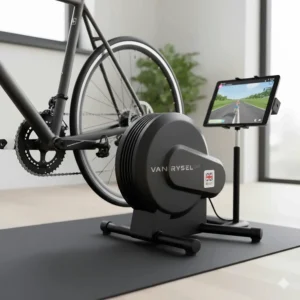
Understanding Smart Trainer Technology: Direct Drive vs Wheel-On
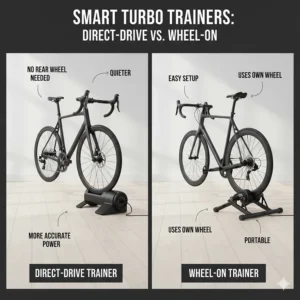
The fundamental decision when shopping for a smart turbo trainer for Zwift UK under £300 centres on drive system. Let’s demystify the differences, because understanding this dramatically affects your satisfaction level.
Direct-Drive Trainers
Direct-drive systems replace your rear wheel entirely—you remove it and mount the bike’s freehub directly onto the trainer. Think of it as temporarily converting your road bike into a stationary bike. The Van Rysel D100 exemplifies this technology at budget pricing.
Advantages of Direct Drive:
- Whisper-quiet operation (typically 55-65dB)
- No tyre wear whatsoever
- Better power accuracy (closer to ±2-3%)
- More realistic road feel
- Stable during sprint efforts
Disadvantages:
- Generally more expensive
- Requires cassette compatibility considerations
- Heavier and less portable
According to British Cycling’s training guidelines, direct-drive trainers provide measurably more consistent power delivery, which matters for structured training programmes. However, at the sub-£300 price point, only the Van Rysel D100 offers this technology.
Wheel-On Trainers
Wheel-on systems clamp your bike in place whilst a roller presses against your rear tyre. Your existing wheel stays mounted—you simply ride as normal whilst the roller provides resistance. The Tacx Flow Smart, Wahoo Kickr Snap, and Elite options all use this approach.
Advantages of Wheel-On:
- Lower price points
- Quick setup (literally 30 seconds)
- Highly portable
- Works with any bike instantly
Disadvantages:
- Tyre wear (budget for specific trainer tyres)
- Noisier operation (65-75dB)
- Requires periodic calibration
- Less stable during hard efforts
For cheap Zwift setup beginner scenarios, wheel-on trainers make tremendous sense. You avoid cassette compatibility headaches, setup is foolproof, and if you decide indoor training isn’t for you, resale values remain decent.
Power Accuracy: How Much Should You Care?
Every trainer manufacturer quotes power accuracy specs—typically ranging from ±1% to ±10%. But here’s the crucial question: how much does this actually matter for your training?
For Zwift Racing and Competition
If you’re competing in Zwift races or following structured trainer road compatibility workouts, accuracy becomes significant. Racing with a trainer reading 10% low gives unfair advantages; conversely, one reading high makes targets frustratingly difficult.
Recommended minimum: ±3-5% accuracy
For General Fitness and Casual Riding
For zone 2 base building, social group rides, or simply enjoying Watopia’s scenery, absolute accuracy matters far less than consistency. If your trainer consistently reads 10W high, you can simply adjust targets accordingly.
Acceptable range: ±5-10% accuracy
Research from Loughborough University’s Sports Technology Institute demonstrates that training adaptations correlate more strongly with consistent effort than absolute power numbers. Translation? A less accurate but consistent trainer often delivers better results than an accurate but temperamental one.
Calibration Tips for UK Riders
Temperature significantly affects magnetic and fluid trainers. UK garages and sheds experience wild temperature swings—a trainer calibrated at 18°C will read differently at 8°C. Smart solutions:
- Calibrate before each ride (takes 60 seconds)
- Use PowerMatch if you own a power meter
- Train in temperature-controlled spaces when possible
- Accept ±5-10% variance as normal for budget kit
Gradient Simulation: Watts vs Percentage
Maximum gradient simulation varies wildly across budget trainers—from 6% (Van Rysel D100, Tacx Flow) to 20% (Saris M2). Understanding what these numbers actually mean prevents disappointment.
What Different Gradients Feel Like
6% Simulation:
- Equivalent to moderate climbs (e.g., Box Hill’s steepest sections)
- Adequate for 90% of Zwift routes
- Default trainer difficulty at 50% means you experience 12% in-game
10-12% Simulation:
- Covers serious climbs (e.g., Alpe du Zwift at default difficulty)
- Suitable for proper hill training
- Necessary for realistic climbing simulation
15-20% Simulation:
- Extreme gradient capability
- Only essential for specific hill training
- Overkill for most recreational riders
Here’s the reality check: Zwift’s trainer difficulty slider fundamentally changes this equation. At 50% difficulty (the default), a 12% in-game gradient applies only 6% resistance. Most riders never touch this slider, meaning even 6% trainers handle Zwift’s toughest climbs adequately.
According to data from Zwift Insider, approximately 73% of Zwift users never adjust trainer difficulty from default settings, meaning gradient simulation matters less than manufacturers suggest.
Connectivity Essentials: ANT+ vs Bluetooth
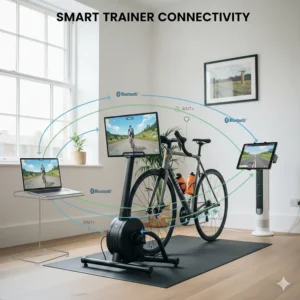
Both ANT+ and Bluetooth enable your trainer to communicate with Zwift, but understanding their differences prevents frustrating connectivity issues—particularly common in UK homes with thick walls.
ANT+ Advantages
- More stable connection through walls
- Supports multiple simultaneous devices
- Standard protocol across cycling tech
Best for: PC users, multi-device setups, dedicated pain caves
Bluetooth Advantages
- Native iOS/Apple TV support
- No dongle required for most devices
- Simpler initial pairing
Best for: Apple device users, minimal tech hassle, simple setups
Top UK Setup Recommendation: Apple TV 4K (£125-£150) + Bluetooth trainer = foolproof Zwift experience. Why? Apple TV’s powerful processor handles Zwift’s graphics smoothly, Bluetooth pairing is literally tap-and-go, and you’re using your telly rather than squinting at a laptop screen.
For PC users, invest in a quality ANT+ dongle (£15-£25) and position it close to the trainer using a USB extension cable. This simple £5 cable solves 90% of connectivity headaches.
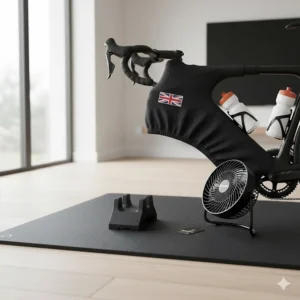
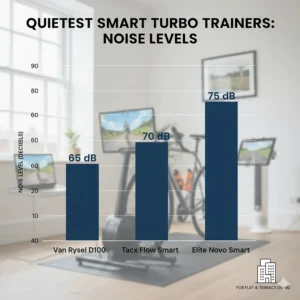
Noise Levels: Keeping the Peace with Neighbours
Living in UK terraced houses, flats, or semi-detached properties makes noise a genuine concern. Here’s what decibel ratings actually mean in practical terms:
Noise Level Reference Guide
55-60dB (Van Rysel D100, Tacx Neo):
- Comparable to normal conversation
- Barely audible through walls
- Acceptable for flat living
65-70dB (Tacx Flow, Elite Tuo):
- Similar to TV at moderate volume
- Noticeable but not intrusive
- Fine for houses, questionable for thin-walled flats
70-75dB (Wahoo Snap, Elite Novo at high power):
- Equivalent to washing machine spin cycle
- Will be heard through walls
- Requires consideration of training times
75dB+ (Budget trainers during sprints):
- Vacuum cleaner level
- Neighbours will definitely hear
- Plan training accordingly
UK-Specific Noise Reduction Strategies
Training Mats: Premium options like the Wahoo Kickr Mat (£50-£70) genuinely reduce vibration transmission. Budget alternative? Yoga mats from Amazon (£15-£25) work surprisingly well when doubled up.
Trainer-Specific Tyres: Continental Hometrainer (£25-£35) or Tacx trainer tyres (£20-£30) reduce noise by 3-5dB compared to regular road tyres. Worth every penny for regular indoor riders.
Strategic Timing: UK noise regulations typically restrict “unreasonable noise” between 11pm-7am. Schedule hard sessions for mid-morning or early evening to maintain neighbourly relations.
Benefits vs Traditional Alternatives
| Feature | Smart Trainer | Basic Trainer + Sensors | Rollers |
|---|---|---|---|
| Automatic resistance | ✅ Yes | ❌ No | ❌ No |
| Zwift compatibility | ✅ Native | ⚠️ With sensors | ⚠️ With sensors |
| Power measurement | ✅ Built-in | ❌ Requires power meter | ❌ Requires power meter |
| Setup time | 2-3 minutes | 5-10 minutes | 1-2 minutes |
| Storage space | Moderate | Moderate | Minimal |
| Bike attachment | Secure | Secure | Balance required |
| Road feel | Good-Excellent | Basic | Excellent |
| Price (under £300) | ✅ Available | ✅ Cheaper | ✅ Available |
Smart trainers dominate for Zwift-specific use due to native ERG mode and automatic resistance
Setting Up Your First Smart Trainer: Step-by-Step UK Guide
What You Actually Need (Beyond the Trainer)
Essential Items:
- Trainer itself (obviously!)
- Front wheel riser block (£10-£25, often included)
- Training mat (£15-£50)
- Fan (absolutely critical—£25-£100)
Device Options:
- Apple TV 4K (£125-£150) – easiest option
- PC/laptop – most flexible
- iPad/tablet (£200+) – portable solution
- Android phone (varies) – budget-friendly
Zwift Subscription:
- £12.99/month or £129.99/year
- First month often free with trainer purchases
- Essential for full smart trainer functionality
Physical Setup Process
Step 1: Location Selection Choose a well-ventilated space with solid flooring. UK carpets work but add instability—wooden or concrete floors are ideal. Allow 2 metres square minimum space.
Step 2: Trainer Assembly Most budget trainers arrive partially assembled. Expect 10-15 minutes with basic tools:
- Unfold/extend legs (click into place)
- Attach quick-release skewer if wheel-on
- Level using adjustable feet
- Position front wheel riser to match rear axle height
Step 3: Bike Mounting Wheel-on trainers: Simply place rear wheel in roller, tighten clamp, ensure proper roller pressure.
Direct-drive: Remove rear wheel, install bike onto trainer’s freehub (check cassette compatibility first!).
Step 4: Digital Connection Power on trainer → Open Zwift app → Select “Pair” → Choose your trainer from Controllable Trainer list → Spin pedals to wake trainer → Confirm connection.
UK-Specific Tip: If using ANT+ with a PC, position the dongle within 2 metres of the trainer using a USB extension cable. UK homes’ thick walls interfere with ANT+ signals more than modern US construction.
Calibration Requirements
Wheel-On Trainers (Critical):
- Warm up trainer for 10 minutes
- Open manufacturer app (Tacx Utility, Wahoo Fitness, Elite My E-Training)
- Follow calibration/spindown protocol
- Record baseline number for future reference
Direct-Drive Trainers: Generally pre-calibrated from factory. Annual recalibration recommended but not essential for recreational use.
Maximising Your Budget: What to Prioritise
When shopping for a smart turbo trainer for Zwift UK under £300, strategic compromises determine long-term satisfaction. Here’s where to allocate limited funds:
Spend More On:
1. The Trainer Itself (obviously!) – Aim for £200-£280 range Buying the cheapest £100 “smart” trainer invariably disappoints. Stretch to the £200+ bracket where genuine quality emerges.
2. A Proper Fan – Budget £40-£100 UK riders underestimate cooling needs. Even February garages get sweltering during intervals. A powerful fan transforms the experience.
3. Training Mat – Budget £20-£50 Protects floors, reduces noise, prevents trainer migration. Not glamorous but genuinely valuable.
Save Money On:
1. Front Wheel Blocks – DIY Options Stack books wrapped in towels. Seriously. Works perfectly and costs nothing.
2. Initial Zwift Subscription Many trainers include 1-3 months free. Don’t pay until necessary.
3. Cycling Computer Your phone/tablet runs Zwift perfectly. Dedicated bike computers add nothing.
UK Retailer Strategies
Best Times to Buy:
- January sales (post-Christmas cycling gift returns)
- Black Friday/Cyber Monday (November)
- March-April (retailers clearing winter stock)
Recommended UK Retailers:
- Decathlon: Van Rysel D100, competitive pricing, excellent returns policy
- Halfords: Frequent 15-20% off sales, Cycle2Work scheme compatible
- Evans Cycles: Price matching, knowledgeable staff
- Amazon UK: Convenience, quick delivery, sometimes cheaper
- Wiggle/Chain Reaction: Occasional clearance bargains
Cycle to Work Scheme: If employed, this UK tax-break scheme effectively discounts trainers by 25-39% depending on your tax bracket. A £300 trainer costs approximately £200 after savings—absolutely worth investigating through your employer.
Common UK Beginner Mistakes to Avoid
1. Underestimating Space Requirements
A compact trainer still needs 2m × 2m clearance. Factor in handlebar width, getting on/off the bike, and fan placement. UK spare bedrooms often prove tighter than anticipated.
2. Ignoring Ventilation
Closed UK rooms become oppressive saunas rapidly. Crack windows even in winter, or budget for powerful ventilation. Overheating ruins sessions faster than poor equipment.
3. Skipping Calibration
“It’ll be fine out of the box” thinking leads to wildly inaccurate power numbers. Spend 5 minutes calibrating—it matters.
4. Wrong Tyre Pressure
Road tyres need lower pressure (80-90 PSI) on trainers compared to outdoor riding (100-110 PSI). Over-inflated tyres slip and wear faster.
5. Neglecting Maintenance
Wheel-on trainers require periodic roller cleaning (every 5-10 hours) and tyre replacement (every 300-500 hours). Direct-drive units need annual belt checks. Budget for £30-£50 annual maintenance.
6. Assuming Cheap = Adequate
£80 Amazon “smart trainers” aren’t. They’re basic magnetic trainers requiring separate sensors. True smart trainers start around £180-£200 minimum.
Accessories That Actually Matter
Essential Tier (Buy Immediately)
Quality Fan (£40-£100):
- Lasko 20″ High Velocity (£50-£70): Powerful, adjustable, brilliant value
- Wahoo Kickr Headwind (£100-£250): Auto-adjusts to effort, expensive but transformative
- Basic Screwfix fan (£25-£40): Adequate for budget builds
Training Mat (£15-£50):
- Decathlon own-brand (£15-£25): Thin but functional
- Elite Training Mat (£30-£40): Purpose-built, good noise reduction
- Wahoo Kickr Mat (£50-£70): Premium option, excellent protection
Towel (£5-£15): Sweat protection cannot be overstated. Perspiration corrodes bike frames rapidly indoors. Multiple cheap gym towels work perfectly.
Nice-to-Have Tier (Consider After 3-6 Months)
Trainer Tyre (£20-£35): Continental HomeTrainer or Tacx trainer tyre dramatically reduces noise and lasts 10× longer than road tyres.
Heart Rate Monitor (£30-£80): Zwift’s training plans rely heavily on heart rate zones. Chest straps (more accurate) or optical wrist monitors both work.
Rocker Plate (DIY £50-£200 / Commercial £200-£400): Allows subtle bike movement, reducing pressure points during long rides. Brilliant but genuinely optional.
Luxury Tier (6-12+ Months In)
Wahoo Kickr Climb (£500+): Raises/lowers front end to match gradient. Utterly unnecessary but genuinely immersive.
Dedicated Zwift Bike (£1,000+): Removes need for mounting/unmounting. Only sensible if training 5+ times weekly.
Price Range & Value Analysis
| Budget Range | What You Get | Ideal For |
|---|---|---|
| £180-£220 | Basic smart connectivity, acceptable accuracy, wheel-on only | Absolute beginners testing waters |
| £220-£270 | Improved build quality, better accuracy, quieter operation | Committed beginners, regular use |
| £270-£300 | Direct-drive options emerge, premium features, exceptional value | Serious enthusiasts on budgets |
| £300-£400 | Premium build, better specs, improved longevity | Regular trainers, racing ambitions |
Sweet spot for most UK buyers: £220-£280 bracket
Frequently Asked Questions
❓ Can I use a smart turbo trainer for Zwift UK under £300 without a subscription?
❓ How long do budget smart trainers last with regular use?
❓ Do smart trainers work with mountain bikes and other bike types?
❓ Can I train for real-world cycling events using a smart trainer?
❓ What's the difference between Zwift Ready trainers and regular smart trainers?
Conclusion: Your Perfect Trainer Awaits
Choosing the right smart turbo trainer for Zwift UK under £300 fundamentally depends on your specific circumstances. Are you tentatively exploring indoor cycling, unsure about long-term commitment? The Elite Novo Smart at £180-£220 provides low-risk entry. Confident you’ll become a regular Zwifter but working with strict budgets? The Tacx Flow Smart delivers exceptional all-round value at £210-£270.
For those seeking future-proof investment within the £300 ceiling, the Van Rysel D100 represents genuine innovation—direct-drive technology and Zwift Cog at a price that would’ve seemed impossible just two years ago. Yes, its 600W limit and temperamental cadence readings aren’t perfect, but they’re acceptable compromises for genuinely transformative value.
The British cycling community has never enjoyed better access to quality indoor training equipment. Where £300 once bought barely-functional magnetic trainers requiring elaborate sensor setups, today’s budget delivers authentic smart connectivity, acceptable power measurement, and seamless app integration. Manufacturers competing aggressively for market share directly benefits UK consumers—embrace it.
Whatever trainer you choose, remember this: the best indoor trainer is the one you’ll actually use. A £200 trainer ridden four times weekly delivers better fitness returns than a £1,000 unit gathering dust. Start conservatively, develop the habit, then upgrade if enthusiasm justifies investment.
Now stop overthinking and start pedalling. Watopia awaits, and those KOM jerseys won’t win themselves. Your winter fitness transformation begins today—whether you’re pushing 600 watts or 60, the journey starts with that first virtual pedal stroke. See you on the roads of Zwift!
Recommended for You
- 7 Best Spin Bike Compatible with Zwift UK Under £500 (2026)
- 7 Best Budget Spin Bike UK Under £400 | 2026 Expert Guide
- 7 Best Recumbent Exercise Bike for Knee Rehabilitation 2026 UK
Disclaimer: This article contains affiliate links. If you purchase products through these links, we may earn a small commission at no additional cost to you. Prices shown are approximate and may vary. All products have been researched through reputable UK retailers including Amazon.co.uk, Decathlon UK, Halfords, and Evans Cycles.
✨ Found this helpful? Share it with your mates! 💬🤗
