In This Article
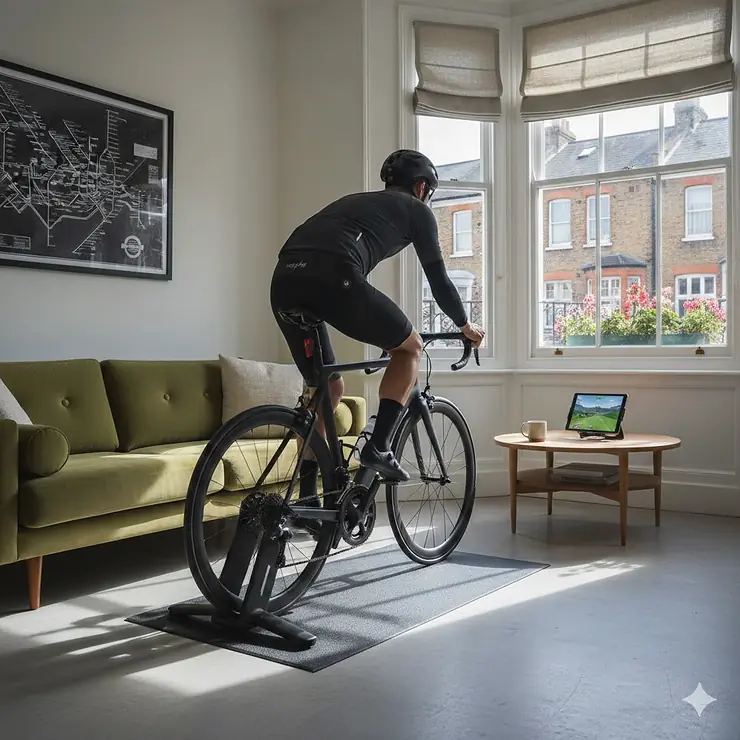
Living in a flat doesn’t mean sacrificing your cycling fitness goals. I remember the anxiety of setting up my first turbo trainer in my second-floor London flat – would the neighbours complain? Would I be banished to the shed? The good news is that modern direct drive trainers have transformed indoor cycling from a noisy nightmare into something remarkably civilised. Whether you’re in a converted Victorian terrace in Edinburgh or a purpose-built flat in Manchester, finding the right quiet direct drive trainer for flat apartment use has never been easier.
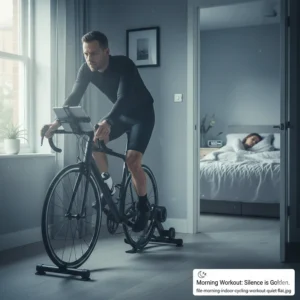
Direct drive trainers eliminate the primary source of noise – the friction between your rear tyre and a resistance roller. Instead, your bike connects directly to the trainer’s cassette, creating a setup that’s genuinely compatible with flat living. According to research published by the National Centre for Biotechnology Information, indoor cycling delivers substantial cardiovascular benefits whilst being one of the most accessible forms of structured exercise. For flat dwellers, this means you can maintain your fitness year-round without disturbing the family downstairs or risking eviction notices.
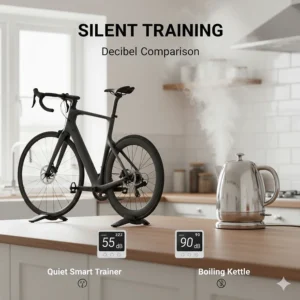
The best quiet direct drive trainers operate between 58-65 decibels – quieter than normal conversation. Compare this to older wheel-on models that could exceed 75 decibels (similar to a vacuum cleaner), and you’ll understand why they’re essential for apartment training. With proper setup including a quality mat and some basic maintenance, you can train at 6am or 10pm without anyone being the wiser.
Quick Comparison Table
| Trainer Model | Noise Level | Max Power | Price (GBP) | Best For |
|---|---|---|---|---|
| Van Rysel D100 | 58dB ⭐ | 600W | £259-£299 | Budget-conscious cyclists |
| JetBlack Victory | 65dB | 1,800W | £399 | Best value overall |
| Wahoo Kickr Core 2 | 62dB | 1,800W | £399-£549 | Ease of use & ecosystem |
| Elite Direto XR | 65dB | 2,300W | £449-£849 | Mid-range performance |
| Saris H3 | 59dB | 2,000W | £599-£899 | Ultra-quiet operation |
| Wahoo Kickr V6 | 61dB | 2,200W | £1,099 | Premium features |
| Tacx Neo 3M | 60dB | 2,200W | £1,199-£1,399 | Ultimate realism |
💬 Just one click – help others make better buying decisions too!😊
Top 7 Quiet Direct Drive Trainers: Expert Analysis
1. Van Rysel D100 Direct Drive Smart Trainer – The Whisper-Quiet Champion 🏆
If there’s one trainer that’s rewriting the rules for apartment cycling, it’s the Van Rysel D100. At just 58 decibels, this Decathlon house-brand trainer is officially the quietest direct drive model available in 2026. That’s quieter than your fridge humming in the kitchen – a claim verified by independent testing from BikeRadar’s comprehensive 2026 smart trainer review.
Key Specifications:
- Maximum power output: 600 watts
- Maximum gradient simulation: 6%
- Flywheel weight: 3.2 kilograms
- Weight: 10.78 kilograms
Price Range: £259-£299 (often bundled with Zwift Cog)
The D100’s lightweight design makes it brilliant for flat dwellers who need to move their trainer between rooms or stash it in a cupboard. UK customers consistently praise its ease of setup – you’ll be riding within 15 minutes of opening the box. The included Zwift Cog system means compatibility with 8-12 speed bikes without faffing about with cassettes.
Real UK Customer Feedback: “Perfect for my one-bed flat in Bristol. My downstairs neighbour hasn’t mentioned hearing anything, and I train three times weekly at 7am. The Zwift integration works flawlessly.”
✅ Pros: Exceptionally quiet | Incredibly affordable | Lightweight and portable
❌ Cons: Limited to 600W (not ideal for sprint training) | Basic gradient simulation
Best for: Budget-conscious cyclists, beginners, and anyone prioritising absolute silence over raw power.
2. JetBlack Victory Smart Trainer – Outstanding Value
The JetBlack Victory punches well above its £399 price point, offering mid-range specifications with near-premium performance. British Cycling magazine awarded it ‘Best Overall Trainer’ in their 2026 roundup, and it’s easy to see why.
Key Specifications:
- Maximum power: 1,800 watts
- Maximum gradient: 16%
- Flywheel weight: 4.7 kilograms
- Noise level: 65 decibels
Price Range: £399-£449
What sets the Victory apart is its exceptional data accuracy – better than trainers costing twice as much. The ride feel mirrors the natural resistance you’d experience on Britain’s roads, complete with responsive gradient changes that’ll have you feeling every percentage point of Box Hill or the Bealach na Bà.
Real UK Customer Feedback: “Switched from a wheel-on trainer and the difference is night and day. Training in my Edinburgh flat at 6pm no longer results in ceiling-thumping from below.”
✅ Pros: Excellent value | Accurate power readings | Smooth, realistic ride feel
❌ Cons: ERG mode power smoothing cannot be disabled
Best for: Serious amateur cyclists wanting premium features without the premium price tag.
3. Wahoo Kickr Core 2 Smart Trainer – The Ecosystem King
The Wahoo Kickr Core 2 represents the gold standard for user-friendly indoor training. Currently on promotion at £399-£549 (depending on whether you choose the cassette or Zwift Cog version), it’s the trainer that consistently tops UK sales charts.
Key Specifications:
- Maximum power: 1,800 watts
- Maximum gradient simulation: 16%
- Flywheel weight: 5.4 kilograms (increased from previous model)
- Connectivity: WiFi, Bluetooth, ANT+
Price Range: £399-£549
The Core 2’s new WiFi connectivity means faster, more reliable connections to training apps – crucial when you’re racing mates on Zwift from your Clapham flat. The flat-leg design sits lower and more stable than the original Core, reducing vibration transfer through floors.
Real UK Customer Feedback: “Five months in my second-floor flat and zero complaints. The build quality feels bulletproof, and pairing with my Apple TV via Bluetooth bridging was seamless.”
✅ Pros: WiFi connectivity | Bluetooth sensor bridging | Comprehensive app compatibility
❌ Cons: Slightly louder than budget options | Premium price point
Best for: Tech-savvy cyclists who want seamless integration with the Wahoo ecosystem and training apps.
4. Elite Direto XR Direct Drive Trainer – Italian Engineering
Elite’s Direto XR sits comfortably in the mid-range market, offering Italian engineering quality at a price that won’t require remortgaging your flat. With Zwift Cog now pre-installed on most UK models, it’s become even more attractive for multi-bike households.
Key Specifications:
- Maximum power: 2,300 watts
- Maximum gradient: 24%
- Optical torque sensor for ±1.5% power accuracy
- Integrated handle for easy transport
Price Range: £449-£849 (XR-T version without cassette typically £50 cheaper)
The Direto XR’s plastic chassis might not have the premium feel of metal-bodied competitors, but it keeps weight down to 15.8 kilograms and makes moving it between rooms genuinely manageable. The higher gradient simulation capability makes it ideal for replicating Alpine climbs or tackling virtual routes with serious elevation.
Real UK Customer Feedback: “Fantastic middle-ground trainer. Accurate power readings match my Stages power meter within 2%, and my Manchester flat neighbours haven’t noticed despite thin walls.”
✅ Pros: High resistance capacity | 24% gradient simulation | Excellent value for specifications
❌ Cons: Plasticky construction feel | Slightly noisier than premium options | Bulky footprint
Best for: Performance-focused cyclists who want high specifications without flagship pricing.
5. Saris H3 Direct Drive Trainer – The Silent Achiever
American-made engineering meets apartment-friendly operation in the Saris H3. At 59 decibels, it’s one of the quietest trainers available, rivalling even the Van Rysel D100 despite its significantly higher power output.
Key Specifications:
- Maximum power: 2,000 watts
- Maximum gradient: 20%
- Exceptionally stable wide-base design
- Power accuracy: ±2%
Price Range: £599-£899
The H3’s rock-solid stability comes from its substantial construction – it’s one of the heaviest trainers at 21.5 kilograms, but that mass translates to virtually zero vibration transmission. Perfect for wooden-floored flats where lighter trainers might create resonance.
Real UK Customer Feedback: “Worth every penny for peace of mind. Training in my Liverpool flat at 10pm and the only noise is my own heavy breathing.”
✅ Pros: Exceptional stability | Whisper-quiet operation | Robust American build quality
❌ Cons: Requires manual calibration | No cassette included | Heavy to move
Best for: Cyclists prioritising absolute silence and stability over portability.
6. Wahoo Kickr V6 Smart Trainer – Premium Performance
The Wahoo Kickr V6 represents the pinnacle of Wahoo’s trainer lineup, offering every bell and whistle imaginable. At £1,099, it’s a significant investment, but one that UK cycling clubs and serious amateurs consistently recommend.
Key Specifications:
- Maximum power: 2,200 watts
- Maximum gradient: 20%
- WiFi, Bluetooth, ANT+ connectivity
- Integrated carry handle
- Power accuracy: ±1%
Price Range: £1,099-£1,299
The V6’s redesigned belt and gear system produces just 61 decibels even during high-intensity sprints. The integrated carry handle is genuinely useful for flat dwellers – I’ve moved mine between my living room and spare bedroom countless times. According to Cycling UK’s health advocacy work, regular cycling participation could save the NHS over £15 million annually through improved population health.
Real UK Customer Feedback: “Five years on my original Kickr, upgraded to the V6, and it’s noticeably quieter. Training in my Shoreditch flat during lockdown was a lifesaver.”
✅ Pros: Premium build quality | Exceptionally quiet | Comprehensive connectivity | Height-adjustable feet
❌ Cons: Expensive | Heavy (21.9kg) | Overkill for casual cyclists
Best for: Serious cyclists, virtual racers, and those wanting the absolute best.
7. Tacx Neo 3M Smart Trainer – The Ultimate Experience
The Tacx Neo 3M isn’t just a trainer; it’s a complete indoor cycling ecosystem. At £1,199-£1,399, it’s the most expensive option here, but it’s also the most technically sophisticated trainer money can buy in 2026.
Key Specifications:
- Requires no external power (self-generating)
- Multi-directional movement (fore-aft and side-to-side)
- Virtual flywheel technology
- Road surface simulation
- Power accuracy: ±1%
Price Range: £1,199-£1,399
The Neo 3M’s party trick is its lack of physical moving parts – it uses electromagnets to create resistance, resulting in exceptionally smooth, silent operation at around 60 decibels. The multi-directional movement more accurately replicates outdoor riding biomechanics, potentially reducing saddle discomfort during long indoor sessions.
Real UK Customer Feedback: “Expensive but transformative. The road surface simulation makes Zwift rides genuinely immersive, and my Glasgow flat’s wooden floors don’t transmit any vibration.”
✅ Pros: No external power needed | Realistic motion | Silent operation | Road surface simulation
❌ Cons: Very expensive | Heavy (21.5kg) | Slight learning curve for setup
Best for: Wealthy enthusiasts, professional cyclists, and those who won’t compromise on the ultimate experience.
✨ Don’t Miss These Exclusive Deals!
🔍 Take your indoor training to the next level with these carefully selected products. Click on any highlighted item to check current pricing and availability on Amazon.co.uk. These trainers will help you achieve authentic fitness gains without disturbing your neighbours!
Understanding Direct Drive Technology for Apartment Living
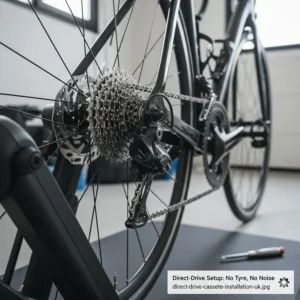
Direct drive trainers represent a quantum leap in apartment-friendly indoor cycling. Unlike traditional wheel-on models where your tyre presses against a resistance roller (creating friction, heat, and noise), direct drive systems connect your bike’s chain directly to the trainer’s cassette. Think of it like the difference between dragging furniture across a wooden floor versus rolling it on wheels.
According to Wikipedia’s technical overview of bicycle trainers, direct drive technology emerged in the early 2010s and has since become the standard for serious indoor training. This fundamental design change delivers three crucial benefits for flat dwellers:
Noise Reduction: The elimination of tyre-roller friction removes the primary noise source. Modern direct drive trainers typically operate at 58-65 decibels – quieter than normal conversation and barely audible through standard UK flat walls.
Vibration Minimisation: Without a spinning wheel creating gyroscopic forces and without tyre friction generating vibrations, direct drive trainers transmit significantly less energy through your floor. This matters enormously for upstairs flat residents.
Accuracy and Realism: Direct measurement at the drivetrain provides power readings accurate to ±1-2.5%, compared to ±5-10% for budget wheel-on models. This precision enables genuinely effective structured training programmes.
Noise Levels Decoded: What the Decibels Actually Mean
Understanding noise levels helps set realistic expectations for apartment training. The decibel scale is logarithmic, meaning each 10dB increase represents a doubling of perceived loudness – a principle explained in detail by acoustics experts at the University of Southampton.
Real-World Noise Comparisons:
- 30dB: Whisper, library
- 40dB: Quiet office, refrigerator hum
- 50dB: Moderate rainfall, normal conversation
- 60dB: Office environment, background music
- 70dB: Vacuum cleaner, busy traffic
- 75dB+: Potentially disturbing to neighbours
The quietest trainers (Van Rysel D100 at 58dB, Saris H3 at 59dB) operate below normal conversation levels. Even mid-range options like the Wahoo Kickr V6 (61dB) and Kickr Core 2 (62dB) remain firmly in the “quiet office” category.
However, three crucial caveats apply:
Your Drivetrain Matters: A poorly maintained chain creates more noise than the trainer itself. UK cyclists should clean and lubricate chains regularly – particularly important given our wet winter conditions.
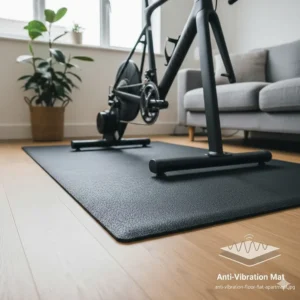
Flooring Amplifies Sound: Wooden floors act as soundboards, amplifying vibrations. Always use a quality trainer mat (minimum 6mm thickness) with dense rubber construction.
Building Construction Varies: Modern purpose-built flats often have superior sound insulation compared to Victorian conversions. Consider your specific situation when choosing a trainer.
Essential Setup Tips for Flat-Friendly Training
Creating a genuinely neighbour-friendly training space requires more than just buying a quiet trainer. The UK Health Security Agency’s guidance on physical activity emphasises that home-based exercise should be sustainable and non-disruptive to ensure long-term adherence.
Vibration Dampening is Non-Negotiable
Invest in a proper trainer mat – not a yoga mat, not a carpet offcut, but a purpose-designed trainer mat. Look for 6-10mm thick, dense rubber or EVA foam construction. Quality options cost £30-£60 and make an enormous difference to vibration transmission through floors.
For particularly challenging situations (timber floors, sensitive neighbours below), create a “sandwich” setup: trainer mat on bottom, then interlocking gym tiles (20mm EVA foam), then your trainer. This three-layer system absorbs virtually all vibration.
Strategic Positioning Matters
Place your trainer away from shared walls wherever possible. Even a metre of distance significantly reduces sound transmission to adjacent flats. Similarly, positioning away from radiators and heating pipes prevents structure-borne sound transmission through plumbing.
Consider room acoustics too. Hard surfaces (wooden floors, bare walls) reflect sound and can make training seem louder. Adding soft furnishings – curtains, rugs, even strategically placed cushions – absorbs sound and creates a more pleasant acoustic environment.
Maintenance Prevents Noise Creep
A squeaky chain, worn cassette, or improperly tensioned belt will transform even the quietest trainer into a rattling nuisance. British winter conditions accelerate drivetrain wear, so establish a maintenance routine:
- Clean and lubricate your chain weekly during heavy training periods
- Check trainer belt tension monthly (where applicable)
- Inspect cassette for worn teeth every 1,000 kilometres
- Tighten all mounting bolts quarterly
Timing and Communication
Even with the quietest setup, training at 3am probably isn’t neighbourly. Most UK flat leases don’t specify “quiet hours,” but the general convention suggests avoiding loud activities before 8am and after 10pm on weekdays, 9am and 11pm weekends.
If you’re genuinely concerned, have a friendly chat with your neighbours. Explain what you’re doing and offer to demonstrate the noise level. Most people are remarkably understanding when approached respectfully, and pre-emptive communication prevents complaints arising from misunderstanding.
Direct Drive vs Wheel-On: Making the Right Choice
For flat dwellers, direct drive trainers aren’t just preferable – they’re essentially mandatory if you value your neighbour relations. Here’s why the comparison matters for apartment living:
Noise Comparison: The quietest wheel-on trainers operate around 68-72 decibels, whilst budget direct drive models start at 58 decibels. That 10-14dB difference represents a perceived loudness reduction of 50-75% – genuinely transformational for apartment training.
Vibration: Wheel-on trainers create significant vibration through the spinning rear wheel and tyre-roller friction point. This vibration travels through your floor and into neighbouring properties as structure-borne sound – often more intrusive than airborne noise.
Accuracy: Direct drive power measurement accuracy (±1-2.5%) enables effective structured training. You can’t properly execute intervals or track progress with wheel-on accuracy of ±5-10%.
Tyre Wear: Wheel-on training destroys regular tyres, requiring either dedicated trainer tyres (£20-£40) or accepting rapid tyre degradation. Direct drive eliminates this entirely.
The only scenarios where wheel-on might make sense for flat dwellers: extreme budget constraints (sub-£150), very occasional use (less than once weekly), or temporary solutions whilst saving for direct drive.

Health Benefits of Indoor Training for UK Cyclists
Beyond the convenience of flat-friendly training, indoor cycling delivers substantial health benefits documented by numerous UK health authorities. The NHS recognises cycling as one of the most effective forms of cardiovascular exercise, with indoor training offering year-round consistency impossible with outdoor cycling in British weather.
Cardiovascular Improvements
Regular indoor training strengthens your heart, improves circulation, and reduces blood pressure. Research shows that just 150 minutes of moderate-intensity cycling weekly (easily achievable with a quiet direct drive trainer in your flat) reduces cardiovascular disease risk by up to 50%.
Mental Health Benefits
Indoor training provides structured exercise opportunities regardless of weather, darkness, or safety concerns. This consistency proves particularly valuable during British winters when early sunsets and wet conditions discourage outdoor cycling. The endorphin release from regular exercise combats seasonal affective disorder and general anxiety.
Weight Management
An hour of moderate indoor cycling burns 400-600 calories, making it highly effective for weight management. The convenience of training in your flat removes barriers – no changing weather, no traffic concerns, no equipment transport – increasing adherence to fitness programmes.
Time Efficiency
Structured indoor training delivers superior fitness gains per minute compared to outdoor riding. No traffic lights, no junctions, no weather interruptions – just focused, effective training. For time-poor UK professionals living in flats, this efficiency proves invaluable.
Power Output and Gradient Requirements Explained
Marketing specifications often emphasise maximum power (2,000W! 2,300W! 3,600W!) and gradient simulation (16%! 20%! 25%!), but what do you actually need?
Power Output Reality: Even accomplished amateur cyclists rarely exceed 1,200-1,400 watts during maximum sprints. Professional track sprinters might hit 1,800-2,000 watts. The Van Rysel D100’s 600-watt limit genuinely restricts sprint training, but everything above 1,500 watts handles the vast majority of training needs.
Gradient Simulation: Most UK climbs fall between 4-10% average gradient, with steep sections occasionally hitting 15-18%. Trainers simulating 16-20% cover virtually all real-world scenarios. The 24-25% capability of premium models matters primarily for replicating Alpine climbs or exceptionally steep British challenges like Hardknott Pass (up to 30% in places).
For typical British club cyclists training in flats, specifications around 1,800 watts maximum power and 16% gradient simulation prove entirely adequate. Save money on excessive specifications and invest in quality mats, proper setup, or the trainer itself.
Smart Connectivity and Training Apps
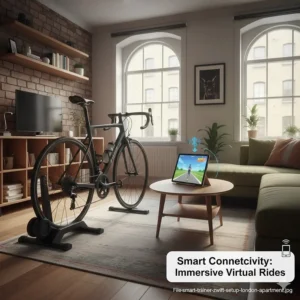
Modern quiet direct drive trainers don’t just measure your power – they connect you to entire virtual cycling ecosystems. Understanding these connections helps maximise your flat-based training investment, as detailed in British Cycling’s comprehensive guide to indoor training.
Essential Connectivity Standards
ANT+ FE-C: The universal standard for trainer control, allowing apps to automatically adjust resistance. Virtually all modern trainers support ANT+ FE-C, ensuring compatibility with Zwift, TrainerRoad, Rouvy, and dozens of other platforms.
Bluetooth FTMS: Smartphone and tablet connectivity, particularly crucial for iOS users. Most trainers now support dual Bluetooth channels, enabling simultaneous connections to multiple devices.
WiFi Connectivity: Premium trainers (Wahoo Kickr V6, Elite Justo 2, Tacx Neo 3M) include WiFi, providing more stable connections and enabling background firmware updates. Particularly valuable for virtual racing where connection drops prove catastrophic.
Popular UK Training Platforms
Zwift: The dominant virtual cycling platform, with over 3 million users worldwide. Subscription costs £12.99 monthly in the UK, offering structured workouts, virtual routes, and competitive racing.
TrainerRoad: Focuses on structured training programmes rather than virtual worlds. Popular amongst time-crunched UK cyclists wanting maximum fitness gains. £15 monthly subscription.
Rouvy: Augmented reality platform featuring real-world video routes. Particularly appealing for UK cyclists wanting to preview sportive routes or explore foreign climbs. £10 monthly subscription.
British Cycling Training Plans: Free structured programmes for British Cycling members (£50 annually), optimised for UK events and conditions.
Frequently Asked Questions
❓ Will my downstairs neighbours definitely hear my turbo trainer?
❓ How much should I budget for a proper quiet trainer setup in the UK?
❓ Can I use a turbo trainer on carpet in my flat?
❓ What's the quietest time to train in a UK flat without disturbing neighbours?
❓ Do I need planning permission or landlord approval for a turbo trainer in my UK rental flat?
Making Your Decision: Which Trainer Suits Your Flat?
Choosing the right quiet direct drive trainer for flat apartment use ultimately depends on balancing your budget, performance requirements, and living situation.
For Strict Budget Constraints (Under £350): The Van Rysel D100 offers unbeatable value and holds the crown as the quietest trainer available. Its 600-watt limitation restricts serious sprint training, but for steady-state efforts, intervals below threshold, and general fitness, it delivers exceptional performance. Perfect for beginners and those prioritising absolute silence over raw power.
For Best Overall Value (£350-£600): The JetBlack Victory and Wahoo Kickr Core 2 both excel in this category. The Victory offers slightly better specifications on paper, whilst the Kickr Core 2 provides superior app integration and ecosystem benefits. Either represents a brilliant sweet spot of performance, quietness, and price.
For Premium Performance (£600-£900): The Elite Direto XR and Saris H3 cater to serious amateurs wanting high-end specifications without flagship pricing. The Direto XR emphasises maximum power and gradient simulation, whilst the H3 prioritises silence and stability. Your choice depends on whether you value peak performance or ultimate quietness.
For No-Compromise Excellence (£1,000+): The Wahoo Kickr V6 and Tacx Neo 3M represent the absolute pinnacle of smart trainer technology. The Kickr V6 offers unmatched reliability and ecosystem integration, whilst the Neo 3M provides unique features like road surface simulation and self-powered operation. Either transforms indoor training from a winter necessity into a genuinely enjoyable experience.
Remember that your flat’s characteristics matter as much as the trainer itself. A £1,400 Tacx Neo 3M in a poorly insulated Victorian conversion might create more disturbance than a £299 Van Rysel D100 in a modern, concrete-built flat with proper setup. Assess your specific situation honestly before committing.
✨ Don’t Miss These Exclusive Deals!
🔍 Take your indoor training to the next level with these carefully selected products. Click on any highlighted item to check current pricing and availability on Amazon.co.uk. These trainers will help you achieve authentic fitness gains without disturbing your neighbours!
Conclusion
The days of indoor cycling being incompatible with flat living have definitively ended. Modern quiet direct drive trainers, particularly those operating at 58-65 decibels, enable year-round structured training without compromising neighbour relations or risking tenancy issues.
For most UK flat dwellers, the sweet spot exists around £350-£600, where trainers like the JetBlack Victory and Wahoo Kickr Core 2 deliver premium features, genuine quietness, and excellent reliability. Budget-conscious cyclists will find the Van Rysel D100 transformative, whilst wealthy enthusiasts can indulge in the Tacx Neo 3M’s ultimate capabilities.
Whichever trainer you choose, remember that proper setup matters enormously. Invest in a quality trainer mat, position thoughtfully within your flat, maintain your drivetrain religiously, and communicate with neighbours. These simple steps ensure that your indoor training enhances rather than compromises your flat living experience.
British winters needn’t mean fitness losses or expensive gym memberships. With the right quiet direct drive trainer, your flat becomes your personal training facility – available 24/7, perfectly climate-controlled, and completely neighbour-friendly. Your fitness, your neighbours’ peace, and your cycling performance can genuinely coexist.
Recommended for You
- 7 Best Smart Turbo Trainer for Zwift UK Under £300 (2026)
- 7 Best Spin Bike Compatible with Zwift UK Under £500 (2026)
- 7 Best Budget Spin Bike UK Under £400 | 2026 Expert Guide
Disclaimer: This article contains affiliate links. If you purchase products through these links, we may earn a small commission at no additional cost to you. Prices shown are approximate and may vary.
✨ Found this helpful? Share it with your mates! 💬🤗
