
In This Article
Setting up a proper home gym in Britain used to mean either splashing out thousands on commercial-grade kit or making do with wobbly second-hand equipment from the local buy-and-sell Facebook group. Thankfully, 2026 has brought us rather civilised options that won’t require remortgaging the house whilst still delivering the safety and stability you’d expect from a proper power rack for home gym training.
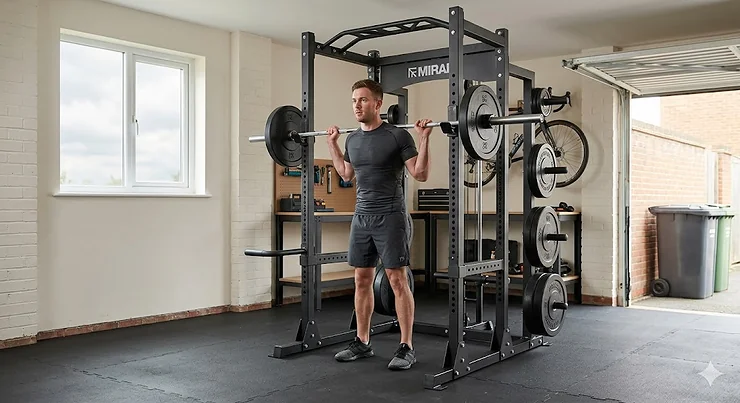
What most UK buyers overlook about power racks is that they’re not just oversized clothes horses for your garage—they’re the single most important safety investment for anyone lifting heavy without a spotter. The cage-style frame with adjustable safety bars means you can push your limits on squats and bench press without the nagging worry that a failed rep will send you to A&E. Whether you’re converting a spare bedroom in a Manchester terrace or kitting out a garage gym in Surrey, choosing the right power rack requires understanding what actually matters beyond the marketing photos.
This guide examines seven carefully selected power racks available on Amazon.co.uk, ranging from budget-friendly options around £200 to premium setups approaching £900. Each has been evaluated not just on specifications, but on real-world performance in typical British home environments—compact spaces, low garage ceilings, and the occasional bout of damp that makes proper British weather rather infamous. I’ve prioritised racks with genuine UK availability, UHMW-lined safety features to protect your barbell investment, and versatility for those of us without the luxury of a dedicated 50-square-metre gym space.
The NHS recommends adults perform muscle-strengthening activities on at least two days per week, which makes having safe, accessible strength training equipment at home rather important for maintaining long-term health.
Quick Comparison: Top Power Racks at a Glance
| Model | Height | Max Load | Price Range | Best For |
|---|---|---|---|---|
| Mirafit M200 | 220cm | Light commercial | £500-£600 | Serious home lifters |
| Strongway Multi-Gym | 209cm | 250-400kg | £300-£450 | Budget all-in-one |
| Mirafit M100 | 213cm | 250kg | £300-£400 | First-time buyers |
| GYM MASTER GM1 | 213cm | 250kg | £350-£500 | Mid-range value |
| SPORTNOW Cable Rack | 210cm | 300kg | £250-£400 | Cable workout fans |
| Yaheetech Adjustable | 114-179cm | 250kg | £150-£250 | Tight budgets/low ceilings |
| Mirafit M3 | 188-228cm | Commercial grade | £600-£900 | Premium choice |
💬 Just one click — help others make better buying decisions too! 😊
Top 7 Power Racks for Home Gym: Expert Analysis
1. Mirafit M200 Power Rack — The British Workhorse
The Mirafit M200 represents what happens when a UK manufacturer actually listens to British home gym owners rather than just importing American designs. At 220cm tall with a robust 60mm steel frame, this power cage delivers light commercial-grade performance whilst remaining sensible for garage installations.
The 60mm x 60mm tubing provides genuine stability—you’ll notice the difference immediately if you’re upgrading from a budget rack with thinner uprights. The UHMW-lined J-cups and safety spotters mean your barbell won’t get scratched to bits over time, which matters when you’ve invested £300+ in an Olympic bar. With compatibility for the full M200 attachment ecosystem, you can add everything from dip bars to landmine anchors as your training evolves. What most buyers miss about this model is the optional cable system that bolts on seamlessly, transforming it into a genuinely versatile training station without the bulk of integrated pulley systems.
UK customers consistently praise the straightforward assembly process—most report completing the build solo in under 90 minutes with basic tools. The black or orange powder-coat finish holds up well to British garage conditions, though some users in coastal areas note surface rust can appear on uncoated hardware after a year of damp winters. For around £550-£600, this sits in the sweet spot between budget racks that wobble under heavy loads and eye-wateringly expensive commercial units.
✅ 60mm commercial-grade steel frame provides exceptional stability
✅ UHMW liners on J-cups and spotters protect barbell finish
✅ Compatible with extensive M200 attachment range
❌ At 220cm, too tall for some UK garages with low ceilings
❌ Needs floor fixings for maximum stability (sold separately)
Price verdict: Around £550-£600 represents solid value for a rack you won’t outgrow. Available with free UK delivery on Amazon.co.uk for Prime members.
2. Strongway Multi-Gym Power Cage with Dual Pulley System
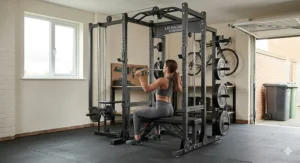
The Strongway Multi-Gym Power Cage answers the question: “Can I get a full home gym for under £400 without buying complete rubbish?” Surprisingly, the answer is rather yes. At 209-212cm tall (dimensions vary slightly between models), this all-in-one unit combines a solid power rack with an integrated dual pulley system, dip handles, and landmine attachment.
The dual cable pulley system supports both 25mm and 50mm Olympic weight plates up to 100kg load, which covers most home gym cable work—lat pulldowns, tricep extensions, rows, and face pulls all become viable without needing separate cable machines. The 250kg maximum barbell capacity sits comfortably above what most home lifters will ever load, even for squats. What you’re trading off for the £300-£450 price point is refinement—the pulleys aren’t as smooth as dedicated cable units, and UK reviewers note the cable routing can feel slightly awkward on certain exercises. But for someone converting a spare garage on a sensible budget, getting both a safe squat rack and functional cable station in one unit is genuinely clever.
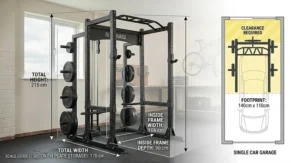
Assembly takes roughly 2-3 hours according to UK buyers, with most recommending a second person for the pulley system installation. The solid steel J-cups include safety locks, though they lack UHMW lining—consider adding barbell spotter pads if you’re particular about bar preservation. The 140cm depth means it demands more floor space than standalone racks, which matters in typical British garages that also house the lawn mower and Christmas decorations.
✅ Dual pulley system included at this price point is exceptional value
✅ All essential attachments included (dip handles, landmine, safety bars)
✅ 250kg capacity handles heavy compound lifts safely
❌ Pulley action not as smooth as dedicated cable machines
❌ Larger footprint (140cm depth) requires more garage space
Price verdict: In the £300-£450 range, this delivers more functionality per pound than almost anything on Amazon.co.uk. Check current pricing for the model that matches your ceiling height.
3. Mirafit M100 Power Rack — The Starter Special
The Mirafit M100 is Mirafit’s entry-level offering, and it’s precisely what a first power rack should be—honest, functional, and not trying to be something it isn’t. At 213cm tall (or 204cm if you mount the pull-up bar inverted), this 250kg-rated rack provides everything you need to squat and bench safely at home without the premium features that inflate prices.
The 17 adjustable height levels across the uprights give you proper precision for J-cup and spotter placement—something budget racks often skimp on with just 5-7 positions that never quite align with your biomechanics. The multi-grip pull-up bar offers neutral, wide, and close grip options, which is rather handy for anyone who actually uses their pull-up bar beyond hanging washing. What stands out in UK customer reviews is the value proposition: for £300-£400, you’re getting a rack that simply works without cutting corners on the bits that matter for safety.
The M100’s compatibility with Mirafit’s attachment ecosystem means you can start basic and gradually add cable systems, dip stations, or plate storage as budget allows. One thoughtful design feature for British home gyms: the rear base bar is set back further than typical racks, creating more room for bench positioning—crucial when you’re working in a 3m x 3m garage space rather than a sprawling American basement. The trade-off is a slightly smaller internal training area, which taller lifters (over 6’2″) sometimes find restrictive during squats.
✅ Excellent value at £300-£400 for a properly functional rack
✅ 17 height adjustments allow precise positioning
✅ Pull-up bar can be inverted to reduce total height to 204cm
❌ 250kg max load is fine for most but could limit elite-level lifters
❌ Internal space tighter than M200, less comfortable for taller users
Price verdict: Around £300-£400 represents one of the best entry points for home gym strength training. Perfect for beginners who’ll outgrow basic squat stands but aren’t ready for £600+ setups.
4. GYM MASTER GM1 Power Rack Squat Cage
The GYM MASTER GM1 occupies an interesting middle ground between basic starter racks and premium units—it’s built for people who know they’ll stick with strength training but don’t want to overpay for commercial-spec overkill. The 25-level adjustability with laser-cut numbering is genuinely useful when you’re alternating between different lifters or varying bench press and squat setups.
At 213cm tall (reducible to approximately 204cm by mounting the multi-grip pull-up bar upside down), it fits most British garages whilst maintaining a professional appearance with its gunmetal powder-coated finish. The 2.0mm steel construction with a 250kg maximum load handles serious lifting, and the inclusion of 2 full-length steel safety bars and laser-cut J-cups with HDPE protection shows attention to detail. What British buyers particularly appreciate is the optional cable pulley system that bolts directly to pre-drilled holes—it’s genuinely modular rather than the “optional extras that never quite fit properly” approach some brands take.
The GM1’s 50mm x 50mm column tubing strikes a sensible balance between stability and not being unnecessarily overbuilt. UK reviewers consistently mention the solid feel during heavy lifts, though some note a slight flex in the uprights when doing aggressive kipping pull-ups—not an issue for strict pull-ups or the rack’s primary function. The laser-cut numbering every few holes is a small touch that makes a difference when you’re rushing to adjust heights between supersets.
✅ 25 levels of adjustment with clear laser-cut numbering
✅ HDPE-protected J-cups prevent barbell damage
✅ Modular design allows adding cable system later
❌ Some upright flex noted during kipping pull-ups
❌ Gunmetal finish, whilst attractive, shows scratches more than black
Price verdict: At £350-£500, it sits between budget and premium tiers—excellent for committed home lifters who value adjustability and long-term expandability.
5. SPORTNOW Cable Crossover Multi-Functional Power Rack
The SPORTNOW Cable Crossover represents the maximalist approach to home gym equipment—why have just a power rack when you can have a power rack, cable station, lat pulldown, and probably make toast with it as well? At 210cm tall with a built-in 15-level adjustable cable pulley system, this rack targets buyers who prioritise training variety over specialisation.
The integrated cable system accommodates up to 50kg of weight plates per side, which covers most accessory work and provides enough resistance for lat pulldowns, cable flyes, and tricep work. The heavy-duty steel frame construction provides stability for the 300kg maximum capacity, though the wider footprint (necessary for the cable towers) means you’ll need proper floor space—not ideal for compact British utility rooms. What sets this apart from cheaper cable-rack combos is the 15-level height adjustment system across both the rack and pulleys, allowing you to fine-tune positioning for everything from cable curls to high pulley face pulls.
UK customers report mixed experiences with assembly—the modular design means more pieces to connect, and the instructions assume a comfort level with flat-pack furniture that not everyone possesses. Budget 3-4 hours and definitely recruit a mate to help with the pulley tower installation. Once assembled, the unit performs admirably for its price point, though the cable action isn’t as buttery-smooth as dedicated commercial cable stations. For around £250-£400, you’re essentially getting two pieces of equipment that would cost £600+ separately if bought standalone.
✅ Integrated cable system eliminates need for separate cable machine
✅ 300kg capacity handles heavy compound movements safely
✅ 15-level adjustment provides excellent positioning options
❌ Assembly more complex than basic power racks (3-4 hours)
❌ Larger footprint requires more dedicated floor space
Price verdict: In the £250-£400 bracket, this suits buyers who value training variety and have space to spare. Check Amazon.co.uk for current offers.
6. Yaheetech Adjustable Squat Rack — The Budget Champion
The Yaheetech Adjustable Squat Rack is what happens when you absolutely need something safe to squat with but your budget is closer to “new trainers” than “new car.” At £150-£250, this adjustable rack delivers the essential safety features of a power cage without the refinements that push prices higher.
The height adjustability (114-179cm) makes this particularly valuable for British homes with awkward ceiling heights—those Victorian conversions and garage gyms where full-size racks simply won’t fit. The 1.5mm thick steel construction with 50mm L x 50mm W tubing and 250kg maximum capacity covers typical home gym loads, though you’ll notice more flex under heavy weight compared to commercial-grade 60mm tubing. The base measures 54.5cm x 50.5cm, which provides decent stability without requiring as much floor real estate as larger racks.
What you sacrifice for the budget pricing is adjustability precision and long-term durability. UK reviewers note the hole spacing gives fewer height options than premium racks, and the powder coating can chip over time, especially if you’re loading and unloading in a damp garage. The safety bars work but lack UHMW lining, so expect some barbell wear if you’re dropping heavy loads regularly. For students, first-time home gym builders, or anyone working in genuinely tight spaces, this provides legitimate safety for a fraction of what you’d spend on mid-range racks.
✅ Exceptional value at £150-£250 for basic power rack safety
✅ Height-adjustable design fits low-ceiling British spaces
✅ Compact footprint works in smaller rooms and garages
❌ Less stable than heavier racks with thicker tubing
❌ Fewer height adjustment positions than premium options
Price verdict: Around £150-£250 makes this one of the most affordable ways to lift safely at home. Perfect for tight budgets or unconventional spaces.
7. Mirafit M3 Power Rack — The Premium Pick
The Mirafit M3 is Mirafit’s answer to the question, “What if we built a home power rack to actual commercial specifications?” The 60mm x 60mm x 3mm (11 gauge) steel frame construction puts this in territory usually reserved for professional gym equipment, with the build quality and price tag to match.
Available in three heights (188cm, 208cm, 228cm) and two internal depths (60cm, 90cm), the M3 accommodates everything from compact British garages with low ceilings to proper dedicated gym spaces. The west side hole spacing—1 inch in the bench press area and 2 inch throughout the uprights—provides precision adjustment that serious lifters genuinely appreciate when dialling in perfect J-cup height. The 17mm hole size ensures compatibility with the extensive M3 attachment ecosystem, from lever arms to belt squat attachments.
What justifies the £600-£900 price range is the commercial-grade construction quality that means you genuinely could pass this rack down to your children. UK customers who’ve upgraded from budget racks consistently report the difference in stability is immediately noticeable—no flex, no wobble, just solid steel doing its job. The UHMW-lined J-cups and spotters protect expensive barbells, and the powder-coated finish (available in black, orange, or other colours depending on stock) holds up remarkably well to British weather conditions. The laser-cut number markings at 5-hole intervals are a thoughtful detail that makes height adjustment less fiddly during training.
✅ Commercial-grade 60mm x 60mm x 3mm steel construction
✅ Multiple height and depth options fit various British spaces
✅ West side spacing provides precision bench press positioning
❌ Premium pricing (£600-£900) puts it beyond many home gym budgets
❌ Heavy weight means installation is definitely a two-person job
Price verdict: At £600-£900, this represents a lifetime investment for serious home lifters who never want to upgrade again. Exceptional quality available on Amazon.co.uk with Mirafit’s 30-day guarantee.
Setting Up Your Power Rack for British Home Conditions
The spec sheet won’t tell you this, but power racks behave quite differently in a British garage in February than they do in the climate-controlled showroom where you tested them. The damp that seeps through most British garages means any exposed steel hardware will develop surface rust within months unless you’re diligent with maintenance. A light coating of 3-in-1 oil on bare metal parts every few months prevents this becoming a problem—takes five minutes and saves you from dealing with seized adjustment pins next winter.
Floor preparation matters more than most people realise. Your power rack loaded with 200kg on the J-cups whilst you’re mid-squat generates significant point loads that most garage concrete wasn’t designed to handle. Rubber flooring not only protects your floor from cracking but also reduces noise transmission—rather important if your garage shares a wall with next door’s living room. The bolt-down floor fixings that most racks include as “optional” become rather less optional if you’re lifting genuinely heavy, as the entire assembly can shift during the eccentric portion of heavy squats or when doing aggressive pull-ups.
Ceiling height catches out more British home gym builders than any other factor. That 220cm power rack sounds fine until you remember you need clearance above it for actually using the pull-up bar and for standing upright whilst loading plates. Add your height plus arm reach, and suddenly that 240cm garage ceiling creates problems. This is why shorter rack variants exist (188cm, 204cm versions) and why the option to mount pull-up bars inverted matters. Before ordering, physically measure your space with a tape measure rather than trusting your spatial awareness—your wallet will thank you when the £500 power rack actually fits.
Cable system installations require extra planning in British garages where electrical outlets aren’t conveniently positioned. You’ll need space above the rack for the pulley mounting points and sufficient clearance around the rack for the full range of cable motion. Many British garages also double as storage for bikes, tools, and garden equipment, which means your 140cm-deep power rack with cable attachments can quickly dominate the entire space. Measure twice, order once, and accept that your car might be living outside permanently.
How to Choose a Power Rack for Your UK Home Gym
Ceiling height should be your first consideration, not your last afterthought when the delivery van is already on its way. Measure from floor to ceiling and subtract your height plus 30cm for clearance—that’s your maximum usable rack height. Most British garages sit around 230-250cm, which accommodates standard racks (210-220cm) but requires careful checking. If your ceiling is lower, specifically look for short-variant racks or models where the pull-up bar can be mounted inverted.
Steel tubing thickness directly correlates to stability and price. Budget racks typically use 40mm x 40mm or 50mm x 50mm tubing with 1.5mm wall thickness—adequate for home use but you’ll notice flex under heavy loads. Mid-range options jump to 50mm x 50mm with 2.0mm walls, providing noticeably better rigidity. Premium racks employ 60mm x 60mm x 3mm construction, which is commercial-grade and frankly overkill unless you’re genuinely lifting elite-level weights. For most British home lifters working with 100-200kg on squats, 50mm x 50mm x 2mm represents the sweet spot between stability and not spending £800.
Weight capacity ratings in the UK market can be rather generous depending on the manufacturer. A “250kg capacity” doesn’t always mean the rack can safely handle 250kg dropped from height onto the safety bars—it might mean static load capacity with perfect bar positioning. Look for EN 957 or ISO 20957 certification markings, which indicate the rack has undergone proper testing according to European fitness equipment standards. Mirafit and other UK manufacturers typically provide clearer guidance on tested vs. theoretical capacity, whilst some budget imports list aspirational figures.
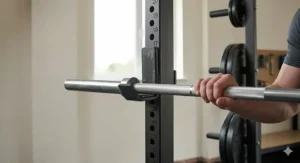
J-cup and safety bar quality separate racks that protect your equipment from those that destroy it. UHMW (ultra-high-molecular-weight polyethylene) liners on J-cups prevent barbell knurling damage every time you rack the bar. Steel-on-steel contact will gradually wear your barbell finish, which matters when British barbells cost £200-400. Similarly, safety bars with UHMW or nylon liners catch failed lifts without gouging the bar shaft. Budget racks skip these liners; mid-range racks include them on J-cups; premium racks line everything. If your rack lacks liners, aftermarket barbell spotter pads cost £20-30 and save hundreds in barbell replacement.
Hole spacing determines adjustment precision. Budget racks use 50mm (2 inch) hole spacing throughout, which means large jumps in J-cup height—frustrating when the perfect position sits exactly between two holes. Better racks employ west side spacing: 25mm (1 inch) spacing in the bench press zone (where precision matters most) and 50mm spacing elsewhere. This gives you 7-10 height positions for bench press within the working range instead of 3-4, making it easier to find your ideal starting position without shoulder strain.
Space requirements extend beyond the rack’s footprint. You need a 7-foot barbell worth of width (about 215cm minimum) plus loading space on each end—call it 300cm total width. Depth depends on whether you want to walk out your squats (needs 150cm behind the rack) or squat inside the cage (90-120cm depth works). British terraced house garages are typically 250cm wide, which creates challenges for positioning both the rack and walking paths. Measure your actual usable floor space, mark it out with tape, and physically stand in it with a broomstick to simulate barbell positioning before committing.
Common Mistakes When Buying Power Racks in the UK
Assuming all racks ship pre-assembled remains the most expensive mistake British buyers make. That £300 rack arrives in three massive boxes containing 47 pieces of steel, 128 bolts, and instructions written in what might technically be English if you squint. Budget 2-4 hours for assembly, have a second person available for holding upright sections, and own actual tools—the included Allen keys are usually rubbish. Some buyers end up paying £100+ for professional assembly when they realise their DIY enthusiasm exceeds their actual capability.
Ignoring floor protection costs add-up quickly when your dropped squat dents the garage concrete. Proper rubber gym flooring runs £2-4 per square foot, so protecting a 3m x 3m area costs £60-120. Cheaper alternatives like horse stall mats work but smell terrible for the first month and don’t always fit nicely together. EVA foam tiles are affordable but compress too much under heavy weight, creating stability issues. Include flooring costs in your budget from the start rather than discovering six months later that your cracked concrete now needs professional repair costing hundreds.
Overlooking attachment compatibility means that “great deal” on a cable system attachment won’t actually fit your rack’s hole pattern. Different manufacturers use different hole sizes (5/8 inch vs 1 inch), hole spacing (Westside vs standard), and upright widths (43 inch vs 48 inch). Mirafit M100 attachments won’t fit M200 racks; Rogue Monster Lite attachments won’t fit most UK racks without adaptors. Before buying attachments, verify they’re specifically designed for your exact rack model. The £50 you save on a “compatible” dip attachment becomes £0 saved when it doesn’t actually attach.
Choosing racks based on Amazon photos rather than specifications creates disappointment when the “compact” rack still doesn’t fit your garage. Those professional photos shoot racks in massive warehouses that make a 220cm x 140cm cage look modest. In your 250cm x 250cm garage sharing space with bikes and the lawnmower, that same rack dominates the entire area. Download the technical drawing PDFs (usually available on manufacturer websites), print them to scale, and physically lay them on your floor. This reveals clearance issues before you’ve spent £500.
Forgetting about British weather if you’re installing in an unheated garage or shed means dealing with condensation, rust, and seized hardware. Powder coating helps but doesn’t make racks immune to moisture. Exposed springs, pins, and J-cup mechanisms rust quickly in damp conditions. Budget for basic maintenance supplies: spray oil for moving parts, rust converter for any spots that appear, and ideally a dehumidifier if your garage tends toward tropical moisture levels. A £10 can of oil prevents £100 worth of rust damage and frustration with stuck adjustment pins.
Power Rack Safety Features That Actually Matter
Safety bar thickness and construction method determine whether they’ll save your life or bend like a banana when you actually need them. Solid steel bars (not hollow tubing) with a minimum 25mm diameter handle serious loads. The connection method matters just as much—pins that simply slide through holes can shift under impact; captured pins or bolt-through designs stay put. Premium racks weld safety bar caps to prevent the bars from sliding out even if pins fail. Test your safety bars before loading heavy—set them low, rest the barbell on them, and apply downward force to verify they’re truly secure.
J-cup safety locks prevent the most common power rack accident: the bar rolling off J-cups during unracking or re-racking. Cheap racks use J-cups that are essentially horizontal shelves where the bar sits freely—one slight mishap during reracking and the bar rolls backwards off the cups onto your shins or feet. Better racks include flip-up safety catches that lock the bar in place until you deliberately lift it clear. This feature seems minor until you’re shaky from a heavy set and slightly miss the rerack—the safety lock catches the bar instead of gravity demonstrating its reliability on your toes.
Structural stability factors often ignored in specifications determine whether your rack wobbles or stands firm. Bolt-together racks generally flex more than welded designs, particularly at the joints where uprights meet bases. Corner bracing (diagonal supports between uprights) dramatically increases rigidity but also increases cost and weight. For home use without bolting to the floor, wider base footprints (140cm vs 120cm) provide better stability. The weight of the rack itself matters too—a 70kg rack sits steadier than a 45kg rack when you’re doing aggressive chin-ups or dropping weight onto safety bars.
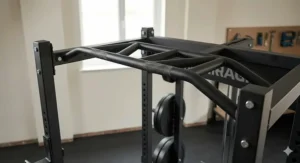
Pull-up bar design affects shoulder health more than most buyers realise. Straight bars force your hands into pronated grip only, which can aggravate shoulder issues over time. Multi-grip bars offering neutral (palms facing) and angled grip options reduce shoulder strain and allow training through minor injuries. The diameter matters as well—32mm is comfortable for most hands; thinner bars (25mm) favour smaller hands but become difficult to grip when fatigued; thicker bars (35mm+) build grip strength but limit reps for most people. If pull-ups feature heavily in your training, this seemingly minor detail affects every session.
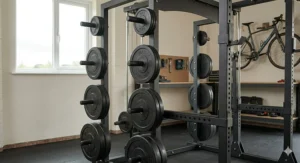
Weight plate storage integration sounds like a convenience feature but actually improves stability. Adding loaded weight plate posts to your rack’s base increases the overall system weight, making the entire structure more stable for pull-ups and reducing shifting during heavy lifts. This is particularly valuable if you’re not bolting the rack to the floor (common in British homes where you want to preserve the garage floor for resale value). Weight storage posts holding 100kg of plates add significant stability—it’s like adding ballast to a ship.
Power Cage vs Squat Rack: What British Home Gyms Need
Power cages (full four-post enclosures) provide maximum safety for solo lifting, which matters tremendously for anyone training alone in a British garage at 6am before work. The enclosed design means safety bars catch failed lifts from any angle—squat too deep, bench press fails at lockout, overhead press dumps backwards. You’re training inside a protective cage rather than in front of exposed uprights. This safety premium justifies the extra cost and space requirements for serious lifters working near maximum weights without spotters. The psychological benefit is genuine—knowing you can safely push to failure changes how confidently you approach heavy sets.
Squat racks (half racks or independent stands) save considerable floor space and cost but sacrifice the protective cage. You’re lifting in front of the rack, which means failed squats require deliberately dumping the bar backwards onto safety bars—doable but requiring more awareness than simply collapsing inside a cage. For British homes with limited space, half racks make sense if you’re disciplined about safety protocols and rarely push true maximum efforts. They’re also easier to move if you’re renting and the landlord gives you that look when you mention installing a power cage.
Hybrid designs attempt to split the difference—wall-mounted rigs, foldable racks, or half racks with optional spotter arms. Wall-mounted rigs (like Rogue’s fold-away models) save maximum space but require serious wall mounting into studs or masonry, which most landlords won’t approve. Foldable racks work theoretically but in practice become permanent fixtures because folding and unfolding a 60kg rack every session is absurd. Spotters arms for half racks provide some cage-like safety but with more setup complexity per exercise.
For British garages typically ranging 250-300cm wide, a full power cage (110-140cm wide) plus barbell loading space (70cm per side) leaves minimal room for anything else. This works if your garage is dedicated gym space but becomes challenging if you’re also storing bikes, tools, and the Christmas tree. A half rack (60-90cm wide) preserves more floor space whilst still enabling safe training—the trade-off British home gym owners face comes down to dedicated space availability versus safety preferences. Most serious lifters eventually conclude the full cage is worth the space sacrifice after that first truly scary failed rep.
For those interested in competitive powerlifting with proper equipment, British Powerlifting is the UK’s national governing body and provides guidance on approved equipment specifications and training standards.
Space efficiency tricks help British home gyms maximise limited areas. Corner-mounted racks use wall support to reduce footprint; vertical weight storage (plate trees) takes less floor space than horizontal posts; folding benches store against walls when not in use. The Mirafit M100’s recessed rear base bar is specifically designed for British garages where every centimetre matters. Think vertically (wall-mounted accessories, high storage) rather than horizontally when planning your space.
Best Power Racks for Small British Spaces
Ceiling-challenged garages and converted spare rooms require special consideration. The Mirafit M100 at 213cm (or 204cm with inverted pull-up bar) fits most British garages whilst maintaining full functionality. The Mirafit M3’s 188cm variant accommodates genuinely low ceilings down to 210cm total height—rare but essential for Victorian conversions or garage spaces under living room extensions. Yaheetech’s adjustable models (114-179cm) suit unconventional spaces where standard racks simply won’t work, though you sacrifice some stability for this height flexibility.
Narrow garage widths (under 250cm) make full-depth power cages impractical. Half racks like the GYM MASTER GM2 (not fully detailed in our top 7 but available on Amazon.co.uk) provide J-cups and safety bars whilst taking up half the width of full cages. The trade-off is lifting in front of rather than inside the rack, which requires more discipline with safety protocols. For genuinely tight spaces under 200cm wide, independent squat stands become necessary—these sacrifice the cage safety but allow setting up wherever floor space exists then storing them when finished.
Foldable power racks exist but rarely deliver on their space-saving promises in practice. The engineering required to make a folding power rack sufficiently stable adds weight and complexity; most fold-away racks still project 30-40cm from the wall when folded, which barely saves space; and the faff of folding and unfolding for every session means most owners leave them permanently deployed anyway. Consider these only if you genuinely need to reclaim the floor space daily—perhaps a garage that still houses vehicles or a spare room that converts back to a bedroom.
Depth-reduced racks (60cm internal depth vs standard 90cm) force you to squat closer to the front uprights but save 30cm of precious floor space. The Mirafit M3’s 60cm depth option is specifically designed for British compact garages. You’ll need to adjust your squat walkout—smaller steps backwards—but most lifters adapt within a few sessions. This becomes more limiting for tall lifters (over 6’3″) who need more natural walkout distance to feel comfortable, but for average-height British lifters, 60cm internal depth works perfectly well.
Long-Term Costs: Maintaining Your Power Rack in British Weather
Rust prevention in British garages isn’t optional unless you enjoy watching your £500 investment turn orange. The combination of temperature swings and moisture makes unheated British garages rather hostile to bare steel. Monthly maintenance takes 10 minutes: wipe down the frame with a dry cloth to remove condensation; apply a light coating of 3-in-1 oil or WD-40 to any exposed steel hardware (pins, springs, bolts); inspect powder coating for chips and touch up with black spray paint before rust starts. This minimal effort extends rack lifespan by years and prevents seized adjustment mechanisms.
J-cup and safety bar replacement eventually becomes necessary if you’re genuinely using your rack hard. UHMW liners wear gradually—expect 2-3 years before they need replacing with heavy use. Replacement liners cost £20-40 depending on the rack model, and most manufacturers sell them separately. Steel J-cups without liners eventually develop grooves from repeated barbell contact, which can damage barbell knurling. Budget £50-100 every 3-5 years for J-cup and safety bar maintenance or replacement if you’re training 4-5 times weekly.
Bolt and hardware tightening should happen quarterly—vibrations from dropping weights and general use gradually loosen connections. A quick inspection with a socket wrench takes 15 minutes and prevents catastrophic failures. Pay special attention to pull-up bar mounting bolts and base connection points, which experience the highest forces. If you’ve installed in a garage where cars park nearby, vibrations from opening garage doors accelerate bolt loosening. Keep the original Allen keys and wrenches somewhere memorable for these maintenance sessions.
Powder coating touch-ups preserve appearance and prevent rust starting from chips. A £10 can of matt black spray paint matches most racks well enough. Clean the chipped area with degreaser, light sand any rust, apply rust converter if needed, then spray paint in thin coats. This beats watching a small chip become a spreading rust patch that eventually compromises structural integrity. Coastal British homes and particularly damp garages may need annual touch-ups; drier inland locations might go several years between maintenance.
Accessory wear and replacement varies by attachment type. Cable system pulleys need occasional replacement (every 3-5 years with heavy use)—expect £30-50 for pulley assemblies. Weight plate storage posts develop scratches but rarely need replacement. Dip bar attachments are essentially indestructible unless you’re doing something truly creative with them. Landmine attachments’ rotating sleeves eventually need lubrication or replacement. Budget roughly £50-100 annually for miscellaneous accessory maintenance if you have a fully loaded rack with multiple attachments.
Home Gym Power Rack Setup: Essential Accessories
Barbell selection massively affects your power rack experience. A proper 20kg Olympic barbell (£150-300) with decent knurling and 700kg+ rating is non-negotiable. Budget 25mm “standard” bars (£40-80) don’t fit proper J-cups, have terrible knurling, and bend under moderate loads—false economy that wastes money. British buyers can choose between imported bars (Rogue, Eleiko—expensive but exceptional) or UK brands like Mirafit and Wolverson (£150-250, excellent value). The barbell is what actually touches your hands every session; the rack just holds it—prioritise accordingly.
Weight plates in British garages face the tri lemma: cost, space efficiency, and floor protection. Iron plates (£1-1.50/kg) are cheapest but noisy and damage floors if dropped. Rubber-coated plates (£1.80-2.50/kg) reduce noise and protect floors moderately. Bumper plates (£2.50-4/kg) allow dropping from height without destroying everything but take up more space due to their diameter. For British home gyms where neighbours share walls, bumper plates or at minimum rubber-coated plates become rather important unless you enjoy weekly noise complaints. Budget £200-400 for a starter 100kg plate set.
Adjustable bench purchase cannot be postponed—power racks without benches only enable squats and standing presses. A proper adjustable bench (£150-300) with 7+ backrest positions and 300kg+ capacity enables flat bench press, incline work, and dumbbell movements. Foldable benches save storage space but add setup faff each session. The Mirafit M350 bench frequently pairs with their racks and typically sells for £180-250—solid value if you’re already investing in Mirafit equipment for parts compatibility.
Barbell collars prevent plates sliding during lifts—the included spring collars on budget barbells are rubbish. Lockjaw-style collars (£25-35) clamp securely, release quickly, and last years. Cheaper spring collars (£8-15) eventually lose tension and allow plate movement mid-set, which is rather distracting when you’re under 120kg for squats. This is a small expense with meaningful safety benefits—buy proper collars.
Safety accessories like spotter arms (if your rack doesn’t include them), deadlift platform materials (to protect garage floors from barbell drops), resistance bands for warm-ups, and a landmine attachment for rowing variations round out essential purchases. Budget an additional £150-250 beyond the rack itself for these necessities. This pushes total investment to £600-1,000 for a properly equipped power rack setup—still vastly cheaper than annual gym membership costs whilst providing superior training availability.
FAQ
❓ Do I need to bolt my power rack to the garage floor?
❓ What power rack fits a 230cm ceiling garage?
❓ Are power racks from Amazon.co.uk safe for heavy squatting?
❓ Can I use a power rack in a flat or apartment in the UK?
❓ How long does a power rack typically last in a British garage?
Conclusion
Choosing a power rack for your British home gym comes down to matching your actual training needs, budget, and space constraints rather than chasing specifications that sound impressive but don’t matter in practice. The Mirafit M200 represents the sweet spot for serious lifters who have space and budget—commercial-grade quality for around £550 that you’ll never outgrow. The Strongway Multi-Gym delivers remarkable value for budget-conscious buyers wanting cable functionality without spending £800 on separate equipment.
What separates successful home gym builds from expensive garage ornaments is honest assessment of your space before buying. That 220cm rack looks perfectly reasonable until it arrives and your 240cm garage ceiling suddenly feels rather cramped. The 140cm-deep rack with full cable system sounds brilliant until you realise your garage is only 250cm wide and you’d quite like to still walk around it. Measure everything twice, use tape on the floor to mark actual dimensions, and choose the rack that fits your real space rather than your aspirational one.
British home gyms face unique challenges—damp weather, compact spaces, noise-conscious neighbours, and the eternal struggle between gym equipment and household storage competing for garage space. The racks featured here all succeed because they acknowledge these realities rather than pretending British garages are spacious American basements. Monthly maintenance, proper floor protection, and realistic expectations about what fits where separate successful home gym owners from frustrated ones trying to sell barely-used equipment six months later.
The power rack for home gym investment pays for itself remarkably quickly compared to commercial gym memberships—£500 for a quality rack equals roughly 8-10 months of typical British gym membership fees. After that, you’re training for free whilst building genuine strength in your own space, on your own schedule, without waiting for equipment or making small talk with that bloke who never wipes down the bench. For British lifters serious about long-term strength training, a proper power rack isn’t an expense—it’s infrastructure.
Recommended for You
- 7 Best Heavy Duty Assault Bike for CrossFit at Home UK 2026
- 7 Best SkiErg Alternative Cheaper UK Home Gym Options (2026 Guide)
- 7 Best Fan Bike for HIIT Workouts Home Gym UK 2026
Disclaimer: This article contains affiliate links. As an Amazon Associate, I earn from qualifying purchases. If you purchase products through these links, we may earn a small commission at no additional cost to you.
✨ Found this helpful? Share it with your mates! 💬🤗
