
In This Article
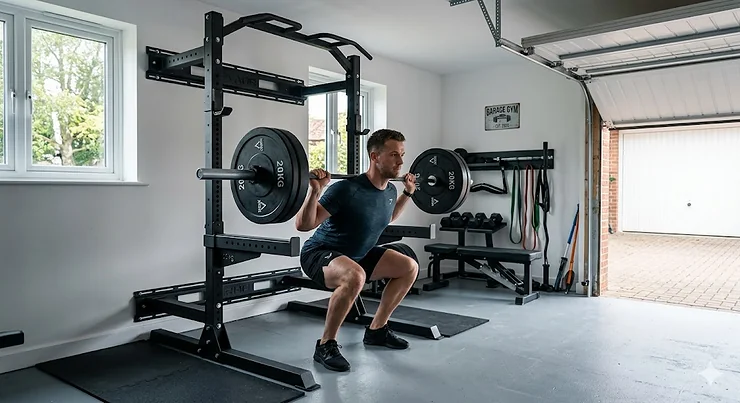
You’ve got a single garage that’s barely 5 metres by 2.5 metres, a ceiling that’s threatening your overhead press ambitions, and a partner who’d quite like to park the car occasionally. Sound familiar? For most of us in the UK, transforming a garage into a proper training space means making some rather creative compromises — and that’s precisely where a foldable power rack for garage setups becomes less of a luxury and more of a necessity.
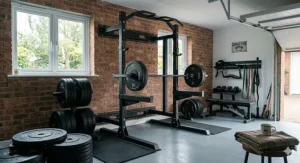
Unlike the sprawling home gyms you see plastered across American YouTube channels, British garages demand intelligent space management. According to government planning guidelines, the average UK single garage offers roughly 12.5 square metres of floor space, and once you’ve accounted for the boiler, the lawnmower, and those boxes of Christmas decorations you’ll definitely sort through “next year,” you’re left with precious little room for a traditional four-post power cage. A wall mounted power rack folding design solves this beautifully — fold it flat against the wall when you’re done, and you’ve got your garage back for storing bikes, tools, or actually parking a vehicle.
What most buyers overlook about these space saving power cage units is their genuine versatility. Modern foldable racks aren’t the flimsy afterthoughts they were a decade ago. Today’s designs use commercial-grade 75mm x 75mm steel tubing with 3mm wall thickness, handle weight capacities exceeding 360kg, and incorporate proper safety mechanisms that would make a traditional power rack jealous. The clever engineering lies in the hinge mechanism and wall-mounting system — essentially, you’re getting the functionality of a full power rack without the permanent floor footprint.
For UK buyers specifically, there’s an additional consideration that Americans rarely face: our garages are cold, damp, and subject to British weather’s relentless assault. A garage gym space solutions approach that keeps equipment off the floor when not in use actually extends the lifespan of your rack by reducing exposure to moisture and temperature fluctuations. Plus, when your garage does double duty as storage and training space, being able to reclaim those square metres between sessions makes the difference between a functional home gym and a cluttered nightmare that you eventually abandon.
Quick Comparison: Top 7 Foldable Power Racks for UK Garages
| Model | Folded Depth | Weight Capacity | Steel Construction | Price Range (£) | Best For |
|---|---|---|---|---|---|
| Bulldog Gear Mammoth Lite | 30cm | 350kg | 75x75mm, 3mm | £700-£900 | Standalone folding versatility |
| Strength Shop Riot Garage | 15cm | 400kg+ | 75x75mm, 3mm | £500-£650 | Budget-conscious serious lifters |
| SuperStrong Folding Rack | 20cm | 450kg | 75x75mm, 3mm | £550-£700 | UK-certified commercial quality |
| PRx Performance Profile | 10cm | 360kg | 76x76mm, 11-gauge | £900-£1,200 | Premium quick-fold mechanism |
| Solo Fitness Wall Mounted | 25cm | 400kg | 80x80mm, 3mm | £600-£750 | UK-made custom options |
| Primal Strength Folding | 30cm | 500kg | 100x100mm, 3mm | £800-£1,000 | Heavy-duty powerlifting |
| Mirafit M200S Short | N/A (fixed) | 250kg | 50x50mm, 2.5mm | £300-£400 | Low ceilings, compact spaces |
💬 Just one click — help others make better buying decisions too! 😊
Top 7 Foldable Power Racks for Garage: Expert Analysis
1. Bulldog Gear Mammoth Lite Folding Power Rack
The Bulldog Gear Mammoth Lite represents something genuinely unusual in the UK market — a full four-post power rack that folds completely flat without requiring wall mounting. For anyone who’s nervous about drilling substantial holes into their garage walls, or for renters who need a non-permanent solution, this addresses the single biggest barrier to entry for folding racks.
Built with 75mm x 75mm steel tubing at 3mm wall thickness, this rack delivers commercial-grade durability with a 350kg weight capacity that accommodates the vast majority of home lifters. The folding mechanism uses heavy-duty split pins rather than complex hinges, which means fewer moving parts to fail and easier setup — you’re looking at about 30 seconds to deploy or fold away once you’ve done it a few times. When folded, it sits roughly 30cm from the wall, which is competitive with wall-mounted options whilst offering superior stability during use.
What distinguishes this from cheaper alternatives is the engineering quality. The welds are smooth and professionally executed, the powder coating withstands the damp British garage environment without chipping, and the numbered hole spacing makes height adjustments straightforward even mid-workout. UK buyers particularly appreciate that Bulldog Gear operates from Warwickshire with proper customer service and readily available replacement parts — a significant advantage over importing American brands that treat UK customers as afterthoughts.
For the typical UK garage gym owner juggling space constraints with serious training ambitions, this rack bridges the gap brilliantly. It’s particularly well-suited to intermediate to advanced lifters who’ve outgrown basic squat stands but lack the permanent floor space for a traditional power cage. The freestanding design also means you can position it optimally for lighting and ventilation rather than being constrained by wall locations.
Pros:
✅ No wall mounting required — genuine game-changer for renters
✅ Commercial-grade construction handles serious weight
✅ UK-based company with local customer service and parts availability
Cons:
❌ Higher price point than wall-mounted alternatives
❌ 30cm folded profile larger than ultra-slim wall-mounted options
Price range: Around £700-£900 — represents solid value considering the freestanding versatility and build quality.
2. Strength Shop Riot Garage Wall Mounted Foldable Rack
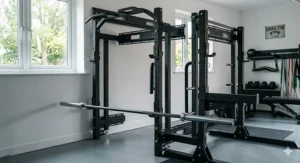
The Strength Shop Riot Garage rack delivers exactly what its name suggests — a no-nonsense, brutally effective wall-mounted solution for serious garage gym enthusiasts. Built in the UK using 75mm x 75mm steel box section with 3mm wall thickness (identical specifications to Strength Shop’s commercial power cages), this rack handles big weights without the big footprint.
When folded against the wall, the Riot Garage occupies roughly 15cm of depth — genuinely slim enough that you can park a car in a standard UK single garage with the rack still mounted. The six-pin folding mechanism is straightforward and reliable, though it takes slightly longer to deploy than some premium quick-release designs. This isn’t necessarily a disadvantage; the mechanical simplicity means fewer potential failure points and easier maintenance over years of use.
What British buyers particularly value about Strength Shop is their honest approach to specifications and capacity ratings. The 400kg+ weight capacity isn’t marketing hyperbole — it’s based on actual testing with safety factors built in. The integrated pull-up bar contributes to overall stability whilst providing a genuine training station, and the adjustable bottom crossbeam (10cm to 29cm from ground) accommodates different garage floor setups without requiring shimming or custom mounting solutions.
The Riot Garage suits lifters who prioritise function over flash and value straightforward British engineering. It’s especially appropriate for those working in converted garages with solid brick or blockwork walls where secure mounting presents no concerns. The lack of proprietary components means standard Westside-spacing attachments from various manufacturers will fit, giving you flexibility for future expansion without vendor lock-in.
Pros:
✅ Ultra-slim 15cm folded profile maximises garage floor space
✅ Robust UK construction with honest weight capacity ratings
✅ Compatible with standard Westside-spacing attachments
Cons:
❌ Pin-based folding mechanism slower than premium quick-release systems
❌ Requires professional wall mounting advice for optimal safety
Price range: Typically £500-£650 — exceptional value for commercial-grade British construction.
3. SuperStrong Folding Wall Mounted Squat Rack
SuperStrong’s folding rack exemplifies why UK-manufactured equipment often represents better value than imported alternatives for British buyers. Certified to both UK and European standards, this wall-mounted unit uses dual steel stringer wall plates rather than single bracket mounts — a superior and safer fixing solution that distributes load across a wider wall area.
The 75mm x 75mm box steel construction with 3mm wall thickness delivers a 450kg capacity that handles powerlifting-level loads with confidence. What sets this apart from budget competitors is the attention to manufacturing detail: laser-cut numbered uprights make height adjustments precise and repeatable, whilst the powder-coated finish proves genuinely resistant to the moisture and temperature swings endemic to British garages. The hinge system uses heavy-duty split pins that slot in and out smoothly without requiring excessive force — important when you’re setting up or packing away after a tough session.
For UK buyers concerned about wall mounting safety, SuperStrong’s stringer plate system addresses the primary concern. Instead of concentrating all load on four individual bolt points, the full-length plates distribute forces across the wall structure. This design works with block, brick, or reinforced stud walls, though professional mounting advice remains sensible given the loads involved. The slotted fixing holes provide adjustment during installation to ensure everything sits level and plumb despite typical garage wall irregularities.
This rack particularly suits buyers prioritising UK certification and commercial-grade durability for home use. Personal trainers running garage gym sessions with multiple clients will appreciate the robust construction and professional appearance. The integrated or modular pull-up bar options provide flexibility depending on ceiling height constraints — a thoughtful touch that American manufacturers often overlook in their “one size fits Britain” approach.
Pros:
✅ Dual stringer wall plates provide superior mounting stability
✅ UK/European certified for commercial and home use
✅ Laser-cut numbered uprights ensure precise adjustments
Cons:
❌ Requires proper wall assessment before installation
❌ Limited colour options compared to custom UK builders
Price range: Generally £550-£700 — strong value proposition for certified British engineering.
4. PRx Performance Profile Folding Squat Rack
The PRx Performance Profile rack represents the premium end of the folding rack market, and for good reason — it’s the only system using patented fold-away technology that deploys or stows in genuinely seconds rather than minutes. For buyers who’ll actually use their folding rack’s folding capability regularly (rather than leaving it permanently deployed), this convenience factor proves transformative.
Built with 76mm x 76mm 11-gauge steel tubing, the Profile rack matches traditional power racks for structural integrity whilst folding to just 10cm from the wall — slimmer than most mounted coat racks. The magic lies in the spring-assisted folding mechanism: lift up slightly, pull forward, and the rack swings out into position with minimal effort. Reverse the process with equal ease. This isn’t revolutionary technology, but the execution quality separates PRx from imitators who’ve attempted similar designs with inferior results.
The 360kg weight capacity suits the vast majority of home lifters, though serious powerlifters pushing beyond 180kg squats may prefer the higher ratings of commercial-oriented alternatives. What you’re paying for with PRx isn’t just the mechanism — it’s the refinement. The Westside 1-inch hole spacing around the bench press area allows millimetre-perfect spotter arm positioning, the J-hooks incorporate UHMW plastic protection for your barbell, and the overall fit and finish reflects American manufacturing precision.
For UK buyers, the main considerations are price and availability. PRx ships to the UK, but you’re paying import duties post-Brexit on top of the already substantial base price, pushing the total towards £1,200. Delivery times can extend to several weeks, and warranty claims require dealing with a US company rather than local support. These aren’t deal-breakers if you value the convenience factor above all else, but they’re worth weighing against excellent UK alternatives at significantly lower prices.
Pros:
✅ Patented quick-fold mechanism genuinely lives up to marketing claims
✅ Ultra-slim 10cm folded profile maximises garage usability
✅ Premium construction quality with thoughtful details
Cons:
❌ Significantly higher price, especially post-Brexit with import duties
❌ US-based company means longer shipping and complicated warranty process
Price range: Around £900-£1,200 including shipping and import duties — premium pricing for premium convenience.
5. Solo Fitness Wall Mounted Folding Squat Rack
Solo Fitness operates from the UK with a refreshing approach — made-to-order equipment with options for custom colours, branding, and bespoke modifications. Their wall-mounted folding rack uses 80mm x 80mm steel tubing at 3mm thickness, delivering a 400kg capacity with aesthetic minimalism that appeals to buyers who actually care what their garage gym looks like.
The construction quality reflects British manufacturing standards: smooth welds, durable powder coating available in various colours, and thoughtful design details like the long mounting slot in the backplate that provides installation flexibility for non-perfect walls. The J-hooks tuck away onto the uprights when folded, whilst the pull-up bar detaches and hangs from the top of the frame — clever touches that reduce the folded profile and prevent damage during the folding process.
What distinguishes Solo from mass-market alternatives is the customisation capability. Want your rack in Oxford Blue to match your garage scheme? Done. Need slight dimension adjustments to fit an awkward wall space? They’ll accommodate reasonable modifications. This bespoke approach does mean lead times of 4-6 weeks rather than next-day Amazon Prime delivery, but for buyers prioritising quality and personalisation over instant gratification, Solo delivers.
The Solo rack particularly suits home gym owners who view their training space as a long-term investment worth doing properly. The made-to-order nature means you’re getting current production rather than warehouse stock that’s been sitting for months, and the UK-based customer service proves invaluable if you need advice on wall mounting or future modifications. Solo explicitly recommends mounting only to solid structural walls with appropriate fixings and suggests professional installation advice — responsible guidance that budget brands conveniently omit.
Pros:
✅ UK-made with custom colour and branding options
✅ Robust 80mm tubing provides excellent stability
✅ Thoughtful design details like detachable pull-up bar
Cons:
❌ Made-to-order means 4-6 weeks lead time
❌ Higher price than mass-produced alternatives
Price range: Typically £600-£750 depending on customisation — fair pricing for bespoke British manufacturing.
6. Primal Strength Folding Power Rack
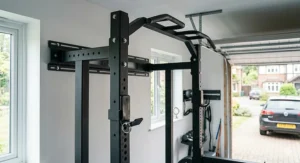
Primal Strength’s folding rack targets the serious powerlifter or CrossFit athlete who refuses to compromise on structural capacity despite space constraints. Built with 100mm x 100mm steel tubing at 3mm wall thickness — substantially beefier than standard folding racks — this unit delivers a 500kg capacity that accommodates genuinely heavy lifting without the structural flex that undermines confidence during maximal attempts.
The trade-off for this commercial-grade construction is size and weight. When folded, the rack protrudes roughly 30cm from the wall, and the installation process requires serious consideration of wall structure and mounting. This isn’t equipment for Victorian terraces with questionable brickwork — you need solid blockwork or brick walls with professional-grade fixings. Primal Strength offers installation services in some UK regions, which speaks volumes about their understanding that not every buyer has the skills or confidence to mount several hundred kilograms of steel correctly.
What heavy lifters appreciate about the Primal design is the absence of unwelcome surprises during use. There’s no upright flex under 180kg squats, no concerning creaks during heavy bench presses, and the safety bars inspire genuine confidence when attempting personal records alone. The modular design accommodates various Primal attachments including dip stations, landmine attachments, and plate storage — transforming the basic rack into a complete training station.
This rack suits competitive powerlifters, serious CrossFit athletes, or advanced home gym owners who’ve outgrown lighter equipment and need commercial-standard capability in a space-constrained environment. The higher price reflects the substantial materials and engineering required to deliver genuine 500kg capacity in a folding design — this isn’t marketing exaggeration but actual tested performance. For most recreational lifters, this level of capacity exceeds requirements, making lighter (and more affordable) alternatives more appropriate.
Pros:
✅ Massive 500kg capacity handles serious powerlifting loads
✅ Commercial-grade 100mm tubing provides exceptional stability
✅ Modular design accepts wide range of training attachments
Cons:
❌ Substantial size and weight requires expert wall mounting
❌ Higher price point reflects commercial-grade construction
Price range: Around £800-£1,000 — premium pricing justified by genuine commercial capability.
7. Mirafit M200S Short Power Rack
Strictly speaking, the Mirafit M200S isn’t a folding rack — it’s a compact, low-profile fixed power rack. But for UK garage gym owners battling the twin tyrannies of low ceilings and tight floor space, it deserves inclusion as an alternative solution worth serious consideration.
At just 183cm total height compared to standard racks’ 220cm, the M200S fits comfortably in garages with the 240cm ceiling height common in UK residential construction. This solves the overhead clearance problem that plagues many garage gym setups, particularly for taller lifters who otherwise find themselves hunching awkwardly during pull-ups or overhead presses. The 14 adjustment levels at 8cm intervals provide precise positioning for various exercises despite the compressed height.
Built with 50mm x 50mm steel tubing at 2.5mm wall thickness, the M200S delivers a 250kg capacity — adequate for most home lifters though noticeably lower than the commercial-oriented racks discussed earlier. The construction quality reflects Mirafit’s reputation for value-oriented British equipment: solid welds, effective powder coating, and UHMW-lined safety spotters that protect both your rack and barbell from damage. The four-post cage design provides inherent stability without wall mounting, though pre-drilled footplates allow floor bolting for ultimate security.
What UK buyers particularly value about Mirafit is the combination of direct-from-manufacturer pricing and proper British customer service. Standard delivery costs just £4.95 regardless of order size, items typically arrive within 2-3 working days, and the 30-day money-back guarantee provides confidence for buyers uncertain about specific dimensions. Customer reviews consistently mention the commercial-quality feel at home-gym pricing — rare praise in an industry where “commercial quality” usually means “commercial pricing” as well.
Pros:
✅ 183cm height fits standard UK garage ceiling clearances
✅ Four-post cage design provides inherent stability
✅ Excellent value with reliable UK delivery and customer service
Cons:
❌ Fixed design doesn’t fold — permanent floor footprint
❌ 250kg capacity lower than serious powerlifting requirements
Price range: Typically £300-£400 — exceptional value for space-constrained UK home gyms.
✨ Don’t Miss These Exclusive Deals!
🔍 Take your garage gym to the next level with these carefully selected products. Click on any highlighted item to check current pricing and availability on Amazon.co.uk. These picks will help you find exactly what you need for your training space!
How a Wall Mounted Power Rack Folding System Actually Works
The engineering behind fold-away racks fascinates anyone who’s actually stopped to consider how several hundred kilograms of steel and iron remains safely suspended from a garage wall. Unlike simple shelving brackets, these systems must handle dynamic loads — the forces generated during aggressive re-racking, failed lifts, and the occasional dropped bar. Understanding the mechanics helps UK buyers make informed decisions about wall suitability and installation requirements.
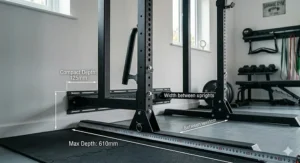
Most folding racks use one of three fundamental hinge mechanisms. The simplest design employs heavy-duty steel pins that slot through aligned holes in the upright and wall bracket — basically an oversized version of the pin that holds your dumbbell plates. To deploy the rack, you remove the pins, swing the uprights forward until they lock at 90 degrees to the wall, then reinsert the pins to prevent collapse. This design dominates the UK market because it’s mechanically simple, requires no maintenance, and fails obviously rather than catastrophically (missing pins are immediately visible). The Strength Shop Riot Garage and SuperStrong racks exemplify this approach.
The second mechanism type uses spring-loaded automatic locking. PRx Performance pioneered this system with their patented design: lift up slightly on the rack, pull forward, and spring-loaded pins automatically engage when the rack reaches the deployed position. Folding reverses the process — lift, push back, and the springs retract the locking pins whilst guiding the rack flush to the wall. This convenience comes at a cost premium and introduces moving parts that require occasional lubrication, but for users who fold and deploy daily, the time savings prove substantial.
The third approach, less common in UK markets, uses pivot plates with bolt-through locking. Instead of pins that fully remove, heavy-duty bolts remain threaded through both the upright and wall bracket, acting as the pivot point. To deploy, you loosen the bolts slightly (they don’t remove completely), swing the rack out, then retighten the bolts to lock everything in position. This design theoretically requires the least setup time since nothing fully disconnects, but in practice, most users find the bolt-loosening process fiddly, and thread wear over years of use creates potential safety concerns.
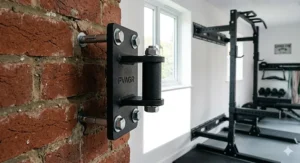
Regardless of mechanism, the critical stress point remains the wall attachment itself. Quality racks use dual-stringer wall plates that distribute loading across substantial wall area rather than concentrating forces on individual bolts. In the UK, where garage walls might be brick, blockwork, reinforced stud, or occasionally concrete, the mounting approach varies significantly. Brick and blockwork typically use resin anchors or expansion bolts rated for substantial loading, whilst stud walls require bolts that penetrate through to solid timber or ideally, direct bolting to wall studs at appropriate centres.
British building regulations don’t specifically address garage gym equipment mounting, but general structural principles apply: any wall-mounted load exceeding 50kg per square metre requires assessment of wall construction and appropriate fixing selection. Given that most folding racks weigh 60-80kg before you add any plates or barbell, and dynamic loads during use can exceed 500kg, professional mounting advice isn’t paranoia — it’s sensible risk management. Several UK rack manufacturers offer installation services or at minimum, detailed guidance on fixing requirements for various wall types.
For UK buyers uncertain about their garage walls, a freestanding folding rack like the Bulldog Gear Mammoth Lite eliminates wall mounting concerns entirely. You sacrifice some floor space efficiency compared to true wall-mounted units, but gain installation simplicity and rental-friendly portability. The structural challenge shifts from wall capability to floor loading, which standard concrete garage floors handle comfortably.
Real-World Performance: British Garage Gym Scenarios
Understanding how these racks perform in actual UK garage conditions provides perspective that specification sheets can’t capture. Let me walk through three typical scenarios that illustrate the practical considerations most British buyers face.
Scenario 1: The London Flat Conversion
James works in tech, rents a ground-floor flat in Hackney, and has access to a shared external storage area roughly 2 metres by 3 metres with brick walls and a concrete floor. He’s an intermediate lifter (100kg squat, 70kg bench press) who trains four times weekly. Space constraints mean the rack must fold completely when not in use to avoid blocking access for other residents.
For James, a wall-mounted solution like the Strength Shop Riot Garage makes perfect sense. The 15cm folded profile minimises obstruction when stored, the 400kg+ capacity accommodates his current lifts with room for progression, and the straightforward pin mechanism means he’s not worried about complex folding systems failing. The main installation challenge involved getting landlord permission to drill into the shared building structure — solved by offering to restore the wall upon moving out and providing insurance documentation covering equipment failure liability.
What James didn’t anticipate was the London damp affecting his barbell faster than the rack itself. Within three months, the chrome on his budget barbell showed rust spots from moisture accumulation. The solution involved applying a thin layer of 3-in-1 oil after each session and storing the barbell inside his flat rather than leaving it in the storage area. The rack’s powder coating, however, proved entirely resistant to the damp conditions — no corrosion, no coating degradation.
Scenario 2: The Semi-Detached Suburban Family
Sarah and Mark live in Berkshire with two children and a single garage that stores bikes, tools, gardening equipment, and aspirationally, Sarah’s training equipment. The garage measures roughly 5m x 2.7m with a standard 240cm ceiling and brick walls. Sarah’s an experienced CrossFit athlete (85kg squat, regular pull-ups) whilst Mark uses the equipment occasionally for general fitness.
They initially considered a traditional four-post rack but quickly recognised it would permanently consume half their garage floor space. The Bulldog Gear Mammoth Lite freestanding folding rack provided the compromise needed: when Sarah trains (five mornings weekly before work), the rack deploys in under a minute. When finished, it folds against the long wall, leaving sufficient floor space for the bikes, Mark’s workbench, and occasionally parking their car when expecting visitors.
The real-world challenge emerged around ceiling height. At 175cm tall, Sarah finds the pull-up bar positioning adequate for strict pull-ups but occasionally bumps her head during kipping movements when enthusiasm exceeds spatial awareness. They solved this by marking a clear training zone on the floor with tape — a visual reminder to position herself appropriately before starting dynamic movements. The children, predictably, view the rack as a climbing frame, requiring clear ground rules and padlock-secured storage of the J-hooks and barbell when the rack’s not supervised.
Scenario 3: The Rural Peak District Powerlifter
Tom lives in a converted barn in Derbyshire with a dedicated 6m x 4m garage gym space featuring solid stone walls and a proper insulated ceiling at 280cm height. He’s a competitive powerlifter (200kg squat, 150kg bench press) who trains six days weekly and occasionally hosts training partners. Space isn’t his constraint — structural capacity is.
For Tom, the Primal Strength Folding Power Rack with its 500kg capacity addresses the genuine need for commercial-grade equipment in a residential setting. The 100mm tubing doesn’t flex under maximal loads, the safety bars inspire confidence during solo limit attempts, and the modular attachment compatibility means he’s gradually built a complete training facility around the core rack. The wall mounting required professional assessment — the stone walls needed resin anchors rated for substantial loading, and installation took a full day to ensure everything sat level and plumb.
The folding capability, ironically, sees minimal use in Tom’s case. He initially valued it for the option to reclaim space for other activities, but in practice, the rack remains permanently deployed because his garage gym serves no other function. The lesson here is instructive: if you have dedicated space and won’t actually fold the rack regularly, a traditional fixed power cage often provides better value and potentially higher capacity at similar price points. The folding mechanism adds cost and introduces potential failure points that benefit only users who genuinely need the space-saving functionality.
Common Mistakes When Buying a Foldable Power Rack for Garage Use
After reviewing countless UK garage gym setups and speaking with buyers who’ve navigated this purchase, several recurring mistakes emerge. Avoiding these pitfalls saves both money and frustration.
Mistake 1: Ignoring Ceiling Height Realities
The single most common error involves buying a standard-height rack for a low-ceiling garage without properly measuring working clearance. UK residential garages typically offer 240cm ceiling height, but subtract 10cm for fluorescent light fittings and another 5-10cm for the rack’s pull-up bar thickness. Your actual overhead clearance for pull-ups is often 220cm or less.
If you’re 180cm tall, that leaves barely 40cm between the top of your head and the pull-up bar — enough for strict pull-ups but cramped for kipping movements or muscle-ups. Taller lifters find standard-height racks genuinely unusable for overhead work in typical UK garages. The solution involves either choosing a short-profile rack like the Mirafit M200S or accepting that pull-ups will happen elsewhere (doorway pull-up bar, park, or conventional gym).
What’s frustrating is how many rack manufacturers bury the crucial “required ceiling height” specification deep in product descriptions whilst prominently displaying total rack height. The Strength Shop Riot Garage, for example, measures 190cm tall but requires 210cm minimum ceiling clearance to function properly — that 20cm difference between rack height and required clearance catches buyers who skim specifications rather than reading thoroughly.
Mistake 2: Underestimating Wall Mounting Complexity
DIY-confident buyers often assume that mounting a folding rack involves similar complexity to installing heavy-duty shelving. In reality, the forces involved during lifting create dynamic loads that challenge even professional-quality wall constructions. Victorian terraces with 9-inch brick walls might seem substantial until you recognise the mortar’s often degraded after 120+ years. Post-war homes with cavity brick walls require careful attention to fixing placement to avoid the cavity itself. Modern timber-frame houses need bolting directly to structural studs, not just the plasterboard facing.
The mistake compounds when buyers use inadequate fixings to save money. Standard wall plugs designed for hanging pictures or shelves simply won’t cope with the shear forces generated by 150kg+ of combined rack, barbell, and lifter weight plus dynamic loading during aggressive movements. Quality resin anchors or expansion bolts rated for several thousand kilograms’ loading seem excessive until you understand that safety factors should account for worst-case scenarios — like dropping a failed squat attempt onto the safety bars from height. Professional guidance from organisations like the British Standards Institution can help identify appropriate fixing types for your specific wall construction.
Professional mounting typically costs £150-£300 depending on wall complexity and whether structural reinforcement is needed. Compared to rack prices of £500-£1,000, that represents modest insurance against catastrophic failure that could injure you and damage property. Yet many buyers skip this expense, convincing themselves that “it’s just drilling holes and tightening bolts.” Sometimes it is. Sometimes it’s drilling through to electrical cables hidden in walls, or discovering the wall isn’t solid brick but renders over blockwork, or finding that the studs aren’t where you expected because cowboys built your garage in 1987 with creative interpretations of building regulations.
Mistake 3: Buying for Current Lifts, Not Progression
New lifters often purchase racks based on their current working weights without accounting for progression. Someone squatting 60kg today might reasonably expect to reach 100-120kg within 12-24 months of consistent training. A rack rated for 250kg seems adequate for 60kg squats plus bodyweight — and it is, initially. But as weights increase, that safety margin shrinks uncomfortably.
Dynamic loading means the forces during lifting exceed barbell weight significantly. Aggressive re-racking, bouncing the bar off safety catches, or dropping failed attempts generates impact forces 1.5-2x static weight. That 120kg squat creates 180-240kg of dynamic load under realistic training conditions. Suddenly, a 250kg-rated rack operates with minimal safety margin rather than the comfortable buffer you’d prefer when attempting personal records alone in your garage.
Quality racks with honest capacity ratings (typically UK and European manufacturers complying with EN957 standards) build safety factors into their specifications. Budget racks from unknown manufacturers often state aspirational capacities based on theoretical calculations rather than actual destructive testing. The difference between “rated for 400kg based on our engineering calculations” and “tested to 400kg across 100,000 load cycles per EN957” is the difference between marketing claims and verified performance.
The solution involves buying slightly more capacity than you currently need. If you’re squatting 80kg now, target racks rated for 350-400kg+ rather than 250kg. The incremental cost is modest, but the confidence during heavy lifting and the longevity as you progress makes it worthwhile. Plus, higher-capacity racks typically use thicker-gauge steel and better construction throughout, improving stability and reducing flex even at lower weights.
Mistake 4: Overlooking UKCA and Safety Certification
Post-Brexit, equipment sold in Great Britain should carry UKCA marking if it falls within scope of relevant safety regulations. Many strength training equipment categories aren’t yet mandated for UKCA marking, but reputable UK and European manufacturers increasingly voluntarily certify to demonstrate compliance with British Standards (particularly BS EN 957 for stationary training equipment).
The mistake involves assuming that all equipment sold on Amazon.co.uk meets UK safety standards simply because it’s available for purchase. In reality, Amazon operates as a marketplace where third-party sellers from various countries list products with minimal oversight regarding compliance. A rack manufactured in China, sold by a Shenzhen-based company with no UK presence, and shipped from an overseas warehouse might carry CE marking (or worse, no marking at all) without meeting UKCA requirements or British Standards.
Why does this matter? Beyond the legal compliance aspect, certified equipment undergoes rigorous testing for structural integrity, stability, and safety under repeated loading. BS EN 957-2 (the specific standard for strength training equipment) requires load testing across 100,000 cycles at maximum rated capacity — revealing fatigue failures that single static tests miss. Equipment lacking this certification might perform adequately under light use but develop cracks, weld failures, or structural issues after months of regular training. The International Organization for Standardization (ISO) has also adopted this as ISO 20957, providing additional international recognition.
UK buyers should prioritise equipment from British and European manufacturers who explicitly state UKCA compliance or BS EN 957 certification. This doesn’t guarantee perfection, but it demonstrates the manufacturer’s commitment to meeting established safety standards rather than simply chasing the lowest production cost. Companies like Bulldog Gear, Strength Shop, SuperStrong, and Mirafit operate within British regulatory frameworks and maintain UK-based customer service — crucial if issues arise requiring warranty claims or safety investigations.
Mistake 5: Neglecting the Folded Profile in Real-World Space Planning
Specification sheets list folded depth — typically 10-30cm depending on design — but buyers often fail to visualise what that means in their specific garage layout. A rack with 15cm folded depth sounds impressively slim until you discover it positions exactly where your car’s side mirror sits when parked, or blocks access to the electrical consumer unit that you’re required by law to keep accessible, or prevents the garage door from opening fully because of clearance geometry.
The solution involves physical space planning before purchase. Use masking tape on your garage wall to mark the exact footprint of the folded rack based on manufacturer dimensions. Then physically test your intended use patterns: Can you open car doors with the rack folded? Does it block access to utilities or storage? Will you actually be able to walk past it comfortably, or will you be turning sideways and swearing every time?
This exercise reveals why ultra-slim profiles like PRx’s 10cm folded depth command premium pricing — that 5cm difference between 10cm and 15cm depth genuinely transforms usability in tightly constrained spaces. It’s also why freestanding folding racks like the Bulldog Gear Mammoth Lite, despite larger folded profiles of 30cm, provide flexibility advantages: you can position them anywhere along the wall depending on seasonal parking needs rather than being locked into permanent mounting locations.
Long-Term Cost and Maintenance in UK Garage Conditions
British garages subject equipment to environmental challenges that American or Australian garage gyms rarely encounter. Our wet climate, substantial temperature swings between summer and winter, and generally unheated garage conditions create maintenance requirements that buyers often overlook when calculating total cost of ownership.
Rust Prevention and Surface Protection
Quality powder coating provides the primary defence against corrosion, but British damp eventually finds coating chips, scratches, or weld areas where protection is thinner. Within 6-12 months of regular use, most racks accumulate minor coating damage from barbell impacts, J-hook adjustments, and general contact wear. Left untreated, these vulnerable spots begin rusting — slowly in well-ventilated garages, alarmingly fast in damp or poorly sealed spaces.
The maintenance solution is straightforward but requires discipline: inspect your rack every few months for coating damage, particularly around high-wear areas like J-hook contact points and safety bar receivers. Small chips can be touched up with matching powder coat paint or even rust-prevention spray paint from automotive suppliers. Larger areas of damage might require professional powder coat repair, but this is rare unless you’ve been genuinely abusive to the equipment.
The barbell requires more aggressive protection. Chrome, bare steel, and even stainless steel barbells all corrode in damp British garages unless actively maintained. A thin layer of 3-in-1 oil or specialist barbell oil (essentially the same product at different prices) applied after each session and wiped down before use prevents surface rust. This adds 30 seconds to your post-workout routine but extends barbell life from 2-3 years to potentially decades. Alternatively, store barbells indoors in climate-controlled space — inconvenient but genuinely effective.
Weight plates prove remarkably resistant to British conditions. Cast iron plates develop surface rust that’s primarily cosmetic, whilst rubber-coated bumper plates generally ignore environmental conditions entirely. Some lifters treat cast iron plate rust as character rather than damage — legitimate enough if it doesn’t progress beyond surface oxidation.
Moving Parts and Mechanism Maintenance
Folding racks introduce mechanical components that require occasional attention. Pin-based systems need the least maintenance — essentially ensuring pins remain undeformed and holes remain clear of debris. Spring-loaded mechanisms like PRx’s design benefit from annual lubrication of moving parts using lithium grease or similar moisture-resistant lubricant. Neglecting this results in increasing resistance when folding and deploying, plus accelerated wear on spring mechanisms.
Hinges themselves rarely fail on quality racks but do accumulate dirt and moisture over time. An annual clean with degreaser followed by light oil application keeps movement smooth. This maintenance takes perhaps 15 minutes annually — negligible effort that prevents the frustrating experience of pins binding in holes or hinges requiring excessive force to move.
J-hooks and safety bars experience the highest wear rates since they directly contact the barbell during every session. UHMW plastic liners (if fitted) protect both the hook and barbell but wear down over years of use. Replacement UHMW strips cost £10-20 and take minutes to install — minor expense compared to replacing damaged J-hooks or refinishing scratched barbells. Some lifters skip this maintenance, reasoning that metal-on-metal contact is fine. It functions, certainly, but expect accelerated wear on barbell knurling and J-hook surfaces.
Total Cost of Ownership Over Five Years
Consider a mid-range rack like the Strength Shop Riot Garage at £600 initial purchase, plus £200 professional installation, £30 in mounting bolts and fixings, and approximately £50 in maintenance supplies (touch-up paint, lubricants, replacement UHMW liners) over five years. Total: £880, or £176 annually.
Compare this with commercial gym membership in the UK averaging £40-50 monthly (£480-600 annually). The rack pays for itself in 18-24 months, after which you’re training essentially free aside from minor ongoing costs. This calculation improves further when accounting for time saved on gym commutes, parking costs, and the convenience of training at antisocial hours without depending on facility opening times.
The value proposition strengthens for families. A single rack accommodates multiple users across different fitness levels and goals. Sarah does CrossFit-style conditioning, Mark does basic strength training, and their teenage daughter uses it for pull-up progressions — three distinct training programmes using the same equipment. Compare this flexibility with commercial gym memberships for three people at £120-150 monthly combined, and the home rack pays for itself in under six months.
Resale value provides additional cost recovery. Quality racks from established UK brands retain 50-70% of purchase price when sold used, assuming reasonable condition and complete accessories. Budget no-name brands prove nearly worthless secondhand — nobody wants to gamble on structural integrity of unknown equipment with mystery metallurgy. This residual value matters if you eventually upgrade or relocate; quality equipment represents investment rather than pure expense.
UK Regulations, Safety Standards, and Legal Requirements
British buyers navigating garage gym equipment encounter a confusing landscape of regulations, standards, and compliance requirements that differ substantially from pre-Brexit guidance. Understanding what actually applies helps avoid both unnecessary worry and genuine safety oversights.
UKCA Marking and BS EN 957 Certification
The UKCA (UK Conformity Assessed) marking replaced CE marking for products sold in Great Britain from 1st January 2023, though products certified under CE marking before 31st December 2024 can continue using that certification until expiry or 31st December 2027, whichever comes first. For strength training equipment, the relevant standard is BS EN 957-2, which establishes safety requirements for stationary training equipment including power racks, squat stands, and associated attachments.
Here’s what confuses most buyers: UKCA marking isn’t universally mandatory for all products. It applies to specific product categories governed by particular regulations, and many strength training equipment items fall outside these current requirements. However, all products sold in the UK must comply with general product safety requirements under the Consumer Rights Act 2015, regardless of whether UKCA marking is specifically mandated.
Reputable UK and European manufacturers increasingly pursue BS EN 957-2 certification voluntarily because it demonstrates compliance with recognised safety standards and provides legal protection if products are challenged by Trading Standards or market surveillance authorities. As noted by fitness industry regulatory guidance, this certification requires independent testing by approved bodies, verifying that equipment can withstand 100,000 load cycles at maximum rated capacity without structural failure, fatigue cracks, or dangerous deformation.
For buyers, the practical guidance is straightforward: prioritise equipment from manufacturers who explicitly state BS EN 957-2 compliance or UKCA certification. This doesn’t guarantee absolute safety, but it indicates that products have undergone rigorous third-party testing rather than relying solely on manufacturer claims about capacity and construction. UK brands like Bulldog Gear, Strength Shop, and SuperStrong typically meet or exceed these standards as part of their standard manufacturing processes.
Building Regulations and Structural Loading
British building regulations don’t specifically address garage gym equipment installation, but general structural principles apply under Part A (Structure) of the Building Regulations. Any wall-mounted equipment creating substantial loading requires assessment of wall construction and appropriate fixing selection. For typical folding racks generating combined loads of 400-600kg during use, this assessment isn’t optional — it’s prudent risk management.
Local council Building Control departments can provide guidance on whether specific installations require formal approval, though most single-family residential garage gym setups fall below notification thresholds. Commercial gym facilities or home gyms in unusual structures (converted outbuildings, listed buildings, or properties with known structural issues) might require Building Control involvement and potentially structural engineer sign-off.
The key consideration involves wall loading capacity. Solid brick or blockwork walls typically handle power rack installations comfortably when appropriate fixings are used. Cavity walls require special attention to ensure fixings engage solid construction rather than just the outer leaf. Timber-frame walls need bolting directly to structural studs, and even then, may require additional reinforcement for heavy equipment.
Professional structural assessment costs £200-400 for straightforward residential garage evaluations — modest expense that provides peace of mind and documentation if issues arise. Some rack manufacturers offer installation services including structural assessment, effectively bundling everything into a single transaction. For buyers uncomfortable with DIY structural evaluation, this package approach proves worthwhile despite higher overall cost.
Insurance and Liability Considerations
Home insurance policies vary regarding coverage for home gym equipment and associated liability. According to UK consumer rights guidance, most standard policies cover garage contents up to specified limits (typically £5,000-10,000 as part of overall contents coverage), which adequately protects most home gym setups. However, some insurers impose restrictions on commercial-style equipment or weight limits on individual items.
The more significant consideration involves liability if equipment failure injures someone. If you’ve installed a wall-mounted rack using inappropriate fixings against professional advice, and it subsequently fails injuring you or a family member, your insurer might challenge whether the injury resulted from negligent installation. Documented evidence of professional installation, structural assessment, and adherence to manufacturer guidance strengthens your position in any claim.
For home gym owners hosting training partners or clients (personal trainers operating from home), standard home insurance typically proves inadequate. You’ll need public liability insurance covering training activities, plus potentially professional indemnity if providing paid coaching. These policies cost £200-500 annually depending on coverage limits and activities — necessary expense that protects against catastrophic financial exposure if someone’s injured using your equipment.
Health and Safety Executive (HSE) Guidance
For commercial gym facilities or personal trainers operating from garage gyms, HSE guidance on workplace health and safety applies. This includes risk assessments for equipment use, maintenance schedules, user instruction requirements, and emergency procedures. Home gyms used solely by household members fall outside HSE jurisdiction, but adopting similar risk management approaches makes sense regardless of legal requirements.
The practical takeaway involves documented maintenance schedules, regular equipment inspections, and clear operating procedures. If you’re training alone and something fails catastrophically, evidence that you’ve maintained equipment properly and used it within manufacturer specifications provides both safety assurance and legal protection if injury claims arise.
Foldable Power Rack for Garage vs Traditional Fixed Racks
The fundamental question UK buyers wrestle with is whether folding functionality justifies the premium cost and potential compromises compared to traditional fixed power racks. The answer genuinely depends on your specific circumstances rather than a universal recommendation.
Space Requirements: The Central Consideration
A traditional four-post power rack typically measures 120-130cm wide by 120-150cm deep — essentially 1.5-2 square metres of permanent floor footprint. In a single UK garage measuring 5m x 2.5m (12.5 square metres total), that rack consumes 12-16% of available floor space before accounting for the 60-80cm clearance needed around the rack for safe movement and exercise performance. Factor in that clearance, and you’re dedicating nearly half your garage to the rack alone.
Folding racks reclaim that floor space when stowed. A wall-mounted design occupies 10-30cm of wall depth when folded — essentially the same footprint as wall-mounted shelving. You’ve traded permanent floor space for wall space, which proves transformative in garages serving multiple purposes. The car can park, children can play table tennis, you can undertake DIY projects without constantly navigating around the rack.
However, if you have dedicated gym space that serves no other function, this space-saving advantage provides minimal value. A traditional rack in a dedicated room sits permanently deployed regardless of folding capability. In this scenario, folding mechanisms add cost and introduce potential failure points without delivering practical benefit.
Structural Integrity and Stability Comparison
Traditional four-post racks achieve inherent stability through their four-point floor contact and triangulated frame geometry. Load forces distribute evenly across the structure, and the rack’s weight (typically 80-120kg for quality units) provides additional stability resisting movement during vigorous training.
Wall-mounted folding racks transfer all loading to wall attachments and hinge mechanisms. When properly installed with quality fixings and appropriate wall construction, they match traditional racks for practical stability during normal use. The difference emerges under extreme loading — particularly lateral forces from aggressive re-racking or impact from dropped lifts. Traditional racks absorb these forces through their mass and distributed footprint, whilst folding racks rely entirely on wall mounting integrity and hinge strength.
Freestanding folding racks like the Bulldog Gear Mammoth Lite bridge this gap by returning to four-point floor contact when deployed. They achieve stability comparable to traditional racks whilst maintaining fold-away capability — though at the cost of larger folded profile compared to wall-mounted alternatives.
The practical implication: for genuinely heavy lifting (180kg+ squats, 150kg+ bench press), traditional fixed racks provide maximum confidence through structural simplicity and over-engineered stability. For recreational to intermediate lifting (up to 150kg squats, 120kg bench press), quality folding racks deliver equivalent practical performance with space-saving advantages.
Expandability and Attachment Compatibility
Traditional power racks typically accept wider ranges of attachments and accessories. Dip stations, lat pulldown systems, plate storage, landmine attachments, and jammer arms usually mount more easily to fixed racks with standard hole spacing and non-moving uprights. The ability to build a complete training facility around a central rack appeals to buyers planning long-term equipment expansion.
Folding racks impose constraints on attachment compatibility. The hinge mechanisms and folding requirements limit mounting positions and compatible accessories. Some attachments prove impossible to use with folding designs — for example, rear-mounted lat pulldown systems or extensive plate storage that would prevent the rack folding properly.
However, most home gym owners overestimate how many attachments they’ll actually use. The rack, a bench, a barbell, and weight plates handle 95% of effective training programmes. Elaborate attachment collections often represent aspirational purchases that see minimal actual use. If your training focuses on fundamental barbell movements rather than extensive machine-based variations, folding rack limitations matter less than initially feared.
Long-Term Durability and Maintenance Requirements
Traditional racks’ mechanical simplicity translates to minimal maintenance requirements and extended longevity. No moving parts means nothing to lubricate, adjust, or eventually replace. Quality fixed racks routinely survive decades of regular use with nothing more than occasional touch-up paint on coating chips.
Folding mechanisms introduce components that eventually wear. Pins develop burrs, springs lose tension, hinges accumulate play in mounting holes, and locking mechanisms require periodic adjustment. This isn’t necessarily problematic — cars have far more complex mechanical systems that we routinely maintain — but it does represent ongoing maintenance commitment that fixed racks don’t require.
The lifespan difference proves modest with quality equipment. A well-maintained folding rack from a reputable manufacturer should deliver 10-15+ years of reliable service. A traditional fixed rack might extend to 20-30+ years. For most home gym owners, these timeframes both exceed realistic equipment ownership periods (upgrades, relocations, changing training goals) making the durability difference academically interesting but practically irrelevant.
Cost Comparison at Similar Quality Levels
Comparable-quality traditional and folding racks typically show £100-200 price difference favouring traditional designs. A traditional power rack with 75mm x 75mm steel tubing, 400kg capacity, and quality British construction costs £400-550. An equivalent folding rack with the same steel specifications and capacity costs £550-700. The premium pays for engineering complexity, hinge mechanisms, and wall-mounting hardware.
However, installation costs can shift this calculation. Traditional racks require no professional installation — assemble on the floor and you’re done. Folding racks often benefit from professional wall mounting (£150-300 depending on wall complexity). When you factor in total installed cost, traditional racks sometimes prove more economical despite lower purchase price.
For budget-constrained buyers, traditional racks offer easier entry into serious strength training. For space-constrained buyers, the folding rack premium represents worthwhile investment. The question isn’t which design is objectively superior but which better matches your specific constraints and priorities.
FAQ: Foldable Power Racks for UK Garages
❓ Can I mount a folding power rack to a garage with cavity walls?
❓ Do folding power racks work for Olympic lifting and CrossFit training?
❓ How long does it actually take to fold and deploy a wall-mounted rack daily?
❓ Are British-made folding racks worth the premium over imported alternatives?
❓ Can I use a folding rack in a garage with a standard 240cm ceiling for overhead press?
Conclusion: Choosing Your Ideal Foldable Power Rack for Garage
The British garage gym journey represents a peculiarly satisfying form of problem-solving — transforming limited, damp, unheated space into a functional training environment through clever equipment selection and spatial planning. Folding power racks exemplify this creative compromise, delivering genuine training capability without the permanent space commitment that traditional equipment demands.
For UK buyers weighing options, start with honest self-assessment. Do you genuinely need the space-saving functionality, or are you attracted to the engineering cleverness whilst having dedicated gym space that would happily accommodate a fixed rack? If your garage serves multiple purposes, children use the space for activities, or parking occasionally takes priority, folding racks deliver transformative convenience. If you have dedicated training space, traditional racks often provide better value through structural simplicity and lower cost.
Wall construction determines much of your decision-making. Solid brick or blockwork walls with professional installation support heavy-duty wall-mounted racks confidently. Questionable wall construction, stud walls, or rental properties where drilling is problematic push you towards freestanding folding options like the Bulldog Gear Mammoth Lite despite their larger folded profile. Don’t underestimate wall mounting complexity — several hundred kilograms suspended from your garage wall deserves professional assessment regardless of DIY confidence.
Capacity requirements reflect your current and projected training intensity. Recreational lifters working below 100kg on major movements function perfectly well with 250-350kg rated racks. Serious strength athletes approaching or exceeding bodyweight-plus-150kg squats should target 400-500kg capacities from manufacturers who actually test rather than merely claim these figures. Remember that dynamic loading during aggressive lifting creates forces substantially exceeding static barbell weight.
Budget considerations extend beyond purchase price. Factor installation costs (£150-300 for professional wall mounting), ongoing maintenance supplies (£10-20 annually for touch-up paint and lubricants), and potential structural assessment fees (£200-400 if wall capability is uncertain). Compare this total against commercial gym memberships at £40-50 monthly — most quality racks pay for themselves within 18-24 months whilst delivering superior convenience and long-term value.
The recommendations that emerge from UK-focused analysis favour British and European manufacturers operating within our regulatory framework and understanding our specific requirements. The Bulldog Gear Mammoth Lite revolutionises the space for freestanding folding capability, the Strength Shop Riot Garage delivers exceptional value for budget-conscious serious lifters, and SuperStrong’s certified options provide commercial-grade construction for home gym environments. Premium options like PRx Performance offer undeniable convenience through superior folding mechanisms, though the import duties and distant customer service introduce complications that domestic alternatives avoid.
Ultimately, the best foldable power rack for your garage is the one you’ll actually use consistently for years. Overthinking specifications whilst neglecting practical considerations like folding convenience, wall suitability, and installation complexity leads to expensive mistakes. Measure thoroughly, assess honestly, buy quality from reputable manufacturers, and invest in professional installation when appropriate. Your future self, training in a properly equipped garage gym at 6am on a rainy Tuesday morning, will thank you for making thoughtful decisions rather than chasing the cheapest option or the flashiest marketing claims.
Recommended for You
- Budget Power Rack UK 2026: 7 Best Value Options Under £500
- 7 Best Commercial Grade Power Racks UK 2026
- 7 Best Power Rack for Home Gym UK: Expert Reviews 2026
Disclaimer: This article contains affiliate links. As an Amazon Associate, I earn from qualifying purchases. If you purchase products through these links, we may earn a small commission at no additional cost to you.
✨ Found this helpful? Share it with your mates! 💬🤗
