
In This Article
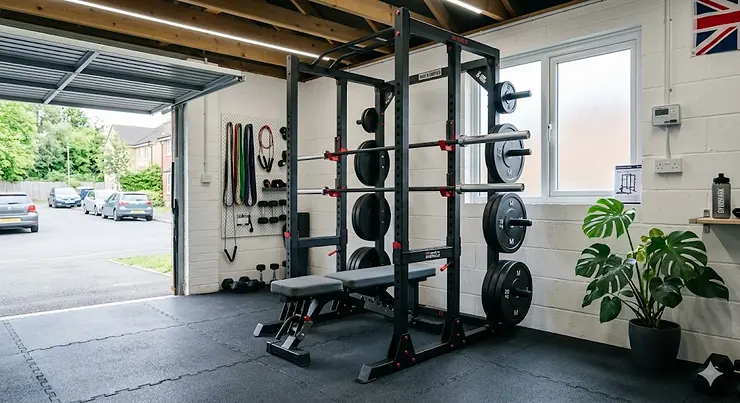
Setting up a proper home gym doesn’t require remortgaging the house or converting your entire garage into a commercial-grade facility. What most British home gym enthusiasts overlook is this: a decent budget power rack delivers 90% of the functionality of premium cages at less than half the cost, making it the single most valuable investment for strength training at home.
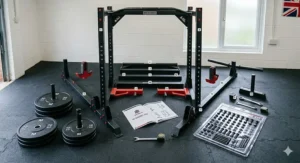
The UK home fitness market has exploded since 2020, and with it has come a flood of affordable power racks designed specifically for compact British homes. As consumer champion Which? magazine notes, investing in home gym equipment can save money in the long run compared to expensive gym memberships. Whether you’re working with a spare bedroom, a single garage, or even a corner of your dining room, today’s budget power racks accommodate the spatial reality of UK living whilst providing safe, effective strength training. From squats and bench press to pull-ups and dips, these versatile cages transform limited space into a comprehensive training hub.
Here’s what makes 2026 the ideal time to invest: manufacturers have refined their budget offerings considerably, delivering better steel quality, improved safety features, and more thoughtful design at price points that seemed impossible just three years ago. This guide examines seven genuinely excellent power racks all available on Amazon.co.uk, priced comfortably under £500, with honest commentary on what works, what doesn’t, and who each model suits best. No marketing waffle—just practical insight from someone who understands that British budgets, homes, and training needs differ markedly from American assumptions.
Quick Comparison: Best Budget Power Racks at a Glance
| Power Rack Model | Price Range (GBP) | Max Load Capacity | Best For | Key Feature |
|---|---|---|---|---|
| BodyMax CF375 | £300-£360 | 136 kg | Beginners with limited space | Compact footprint with optional pulley |
| Mirafit M100 | £240-£290 | 250 kg | Intermediate lifters | 17 adjustable levels, solid spotters |
| WINNOW Multi-Functional | £200-£280 | 200 kg | Budget-conscious starters | 21 adjustment positions, plate storage |
| Phoenix Fitness Power Rack | £550-£650 | 250 kg | Serious home trainers | Integrated cable system included |
| SPORTNOW Cable Crossover | £260-£320 | 120 kg rack / 50 kg cables | Versatile training fans | Built-in pulley system |
| Mirafit M200 | £310-£380 | 300 kg | Growing strength athletes | 60 mm steel frame, UHMW liners |
| GYM MASTER GM1 | £380-£480 | 300 kg+ | Advanced home lifters | Optional dual pulley upgrade |
💬 Just one click — help others make better buying decisions too! 😊
Top 7 Budget Power Racks — Expert Analysis
1. BodyMax CF375 Power Rack — The British Classic
The BodyMax CF375 has dominated UK home gym discussions for years, and whilst it’s showing its age against newer competition, it remains a solid entry point for beginners building their first rack-based setup.
Key Specifications:
- Steel construction: 50 x 50 mm box section, 1.5 mm wall thickness (14 gauge steel)
- Max capacity: 136 kg on spotter bars and J-hooks
- Hole spacing: 75 mm between adjustment positions
- Footprint: Approximately 120 cm (W) x 140 cm (D) x 205 cm (H)
- Weight: 46 kg
Here’s what the spec sheet won’t tell you: that 46 kg total weight makes this cage remarkably light for a power rack, which translates to some wobble during aggressive pull-ups or heavy re-racks. British buyers consistently report needing to weight down the base with Olympic plates to prevent the cage shifting on gym matting—not a dealbreaker, but worth factoring into your decision if you’re planning serious overhead work. The 14-gauge steel construction keeps costs down but feels noticeably thinner than the 11-gauge standard on pricier racks.
The 136 kg capacity suits natural bodybuilders and early-intermediate lifters perfectly well, but if you’re already squatting your bodyweight for reps, you’ll outgrow this fairly quickly. UK reviewers mention the sabre-style safety bars require about a metre of clearance in front of the cage to insert properly—something that proves awkward in single garages or spare bedrooms where every centimetre matters.
Customer Feedback Summary: Amazon.co.uk buyers appreciate the straightforward assembly (roughly two hours solo) and the inclusion of multi-grip pull-up bars. Complaints centre on the cage’s tendency to rock during dynamic movements and the thin powder coating that chips relatively easily. Several UK buyers note rust appearing within 12-18 months in damp garages, particularly around weld points—typical for this price bracket but manageable with occasional maintenance.
Pros:
✅ Compact design suits smaller British homes and garages
✅ Optional lat/low pulley attachment expands exercise variety significantly
✅ Widely available with established UK customer service
Cons:
❌ Light weight requires anchoring for stability
❌ 136 kg capacity becomes limiting as strength progresses
Price Range & Value Verdict: Around £300-£360 on Amazon.co.uk makes this competitive, though the Mirafit M100 offers better specifications at similar pricing. Best suited for beginners training under 100 kg loads who value the established brand reputation and don’t mind bolting plates to the base for stability.
2. Mirafit M100 Power Rack — The Smart Budget Choice
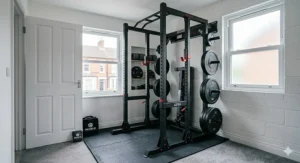
If I were spending my own money on a budget power rack today, the Mirafit M100 would get my £280. This British manufacturer understands UK home gym constraints better than overseas brands, delivering thoughtful design that punches well above its price point.
Key Specifications:
- Commercial-grade steel frame with powder coating
- Max load: 250 kg rack capacity, 110 kg pull-up bar
- 17 adjustable height positions with 75 mm hole spacing
- Includes UHMW-lined J-cups and solid steel spotter bars
- Dimensions: 122 cm (W) x 130 cm (D) x 218 cm (H)
- Compatible with full range of M100 attachments
The jump from 136 kg to 250 kg capacity matters more than the numbers suggest. Most intermediate lifters in the UK work in the 100-180 kg range for compound lifts, meaning the M100 accommodates your progression for years rather than months. The UHMW plastic liners on the J-cups protect your barbell from scratches whilst reducing noise—crucial when training in attached garages or converted bedrooms where neighbours might object to metal-on-metal clanging at 6 am.
Mirafit ships this in multiple boxes, which UK delivery drivers sometimes deliver on separate days—frustrating but manageable. The actual assembly takes 2-3 hours for one person, less if you’ve got a mate and a drill with socket attachments. Unlike the BodyMax, this cage feels planted once assembled, though Mirafit still recommends bolting to concrete floors for maximum stability. The pre-drilled footplates accept standard M10 fixings, and whilst the bolts aren’t included, they cost under £5 from any UK DIY shop.
Customer Feedback Summary: Recent UK buyers on Amazon.co.uk consistently praise the build quality relative to price, with several noting it feels comparable to racks costing £400+. The orange powder coat option divides opinion—some love the high-vis aesthetic, others find it garish—but the black version blends into most gym setups. A few complaints mention minor scratches on delivery, though these seem cosmetic rather than structural.
Pros:
✅ 250 kg capacity accommodates intermediate to advanced lifting
✅ UHMW-lined attachments protect barbell and reduce noise
✅ Extensive attachment ecosystem allows future expansion
Cons:
❌ Multi-box delivery sometimes arrives on different days
❌ Requires floor bolting for optimal stability (bolts not included)
Price Range & Value Verdict: At £240-£290 on Amazon.co.uk, this represents exceptional value. It’s roughly £40 more than the absolute cheapest options but delivers specifications that compete with £400+ cages. Ideal for intermediate lifters who’ll train consistently for 3-5+ years and want room to progress without replacing equipment.
3. WINNOW Power Cage Multi-Functional — Maximum Features, Minimum Spend
The WINNOW Power Cage exemplifies the current state of budget fitness equipment: Chinese manufacturing, sold via Amazon UK, delivering surprisingly complete feature sets at prices that seemed impossible a decade ago.
Key Specifications:
- Heavy-duty steel frame with commercial-grade powder coating
- 21 vertical adjustment holes for maximum customisation
- Max capacity: Approximately 200 kg
- Includes J-hooks with rubber padding, spotter bars, dip handles, landmine attachment
- Weight: 27 kg (notably light)
- Dimensions: 111 cm (H) x 114 cm (D) x 68 cm (W)
That 27 kg weight raises immediate questions. This cage achieves its low price partly through thinner gauge steel and a relatively compact frame. For beginners working with 40-80 kg loads, it functions perfectly well. Push beyond 120 kg on squats, and you’ll notice flex in the frame during heavy re-racks. The 21 adjustment holes provide excellent flexibility for different exercises and user heights, though the hole spacing varies throughout the rack rather than maintaining consistent intervals.
The included attachments represent genuine value—buying a landmine attachment, dip handles, and padded J-hooks separately would cost £80-£120. The multi-grip pull-up bar offers wide, narrow, and neutral grip positions, accommodating different back training preferences. However, the curved bar design that WINNOW markets as “user-friendly” actually positions some grip options at awkward angles, particularly for taller users.
Customer Feedback Summary: UK buyers on Amazon.co.uk appreciate the complete package and relatively simple assembly. Italian and German reviews (visible on the UK store) note the cage handles moderate weights adequately but isn’t suitable for powerlifting-level loads. Several mention the rubber feet providing inadequate grip on smooth floors, requiring gym matting underneath. One consistent praise point: the thick padded J-hooks genuinely protect barbells better than bare metal alternatives at this price.
Pros:
✅ Comprehensive attachment package (landmine, dips, padded hooks) included
✅ 21 adjustment positions suit various exercises and user heights
✅ Under £280 delivers exceptional feature-to-price ratio
Cons:
❌ 27 kg weight feels unstable under heavy loads without anchoring
❌ Not suitable for powerlifting-level loads beyond 150-180 kg
Price Range & Value Verdict: Around £200-£280 on Amazon.co.uk makes this the budget king for beginners who want maximum versatility immediately. It’s a brilliant first rack that’ll serve you well for 12-24 months of progressive training, after which most users upgrade to something with greater capacity. University students, first-time gym builders, or anyone unsure about long-term commitment will find this a low-risk entry point.
4. Phoenix Fitness Power Rack — Premium Budget Option
The Phoenix Fitness Power Rack technically exceeds strict budget parameters at £550-£650, but it merits inclusion for delivering mid-range specifications at entry-level plus pricing, particularly for UK buyers who value integrated cable systems.
Key Specifications:
- High-quality carbon steel construction with powder coating
- 13 adjustable levels throughout the rack
- Max load: 250 kg on rack, separate cable system capacity
- Includes cable pulley system, straight bar, wide lat pulldown bar, J-cups, spotter arms, multi-grip pull-up bars, and dip bars
- Dimensions: 110 cm (W) x 140 cm (D) x 205-220 cm (H adjustable)
Phoenix Fitness, a UK-based brand, designs equipment accounting for British ceiling heights, garage dimensions, and the reality that most of us train in converted spaces rather than purpose-built gyms. The included cable pulley system—which other manufacturers charge £150-£200 for as an add-on—transforms this from a simple cage into a comprehensive training station capable of lat pulldowns, cable flyes, tricep extensions, and dozens of isolation movements.
The 13-level adjustment provides sufficient granularity for most exercises, though lifters accustomed to Westside spacing might find it less precise for bench press setup. Build quality surpasses the ultra-budget options considerably: thicker gauge steel, more robust welds, and powder coating that resists chips better during regular use. The multi-grip pull-up bar offers proper width variation, and the dip bars feel stable under bodyweight plus added load.
Customer Feedback Summary: Amazon.co.uk reviews lean heavily positive, with buyers particularly appreciating the cable system integration and the brand’s responsive UK customer service. A few mention receiving units with minor cosmetic scratches, though Phoenix typically resolves these quickly. Assembly takes 3-4 hours solo, less with help, and requires careful attention to the cable routing instructions. One recurring comment: the straight bar attachment for cables feels thin compared to commercial gym equipment, though it functions adequately for home use.
Pros:
✅ Integrated cable pulley system saves £150+ compared to separate purchase
✅ UK-based brand understands British home gym constraints
✅ Comprehensive attachment package eliminates immediate upgrade needs
Cons:
❌ £550-£650 price pushes boundaries of “budget” category
❌ Cable system takes significant rear clearance space
Price Range & Value Verdict: At £550-£650 on Amazon.co.uk (occasionally discounted to around £490-£530), this represents excellent value if you definitely want integrated cables and plan to use them regularly. For pure rack functionality, the Mirafit M100 delivers 95% of the utility at £250 less. Best suited for intermediate lifters who’ve identified cable work as essential to their training and want an all-in-one solution.
5. SPORTNOW Cable Crossover Machine — The Versatility Champion
The SPORTNOW Cable Crossover Machine takes a different approach to the budget power rack category: rather than maximising load capacity, it prioritises exercise variety through integrated cable systems at genuinely budget pricing.
Key Specifications:
- Steel frame construction with 15-level adjustable rack
- Rack weight capacity: 120 kg
- Cable system capacity: 25 kg per arm (50 kg total)
- Compatible with 1″ and 2″ Olympic weight plates
- Includes pull-up bar, lat pulldown attachment, low row attachment
- Dimensions: 152 cm (L) x 105 cm (W) x 212 cm (H)
That 120 kg rack capacity represents this unit’s primary limitation and intended market positioning. SPORTNOW explicitly targets home users focused on muscle building and conditioning rather than maximal strength development. If your goal involves progressive overload toward a 200 kg squat, look elsewhere. If you’re after muscle definition, functional fitness, or maintaining strength whilst prioritising cable work, this delivers surprising utility.
The cable system uses plate-loaded weight stacks, meaning you control resistance by adding your own Olympic plates to the pin. This keeps costs down versus weight stack systems but requires Olympic plates as a separate investment. The 50 kg total cable capacity handles most accessory work adequately—lat pulldowns, flyes, tricep extensions, face pulls—though serious back training might demand more resistance than 25 kg per arm provides.
British buyers should note the rack width accommodates standard Olympic 7ft barbells comfortably but may feel cramped with particularly wide grip bench pressing. The 15-level adjustment provides reasonable granularity, and the pull-up bar includes multiple grip options. Assembly requires 2-3 hours and benefits from having a second person for cable routing.
Customer Feedback Summary: UK Amazon reviews show solid 4+ star ratings, with buyers appreciating the complete package at this price point. Complaints typically centre on the 120 kg rack capacity feeling limiting for squatters and the cable system feeling less smooth than commercial gym equipment. Several mention the unit’s footprint requiring more space than anticipated once cables are factored in—measure carefully before purchase if working with tight quarters.
Pros:
✅ Integrated cable system at genuinely budget pricing (£260-£320)
✅ Versatile training options suit bodybuilding and conditioning goals
✅ Plate-loaded cables allow progressive resistance as strength improves
Cons:
❌ 120 kg rack capacity insufficient for serious strength development
❌ Cable smoothness acceptable but noticeably inferior to premium units
Price Range & Value Verdict: Around £260-£320 on Amazon.co.uk positions this as the value option for muscle-building focused trainers rather than pure strength athletes. It’s an excellent choice for bodyweight plus moderate loading, particularly if cable exercises form a significant portion of your programming. Less suitable for anyone pursuing heavy barbell work as a primary focus.
6. Mirafit M200 Power Rack — The Capacity Upgrade
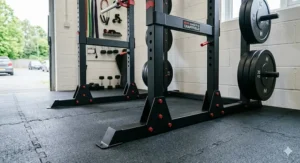
For UK lifters who’ve progressed beyond beginner racks but aren’t ready to spend £600+, the Mirafit M200 offers legitimate 300 kg capacity at mid-budget pricing, making it the sweet spot for intermediate to advanced home trainers.
Key Specifications:
- 60 mm steel frame (versus 50 mm on cheaper models)
- 300 kg rated capacity across rack, spotters, and J-cups
- UHMW-lined safety spotters and J-cups as standard
- Compatible with optional M200 cable system (sold separately)
- Available in 220 cm or 183 cm (6ft) height variants
- Black or orange powder coat finish
The jump to 60 mm frame tubing makes a tangible difference in rigidity during heavy lifts. Re-rack a 150 kg squat on a 50 mm frame cage and you’ll feel noticeable flex; the M200 absorbs that impact with minimal movement. This matters enormously for solo training where safety depends on equipment stability. The 300 kg rating isn’t just theoretical—British buyers report using this rack consistently with 180-220 kg loads over multiple years without issues.
Mirafit’s UHMW liners (ultra-high molecular weight polyethylene) protect both your barbell and your neighbours’ patience. Metal-on-metal J-cups produce a sharp clang every re-rack; UHMW-lined versions dampen noise by roughly 60-70%, crucial for attached garage gyms or first-floor spare rooms. The liners also prevent the micro-scratches that gradually damage barbell knurling over hundreds of workouts.
The optional cable system uses Mirafit’s simple bolt-on design, allowing future upgrade without replacing the entire rack. This modular approach suits British budgets well—buy the base rack now, add cables in 6-12 months once finances recover from the initial gym build. The 220 cm height suits standard UK ceiling heights comfortably, whilst the 183 cm version accommodates lower ceilings in older properties or converted lofts.
Customer Feedback Summary: Recent Amazon.co.uk buyers consistently praise the build quality, with many noting it exceeds expectations for the price point. The orange finish proves somewhat contentious—lovers appreciate the visual pop in garage gyms, detractors find it overly bright. Assembly takes 2-3 hours solo and benefits from Mirafit’s YouTube video guide, which addresses common mistakes not obvious from the printed instructions. A few mention the multi-box delivery occasionally arriving over 2-3 days rather than simultaneously.
Pros:
✅ 300 kg capacity accommodates serious strength progression
✅ 60 mm frame provides noticeably superior rigidity versus thinner options
✅ UHMW liners protect equipment and reduce noise significantly
Cons:
❌ Optional cable system sold separately (£150-£180 additional)
❌ Orange finish won’t suit all aesthetic preferences
Price Range & Value Verdict: At £310-£380 on Amazon.co.uk, the M200 represents the upper boundary of budget whilst delivering mid-range specifications. It’s roughly £70-£100 more than the M100 but provides meaningfully superior load capacity and rigidity. Ideal for intermediate lifters (1-3 years consistent training) who’ve identified strength training as a long-term commitment and want equipment that won’t require replacement as numbers climb.
7. GYM MASTER GM1 Power Rack Squat Cage — The Budget-Plus Investment
The GYM MASTER GM1 pushes firmly into premium budget territory at £380-£480, but for UK lifters who want commercial-gym feel at home-gym pricing, it merits serious consideration as a buy-once solution.
Key Specifications:
- Heavy-duty steel construction rated for 300 kg+
- Pre-drilled holes throughout for extensive attachment compatibility
- Includes J-hooks, spotter arms, multi-grip pull-up bar
- Optional dual pulley cable system available (£200-£250 additional)
- Dimensions designed for UK garage and spare room constraints
- Black powder coat with weather-resistant treatment
The GYM MASTER represents the point where budget equipment transitions toward genuine commercial-grade quality. The steel gauge, weld quality, and powder coat thickness all exceed what you’ll find on sub-£300 options, translating to equipment that’ll serve reliably for 5-10+ years rather than 2-3. The rack arrives in commercial-style packaging designed to survive courier handling, reducing the cosmetic damage complaints common with cheaper units.
Pre-drilled attachment holes throughout the uprights provide extensive customisation potential. Add landmine attachments, band pegs, plate storage, dip bars—the ecosystem accommodates dozens of add-ons without requiring new drill holes that could compromise frame integrity. This futureproofing suits lifters who anticipate their training evolving and want a rack that adapts rather than limits.
The optional dual pulley cable system uses commercial-grade components rather than budget equivalents, with sealed bearings and aircraft-grade cables that run noticeably smoother than cheap alternatives. At £200-£250 additional, it’s expensive—but compare that to commercial cable systems at £600-£1,000, and the value proposition clarifies. Total investment of £600-£700 buys a comprehensive training station rivalling £1,200+ commercial setups.
Customer Feedback Summary: UK buyers on Amazon.co.uk rate this highly, particularly those upgrading from cheaper racks who immediately notice the quality difference. Common praise points include the rack’s stability without floor bolting (though bolting still recommended), the smooth powder coat finish, and customer service responsiveness. Complaints occasionally mention complex assembly instructions, though this seems less frequent with recent purchases suggesting improved documentation.
Pros:
✅ Commercial-grade quality at home gym pricing
✅ Extensive attachment compatibility enables long-term expansion
✅ Built to last 5-10+ years of consistent heavy use
Cons:
❌ £380-£480 base price before optional cable system
❌ Heavier weight makes solo assembly more challenging
Price Range & Value Verdict: At £380-£480 (base rack only) on Amazon.co.uk, this exceeds many people’s budget ceiling for home gym equipment. However, for serious lifters planning 5+ years of consistent training, the total cost of ownership favours buying quality once rather than upgrading twice. Best suited for experienced lifters who’ve identified strength training as a lifestyle rather than an experiment and want equipment matching that commitment.
Setting Up Your Budget Power Rack: Practical UK Installation Guide
Buying the rack represents just half the battle—proper installation determines whether you’re training safely or creating hazards. Here’s what British home gym builders need to know that manufacturers conveniently omit from instruction manuals.
Floor Considerations for British Homes
Most UK properties feature concrete garage floors or timber-framed upper floors, each presenting distinct challenges. For concrete garage installations, bolt-down mounting dramatically improves stability, particularly with lighter budget racks. According to UK building regulations guidance from the Planning Portal, detached garages under 30m² typically don’t require building control approval, though proper installation remains important for safety. Masonry bolts (M10 x 75 mm minimum) cost roughly £8-£12 for a pack of four from Screwfix or Toolstation—don’t skip this £10 investment on a £300 rack.
Timber-framed floors require different thinking. Bolting through floorboards into joists works if joists run perpendicular to your intended rack placement and you’re confident locating them accurately. Many British home gym builders in upstairs rooms opt for heavy rubber gym flooring (20-25 mm thickness) plus weight plates on the rack base rather than floor penetration. This spreads load better and avoids angering the structural engineer when you eventually sell.
Spatial Planning for Compact British Homes
The rack itself occupies X space, but functional space requirements extend further. Budget roughly 30 cm clearance minimum on all sides for safe barbell loading/unloading. For rack-mounted accessories like cables or dip bars, factor another 60-80 cm behind the rack. Total minimum footprint: rack dimensions plus approximately 1.2 metres additional depth and 60 cm width per side.
UK ceiling heights present the next constraint. Standard British homes feature 2.4 m ceilings, whilst older properties and conversions sometimes measure just 2.2-2.3 m. Most power racks extend to 2.05-2.2 m height, leaving minimal clearance for pull-ups or overhead pressing. Measure carefully: if ceiling height minus rack height leaves less than 40 cm, taller users (over 185 cm) will struggle with overhead movements. Consider shorter rack variants or wall-mounted pull-up bars as alternatives.
British Weather and Rack Maintenance
Here’s what manufacturers won’t tell you: budget powder coating often fails within 12-24 months in typical British garage conditions. Damp coastal air, winter condensation, and general moisture accelerate rust at weld points and bolt holes. Mitigate this with annual maintenance: wipe down after sweaty sessions, apply light machine oil to moving parts quarterly, and consider garage dehumidifiers if rust appears early.
Outdoor storage represents another matter entirely. Unless you’ve got a weatherproof garden gym building (rare in British property layouts), keeping budget racks outdoors shortens lifespan dramatically. Even weather-resistant powder coating eventually fails when exposed to months of British drizzle. If outdoor storage proves unavoidable, invest in commercial-grade waterproof covers (£40-£60) and remove barbells/cables when not training to prevent accelerated deterioration.
Budget Power Rack vs Traditional Squat Stands: Making the Right Choice
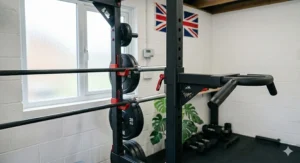
Before committing to a full cage, British home gym builders should consider whether traditional squat stands better suit their needs. Power racks (also known as power cages) function as mechanical spotters for free weight barbell exercises, offering four upright posts with adjustable safety catches. Here’s the honest comparison the equipment manufacturers won’t provide.
When Squat Stands Win: Stands occupy roughly 60% less floor space than full cages, crucial in terraced house conversions or flat spare rooms. They typically cost £80-£150 versus £200-£400 for budget cages. For lifters focusing primarily on squats and overhead pressing with minimal bench work, stands deliver core functionality without spatial commitment. Also consider stands if you’re genuinely uncertain about home training longevity—it’s easier to offload £120 stands than a £350 cage should interest wane.
When Power Racks Prove Essential: Safety represents the decisive factor. Power racks provide safety catches on all four sides, meaning failed lifts get caught reliably regardless of direction. Training alone (as most British home gym users do) without safety catches means one failed rep could mean injury or equipment damage. If you’re pushing intensity and occasionally training to failure, the rack’s safety system justifies the additional space and cost.
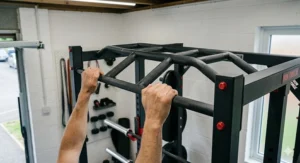
Racks also enable significantly more exercise variety. Pull-ups, dips, cable work (with attachments), inverted rows, band-resisted movements—a properly equipped rack functions as a comprehensive training station. Stands accommodate squats, presses, and little else. For lifters pursuing varied programming, the rack’s versatility repays the investment quickly.
The British Compromise: Many UK home gym builders start with adjustable stands, train for 6-12 months to confirm commitment, then upgrade to a rack once they’ve identified weaknesses in the standalone approach. This phased investment spreads costs whilst minimising risk of expensive equipment gathering dust. Stands also retain decent resale value on Facebook Marketplace or Gumtree, partially funding the rack upgrade.
Common Mistakes When Buying Budget Power Racks in the UK
British home gym builders consistently make these errors, most of which only become apparent after delivery when return windows have closed.
Mistake 1: Ignoring Import Specifications on “UK” Listings
Amazon.co.uk hosts numerous sellers shipping from overseas warehouses, sometimes listing equipment designed for US/European markets under UK product pages. Check carefully: racks designed for US markets often assume higher ceilings (2.7-3 m), wider garage bays, and different floor construction. Whilst you can technically use them, they’re optimised for spatial constraints we don’t have in Britain. Prioritise manufacturers who explicitly design for UK homes—Mirafit, BodyMax, Phoenix Fitness.
Mistake 2: Underestimating Assembly Complexity Solo
Instruction manuals invariably claim “easy assembly” whilst neglecting to mention that “easy” assumes two adults, a full socket set, and three hours minimum. British buyers working solo report assembly taking 4-6 hours for budget racks, with particular challenges around frame alignment before final bolt tightening. If attempting solo, budget double the stated time and consider magnetic drilling guides (£12-£15) to prevent wobbly holes if additional drilling proves necessary.
Mistake 3: Maximising Capacity Immediately
Budget racks rated for 200-250 kg don’t mean you should immediately load 200 kg. Manufacturers rate maximum capacity—the point where catastrophic failure risk becomes unacceptable. Sensible working loads sit at 60-70% of rated maximum for equipment longevity and safety margin. On a 200 kg rated rack, comfortable working maximum should be 120-140 kg. Exceed this regularly, and you’ll accelerate wear on spotter arms, J-hooks, and frame flex points.
Mistake 4: Skipping Garage Insurance Notification
British home insurance policies sometimes require notification when garages contain significant value fitness equipment or when modifications (like floor bolting) occur. Whilst many people skip this, it potentially voids cover if you need to claim for theft or damage. A quick email to your insurer typically costs nothing and ensures you’re protected if someone nicks your £400 rack from your garage.
Mistake 5: Ignoring Long-Term Space for Barbell Storage
The rack lives permanently in your garage; fine. But where are you storing the 7ft Olympic barbell, 100-150 kg of plates, adjustable bench, and various accessories? British garages and spare rooms fill quickly once you account for actual training setup. Budget at least 2 x 1.5 metres of additional space beyond the rack footprint for equipment storage, or accept that your “home gym” becomes a permanent fixture that prevents parking your car in the garage (a common British home gym builder confession).
What Heavy Lifters Won’t Tell You About Budget Power Racks
Having trained on both budget and premium racks over the past eight years, here’s the reality check that online reviews strategically avoid mentioning.
Budget Racks Develop Character (Not Always Good Character)
Cheap powder coating chips. Within 6-12 months, you’ll notice exposed metal at high-friction points—where J-hooks slide on uprights, where safety spotters adjust, where your knees occasionally knock the frame during positioning. This isn’t catastrophic, but it does look shabby faster than you’d prefer. Touch-up paint (£6-£8) from automotive suppliers matched to your rack colour helps, but expect that factory-fresh appearance to deteriorate noticeably faster than on premium equipment.
The Noise Factor in Attached Properties
British homes sit closer together than US equivalents, and terraced or semi-detached properties share walls directly with neighbours. Metal-on-metal contact produces surprising noise levels—re-racking heavy squats at 6 am will likely wake the neighbours. UHMW-lined J-hooks help considerably, but they’re not standard on budget racks under £250. Budget £30-£40 for aftermarket padded hooks if training in attached properties and maintaining neighbourly relations matters to you.
Progressive Overload Eventually Requires Equipment Overload
The uncomfortable truth: most budget racks become limiting factors within 18-36 months for consistent trainers. A 250 kg capacity seems generous when you’re squatting 80 kg, less so when you’re approaching 150 kg for reps. Factor replacement costs into your budget—that £280 rack likely needs upgrading to a £500-£600 unit once you’ve achieved intermediate strength levels. This isn’t failure; it’s successful progression. But it does mean total home gym costs exceed initial equipment purchase.
Frequently Asked Questions
❓ Are budget power racks safe enough for solo training in UK homes?
❓ Do I need to bolt my power rack to the floor in a UK garage?
❓ What's the minimum ceiling height needed for a power rack in UK homes?
❓ Can budget power racks handle British weather in garage gyms?
❓ Which budget power rack offers the best value for UK buyers in 2026?
Conclusion: Your Budget Power Rack Decision Matrix
Choosing a budget power rack ultimately depends less on objective “best” rankings and more on honest assessment of your training goals, spatial constraints, and realistic timeline for progression.
Choose the WINNOW Multi-Functional (£200-£280) if: You’re beginning strength training, working with under 100 kg loads currently, value maximum accessory inclusion immediately, and accept 18-24 month equipment lifespan before potential upgrade.
Choose the Mirafit M100 (£240-£290) if: You’re past absolute beginner stage or anticipate rapid progression, value British manufacturer support, want 3-5 year equipment lifespan, and prioritise capacity over integrated accessories.
Choose the BodyMax CF375 (£300-£360) if: Brand recognition and established UK customer service outweigh slightly inferior specifications versus competitors, and you’re comfortable with 136 kg capacity limitations long-term.
Choose the SPORTNOW Cable Crossover (£260-£320) if: Your training emphasises muscle building and conditioning over pure strength, you’ll genuinely use integrated cables regularly, and 120 kg rack capacity suffices for your programming.
Choose the Mirafit M200 (£310-£380) if: You’ve achieved intermediate strength levels (100+ kg squat), identified strength training as long-term commitment, and want capacity accommodating 3-5 years of continued progression.
Choose the Phoenix Fitness Power Rack (£550-£650) if: Integrated cable systems prove essential to your training, you want comprehensive all-in-one functionality immediately, and the price sits within your budget despite exceeding strict “budget” parameters.
Choose the GYM MASTER GM1 (£380-£480) if: You want commercial-grade quality at home pricing, plan 5-10+ years of consistent training, and view equipment as buy-once investment rather than temporary solution.
The British home gym landscape has evolved remarkably. Where five years ago, budget racks meant compromising extensively on quality and safety, today’s market delivers genuinely functional equipment at prices that won’t destroy monthly budgets. Whether you’re converting a spare bedroom in Manchester, optimising a single garage in Bristol, or claiming corner space in a London flat, there’s a budget power rack designed specifically for how we train in Britain—compact homes, variable weather, and pragmatic budgets that balance fitness goals against life’s other financial demands.
Your home gym transformation starts with honest assessment: what do you genuinely need versus what seems appealing? The rack that serves you best isn’t necessarily the highest-rated or most feature-packed; it’s the one matching your actual training style, realistic progression timeline, and available space. Choose thoughtfully, train consistently, and that £280-£480 investment will deliver years of strength gains without requiring commercial gym memberships or navigating January crowds at your local leisure centre.
Recommended for You
- 7 Best Commercial Grade Power Racks UK 2026
- 7 Best Power Rack for Home Gym UK: Expert Reviews 2026
- 7 Best Heavy Duty Assault Bike for CrossFit at Home UK 2026
Disclaimer: This article contains affiliate links. As an Amazon Associate, I earn from qualifying purchases. If you purchase products through these links, we may earn a small commission at no additional cost to you.
✨ Found this helpful? Share it with your mates! 💬🤗
