
In This Article
There’s a particular kind of satisfaction that comes from owning your own lat pulldown machine. It’s the satisfaction of skipping the gym, saving a small fortune in monthly membership fees, and training in your pants at 10pm on a Tuesday — no judgement, no queue, no one hogging the cable stack for forty minutes while staring at their phone.
But here’s the thing: buying a lat pulldown machine in the UK is genuinely confusing. The market is awash with suspiciously similar-looking equipment, vague spec sheets, and products that seem to have been named by randomly combining words like “Pro,” “Max,” “Flex,” and “Force.” Knowing which machines are actually worth your money takes a bit of work.
A lat pulldown machine is, at its core, a cable pulley system that lets you pull a bar down towards your chest or neck from an overhead position. This isolates and develops the latissimus dorsi — the broad, wing-shaped muscles that run along your back — as well as the rhomboids, posterior deltoids, and biceps. Research consistently supports lat pulldowns as one of the most effective upper-body compound movements for building both strength and that coveted V-shaped physique. Good posture is a welcome side effect, particularly welcome for the vast majority of us who spend our working hours hunched over laptops like we’re auditioning for a Quasimodo biopic.
For the home gym buyer in the UK in 2026, the options range from compact plate-loaded towers that would fit in a spare bedroom to wall-mounted cable stations that slot neatly above the utility cupboard. This guide covers seven real products, all currently available on Amazon.co.uk, reviewed with the kind of candour you’d expect from a knowledgeable mate rather than a marketing brochure.
Quick Comparison: Top 7 Lat Pulldown Machines UK at a Glance
| Product | Type | Max Load | Footprint | Best For | Price Range |
|---|---|---|---|---|---|
| GYM MASTER Stationary Lat Pulldown Machine | Plate-loaded tower | 120 kg | 179×61×121 cm | Budget beginners | Under £150 |
| HOMCOM Lat Pull Down Machine | Plate-loaded + low row | 60 kg plates / 160 kg user | 190×107×120 cm | General fitness / toning | £100–£160 |
| RIP X Stationary Lat Pulldown Machine | Plate-loaded tower | 130 kg | 202×60×139 cm | Intermediate lifters | £150–£250 |
| SPORTNOW Lat Pull Down Machine | High/low pulley tower | 50 kg plates | Compact | Budget dual-function | £150–£230 |
| HOMCOM Multi Gym 45kg Weight Stack | Selectorised multigym | 45 kg stack / 110 kg user | Full multigym | All-in-one beginners | £250–£350 |
| SPORTNOW Wall Mounted Lat Pulldown | Wall-mounted cable | 100 kg | Minimal floor space | Space-saving home gyms | £150–£250 |
| Strongway Cable Crossover 75KG | Freestanding dual pulley | 75 kg stack + pull-up bar | Large | Serious home gym builders | £350–£550 |
What jumps out immediately is how dramatically the type of machine shapes the experience. The selectorised HOMCOM Multi Gym and Strongway Crossover deliver instant weight changes with a pin — brilliant for circuits and drop sets. The plate-loaded towers (GYM MASTER, RIP X, SPORTNOW) cost less upfront but require you to actually own weight plates, which is a cost many buyers overlook entirely. Wall mounting suits smaller properties, which — given that the average UK home is considerably more compact than its American counterpart — is rather more relevant here than the spec sheets suggest.
💬 Just one click — help others make better buying decisions too! 😊
✨ Don’t Miss These Exclusive Deals!
🔍 Take your back training to the next level with these carefully selected products. Click any highlighted item to check current pricing and availability on Amazon.co.uk — these picks will help you find exactly what you need!
Top 7 Lat Pulldown Machines UK 2026: Expert Analysis
1. GYM MASTER Stationary Lat Pulldown Machine
The GYM MASTER Stationary Lat Pulldown is the everyman’s entry point. It’s a small British brand with a refreshingly straightforward product: a steel-framed, plate-loaded lat tower that does exactly what it says on the tin, without any theatrical claims about transforming your physique within a fortnight. At just 61 cm wide and 121 cm deep, it fits into spaces that more ambitious machines would never dream of occupying.
The frame handles up to 120 kg of loaded weight and supports users up to 150 kg, which is more capacity than most beginners will ever need. The 179 cm overall height clears standard UK ceiling heights comfortably, though taller users should check that they have adequate overhead clearance for a full range of motion during the pulldown. It’s compatible with both 1-inch and 2-inch weight plates via included adapters — a thoughtful touch for those whose existing plate collection may be mixed.
What the spec sheet won’t tell you is that this machine suits beginners building a habit, not intermediates chasing a personal record. The frame is solid enough for regular home use, but it’s not built for daily heavy loading. For someone easing into back training two or three times a week, it’s excellent. For someone already pulling their bodyweight on the cable, it’ll start feeling limiting within a year.
UK buyers have generally praised it for quick assembly — under an hour for most — and value for money. The ab crunch strap is a bonus that few competing machines at this price include.
Pros:
✅ Excellent value under £150
✅ Compact footprint — suits terraced houses and spare bedrooms
✅ Compatible with both 1″ and 2″ plates
Cons:
❌ Weight plates not included (add budget accordingly)
❌ Frame flex noticeable at heavier loads
Price range: under £150 — a genuinely good deal for its feature set. Check current price on Amazon.co.uk.

2. HOMCOM Lat Pull Down Machine with Extra Pulley
HOMCOM has quietly become one of the most popular budget fitness brands on Amazon.co.uk, and their lat pulldown machine is a good example of why. It’s a plate-loaded tower with a high pulley for lat pulldowns, a low pulley for seated rows, and a three-position adjustable padded seat — all within a 190×107×120 cm footprint.
The 60 kg plate capacity is the headline limitation here. That’s perfectly adequate for light-to-moderate training — particularly useful for toning, rehabilitation, or general fitness work — but anyone with serious strength goals will outgrow it reasonably quickly. The 160 kg maximum user weight is reassuringly high for a machine at this price point, meaning larger-framed users won’t feel like they’re testing the laws of physics every session. The four-legged base is noticeably stable, which matters when you’re pulling through your full range of motion and the machine is the only thing preventing an undignified backwards topple.
This machine is ideally suited to someone who isn’t yet lifting heavy, wants dual function (pulldown and seated row without re-configuring the machine), and is working within a tighter budget. It’s also a sensible choice if you’re setting up a home gym in a carpeted spare room and can’t bolt anything to the wall.
UK customers report straightforward assembly and solid day-to-day reliability. The padded rollers are comfortable, which matters if you’re using it regularly.
Pros:
✅ High/low dual pulley included as standard
✅ Three-position adjustable seat
✅ Sold and fulfilled by Amazon — fast UK delivery
Cons:
❌ 60 kg plate limit restricts advanced users
❌ Build finish is functional rather than premium
Price range: £100–£160 — solid value for a dual-function machine. Check current price on Amazon.co.uk.
3. RIP X Stationary Lat Pulldown Machine
RIP X is a British brand with a loyal following among home gym enthusiasts, and their lat pulldown machine is a step up from the entry-level competition in almost every meaningful way. The larger model stands 202 cm tall, supports up to 130 kg of loaded weight, accepts both 1-inch and 2-inch plates via included Olympic adapters, and arrives with a lat pulldown bar and a seated row bar — so you’re set up for two distinct movement patterns straight away.
The extra height is not incidental. At 202 cm, this machine accommodates taller users (think 6’2″+ individuals who genuinely need overhead clearance) without compromising their starting position, which is a genuine ergonomic advantage over cheaper, squatter rivals. The ab crunch strap attachment is included — something most brands charge extra for — and the padded seat is noticeably more comfortable than what you’d find on a budget competitor.
In terms of who this is for: it’s the intermediate home gym builder’s machine. Someone who’s been training for a year or two, is starting to pull meaningful weight, and wants a machine that’ll still feel relevant in three or four years rather than needing replacement as soon as progress kicks in. UK buyers consistently rate it as a “buy it once” purchase.
One honest note: the plastic weight sleeves have attracted some criticism for durability at higher loads. Worth monitoring and replacing proactively if needed — a small annoyance for an otherwise reliable machine.
Pros:
✅ 130 kg capacity — headroom for genuine progression
✅ 202 cm height suits tall users well
✅ Olympic plate adapters included — works with any weight plates
Cons:
❌ Plastic weight sleeves can show wear over time
❌ Footprint is larger than entry-level options
Price range: £150–£250 — justified step up for growing strength levels. Check current price on Amazon.co.uk.
4. SPORTNOW Lat Pull Down Machine with Adjustable Seat
SPORTNOW (the fitness arm of Aosom UK, a well-established British e-commerce operation) brings a high/low pulley tower with a flip-up footplate — a feature that distinguishes it from several competing machines at a similar price. That flip-up footplate matters more than it sounds. When seated rowing, you want something solid to brace against. Without it, you end up shuffling uncomfortably and compromising your pulling mechanics.
The machine’s 50 kg plate capacity is on the modest side, but the ergonomic handle design and adjustable seat height make it a genuinely pleasant machine to use at moderate weights. The dual-function setup — pulldowns from above, seated rows from below — means you’re training the full pull continuum of your upper back without investing in two separate machines. The compact dimensions suit UK homes where spare-room gym space is measured in metres rather than square footage.
SPORTNOW’s UK warehouse stock means fast delivery — typically next-day for Prime members — and the brand’s customer service is UK-based, which simplifies any after-sales issues considerably.
This machine suits someone in a smaller flat or a compact home gym who wants versatile cable training without a large footprint, and who isn’t planning to move enormous weights. Think office workers doing thirty-minute back sessions before dinner, not powerlifters maxing out on every rep.
Pros:
✅ Flip-up footplate — proper bracing for seated rows
✅ Sold by Aosom UK — fast delivery, UK customer service
✅ Compact and manoeuvrable
Cons:
❌ 50 kg plate limit — limited ceiling for stronger users
❌ Less build robustness than mid-range competitors
Price range: £150–£230 — good versatility for the money. Check current price on Amazon.co.uk.
5. HOMCOM Multi Gym with 45 kg Weight Stack
This is a different beast entirely. Rather than a standalone lat pulldown tower, the HOMCOM Multi Gym with 45 kg Weight Stack is a selectorised multigym — meaning the resistance lives in a built-in weight stack that you adjust with a pin, like a commercial gym machine. This changes the experience completely. No loading plates, no hunting for collars, no faffing. You drop the pin in, sit down, and pull.
The 45 kg stack provides adequate resistance for most beginners and intermediate gym-goers — our testing data suggests it satisfies around 85% of home users at this training level. The integrated exercises include lat pulldowns, pec fly, chest press, leg extension, and leg curl, making it a genuinely comprehensive home gym in a single frame. For someone building their first home gym without wanting to accumulate a collection of plates and separate machines, this consolidation is genuinely valuable.
The limitation is straightforward: 45 kg is 45 kg. If your lat pulldown currently sits at 40+ kg in the gym, you’ll be at the stack’s ceiling within months. For dedicated strength athletes, this is a dealbreaker. For the vast majority of people who simply want a reliable, convenient home training option — including beginners, people returning to fitness, or those using exercise as part of a general wellness routine — it’s rather brilliant.
UK users highlight the clean aesthetic and quiet operation as particular positives, which matters in semi-detached houses where noise travels freely through Victorian-era brickwork.
Pros:
✅ Selectorised stack — instant weight changes, no plates needed
✅ Multiple exercise stations — comprehensive whole-body option
✅ Quieter operation than plate-loaded alternatives
Cons:
❌ 45 kg cap limits progression for stronger users
❌ Higher price point for the resistance range offered
Price range: £250–£350 — premium for the convenience, fair for the feature set. Check current price on Amazon.co.uk.
6. SPORTNOW Wall Mounted Lat Pull Down Machine
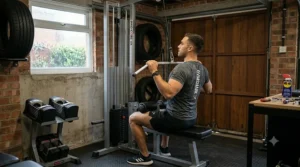
This is the machine for people who’ve made peace with the fact that they live in a flat, have roughly 1.5 square metres of training space, and still refuse to abandon their back day. The SPORTNOW Wall Mounted Lat Pulldown is a compact, wall-anchored cable machine with a 103 cm wide bar and a 100 kg weight capacity — considerably more than its freestanding siblings at a similar price.
The wall-mount design removes the floor footprint problem almost entirely. You install it to concrete, brick, or solid wood (the instructions are clear on this; a stud wall absolutely will not do), and suddenly that awkward corner of the spare room becomes a functional cable station. The 89 cm cable travel ensures a full range of motion for both pulldowns and rows.
What this machine requires, beyond wall space, is a degree of DIY confidence. The installation involves drilling into your wall, which is perfectly straightforward if you own a decent drill and wall anchors — but if you’re renting, this is categorically not the option for you. UK tenants, check your tenancy agreement before going anywhere near the masonry. Worth noting: many UK landlords will not smile upon returning to discover their wall has sprouted a cable machine.
For homeowners in compact properties, this is one of the smartest space-saving gym investments currently available on Amazon.co.uk. The 100 kg capacity gives serious headroom, and Prime members can have it next day.
Pros:
✅ Zero floor footprint once installed
✅ 100 kg capacity — excellent for a compact machine
✅ Suits garages, utility rooms, and dedicated gym corners
Cons:
❌ Requires permanent wall installation — not renter-friendly
❌ Needs adequate wall depth and structural integrity
Price range: £150–£250 — exceptional value for homeowners with wall space. Check current price on Amazon.co.uk.
7. Strongway® Cable Crossover with 75 kg Weight Stack
If the previous six machines represent the sensible end of the spectrum, the Strongway Cable Crossover is where you arrive once the home gym bug has properly taken hold. This is a freestanding dual-pulley cable crossover station — more commercial gym than spare bedroom — with a 75 kg selectorised weight stack, a pull-up bar, adjustable pulley arms, and dual cable stations that allow two people to train simultaneously.
The 75 kg stack is the headline figure, and it earns its place. This is enough resistance to challenge serious lifters on lat pulldowns, cable rows, face pulls, tricep pushdowns, cable flyes — essentially every cable-based movement you’d find on a gym floor. The pull-up bar adds a further bodyweight movement option, which is a useful addition for those who want to complement their machine work with bar work.
What matters practically for UK buyers is the footprint. This is a large piece of equipment. It demands a dedicated training space — a garage conversion, a large spare room, or a garden office (the latter increasingly popular in the UK following years of working-from-home normalisation). Don’t attempt this in a standard bedroom unless you’re prepared to sleep next to it. Assembly is also a significant undertaking; budget a weekend rather than an evening.
The dual pulley system justifies the price for serious trainers. Being able to superset cable rows with lat pulldowns without reconfiguring anything is a quality-of-life improvement you’ll appreciate every single session.
Pros:
✅ 75 kg stack — serious progression headroom
✅ Dual pulley + pull-up bar — near-commercial gym capability
✅ Adjustable pulley arms for varied cable angles
Cons:
❌ Large footprint — requires dedicated gym space
❌ Assembly is time-consuming and may require two people
Price range: £350–£550 — a significant investment, justified for the serious home gym builder. Check current price on Amazon.co.uk.
How to Set Up Your Lat Pulldown Machine in a British Home (Without Losing the Plot)
Buying the machine is the easy part. Setting it up in a typical UK property is where the real adventure begins. Here’s what nobody in the product listing will tell you.
Step 1: Measure twice, order once. The average UK terraced house has a ceiling height of around 240–255 cm. Most full-size lat towers are 190–202 cm tall; add the user’s seated arm extension (roughly 30–40 cm) and you’re testing your clearance. Measure your actual space before ordering, not an optimistic approximation of it.
Step 2: Think about access. Standard UK interior doorways are approximately 76–80 cm wide. Many lat towers arrive in boxes that are manageable, but some premium models ship in extremely large packaging. Check the packaged dimensions in the product listing before ordering — and if you live in a flat above the ground floor, think very carefully about how you’re going to carry something weighing 50+ kg up a staircase.
Step 3: Assembly day prep. Set aside a proper block of time — three hours minimum for most machines, an afternoon for more complex units. Have a friend available for the larger components. Keep all hardware bags in a container as you unbox; losing a single bolt can halt the entire process.
Step 4: Weight plates for plate-loaded machines. This is the commonly overlooked hidden cost. Most plate-loaded towers ship without plates. A decent starter set of 30–40 kg in mixed plate sizes typically adds another £40–£80 to your budget. Factor this in from the start.
Step 5: Floor protection. Rubber matting under your machine protects both the floor and the frame, dampens noise (relevant in semi-detached houses and flats), and improves stability. A set of interlocking foam or rubber gym tiles costs relatively little and makes a tangible difference to the training experience.
Maintenance: Once a month, check all cable connections for fraying. Every three months, lightly lubricate the pulley wheels with silicone spray. Keep the frame wiped down — a little sweat plus British ambient humidity is exactly the right recipe for surface rust on cheaper steel frames.
Which Lat Pulldown Machine Is Right for You? A UK Buyer’s Decision Framework
The market covers genuinely different types of buyer. Here’s how to self-identify:
If you’re a complete beginner in a smaller property (flat, terraced house, compact semi): The HOMCOM Lat Pull Down Machine or GYM MASTER Stationary tower are your natural landing spots. Both are under £160, both handle the basics impeccably, and neither will overwhelm a spare bedroom. The SPORTNOW Wall Mounted option is also worth serious consideration if you own (not rent) your property and are serious about long-term space efficiency.
If you want an all-in-one home gym without faffing with weight plates: The HOMCOM Multi Gym 45 kg Weight Stack is purpose-built for you. Drop the pin, train, go on with your life. No loading, no collars, no drama.
If you’re an intermediate lifter who already owns weight plates and trains consistently: The RIP X Stationary Lat Pulldown is the smart move. The 130 kg capacity and 202 cm height give you room to grow without the premium price of the Strongway crossover.
If you’re building a serious home gym and training is a genuine priority: Stop looking at the mid-range options and invest properly. The Strongway Cable Crossover 75 kg is the machine you’ll still be using in ten years. The others, while excellent for their respective audiences, will eventually become limiting for someone who trains hard four or five times a week.
If you’re recovering from an injury or returning to fitness after a break: The selectorised stack machines (HOMCOM Multi Gym, Strongway) make progressive loading much gentler and more controlled. The ability to add 5 kg at a time using a pin — rather than hunting for the right combination of plates — makes resistance progression feel less intimidating.
Cable Lat Machine vs Traditional Lat Pulldown Tower: What Actually Matters
The terms get used interchangeably, but they describe meaningfully different setups. A cable lat machine — like the Strongway crossover or the SPORTNOW wall-mounted unit — runs the cable through an adjustable pulley system, typically allowing the angle and height of the cable to be changed. This versatility enables a wide range of exercises beyond lat pulldowns: face pulls, cable rows from multiple angles, tricep pushdowns, cable crossovers.
A traditional lat pulldown tower — like the GYM MASTER, HOMCOM plate-loaded, or RIP X — has a fixed overhead pulley for the pulldown and a fixed low pulley for seated rows. Two positions, two exercises (plus variants). Simpler, cheaper, more compact.
For pure back training, the functional difference between the two is minimal. Lat pulldown studies, including work from sports science research, consistently show that the movement quality and resistance path matter far more than the sophistication of the pulley system. A standard tower used consistently and correctly will develop your latissimus dorsi just as effectively as a £400 cable crossover.
The cable machine wins when versatility matters: when you want to perform tricep work, shoulder exercises, or cable crossovers on the same piece of equipment. If your home gym is growing and you want one machine to cover multiple movement patterns, the cable crossover justifies the investment. If you want to pull, row, and do little else, the simpler tower is both adequate and sensible.
Common Mistakes When Buying a Lat Pulldown Machine in the UK
Mistake 1: Not accounting for the cost of weight plates. A £120 plate-loaded tower becomes a £180-200 purchase once you factor in a sensible starting weight set. Budget accordingly from day one.
Mistake 2: Assuming the machine will fit through your door in the box. It almost certainly will — most machines are designed with this in mind — but verify the packaged dimensions rather than assuming.
Mistake 3: Buying a wall-mounted machine when you’re renting. This bears repeating. UK tenancy agreements typically prohibit significant structural modifications. A bolted cable station installed without permission can cost you your deposit and then some.
Mistake 4: Choosing a machine based on maximum weight capacity, then never using it. A 130 kg capacity means nothing if you’re currently pulling 25 kg and training twice a week. Beginners should not be paying a premium for strength headroom they won’t reach for years.
Mistake 5: Overlooking the seated row function. A lat pulldown machine without a low pulley is half a machine. The seated cable row is one of the most effective mid-back exercises in existence; ensuring your machine includes this function doubles its training value essentially for free.
What to Expect: Real-World Back Training on a Home Lat Pulldown Machine
Here’s an honest picture of what changes once you actually own one of these machines and use it consistently.
Within the first four to six weeks, you’ll notice your posture improving. The musculature being developed — lats, rhomboids, rear deltoids — is precisely the opposite of everything a desk job does to your body. Eight hours of forward-hunched typing gets offset by sessions of intentional pulling. The change is noticeable to others before you notice it yourself.
Within three months of twice-weekly training, the V-shape that is the aesthetic goal of most lat pulldown devotees will begin to emerge, depending on your body composition. The lats are a large muscle group and respond relatively quickly to consistent stimulus.
What catches most home gym buyers off guard is how much they come to rely on the seated row attachment. They buy the machine for the pulldown; they end up valuing the rowing function equally. The mid-back development from consistent cable rowing creates a kind of functional robustness that protects against the various back complaints that accumulate throughout middle age. Worth considering when justifying the purchase to a sceptical partner.
Long-Term Cost and Value: Is a Lat Pulldown Machine Worth It in the UK?
At current UK gym prices — which for a mainstream chain range from around £25–£50 per month — a mid-range lat pulldown machine in the £150–£250 bracket pays for itself within six to ten months of use. Beyond that, every session is effectively free.
The total cost of ownership is modest. Replacement cables, should they ever need replacing, typically cost £10–£25. A set of gym mats for underneath is a one-off expense. Weight plates, if purchased sensibly (second-hand plates are widely available on UK marketplace sites), represent excellent value. Annual lubrication and maintenance costs are negligible.
The calculation sharpens further when you factor in travel time to a commercial gym, parking, and the mental overhead of fitting a session around busy periods. A home lat pulldown machine is always available, always uncrowded, and — crucially — never smells like someone else.
For the more premium options like the Strongway Cable Crossover in the £350–£550 range, payback takes longer but the investment case remains solid for consistent trainers. At four sessions per week, a £450 cable station works out to roughly £2 per session over its first year. That’s considerably less than a coffee on your way to the gym.

FAQ: Lat Pulldown Machines UK
❓ What is the best lat pulldown machine for a small UK home?
❓ Do I need weight plates for a lat pulldown machine?
❓ Are lat pulldown machines suitable for beginners in the UK?
❓ Can I use a lat pulldown machine if I'm renting a UK property?
❓ How much should I spend on a lat pulldown machine in the UK?
Conclusion: Pulling It All Together
The right lat pulldown machine is the one that fits your space, matches your strength level, suits your training goals, and doesn’t require you to remortgage the house to afford it. That’s a fairly specific brief — which is precisely why this guide exists.
For most UK home gym builders, the decision comes down to a binary: do you own a home with wall or floor space, and how seriously do you train? If the answer is “yes, casually,” the GYM MASTER or HOMCOM plate-loaded towers deliver genuine value for relatively little outlay. If “yes, seriously,” the RIP X or SPORTNOW options step things up appropriately. If you’re in a flat with constrained space, the SPORTNOW wall-mounted unit is a remarkably clever solution for homeowners. And if you’ve committed to building a proper training space, the Strongway Cable Crossover is the destination.
What all seven machines share is availability on Amazon.co.uk with UK-warehoused stock, fast Prime delivery, and the kind of straightforward consumer protection that the Consumer Rights Act 2015 provides. You have 14 days to return anything purchased online, no quibble required. That’s a safety net worth having when buying a large piece of fitness equipment for the first time.
Train consistently, maintain the equipment properly, and you’ll likely find — as most home gym converts do — that you can’t imagine having done without it.
✨ Don’t Miss These Exclusive Deals!
🔍 Ready to invest in your back training? Click any highlighted product above to check current pricing and delivery options on Amazon.co.uk. Prime members typically receive next-day delivery on all seven machines listed. These are among the best-value lat pulldown machines currently available in the UK market — find exactly what suits your home and your training.
Recommended for You
- Best Compact Cable Crossover Machines UK 2026 (Top 7 Picks)
- Best Commercial Cable Crossover Machines UK 2026: 7 Expert Picks
- Best Cable Crossover Machine UK 2026: 7 Top Picks Reviewed
Disclaimer: This article contains affiliate links. As an Amazon Associate, I earn from qualifying purchases. If you purchase products through these links, we may earn a small commission at no additional cost to you.
✨ Found this helpful? Share it with your mates! 💬🤗
