
In This Article
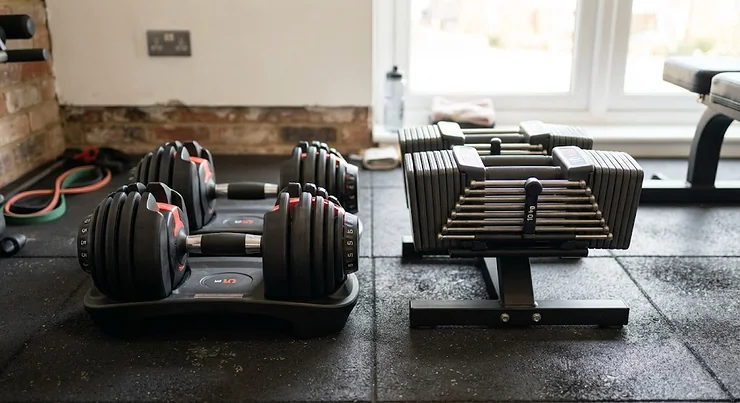
Somewhere in a garage in Guildford, someone is standing over a pair of adjustable dumbbells at 6:47am, trying to decide whether to spin a dial or yank a pin before their coffee’s gone cold. That small decision — dial dumbbells vs pin-select dumbbells — turns out to matter more than most buyers expect, because the mechanism you choose shapes every single session you’ll do for the next five years. Dial dumbbells vs pin-select dumbbells is, at its core, a debate between two very different engineering philosophies: one spins a rotating collar to lock in a weight electronically-smooth, the other slides a metal or magnetic pin through a stack of plates like a mini weight machine. Both replace a rack full of iron. Neither is universally “better” — but one is almost certainly better for you.
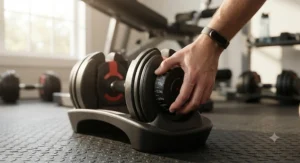
What is dial dumbbells vs pin-select dumbbells, in plain terms? It’s a comparison between two adjustable dumbbell mechanisms: dial systems, which use a twist-lock collar to select weight in seconds, and pin-select systems, which use a physical or magnetic pin inserted through a plate stack. The choice affects adjustment speed, noise, durability, and long-term running cost.
This guide isn’t going to pretend there’s a single winner, because that would be dishonest — and frankly, a little insulting to your intelligence. Instead, we’ve dug into real specs, aggregated review sentiment, and independent testing data on seven genuinely available products, spanning budget dial dumbbells right through to premium pin-lock steel. The NHS recommends muscle-strengthening activity at least twice a week for adults, and adjustable dumbbells are one of the most space-efficient ways to hit that target without turning your spare room into a scrapyard of mismatched irons. Let’s get into which mechanism actually deserves your money.
Quick Comparison Table
| Mechanism | Adjustment Speed | Typical Weight Range | Best For | Price Range |
|---|---|---|---|---|
| Dial Dumbbells (e.g. Bowflex SelectTech 552) | 2-4 seconds per dumbbell | 2-24kg per hand | HIIT, supersets, beginners | £300-£450 |
| Pin-Select Dumbbells (e.g. PowerBlock Elite EXP) | 3-6 seconds per dumbbell | 2-22kg+ (expandable) | Progressive overload, longevity | £250-£450 |
| Hybrid Dial+Pin (e.g. NordicTrack 55lb Select-a-Weight) | 5-8 seconds per dumbbell | 4-25kg per hand | App-based training, fine increments | £280-£400 |
| Quick-Lock (screw-pin) (e.g. Ironmaster Quick-Lock 75) | 20-40 seconds per pair | 2-34kg+ (expandable to 75kg) | Heavy lifters, longevity fanatics | £400-£650+ |
Looking at the numbers above, the honest takeaway is that dial dumbbells win on raw adjustment speed almost every time, which matters enormously if your training style involves supersets or drop sets where seconds count. Pin-select systems, particularly PowerBlock’s magnetic pin design, trade a couple of seconds for a mechanically simpler system with fewer parts that can jam or wear out. Meanwhile, quick-lock screw systems like the Ironmaster Quick-Lock 75 sacrifice speed almost entirely in exchange for a weight ceiling and durability that dial and pin systems simply can’t touch.
💬 Found a mechanism that fits your training style already? Scroll down to see it in action below!
Top 7 Dial and Pin-Select Dumbbells: Expert Analysis
1. Flybird Adjustable Dumbbell — best budget dial dumbbells for beginners
The Flybird Adjustable Dumbbell is the entry point most people stumble into first, and there’s a reason it shows up in so many “just starting out” home gym setups. Available as a single 25lb (11.3kg) dumbbell or a heavier 55lb pair, it uses a rotating dial that clicks through five weight stops in a satisfying, almost mechanical-keyboard kind of way. Based on the spec comparison, the aluminium alloy handle and cast iron plates put it a notch above the fully-plastic budget dumbbells that flood Amazon listings, without pushing the price anywhere near premium territory.
Who should care about this one? Honestly, it’s built for the person who wants to test whether adjustable dumbbells suit their routine before committing serious money. Reviewers consistently note that the dial mechanism is smooth and the “click” of a locked weight is reassuring, though several also flag that the plastic storage tray feels flimsier than the dumbbells themselves — a common theme across budget dial adjustable dumbbells generally. What most buyers overlook is the increment gap: jumping from 15lb to 25lb in one twist is a big leap for smaller muscle groups like shoulders, so this suits compound lifts more than isolation work.
Pros:
- ✅ Genuinely fast one-handed dial adjustment
- ✅ Noticeably cheaper than Bowflex or NordicTrack equivalents
- ✅ Compact footprint that suits small flats
Cons:
- ❌ Storage tray feels less durable than the dumbbells
- ❌ Weight jumps can be too large for isolation exercises
At the time of research, the Flybird Adjustable Dumbbell typically sits in the under-£200 range for a single unit, with pairs landing higher depending on the weight variant. For anyone testing the water with dial adjustable dumbbells before investing in a heavier set, it’s a sound, low-risk starting point.
2. PowerBlock Sport 24 — most compact pin-select for light training
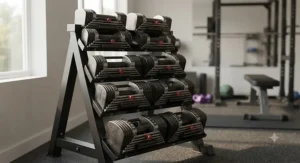
If dial dumbbells are the smartphone of adjustable weights, the PowerBlock Sport 24 is the flip phone — and that’s meant as a genuine compliment. Instead of a spinning collar, it uses a magnetic polypropylene selector pin threaded through nested weight plates, adjusting from 1.4kg to 11kg per hand in roughly 1.4kg increments. There’s no dial to strip, no gears to jam, just a pin and a bungee cord holding it to the frame so you never lose it mid-set.
Here’s what the spec sheet won’t tell you, but reviewers note repeatedly: the pull-pin system is almost comically foolproof compared with more complex mechanisms. One recurring theme in aggregated feedback is that owners appreciate never having to “reset” a jammed cradle, a frustration that occasionally crops up with dial-based competitors. This is the pin-select dumbbell system for anyone doing rehab work, high-rep conditioning, or simply wanting a compact pair that won’t dominate a shelf. It’s not for anyone chasing serious strength gains, though — the 24lb ceiling per hand is genuinely light for intermediate lifters.
Pros:
- ✅ Smallest footprint of any product on this list
- ✅ Magnetic pin rated for a 227kg load, so it won’t slip
- ✅ Colour-coded plates make weight selection foolproof
Cons:
- ❌ Maximum weight is too light for most intermediate lifters
- ❌ Awkward to hold for non-standard grips like goblet squats
Priced in the under-£200 range, the PowerBlock Sport 24 is arguably the most beginner-friendly pin-select dumbbell system on the market, provided you accept its modest weight ceiling as a feature, not a flaw.
3. Core Home Fitness Adjustable Dumbbell Set — fastest one-handed dial adjustment
The Core Home Fitness Adjustable Dumbbell Set does something genuinely clever: instead of a static cradle you have to fumble with, the dumbbell twists directly inside its docking tray, adjusting both units simultaneously with a single twist of the wrist. Reviewers across multiple independent testing panels single this out as one of the smoothest dial adjustable dumbbells mechanisms available, with a weight range of roughly 2.2-22.6kg per hand across ten increments.
Based on the spec comparison, what sets this apart from a typical dial system is the shape-shifting design — the dumbbell physically shortens as you dial down the weight, so light-weight exercises don’t feel like swinging a barbell. What most buyers overlook is that this compact profile also makes it noticeably better for exercises where a long-handled dumbbell gets in the way, like renegade rows or close-grip presses. A common complaint in user reviews is that plates occasionally stick in the docking tray at the top of the weight range, requiring a firmer tug than you’d expect from a premium product.
Pros:
- ✅ Both dumbbells adjust with a single twisting motion
- ✅ Shorter handle length than most dial competitors
- ✅ Textured grip stays secure during sweaty sessions
Cons:
- ❌ Plates can stick in the tray at higher weights
- ❌ UK stock and delivery availability varies by retailer
Availability and shipping costs for this model can vary considerably for UK buyers depending on the retailer, so it’s worth checking current price and delivery terms before ordering. Where available, it typically lands in the low-to-mid £200s — check current price, as third-party import fees can add significantly to that figure.
4. Bowflex SelectTech 552 — best all-round dial dumbbells overall
The Bowflex SelectTech 552 is, by a wide margin, the most recognisable name in this entire category, and honestly, the reputation is mostly earned. Twist the dial from 2kg up to 24kg per dumbbell in fifteen fine increments, and the internal locking pins engage instantly, no cradle fiddling required once you understand the system. It replaces roughly fifteen pairs of fixed dumbbells in a footprint barely bigger than a shoebox.
What most buyers overlook about the SelectTech 552 is how differently it performs depending on your care habits — reviewers consistently report that the dial system is “smooth” and satisfying in normal use, but a recurring theme across aggregated feedback is that the internal plastic components don’t love being dropped, bumped, or handled roughly during transitions between exercises. Based on the spec comparison, the anti-slip metal handle and 2.5kg fine-increment steps make it genuinely well-suited to progressive overload training, where you want to add small amounts of resistance week over week rather than jumping in big leaps. For beginners through to intermediate lifters chasing steady strength gains, this is close to the gold standard of dial adjustable dumbbells.
Pros:
- ✅ Fifteen weight increments in one compact unit
- ✅ Dial locks feel secure once weights are seated correctly
- ✅ Replaces an entire wall of fixed dumbbells
Cons:
- ❌ Predominantly plastic internals demand careful handling
- ❌ Handle length can feel awkward for some exercises
At the time of research, the Bowflex SelectTech 552 typically sits in the £350-£450 range in the UK, prices may vary by retailer and stock availability. Given the sheer versatility on offer, it remains one of the strongest value propositions among dial adjustable dumbbells, provided you treat the internals with the respect a precision mechanism deserves.
5. PowerBlock Elite EXP — most expandable pin-select system
Where the Sport 24 stays compact and light, the PowerBlock Elite EXP scales the same magnetic pin-select dumbbell system all the way up to roughly 22.7kg per hand in its base Stage 1 configuration — and that’s before you factor in expansion kits that push individual dumbbells past 40kg each. The magnetic pin slots through a nested block of nine or so plates, and reviewers describe the adjustment as reliably quick, if not quite as instant as a dial twist.
Here’s what most buyers overlook: this isn’t just a dumbbell, it’s a platform. The same Elite EXP units can be mounted on a compatible barbell sleeve, effectively turning your adjustable dumbbells into an adjustable barbell too. One aggregated review source puts it plainly — these aren’t built for speed like dial systems, they’re built for reliability and longevity, with some owners reportedly using earlier PowerBlock generations for over a decade without mechanical failure. The trade-off is aesthetic and ergonomic: the nested-block shape doesn’t feel like a “real” dumbbell in the hand, and several reviewers note it takes a session or two to adjust your grip technique.
Pros:
- ✅ Expandable well beyond most dial systems’ weight ceiling
- ✅ Magnetic pin selector rated for very high load capacity
- ✅ Compatible with barbell and kettlebell attachments
Cons:
- ❌ Block shape feels unnatural compared with round-plate dumbbells
- ❌ Polypropylene pin needs gentle handling over the years
Prices for the PowerBlock Elite EXP typically fall in the £250-£450 range for the base Stage 1 set, with expansion kits priced separately — always check current pricing before committing, as configuration options affect the final cost significantly.
6. NordicTrack 55lb Select-a-Weight — best app-connected hybrid dumbbells
The NordicTrack 55lb Select-a-Weight dumbbells are a genuinely interesting outlier in the dial dumbbells vs pin-select dumbbells conversation, because they’re technically both. A rotating plastic dial handles the smaller 1-2kg increments, while a separate pin slots in to unlock the larger plate jumps up to roughly 25kg per hand. It’s a hybrid adjustable dumbbell mechanism that tries to combine the fine control of a dial with the raw capacity of a pin-select stack.
Based on the spec comparison, this hybrid approach is genuinely the only one on this list offering such small incremental jumps at the lighter end, which matters if you’re trying to build strength gradually rather than in big leaps — ideal for rehab work or anyone easing back into training. Reviewers consistently note that the weight accuracy is impressively precise, matching what the dial actually claims, which isn’t always true of every adjustable dumbbell mechanism. The catch, according to aggregated feedback, is that the dual dial-and-pin process is a little more fiddly and time-consuming than either a pure dial or pure pin-select design, and the largely plastic construction means it feels less premium in the hand than the metal-heavy Bowflex or Ironmaster units. The bundled iFit trial adds genuine value for anyone who likes guided video workouts, though the subscription cost afterwards is worth factoring into your total cost of ownership.
Pros:
- ✅ Unusually fine weight increments at the lighter end
- ✅ Reported weight accuracy matches the stated dial reading
- ✅ Includes a trial membership with guided video workouts
Cons:
- ❌ Dual dial-and-pin process is slower than either system alone
- ❌ Plastic-heavy build feels less premium than metal rivals
Expect to pay in the £280-£400 range at the time of research for the 55lb (25kg) version, with a lighter 25lb variant also available at a reduced price point. As one UK reviewer at Fit&Well noted in their hands-on testing, the hybrid mechanism is “a little time-consuming and fiddly” mid-workout compared with a pure twist-lock design — a fair trade-off given the increment precision on offer.
7. Ironmaster Quick-Lock 75 — most durable heavy-duty pin-lock dumbbells
Last but very much not least, the Ironmaster Quick-Lock 75 takes a different approach entirely. Rather than a dial or a simple pin, it uses a threaded quick-lock screw that clamps a stack of genuine cast iron plates onto a knurled steel handle — closer in feel to Olympic-style loadable dumbbells than either dial or magnetic-pin competitors. It adjusts from roughly 2.3kg up to 34kg per hand in the base set, with add-on kits pushing that ceiling to 54kg and eventually 75kg per hand.
What the spec sheet won’t tell you, but independent testers consistently note, is just how different this feels in daily use. It’s slower than dial dumbbells vs pin-select dumbbells rivals — expect around 20-40 seconds to change weight on a pair, which rules it out for fast-paced circuit training. But in exchange, you get a dumbbell that genuinely feels and lifts like a fixed-weight iron dumbbell, all-metal construction that can survive being dropped (within reason), and a stated lifetime warranty from the manufacturer. Reviewers who’ve tested essentially every adjustable dumbbell system on the market tend to rank this as the most durable option available, precisely because it has the fewest plastic components of anything on this list.
Pros:
- ✅ All-metal build survives drops far better than plastic rivals
- ✅ Expandable up to 75kg per hand for serious strength training
- ✅ Manufacturer-backed lifetime warranty on the mechanism
Cons:
- ❌ Considerably slower to adjust than dial or magnetic-pin systems
- ❌ Higher upfront cost than most dial adjustable dumbbells
At the time of research, the Ironmaster Quick-Lock 75 sits toward the premium end, typically in the £400-£650+ range depending on included stand and add-on kits. For lifters who value long-term durability over adjustment speed, this is arguably the strongest long-term investment on this entire list.
Practical Usage Guide: Setting Up Your Adjustable Dumbbells Correctly
Getting the mechanism right in the shop is only half the job — how you set it up and maintain it in the first thirty days shapes whether it lasts five years or five months. Start by unboxing on a soft surface (a yoga mat works fine) rather than a hard floor, since a dropped weight plate during assembly is a surprisingly common cause of early damage. For dial dumbbells like the Bowflex SelectTech 552 or Core Home Fitness Adjustable Dumbbell Set, always return the unit fully into its cradle before twisting the dial — attempting to adjust mid-air is one of the most frequently reported causes of jammed mechanisms in aggregated user feedback.
For pin-select systems such as the PowerBlock Elite EXP or PowerBlock Sport 24, get into the habit of checking the pin is fully seated before lifting; a half-inserted magnetic pin is the single biggest safety risk with this mechanism. Wipe down handles after sweaty sessions, particularly on metal-handled units, since salt residue accelerates corrosion over months of use. If you’ve gone for a quick-lock screw system like the Ironmaster Quick-Lock 75, a light coating of machine oil on the threads every few months keeps the screw action smooth and prevents the seizing that some long-term owners report. Whatever mechanism you choose, avoid storing dumbbells in a damp garage or shed — moisture is the enemy of every adjustable dumbbell mechanism, dial and pin alike, and the British Heart Foundation’s home strength training guide is a genuinely useful reference for pairing your new kit with a sensible, progressive routine rather than diving straight into maximum weight.
Real-World Scenarios: Who Should Buy Which Mechanism
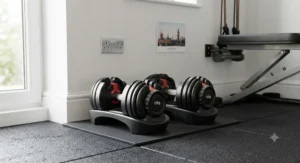
Picture three different people staring at the same comparison table. First, there’s Priya, a university student living in a shared house with barely enough floor space for a yoga mat, let alone a rack of dumbbells — she needs something compact, affordable, and forgiving of irregular workout schedules. For her, the Flybird Adjustable Dumbbell or PowerBlock Sport 24 makes far more sense than a premium set she’ll rarely max out.
Then there’s Tom, a 34-year-old who’s been lifting consistently for three years and wants to keep progressing without buying a fourth pair of fixed dumbbells this year alone. He needs fine increments, a decent weight ceiling, and doesn’t mind spending a bit more upfront. The Bowflex SelectTech 552 or NordicTrack 55lb Select-a-Weight fits that profile well, offering the granular progression that supports genuine strength gains over time.
Finally, there’s Deborah, an experienced lifter in her fifties who’s tired of replacing snapped dial mechanisms and wants something that will genuinely outlast her gym membership. Durability and weight capacity matter more to her than adjustment speed. The Ironmaster Quick-Lock 75 or PowerBlock Elite EXP suits that priority far better than a lighter, faster-adjusting dial set that may not survive years of heavy daily use.
Buyer’s Decision Framework
If you train in fast-paced circuits, HIIT, or frequent supersets, choose a dial system because the adjustment speed genuinely changes how smoothly your session flows. If you’re prioritising long-term durability over convenience, choose a pin-select or quick-lock system because fewer moving parts generally means fewer failure points over years of use. If your budget is under £200, choose an entry-level dial or compact pin-select set like the Flybird Adjustable Dumbbell or PowerBlock Sport 24 rather than stretching for a premium model you won’t fully use. If you’re chasing serious strength gains past 30kg per hand, choose an expandable pin-select or quick-lock system like the PowerBlock Elite EXP or Ironmaster Quick-Lock 75, since most dial systems top out well before that point. And if you want fine-grained progressive overload with the smallest possible weight jumps, choose a hybrid or high-increment dial system like the NordicTrack 55lb Select-a-Weight or Bowflex SelectTech 552.
How to Choose Between Dial Dumbbells and Pin-Select Dumbbells
Choosing between these two adjustable dumbbell mechanisms comes down to five practical criteria that matter far more than marketing copy suggests.
- Adjustment speed under fatigue. Consider how you’ll actually be using the equipment mid-workout — dial systems win decisively for supersets and drop sets, while pin-select systems are perfectly adequate for straight sets with rest between them.
- Weight ceiling and expandability. Dial dumbbells vs pin-select dumbbells often diverge sharply here — most consumer dial sets cap out around 24-25kg per hand, while expandable pin-select and quick-lock systems can climb well past 40kg.
- Build material and durability. Reviewers consistently flag plastic components as the weak point of dial systems, while metal-heavy pin-select and quick-lock designs tend to survive rougher handling.
- Storage footprint and household space. Dial dumbbells generally have a more compact, rounded profile, while nested-block pin-select systems can look and feel less like a traditional dumbbell.
- Total cost of ownership. Factor in replacement parts, warranty length, and expansion kit pricing rather than just the upfront sticker price — a cheaper dial set that needs replacing in eighteen months may cost more over five years than a pricier, more durable alternative.
- Noise and household tolerance. Pin-select systems tend to click quietly into place, while some dial mechanisms produce a louder mechanical clunk that matters if you’re training in a shared flat with thin walls.
- Grip and exercise variety. If your routine leans heavily on non-standard grips like goblet squats or renegade rows, a rounder dial dumbbell profile is often more comfortable than a nested-block pin-select shape.
Dial Adjustable Dumbbells vs Pin-Select Dumbbell System: The Detailed Comparison
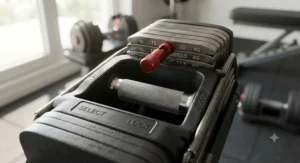
It’s worth stepping back from individual products to talk mechanisms directly, because dial adjustable dumbbells and a pin-select dumbbell system solve the same problem in genuinely different ways. A dial system typically houses its weight plates inside a cradle, with a rotating collar engaging internal locking pins the moment you twist — the speed advantage comes from the fact that one motion adjusts the entire stack simultaneously. A pin-select dumbbell system, by contrast, nests nine or more individual plates around a central handle, and a single external pin determines how many of those plates travel with you when you lift.
The practical upshot is that dial systems tend to feel more like “one smooth unit” in the hand, while pin-select systems feel more modular and mechanical, closer to a gym’s weight stack machine shrunk down to handheld size. Neither is inherently more accurate — both Bowflex and PowerBlock style mechanisms report consistently accurate weight readings in independent testing — but the failure modes differ. Dial systems are more prone to internal plastic wear over years of heavy use, while pin-select systems occasionally suffer from pin bending or magnetic degradation, though this tends to take considerably longer to manifest. For value/ROI purposes, a mid-range dial set and a mid-range pin-select set are often remarkably close in cost-per-kilogram of resistance offered, so the deciding factor really does come down to how you train, not which one is objectively “better”.
Weight Adjustment Speed: What the Numbers Actually Mean in Practice
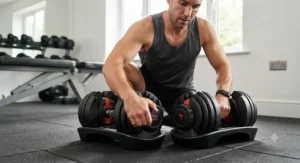
Manufacturer spec sheets love to quote adjustment times in seconds, but those numbers rarely reflect how it feels mid-set with your heart rate climbing. In practice, a well-maintained dial system like the Bowflex SelectTech 552 genuinely does take two to four seconds per dumbbell once you’ve built muscle memory for the twist — fast enough that it barely interrupts a superset’s rhythm. Pin-select systems add perhaps two to four extra seconds, mostly because you’re locating and inserting a physical object rather than simply rotating a collar already in your hand.
Where this genuinely matters is training style. If you’re doing EMOM (every-minute-on-the-minute) work or fast circuit transitions, those extra seconds compound across a sixty-minute session into a meaningfully different training density. If your programme is built around straight sets with ninety seconds of rest between them, the difference becomes essentially irrelevant — you’ll have adjusted the weight well before your rest period ends regardless of mechanism. As one UK fitness outlet observed when comparing a hybrid dial-and-pin design against a pure twist-lock system, “the adjustments require more time and both hands” for pin-assisted designs, which is a fair general rule even if individual products vary. The honest verdict on weight adjustment speed is that it matters enormously for a narrow slice of training styles, and barely at all for the rest.
Dumbbell Durability Comparison: Which Mechanism Actually Lasts Longer
This is where the dial dumbbells vs pin-select dumbbells debate gets genuinely interesting, because aggregated long-term ownership feedback tells a more nuanced story than any single spec sheet. Dial systems built with significant plastic content — which describes most consumer dial adjustable dumbbells, including budget and mid-range options — tend to show wear in the internal locking mechanism after a few years of consistent heavy use, particularly if handled roughly during weight changes. Reviewers of the Bowflex SelectTech 552 specifically flag that treating the unit “like glass” during transitions extends its lifespan considerably, which tells you something important about the underlying build quality.
Pin-select systems and quick-lock screw designs, built from a higher proportion of metal components, generally report longer service lives in aggregated owner feedback, with some PowerBlock and Ironmaster users reporting a decade or more of regular use without mechanical failure. That durability advantage does come at a cost, though — the same metal construction that survives drops also makes these units heavier to move around and, in the case of quick-lock designs, noticeably slower to adjust. A genuine dumbbell durability comparison has to weigh these trade-offs against your actual usage pattern rather than assuming “more metal always wins” — a dial system used gently by a careful owner may well outlast a pin-select system that gets thrown around a garage gym daily.
Common Mistakes When Buying Adjustable Dumbbell Mechanisms
The single most common mistake buyers make is choosing based on brand recognition alone, without considering whether their actual training style suits a dial or pin-select mechanism. Someone who does exclusively straight-set strength training doesn’t need the adjustment speed of a premium dial system, and paying extra for it is money better spent on a higher weight ceiling instead. The second mistake is underestimating future strength gains — buying a set that maxes out at 20kg per hand feels sensible for a beginner, but many lifters progress past that ceiling within twelve to eighteen months of consistent training, forcing an expensive early upgrade.
A third mistake, particularly common with dial adjustable dumbbells, is rough handling during the return-to-cradle motion, which accelerates the exact plastic wear that shortens a unit’s lifespan. Fourth, buyers frequently ignore total footprint when fully loaded — some pin-select systems expand significantly in length as more plates are added, which matters if you’re training in a tight space. And finally, plenty of shoppers skip checking UK-specific stock and delivery costs on models designed primarily for the US market, only to discover import fees that erase any apparent saving — worth factoring in before you commit to any adjustable dumbbell mechanism sold primarily overseas.
Safety, Regulations and Compliance Guide
Adjustable dumbbells sold in Great Britain fall under general product safety regulation, and reputable manufacturers will display either a CE or UKCA conformity mark confirming the product meets recognised safety and construction standards. Since 2024, UK product safety rules have allowed continued recognition of CE marking alongside UKCA for many product categories, giving manufacturers flexibility in how they demonstrate compliance — you can read the official government guidance on UKCA and CE marking for the full technical detail if you want to verify a specific product’s compliance status.
Beyond formal certification, a few practical safety habits apply regardless of which mechanism you choose. Always confirm a dial has fully locked, or a pin is fully seated, before lifting — a partially engaged mechanism is the leading cause of dropped-weight incidents reported in aggregated user feedback across every product on this list. Keep adjustable dumbbells away from small children, since detachable plates and pins present an obvious hazard, and most manufacturers explicitly warn against use by anyone under fourteen without supervision. Finally, floor protection matters more with adjustable dumbbells than fixed-weight equivalents — a dropped dial dumbbell risks cracking internal plastic housing, so a rubber gym mat is a sensible, low-cost addition to any home setup regardless of which mechanism you eventually choose.

Frequently Asked Questions
❓ Are dial dumbbells or pin-select dumbbells better for beginners?
❓ Do pin-select dumbbells last longer than dial dumbbells?
❓ Can I use dial adjustable dumbbells for heavy strength training?
❓ What is the average weight adjustment speed difference between the two systems?
❓ Are adjustable dumbbells safe to drop during a workout?
Conclusion
There’s no universally “correct” answer in the dial dumbbells vs pin-select dumbbells debate, and honestly, anyone claiming otherwise is probably trying to sell you something. What genuinely matters is matching the mechanism to your actual training pattern rather than chasing whichever option has the most reviews. If your sessions are built around fast transitions and supersets, a dial adjustable dumbbells set like the Bowflex SelectTech 552 will make your workouts flow noticeably better. If you’re chasing serious long-term strength gains and want a mechanism that survives a decade of consistent, sometimes rough use, a pin-select dumbbell system like the PowerBlock Elite EXP or a quick-lock design like the Ironmaster Quick-Lock 75 is the more sensible long-term investment.
Budget shoppers shouldn’t feel pressured into premium territory either — both the Flybird Adjustable Dumbbell and PowerBlock Sport 24 prove that a genuinely useful adjustable dumbbell mechanism doesn’t require a four-figure spend. Whatever you choose, the adjustable dumbbell format itself remains one of the smartest space-and-cost trade-offs available for home strength training, replacing a wall of iron with a single, considered purchase.
Recommended for You
- Quick-Change Dumbbells Review 2026: 7 Fastest Picks Tested
- Cast Iron Dumbbells for Home Gym: 7 Brilliant Picks for 2026
- Compact Dumbbell Set for Small Spaces: 7 Best Picks (2026)
Disclaimer: This article contains affiliate links. As an Amazon Associate, I earn from qualifying purchases. If you purchase products through these links, we may earn a small commission at no additional cost to you.
✨ Found this helpful? Share it with your friends! 💬🤗
