
In This Article
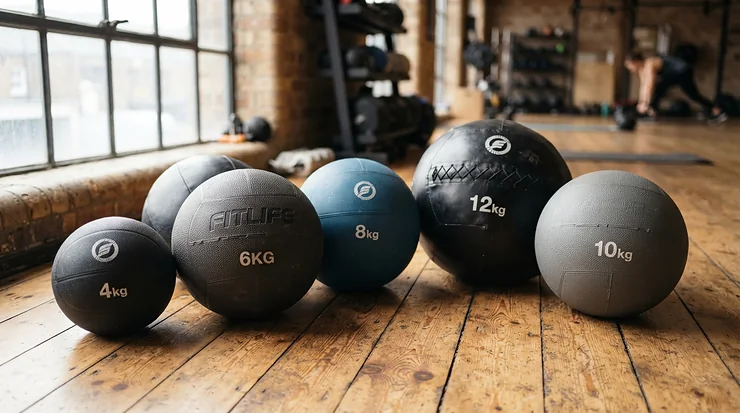
A rubber medicine ball is a weighted training ball with a tough, textured rubber shell, typically weighing between 1 and 10 kg. You throw it, catch it, rotate with it, or hold it through exercises, adding resistance that builds strength, power and coordination without needing a rack, bench or spotter.

The idea is old. Wikipedia’s entry on the medicine ball describes a weighted ball roughly shoulder-width across, long used in rehabilitation and strength training, and quite separate from the big inflated exercise ball. What has changed is the skin. Leather was once the default. Today a rubber medicine ball is the sensible choice for most UK garages, spare rooms and back gardens, because it shrugs off damp hands, cold floors and the occasional wall collision.
So why a whole guide? Because the shelves are a mess. Some balls bounce, some thud. Some have handles, some come in colour-coded packs, and some “leather” balls turn out to be synthetic. Choose badly and you end up with a ball that skids out of sweaty hands, or a heavy lump you never lift again.
Here’s what you’ll get: seven real picks compared on grip, build and value, plus a straight-talking leather medicine ball review. You’ll also find honest advice on medicine ball with handles designs, a medicine ball set versus a single ball, and medicine ball weight. Then we get into core and rotational training, and settle the argument over rubber vs leather durability and grip.
One honesty note before we start. I haven’t handled these balls myself. Everything below is spec analysis plus genuine review themes from public listings. Where a product has no verifiable review pool, I’ll say so rather than invent one.
Quick Comparison: 7 Rubber Medicine Ball Options at a Glance
Short on time? Here’s the whole field on one screen. Price ranges reflect what I found at the time of research and may vary, so check current price on the listing.
| Product | Material | Weights | Handles | Price range | Best For |
|---|---|---|---|---|---|
| Metis Medicine Balls | Textured rubber | 1–10 kg (1 kg steps) | No | Budget (roughly £15–£35) | Beginners on a budget |
| Pure2Improve Medicine Ball | 100% rubber | 2, 3, 4, 5, 6, 8, 10 kg | No | Low-to-mid £30s for lighter weights | Gradual progression |
| Pure2Improve Medicine Ball with Handles | About 94% rubber, 6% nylon | 2, 4, 6, 8, 10 kg | Yes | High £30s to high £40s | Controlled swings and carries |
| BodyMax Coloured Medicine Balls | Rubber | Colour-coded range | No | Mid-range | Shared sets, PT studios |
| Gorilla Sports Medicine Ball | Rubber | 1–10 kg, plus packs | No | Budget-to-mid | Building a collection |
| Amazon Basics Weighted Medicine Ball | Firm rubber | Several weights | No | Budget | Most-reviewed all-rounder |
| Champion Sports Leather Medicine Ball | Synthetic leather | Light to heavy | No | Import pricing, check listing | Leather-style feel |
Looking at the table, Metis Medicine Balls and the Gorilla Sports Medicine Ball win on flexibility if you plan to add weights over time, while Amazon Basics Weighted Medicine Ball wins on sheer review volume. Pure2Improve Medicine Ball with Handles costs more than its handle-free sibling because the grips are the whole point, and Champion Sports Leather Medicine Ball is the odd one out for anyone who simply prefers the feel of leather.
💬 Just one click — help others make better buying decisions too!😊
Top 7 Rubber Medicine Ball Picks: Expert Analysis
Each pick below is judged on what the specs mean in practice, plus the review themes I could verify. Listings and sellers on amazon.co.uk change often, so check the exact weight, colour and seller before ordering.
1. Metis Medicine Balls — widest weight range on a budget
If you like choosing your own adventure, start here. The Metis range from Net World Sports runs from 1 kg to 10 kg in single-kilo steps, so you can buy the exact load you need rather than the nearest one a brand happens to stock.
The surface is textured rubber, described as non-slip and scratch-resistant, with a low, consistent bounce. In practice, low bounce is handy for wall-based rotational throws, because the ball returns predictably instead of ricocheting off the skirting board. Just don’t expect basketball-style rebound. One detail the spec sheet buries: the listing says the brand may differ between weight options, so a trio of Metis balls might not match visually. That’s cosmetic, but check the weight, size and seller before ordering.
Based on the spec comparison, this suits beginners, flat-dwellers and anyone testing whether medicine ball work suits them before spending more. I couldn’t find a meaningful pool of verified product-specific reviews, so treat the durability claims as the manufacturer’s word rather than proof.
Pros:
- ✅ Ten weight options from 1 kg to 10 kg
- ✅ Textured surface helps with sweaty hands
- ✅ Wipe-clean upkeep with a damp cloth
Cons:
- ❌ Brand may vary between weight listings
- ❌ Little independent review data to lean on
Price: budget bracket, roughly £15–£35 depending on weight (check current price). A low-risk, sensible entry point.
2. Pure2Improve Medicine Ball — best for gradual weight progression
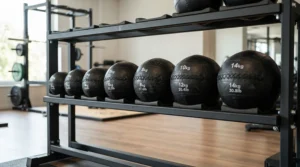
Seven weights (2, 3, 4, 5, 6, 8 and 10 kg) make this the ladder-climber’s choice. The shell is 100% rubber with a textured finish, and one retailer’s spec puts the 3 kg version at about 20 cm across, compact enough for a confident two-handed hold.
Why does the range matter? Progression with a medicine ball is lumpy. Jumping from 4 kg to 6 kg changes load and often diameter too, so the 1 kg steps at the light end let you nudge up when a rotational drill starts feeling easy. The brand is pitched at rehab and general conditioning as much as sport, which suits slower, controlled core work.
Who is it for? People who like structure: a physio-guided return to training, a household wanting graded weights, or anyone assembling a medicine ball set one ball at a time. The retail listings I found carried no product-specific reviews, so I can’t offer an aggregated verdict. What I can say is that the construction is the conventional, well-understood route.
Pros:
- ✅ Seven weights from 2 kg to 10 kg
- ✅ Full rubber shell with textured grip
- ✅ Compact 3 kg size at roughly 20 cm
Cons:
- ❌ No verified product-specific reviews found
- ❌ Dearer than the budget rubber rivals
Price: low-to-mid £30s for lighter weights at one UK retailer I checked, rising with weight. Fair rather than cheap.
3. Pure2Improve Medicine Ball with Handles — grips for heavier, safer swings
The same brand’s handled version swaps the clean sphere for built-in grips, in 2, 4, 6, 8 and 10 kg. A retailer lists the build as roughly 94% rubber and 6% nylon, with a textured surface.
What do handles buy you? Control. With a plain sphere, heavier loads depend on hand span and friction. With handles, you can swing a 6 kg ball through a woodchop or carry it across the room without wondering whether your palms will give up. That makes it a friendlier tool for core and rotational training, especially for people with smaller hands or less grip strength.
The trade-off is that handles are awkward for chest passes and wall throws, and the nylon portions are worth inspecting over time. Reviewers’ views aren’t available here: the listings I found had no product-specific reviews, so this verdict rests on specs and design logic alone.
Pros:
- ✅ Handles keep heavier loads under control
- ✅ Five weights from 2 kg to 10 kg
- ✅ Textured surface for extra security
Cons:
- ❌ Awkward for throws, passes and wall work
- ❌ Priciest of the Pure2Improve pair
Price: high £30s to high £40s, depending on weight. Worth the premium only if swings, carries and floor work are your plan.
4. BodyMax Coloured Medicine Balls — colour-coded for instant weight recognition
BodyMax makes equipment pitched at commercial gyms, PT studios and home setups, and these rubber balls follow that logic. The standout trick is simple: each weight gets its own coating colour, and lighter weights are physically smaller.
Why care? Circuits and partner drills move fast. Colour coding means you grab the right ball by sight, not by squinting at a scuffed number. The size scaling gives you a second, tactile cue. The manufacturer describes the rubber as hard-wearing and long-lasting, and suggests everything from high-rep work and combat-sport training to rehab and gentle stretching. That’s a wide pitch, so judge it against your main use.
It suits households sharing a set, personal trainers and small studios. I couldn’t verify a product-specific review pool, and the brand lists warranty conditions on its product page, so read those before buying a collection.
Pros:
- ✅ Colour-coded coatings speed up weight selection
- ✅ Built with commercial-style use in mind
- ✅ Size scales with weight for quick recognition
Cons:
- ❌ No verified product-specific reviews found
- ❌ Colour range may suit a set better than one ball
Price: mid-range, so check current price for your weight. Good value if the colour coding earns its keep.
5. Gorilla Sports Medicine Ball — best base for building a collection
Gorilla Sports covers 1 to 10 kg in rubber, with a non-slip, abrasion-resistant finish. Balls up to 5 kg measure about 23 cm across, while 6–10 kg versions jump to roughly 28.6 cm.
That diameter step matters more than it sounds. A 5 kg ball and a 6 kg ball differ by one kilo, yet the larger one is noticeably wider in the hands, which changes how you catch, rotate and brace. If you want consistent hand span while progressing, stay within the 1–5 kg group. The brand also sells packs: trios of 1-2-3 kg and 3-4-5 kg, a five-ball 1–5 kg pack, and rack bundles at some European stores.
Review-wise, one price-comparison listing for the 3 kg black-orange version showed 59 reviews. That’s enough to suggest it isn’t a lemon, but too thin for me to quote a verdict.
Pros:
- ✅ Full 1–10 kg range plus ready-made packs
- ✅ Non-slip, abrasion-resistant rubber surface
- ✅ Consistent 23 cm size up to 5 kg
Cons:
- ❌ Bigger 28.6 cm shell above 5 kg
- ❌ Modest review pool found
Price: single balls sit in the budget-to-mid bracket; compare any pack price against buying singles.

6. Amazon Basics Weighted Medicine Ball — most-reviewed all-rounder
Here’s the crowd-pleaser. The US listing carries over 13,500 reviews at roughly 4.7–4.8 stars, a bigger sample than everything else in this list combined. The sizes I found were in pounds (a 10 lb ball at about 9.3 inches), so expect different sizing and a separate review pool on amazon.co.uk.
The ball is firm rubber with a lightly textured surface. Firm means a consistent bounce off hard floors, but it also means a less forgiving feel in the hands than softer shells. Reviewers repeatedly praise sturdiness and simplicity, while several warn against repeatedly slamming it on the ground, which is sound advice for any bouncing rubber ball.
Reviewers also mention an initial rubber smell that tends to fade. Based on the spec comparison, this is the no-drama default for most people who just want a solid ball for twists, passes and wall work.
Pros:
- ✅ Huge review base on the US listing
- ✅ Firm rubber with textured grip
- ✅ Consistent bounce on hard surfaces
Cons:
- ❌ Reviewers report an initial rubber smell
- ❌ Not designed for repeated floor slams
Price: budget bracket on UK listings; check current price. Very strong value for an all-round first ball.
7. Champion Sports Leather Medicine Ball — the leather-style alternative
Fancy something old-school? Champion Sports pairs a synthetic leather cover with stitched construction, sold in light-to-heavy weights. The 9–10 lb model measures about 8.4 inches across (roughly 21 cm), while the 4 lb version is around 6.2 inches (about 16 cm). Note that the cover is faux leather, not hide.
That matters for expectations. A leather-style shell feels different in the hands: less sticky than rubber, more like a traditional gym ball. US reviewers describe it as a genuine “old school” medicine ball with no internal shifting, comfortable on the hands and well stitched. The recurring caveat is that it isn’t meant for slamming. A reviewer of a larger Champion wall-ball model also found the cover slick unless hands were slightly tacky.
Availability on amazon.co.uk can be patchy for imports, so check the seller and delivery terms before relying on it.
Pros:
- ✅ Traditional leather-style feel in the hands
- ✅ Reviewers report no internal shifting
- ✅ Stitched shell with durable-feeling build
Cons:
- ❌ Not intended for slams or hard rebounds
- ❌ UK availability and pricing less certain
Price: US listings sat roughly in the $19–$28 range for light-to-mid weights at the time of research; UK import pricing varies, so check current price.
Leather Medicine Ball Review: Is Leather Worth It Over Rubber?
Let’s be fair to the traditionalists. Early medicine balls were leather shells stuffed with filling, and that heritage still has fans. A historical look at UK medicine balls from Gym Gear notes the classic British leather ball as part of the story.
So what does the modern leather medicine ball review picture look like? The Champion Sports Leather Medicine Ball is the best-documented example I could find, and the key detail is that the cover is synthetic. Buying guides generally say synthetic leather offers similar durability to genuine leather without the upkeep, and good grip even with sweaty hands. Genuine leather, by contrast, needs more care and dislikes excess moisture.
Reviewer themes on the US listings are consistent. People like the traditional feel, the lack of internal rattle and the durability for the money. The recurring warnings are that it isn’t a slam ball and that very smooth covers can feel slick. Prefer a ball for gentle throws, partner passes and controlled core work? Leather-style can be lovely. Prefer to throw it at walls in a damp garage? Rubber is the safer bet.
Rubber vs Leather Durability and Grip: Which Survives Your Garage?
The rubber vs leather durability and grip debate usually collapses into “rubber is tougher, leather feels nicer”. The truth is more interesting. Buying guides say rubber balls are strong and give a firm grip, but can crack or deform with heavy use over time, while leather is long-lasting when cared for yet sensitive to moisture. Synthetic leather sits in the middle: durable, good grip, minimal fuss.
| Factor | Rubber | Leather / synthetic leather | Best For |
|---|---|---|---|
| Grip | Firm, textured, consistent in most conditions | Soft and tacky when dry; some covers feel slick | Amazon Basics Weighted Medicine Ball for rubber grip |
| Durability | Strong; may crack or deform after heavy use | Tough with care; genuine leather dislikes moisture | Champion Sports Leather Medicine Ball for gentle, controlled use |
| Weather | Fine indoors or out | Better kept indoors | Metis Medicine Balls for garden use |
| Upkeep | Wipe with a damp cloth | Genuine leather needs more care | Gorilla Sports Medicine Ball for low maintenance |
| Bounce | Often chosen for livelier rebound; filling matters too | Typically calmer, depending on filling | BodyMax Coloured Medicine Balls for rebound-friendly drills |
On this evidence, rubber wins for mixed-weather, high-use, low-maintenance setups, while leather-style balls win for feel and controlled, indoor work. If your ball lives in a damp UK garage, rubber’s grip and weather tolerance are the stronger argument. Treat the leather option as a considered preference rather than an upgrade.
Medicine Ball With Handles: When Do Grips Actually Help?
A medicine ball with handles looks like a kettlebell and a beach ball had a baby. Silly shape, serious purpose. Handles give your hands a fixed hold, so heavier loads stay under control during swings, woodchops, carries and floor work.
UK retailers’ descriptions of double-grip balls make the same case: more control, less hand strain, and the ability to handle heavier weights. I think that’s fair. Where handles shine is any movement that swings the ball around your body, because you’re no longer relying on friction alone. They also help people with smaller hands or weaker grip, and some retailers pitch handled balls as unstable bases for floor stability work.
Where they struggle: chest passes, overhead throws and wall rebounds. The handles make the shape less predictable and more awkward to release cleanly. The practical rule is simple. If your plan is mostly throwing and catching, a plain sphere like the Pure2Improve Medicine Ball is the better fit. If you’re mostly swinging, rotating and carrying, the Pure2Improve Medicine Ball with Handles earns its higher price. Not sure? Buy the plain ball first, then add handles once your routine tells you what’s missing.
Medicine Ball Set: One Ball, Three Balls or a Full Rack?
A medicine ball set sounds like a bargain, and sometimes it is. Gorilla Sports sells trios (1-2-3 kg and 3-4-5 kg), a five-ball 1–5 kg pack, and rack bundles at some European stores. Sets also make sense when several people share the kit.
Think in jobs instead of numbers. A light ball (around 2–3 kg) is for speed and rotational throws. A mid-weight ball (4–5 kg) is for general core work. A heavier ball (6–8 kg) is for slow strength moves such as squats and carries. Many people only need two of those.
Sets win when you share equipment, coach clients, or love the order of colour coding, as with BodyMax Coloured Medicine Balls. They lose when you buy five and use one. They also eat floor space: five balls without a rack roll into every corner like loose oranges.
My honest take: start with two singles, such as a light Metis Medicine Balls pick and a heavier Gorilla Sports Medicine Ball, then add a third once your routine demands it. Compare any pack price against buying separately before you commit.
Medicine Ball Weight: How Heavy Should You Go?
Medicine ball weight is where first-time buyers overreach. A heavier ball feels serious. It also makes throws slower, form sloppier and shoulders cranky.
Start from the job. One major sports retailer suggests around 2 kg for general fitness and mobility, 3–4 kg for core and shoulder work, and about 5 kg for lower-body moves like squats and lunges. That lines up with sensible reasoning: fast rotational throws need a load you can still accelerate, while slow squats and carries tolerate more.
Research hints that heavier isn’t always the aim. A small pilot study in the ISBS proceedings archive compared 1, 3 and 5 kg punch throws in three collegiate baseball pitchers. Peak trunk rotation power was higher with the heavier balls, yet the authors concluded that trunk rotational power training doesn’t necessarily require the weight that maximises ball power. Three athletes is a thin sample, so read it as a nudge towards variety, not a prescription.
A practical rule: if you can’t throw it crisply for eight reps, it’s too heavy for power work. Watch diameter too, since several brands jump from about 23 cm to roughly 28 cm once you pass 5 kg. Pick two weights, one light for speed and one heavier for control, and you’ll cover most training.
How to Choose a Rubber Medicine Ball: 6 Steps
Choosing well takes five minutes and saves a wasted forty quid. Here’s the order I’d work in:
- Decide the job first. Throwing and wall work favour a plain sphere with a predictable bounce. Swings, carries and floor work favour a handled model.
- Pick a starting weight from your goal. Around 2–4 kg suits core and rotational work; 5 kg and above suits slow lower-body strength.
- Check the diameter. A jump from roughly 23 cm to 28 cm changes hand span more than the extra kilo changes load.
- Inspect the grip. Textured rubber helps when hands are damp, but a very rough finish can chafe during long sets.
- Read the listing details. Some listings mix brands across weights, so confirm the exact size, seller and returns policy.
- Plan for growth. If you expect to add weights, favour brands with a wide range and consistent diameters, such as Gorilla Sports Medicine Ball or Metis Medicine Balls.
Core and Rotational Training With a Rubber Medicine Ball: Your First Month
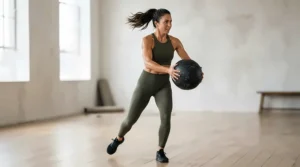
Core work isn’t just crunches. Real life, and most sport, is rotational. A rubber medicine ball trains your trunk to create and resist twisting, which is exactly what a bag-swing, a golf swing or a reach into the boot demands.
Weeks 1–2, two sessions a week, with 60 seconds’ rest between sets:
- Russian twists: 3 sets of 10 per side, ball held at chest height.
- Plank with hands on the ball: 3 sets of 20–30 seconds.
- Standing woodchop (ideally with a handled ball): 3 sets of 8 per side.
Weeks 3–4, add speed:
- Rotational wall throws with a lighter, low-bounce ball: 3 sets of 8 per side.
- Overhead squat-to-press, keeping the ball close to your chest.
- Partner passes, if you’ve got a willing human.
Common mistakes in the first 30 days: throwing with the arms instead of the hips, using a ball too heavy to accelerate, and training on slippery floors. Start each throw by driving through your feet, rotate through the hips, and let the ball follow. If your lower back complains, drop the weight and slow down. Core and rotational training should feel like work, not like a warning.

Real-World Scenarios: Which Rubber Medicine Ball for Which Life?
These are illustrative profiles, not real customers. They show how the same ball behaves differently depending on your space, budget and goals.
The flat-dweller on a budget
Think compact flat, thin floors, two sessions a week. A 2–3 kg Metis Medicine Balls pick keeps costs down, and its low, consistent bounce suits gentle wall work. Use a mat to protect floors and neighbours.
The garage-gym regular
Frequent sessions, a concrete floor and appetite for rotational throws. Here a Gorilla Sports Medicine Ball pair (a lighter 3 kg and a heavier 6 kg) makes sense. Use rubber flooring or a mat, and keep slams to a dedicated slam ball.
The over-50 returning to strength
Strength work matters more with age. A Public Health England and Centre for Ageing Better evidence review says all adults should do strengthening and balance activities at least twice a week, and notes that poor muscle strength raises fall risk in older adults by 76%. A 2–4 kg Pure2Improve Medicine Ball with Handles gives secure grips for slow woodchops and carries, with room to progress.
The small PT studio
Mixed clients, fast sessions. BodyMax Coloured Medicine Balls let you call out “grab the green one” without anyone checking a number.
Problem to Solution: Fixing Common Rubber Medicine Ball Headaches
Rubber medicine balls are simple, but a few snags crop up. Here’s what to do about them:
- The new-rubber smell. Reviewers of popular rubber balls report an odour out of the box that tends to fade. Air the ball in a ventilated spot for a few days and wipe it with a damp cloth.
- Slippery hands. Dry your hands, wipe the shell with a damp cloth to remove dust, and consider a handled model such as the Pure2Improve Medicine Ball with Handles for heavier loads.
- Too much bounce. If wall throws ricochet, switch to a lower-bounce ball like Metis Medicine Balls or stand further back. Soft or synthetic-leather shells also tend to be calmer.
- Cracking or deforming. Store the ball indoors in a clean, dry spot away from radiators, heated floors and direct heat, as retailer care advice suggests. Avoid repeated slams on bare concrete.
- Noise and floor damage. A rubber mat under your feet solves most of both.
Rubber Medicine Ball vs Dumbbells and Kettlebells
People often ask whether a rubber medicine ball can replace weights. Honest answer: it adds something different rather than replacing them.
| Factor | Rubber medicine ball | Dumbbell | Kettlebell | Best For |
|---|---|---|---|---|
| Throwing and rotational drills | Excellent, designed to be thrown | Unsuitable | Unsuitable | Gorilla Sports Medicine Ball for throws |
| Maximum load | Typically 1–10 kg | Much heavier available | Heavy options widely available | Dumbbells for heavy strength |
| Floor and wall tolerance | Rebounds, with care on hard floors | Can damage floors | Can damage floors | Amazon Basics Weighted Medicine Ball for wall work |
| Core and coordination | Strong; unstable loads recruit the trunk | Moderate | Strong for swings | Kettlebells for swings |
| Storage | Compact, rolls | Needs racking | Bulky | Metis Medicine Balls for small spaces |
The table shows why they complement each other. A rubber medicine ball excels where fast, rotational, partner or wall-based work is needed, but it tops out at modest loads. If you want heavy strength lifting, add a dumbbell or kettlebell; if you want athletic, coordinated core work, the ball earns its space.
Common Mistakes When Buying a Rubber Medicine Ball
Five pitfalls come up again and again:
- Confusing it with a slam ball. Bouncy rubber balls and dead-weight slam balls are different tools. Reviewers warn against repeatedly slamming standard rubber balls onto hard floors; the shell can scuff or deform.
- Buying too heavy. A ball you can’t throw crisply trains sloppy movement.
- Ignoring diameter. Weights above 5 kg often jump to a wider shell, which changes how it sits in your hands.
- Skipping the listing details. Some listings mix brands across weights, as the Metis Medicine Balls listing warns, so check size, seller and returns.
- Assuming leather is automatically better. Leather-style balls feel lovely, but for damp garages and heavy use, rubber is usually the more practical choice.
Long-Term Cost and Maintenance
A rubber medicine ball is cheap to own. Say you pay around £30 and use it twice a week for two years. That’s roughly 200 sessions, so the cost works out at around 15p per workout. Even a handled model at the upper end of the range comes out at pennies per session.
Maintenance is minimal. Retailer advice says to wipe the ball with a damp cloth after each session and store it indoors, away from heat sources such as radiators. Buying guides note that rubber can crack or deform with heavy use over time, so inspect the shell occasionally for splits or flat spots. Leather and synthetic leather need more gentle care, and genuine leather dislikes moisture.
Total cost of ownership is therefore dominated by the purchase price, not upkeep. The real saving comes from buying the right weight once. A ball that’s too heavy or the wrong size gets abandoned, which is the most expensive outcome of all.
Safety and Regulations: What UK Buyers Should Know
Medicine ball work is generally low-risk, but a few sensible habits help. Clear at least a couple of metres around you, check ceiling height before overhead throws, and avoid throwing at glass, plasterboard or anything that might give way. Use a mat on hard floors.
Health first: the NHS advises speaking to your GP if you haven’t exercised for some time or have a medical condition. For older adults, NHS guidance on physical activity for older adults is a sensible starting point before adding resistance work.
On the buying side, a medicine ball isn’t something you’d typically expect to carry a CE or UKCA mark the way electrical kit does. Lean instead on a traceable seller, clear weight labelling and a straightforward returns policy. Children should only use balls under supervision, and lighter weights suit smaller hands. Treat any heavy ball like any heavy object: lift with your legs, and stop if something hurts.

FAQ
❓ Can you slam a rubber medicine ball on concrete?
❓ How much does a rubber medicine ball cost in the UK?
❓ Does a new rubber medicine ball smell?
❓ Can I use a rubber medicine ball outdoors?
❓ What should I check before buying a rubber medicine ball online?
Conclusion
A rubber medicine ball is one of the best-value tools you can add to a home gym, as long as you match it to the job. For a first ball on a budget, Metis Medicine Balls and Amazon Basics Weighted Medicine Ball are the safest starting points. For progression and rehab-style work, the Pure2Improve Medicine Ball and Pure2Improve Medicine Ball with Handles make sense, with the handled version suited to swings and carries. If you’re building a medicine ball set, the Gorilla Sports Medicine Ball range and BodyMax Coloured Medicine Balls give you plenty of room to grow. And if leather appeals, the Champion Sports Leather Medicine Ball is the traditional alternative, provided you accept it’s synthetic and not built for slams.
The rubber vs leather durability and grip question mostly comes down to where you train: damp garages favour rubber, dry indoor rooms leave room for leather-style. Whatever you choose, pick your medicine ball weight with care, start light, and let core and rotational training do its quiet, sneaky work.
✨ Ready to get started?
🔍 Click on any highlighted product to check current pricing and availability, pick the ball that fits your space and goals, and make your next workout your most satisfying one yet! 💪
Recommended for You
- Kettlebell Set For Progressive Overload: 7 Proven Picks (2026)
- Kettlebell Set with Rack: 7 Best Amazon UK Picks (2026)
- Colour-Coded Kettlebells For Studio Training: 7 Best Picks (2026)
Disclaimer: This article contains affiliate links. As an Amazon Associate, I earn from qualifying purchases. If you purchase products through these links, we may earn a small commission at no additional cost to you.
✨ Found this helpful? Share it with your friends! 💬🤗
