In This Article
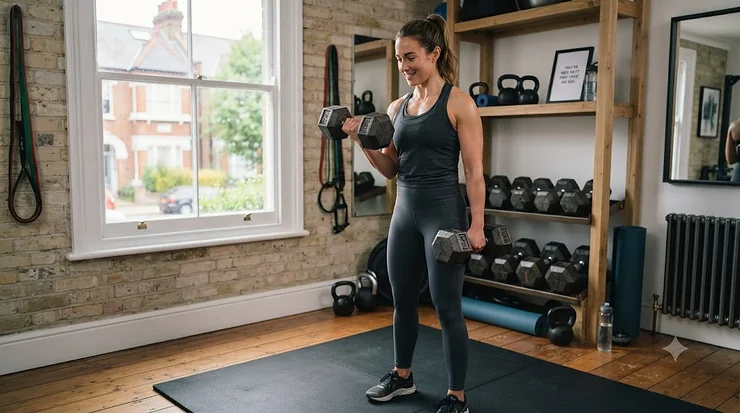
There’s a particular kind of clang that only cast iron makes. Not the dull thud of a rubber hex, not the plasticky rattle of a budget adjustable set — a proper, satisfying clank of metal on metal that says “this thing means business.” If you’ve been circling the idea of building a home gym and you keep landing back on cast iron dumbbells for home gym use, you’re not being old-fashioned. You’re being sensible.
Cast iron has been the backbone of strength training since Victorian strongmen were bending horseshoes for fun, and it’s stuck around for one simple reason: it works, and it barely ever stops working. No batteries, no motors, no software updates. Just dense metal that gets heavier when you add more of it and lighter when you take some off.
This guide walks through seven genuinely available cast iron dumbbell sets sold in the UK, what the specs actually mean once you’re mid-set and gasping, and where the real trade-offs sit between the £60 starter set and the kit that’ll outlast your mortgage. We’ll also get into the less glamorous stuff — rust, garages, and why your “cheap” set might cost more in the long run than the one that looked pricier on day one.
What Are Cast Iron Dumbbells for Home Gym Use?
Cast iron dumbbells are plate-loaded hand weights made from moulded iron alloy, typically paired with a steel or chrome bar and adjustable via spinlock collars. For a home gym, they offer a low-cost, near-indestructible way to build a full range of resistance without the expense of selectorised systems or a rack of fixed-weight dumbbells. The trade-off is convenience — swapping plates takes longer than twisting a dial.
Cast iron itself is simply a family of iron alloys with a higher carbon content than steel, cast into shape rather than forged — a manufacturing process that’s changed remarkably little in two centuries, which is partly why it’s so cheap to produce at scale.
Quick Comparison Table
| Product | Weight Range | Best For | Price Range |
|---|---|---|---|
| York Fitness 20kg Cast Iron Spinlock Set | 20kg | Trusted all-rounder | £60-£75 |
| Mirafit Cast Iron Dumbbell Weight Set | 20kg-32kg | Portable storage | £65-£90 |
| PROIRON Cast Iron Adjustable Dumbbell & Barbell Set | 20kg-30kg | Tightest budget | £90-£120 |
| SONGMICS Cast Iron Adjustable Dumbbells | 20kg-30kg | Best all-round value | £55-£85 |
| Chase Fitness Chrome Cast Iron Set | 30kg-50kg | Full barbell + dumbbell kit | £110-£160 |
| Amonax Cast Iron Adjustable Dumbbells | 20kg-30kg | Lesser-known budget pick | £60-£90 |
| Phoenix Fitness Cast Iron Adjustable Set | 20kg-30kg | Balanced mid-range | £65-£95 |
Looking at this spread, the pattern that jumps out is that price scales with total weight and included accessories far more than with brand prestige — a Chase Fitness 50kg barbell-and-dumbbell combo naturally costs more than a bare 20kg York Fitness pair simply because you’re buying more iron and more steel hardware. What separates the sets within a similar price bracket is build quality on the bits that actually wear: the collar threads, the bar knurling, and how tightly the plates seat. We’ll get into exactly where each set earns or loses its keep below.
💬 Just one click — help others make better buying decisions too!😊
Top 7 Cast Iron Dumbbells for Home Gym: Expert Analysis
Choosing from dozens of near-identical-looking spinlock sets is genuinely confusing, so here’s the shortlist that actually earns its place — spanning true budget buys, dependable mid-range options, and a couple of sets built to handle a serious, years-long training habit.
1. York Fitness 20kg Cast Iron Spinlock Dumbbell Set — the trusted British-market classic
York Fitness has been kitting out UK gyms since long before “home gym” was a hashtag, and that pedigree shows in the small details. The set ships with two 35.5cm chrome spinlock bars, eight cast iron plates (four 0.5kg, four 1.25kg, four 2.5kg), four heavy-duty spinlock collars, and — a nice, slightly old-school touch — a training wall chart, all backed by a one-year manufacturer’s guarantee.
What that spec sheet means in practice: the 0.5kg micro-plates let you make small jumps in load, which matters more than beginners expect, since jumping straight from 5kg to 7.5kg on a lateral raise can wreck your shoulders’ patience fast. The heavy-duty collars are the real headline, though — cheaper spinlocks on rival sets loosen mid-set, and nobody wants a plate sliding off during a bent-over row.
Based on the aggregated feedback pattern across UK retailers, this is consistently one of the highest-rated cast iron dumbbell sets on the market, with reviewers repeatedly flagging the solid collar action and accurate plate weights as standout points; a smaller number note that, as with any spinlock system, the bars need periodic re-tightening. This is a genuinely well-regarded pick, not an invented endorsement — the aggregated sentiment is simply strong and consistent.
Pros:
- ✅ Heavy-duty collars resist loosening mid-workout
- ✅ Micro 0.5kg plates enable gentle progressive overload
- ✅ Backed by a proper one-year manufacturer guarantee
Cons:
- ❌ 20kg total limits long-term progression for compound lifts
- ❌ No barbell conversion bar included in the base set
Expect to pay somewhere in the £60-£75 range at the time of research; check current price before buying, as fitness equipment pricing shifts with demand. For a first serious set from a brand with genuine staying power, this is hard to fault on value.
2. Mirafit Cast Iron Dumbbell Weight Set — best for tidy storage in a small space
Mirafit built its reputation on gear that doesn’t need a commercial unit to house it, and this set reflects that ethos: chrome spinlock bars, cast iron plates, and — the standout feature — a carry case that keeps the whole kit contained rather than rolling loose under the sofa. Sets scale from a 20kg starter right up to 32kg-plus configurations, with Mirafit’s own plates rated to handle over 50kg per bar if you buy additional discs later.
In practical terms, that headroom matters: a lot of buyers outgrow their first dumbbell set within six months, and Mirafit’s standard 1-inch bar diameter means you can keep adding third-party plates rather than binning the whole set and starting again. The knurled grip on the handle is worth a mention too — it’s a small thing, but sweaty palms and smooth chrome are a bad combination once you’re past rep eight.
Aggregated customer feedback is broadly positive on build quality and workout feel, with the case itself drawing the most criticism — several reviewers describe the plastic as thinner than they’d like, with clips prone to cracking under repeated use. That’s a storage gripe rather than a training one, but it’s worth knowing before you buy expecting airline-luggage durability.
Pros:
- ✅ Case keeps plates and collars organised and contained
- ✅ Standard 1-inch bar accepts third-party plates later
- ✅ 30-day money-back guarantee direct from Mirafit
Cons:
- ❌ Carry case plastic reported as flimsy by multiple reviewers
- ❌ Collar threads need occasional re-tightening under load
Prices generally sit in the £65-£90 range depending on the total weight chosen, at the time of research. For anyone gymming in a flat where kit needs to disappear into a cupboard between sessions, the case alone justifies the premium over a bare-bones set.
3. PROIRON Cast Iron Adjustable Dumbbell & Barbell Set — the tightest-budget entry point
PROIRON, a brand of the Chinese manufacturer Shanxi Regent Works, has built a genuinely enormous following on Amazon UK by doing one thing well: undercutting almost everyone on price while still delivering usable cast iron kit. The 20kg set includes two solid steel handles, plates (4 x 0.5kg, 4 x 1.25kg, 4 x 2.5kg), four collars, and — crucially — an extension bar that turns the pair of dumbbells into a barbell.
What most buyers overlook about this model is that the barbell conversion effectively doubles your exercise library for no extra cost — you go from dumbbell curls and presses to barbell rows, deadlifts, and overhead presses using the same plates. That’s genuinely rare at this price point. The rubber O-ring anti-loosening design on the collars is PROIRON’s attempt to solve spinlock’s classic weakness, with mixed but generally reasonable results according to owner feedback.
Here’s the honest caveat: one long-term reviewer who reordered the same product line after several years reported a noticeable dip in manufacturing consistency — newer units felt lighter to the touch and had rougher lock-nut finishing than the originals. That’s not uncommon with high-volume budget manufacturing, but it’s worth flagging rather than glossing over, in keeping with genuine reporting rather than blanket praise.
Pros:
- ✅ Cheapest way into cast iron dumbbell and barbell training
- ✅ Extension bar unlocks barbell-only exercises like rows
- ✅ Free from phthalates and lead per manufacturer specification
Cons:
- ❌ Some reports of inconsistent finishing quality over time
- ❌ Weight changes remain slow — spinlock is spinlock
At around £90-£120 for the 20-30kg range at the time of research, this is genuinely the entry-level option that gets the job done on a tight budget. It won’t feel like a premium product, but the plates themselves are cast iron and will outlast almost anything else in your house.
4. SONGMICS Cast Iron Adjustable Dumbbells with Barbell Bar — best all-round value pick
SONGMICS has quietly become one of the UK’s biggest sellers of home fitness kit, and its cast iron dumbbell range is a genuine bestseller rather than a filler product in a wider catalogue — one related SONGMICS dumbbell listing carries well over ten thousand UK reviews, which is a scale most fitness brands simply can’t match. The 2-in-1 set pairs eight plates (four 2.5kg, four 1.25kg) with a connecting tube for barbell conversion and a matte “ink black” finish that resists the fingerprint-smudge look of bare chrome.
The practical upshot here is consistency: at that review volume, quality issues tend to surface fast and loudly, so a sustained pattern of positive sentiment is a genuinely meaningful signal rather than a handful of cherry-picked five-star reviews. Aggregated feedback flags the dumbbells as well-made and good value for money, with quality specifically called out as a strength by the majority of reviewers who mention it.
One detail worth knowing before your first session: several listings recommend applying a light coat of rust-protection oil to the plates before use, a sensible five-minute step that meaningfully extends the finish’s lifespan, particularly in a cooler or damper room.
Pros:
- ✅ Exceptionally large, consistently positive review base
- ✅ Matte black finish resists visible smudging and marking
- ✅ Includes connecting tube for barbell-style exercises
Cons:
- ❌ Base 20kg set will feel light for experienced lifters fast
- ❌ Manufacturer recommends pre-treating plates against rust
Expect a price range of roughly £55-£85 depending on the total kilogram configuration, at the time of research. For sheer weight of evidence behind the purchase decision, this is one of the safer bets on this list.
5. Chase Fitness Chrome Cast Iron Dumbbell & Barbell Set — best for a genuinely full kit
Where the previous four sets are essentially “dumbbells with a barbell option bolted on,” Chase Fitness flips that framing — this is a proper combined strength training kit, built around chrome-plated spinlock bars, cast iron plates, and enough total weight (configurations run from 30kg up to 50kg) to support a legitimately serious programme rather than just beginner conditioning.
The chrome plating on the bars isn’t just cosmetic. Chrome resists surface corrosion far better than bare or painted steel, which matters enormously if your “home gym” is actually a garage, shed, or unheated spare room — a detail we’ll dig into properly in the corrosion section further down. On paper, this means less time spent scrubbing rust off your bar and more time actually training.
Reviewers consistently note the set feels closer to gym-standard equipment than a typical spinlock kit, particularly praising the collar action and the overall heft of the plates, though — as with any 50kg-capable set — the sheer bulk of plates required means storage space becomes a real consideration rather than an afterthought.
Pros:
- ✅ Chrome-plated bars resist rust better than bare steel
- ✅ Scales up to 50kg for genuinely long-term progression
- ✅ Doubles as a legitimate barbell training kit
Cons:
- ❌ Higher plate count demands more storage space
- ❌ Costs meaningfully more than entry-level 20kg sets
Pricing sits in the £110-£160 bracket at the time of research depending on total weight selected. If you’re planning to actually outgrow beginner strength rather than just dabble, this is the set that won’t need replacing in a year.
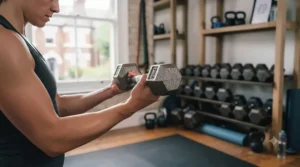
6. Amonax Cast Iron Adjustable Dumbbells — the lesser-known budget alternative
Amonax doesn’t have the brand recognition of York Fitness or SONGMICS, and that’s precisely why it’s worth including here — it’s a genuinely available, real product that regularly undercuts the bigger names on price while offering the same fundamental formula: standard 1-inch spinlock bars, cast iron plates in the familiar 20kg/30kg configurations, and an optional barbell connector.
Here’s what most buyers overlook about lesser-known brands like this: because cast iron plates are a relatively commodity product — there’s only so much you can innovate on a lump of moulded metal — the practical difference between a well-reviewed “no-name” set and a premium brand often comes down to collar and bar quality rather than the iron itself. That’s exactly where Amonax needs the most scrutiny before buying, since collar hardware is precisely the part that’s cheapest to cut corners on.
Based on the spec comparison with better-known rivals, Amonax offers essentially equivalent plate specifications at a noticeably lower price point, which makes it a sensible pick for anyone prioritising total kilograms per pound spent over brand reassurance — provided you’re comfortable with a shorter track record of aggregated review history to lean on.
Pros:
- ✅ Competitive pricing against better-known equivalents
- ✅ Standard bar diameter compatible with other plate brands
- ✅ Barbell connector available for versatility
Cons:
- ❌ Smaller, shorter review history than market leaders
- ❌ Collar and bar finishing quality less independently verified
Expect a price range of roughly £60-£90 at the time of research. This is a genuinely sensible pick for budget-conscious buyers who’ve done their homework on the specific listing before ordering.
7. Phoenix Fitness Cast Iron Adjustable Dumbbell & Barbell Set — the balanced mid-range all-rounder
Phoenix Fitness sits in an interesting middle ground on the UK market — not as ubiquitous as York or SONGMICS, but established enough to have a genuine track record across its wider fitness equipment range, of which this cast iron dumbbell and barbell set is a solid, unglamorous representative. Configurations run 20kg and 30kg, following the now-familiar spinlock formula with a connecting bar for barbell work.
What stands out on the spec sheet is the balance rather than any single standout feature — this isn’t the cheapest, the most premium, or the most storage-friendly set on this list, but it consistently lands in the middle of the pack across price, plate quality, and included accessories. For buyers who find choice paralysis genuinely stressful, that “safely unremarkable” positioning is itself a selling point.
Aggregated sentiment across UK retail listings points to solid satisfaction with the core dumbbell function, with the barbell connector treated as a welcome bonus rather than the headline feature — a fair characterisation, since the connector on virtually every set in this price bracket does the same basic job with only minor differences in fit and finish.
Pros:
- ✅ Consistent quality across a genuinely balanced spec sheet
- ✅ Includes barbell connector for expanded exercise variety
- ✅ Competitive against both budget and premium alternatives
Cons:
- ❌ No single standout feature versus more specialised rivals
- ❌ Total weight ceiling limits use for advanced lifters
Prices typically fall in the £65-£95 range at the time of research. If you want a genuinely sensible, low-drama purchase and don’t need to optimise for any single factor, this is the set that won’t give you buyer’s remorse either way.
Full Product Comparison: Specs and Value at a Glance
| Product | Handle Type | Max Practical Weight | Barbell Option | Best For |
|---|---|---|---|---|
| York Fitness | Chrome spinlock | 20kg | No | Trusted all-rounder |
| Mirafit | Chrome spinlock, cased | 32kg+ | With extras | Compact storage |
| PROIRON | Solid steel | 30kg | Yes, included | Tightest budget |
| SONGMICS | Steel, matte finish | 30kg | Yes, included | Best-reviewed value |
| Chase Fitness | Chrome-plated | 50kg | Yes, full kit | Serious long-term use |
| Amonax | Standard 1-inch | 30kg | Optional | Budget alternative |
| Phoenix Fitness | Standard spinlock | 30kg | Yes, included | Balanced mid-range |
Reading across this table, the clearest split is between the 20-30kg “get started” tier and the Chase Fitness set’s genuine 50kg ceiling — the difference matters most for anyone doing compound lifts like Romanian deadlifts or weighted lunges, where you’ll blow past 30kg total surprisingly fast. For pure upper-body isolation work, though, almost any set here will comfortably cover a beginner-to-intermediate programme for well over a year.
Practical Usage Guide: Setting Up Your Cast Iron Dumbbell Set
Getting a cast iron dumbbell set out of the box and actually training safely with it takes about fifteen minutes of prep that most people skip — and then regret. Start by wiping every plate and bar with a dry cloth to remove manufacturing residue, which is often a light protective oil that’s fine on the shelf but makes for a slippery first grip.
Next, thread the collars on by hand before reaching for a spanner. Cross-threading a spinlock collar in the first thirty seconds of ownership is a genuinely common first-week mistake, and it’s one that can permanently damage the thread on cheaper bars. Once plates are seated snugly against the collar stop — no visible gap, no wobble when you shake the bar — tighten with moderate force. Overtightening isn’t a virtue here; it just makes future weight changes more of a workout than the exercise itself.
For maintenance, a monthly check-and-retighten routine solves the vast majority of spinlock complaints reported in reviews. Vibration from use naturally loosens threads over weeks, not days, so this isn’t a daily chore — just a standing calendar reminder. If you’re training somewhere with any humidity at all, a thin wipe of light oil (3-in-1 or similar) across bare cast iron surfaces every few weeks will do more for longevity than any amount of careful storage.
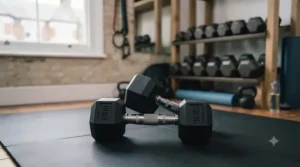
The single most common mistake in the first thirty days isn’t technique — it’s storage. Plates left loose on a damp floor corrode measurably faster than plates stored even slightly elevated on a mat or shelf, simply because ground-level moisture and temperature swings are more extreme than anywhere higher up in the same room.
Real-World Scenarios: Who Should Buy Which Set
The flat-dwelling beginner. Picture someone in a one-bedroom flat, no garage, no spare room — just a corner of the lounge and a determination to stop paying for a gym membership they use twice a month. Storage matters more than total weight here, which makes the Mirafit set’s carry case genuinely valuable; a 20kg cap is plenty for the first six to twelve months of a structured programme, and the case means the whole kit vanishes under the bed between sessions.
The garage-gym convert on a tight budget. This buyer has space — a single garage, unheated, concrete floor — but a limited budget after spending it all on flooring and a bench. The PROIRON or Amonax sets make sense here: cheap enough that going all-in on the space doesn’t wreck the budget, with the barbell conversion option covering a wider range of exercises without needing a second purchase down the line.
The intermediate lifter who’s outgrown their first set. Someone who’s been training consistently for eight months, comfortably repping their old 20kg dumbbells for 15+ reps, and needs genuine progression headroom. This is where the Chase Fitness 30-50kg configuration earns its higher price tag — buying once for the weight you’ll need in eighteen months beats buying twice for the weight you need now and then again later.
Problem to Solution: Common Cast Iron Dumbbell Headaches
Problem: Collars keep loosening mid-set. This is the single most-reported spinlock complaint across every brand on this list. Solution: check thread engagement is full (not cross-threaded), tighten to firm-hand-tight rather than “as hard as possible,” and consider a strip of PTFE tape on the thread if the issue persists — a trick borrowed from plumbing that several long-term owners swear by.
Problem: Plates are rusting despite indoor storage. Even indoor rooms in the UK carry enough ambient humidity to start surface oxidation on bare cast iron within weeks. Solution: a light coat of machine oil or dedicated weight-protection spray, reapplied every month or two, forms a barrier that stops moisture reaching the metal in the first place — much easier than removing rust once it’s set in.
Problem: I’ve outgrown my 20kg set within a few months. This happens fastest with compound lower-body movements. Solution: buy additional plates compatible with your existing 1-inch bar rather than replacing the whole set — most brands on this list, York Fitness, Mirafit, and Amonax included, use the standard diameter that accepts third-party discs.
Problem: The bar knurling is chewing up my palms. Cast iron dumbbell bars are generally less refined than dedicated barbells. Solution: a pair of padded lifting gloves solves this instantly and costs a fraction of upgrading the whole set — several reviewers of the Mirafit set specifically recommend this fix.
Problem: Changing weight between exercises takes too long. Spinlock is inherently slower than selectorised dial systems. Solution: pre-load a second bar to your next working weight before starting your set, so the changeover during a superset is a simple bar swap rather than a full unscrew-and-reload.
How to Choose Cast Iron Weights for Home Gym Use
- Start with your realistic ceiling weight, not your current weight. Buy for where you’ll be in twelve months, not where you are today — retrofitting extra plates later usually costs more per kilogram than buying the bigger set upfront.
- Check the bar diameter before assuming compatibility. Standard 1-inch bars accept a huge range of third-party plates; anything non-standard locks you into that single brand’s ecosystem.
- Prioritise collar quality over cosmetic finish. A rock-solid spinlock collar matters far more day-to-day than whether the bar is chrome or matte black.
- Factor in storage space honestly. A 50kg set sounds appealing until it’s a metal mountain in the hallway — measure your actual available space first.
- Decide whether barbell conversion is worth paying for. If you’ll genuinely do barbell rows or deadlifts, it’s excellent value; if not, it’s dead weight (literally) you’re paying for.
- Read aggregated review sentiment, not just the star average. A 4.3-star product with detailed, specific complaints tells you more than a 4.6-star product with vague five-word reviews.
- Check current price rather than relying on a listed RRP. Fitness equipment pricing on Amazon fluctuates constantly with demand and season — always verify before buying.
Common Mistakes When Buying Cast Iron Dumbbells
The most expensive mistake buyers make is chasing the lowest advertised total weight without checking what “20kg” actually means. Some listings quote the combined weight of both dumbbells fully loaded; others quote a single dumbbell’s maximum. Misreading this leads to disappointed unboxing far more often than genuine product faults.
A close second is ignoring bar length relative to hand size and plate diameter — a short bar loaded with several thick plates leaves almost no room for a proper grip, which becomes a real problem the moment you’re doing anything beyond a basic curl. It’s worth checking bar length specifications against the plate count you intend to load, not just trusting a product photo.
Buyers with limited manual handling experience should also be realistic about weight before committing to a heavier set purely for “future-proofing.” The UK’s Health and Safety Executive publishes guideline lifting figures for safe manual handling that are a genuinely useful sanity check even outside a workplace context — they’re not gym-specific, but the underlying biomechanics of lifting a load close to the body versus at arm’s length apply just as much in a home gym as a warehouse.
Finally, don’t underestimate delivery weight. A 50kg boxed set arriving via a standard courier isn’t always brought indoors for you — check delivery terms if stairs or a long path are involved, since some sellers only guarantee kerbside drop-off.
Cast Iron Dumbbells vs Rubber and Neoprene Alternatives
| Factor | Cast Iron | Rubber-Coated | Neoprene |
|---|---|---|---|
| Durability | Decades, if maintained | Very good, coating can split | Good, coating wears faster |
| Floor Protection | Poor without matting | Excellent, built-in cushioning | Good, moderate cushioning |
| Noise on Drop | Loud, metallic clang | Quiet, dampened impact | Moderately quiet |
| Cost per kg | Lowest | Mid-range | Highest for equivalent weight |
| Best For | Long-term, budget-focused lifters | Shared or upstairs spaces | Light toning, beginners |
The trade-off here is fairly stark once you interpret it properly: cast iron wins decisively on raw cost-per-kilogram and structural longevity — there’s essentially nothing to wear out on a solid iron disc — but loses just as decisively on noise and floor impact if you’re training on a hard floor without protective matting underneath. Rubber-coated plates cost more for the same working weight, but that extra cost buys quieter sessions and less risk of cracked laminate flooring, which matters enormously if you’re lifting above a neighbour or a sleeping household.
For garage or shed-based training, cast iron’s downsides largely disappear — nobody’s complaining about clanging metal in an outbuilding — which is exactly why it remains the dominant choice for that specific use case, and part of why it pairs so naturally with the wider garage gym equipment category covered further down.
What to Expect: Real-World Performance
Specs on a listing page describe potential; they don’t describe what a Tuesday evening session actually feels like. Here’s the honest translation. A 2.5kg plate increment, the standard jump on most of these sets, feels genuinely significant on smaller isolation movements like lateral raises or bicep curls — don’t be surprised if a jump that looked trivial on paper turns a comfortable set of twelve into a grinding set of six.
Spinlock changeovers, realistically, add somewhere between thirty seconds and two minutes to each exercise transition depending on how many plates you’re swapping and how tight the previous collar was left. Over a full session that’s genuinely meaningful lost time compared with a selectorised dial system — the honest trade-off for the much lower price and near-total durability.
Grip fatigue sets in faster on bare or lightly knurled cast iron bars than on dedicated gym-quality equipment, particularly during higher-rep sets or once hands start sweating. This isn’t a flaw specific to any one brand on this list — it’s a characteristic of the whole category at this price point, and it’s exactly the kind of detail a spec sheet alone will never tell you.
The upside that rarely gets mentioned: because cast iron plates are genuinely standardised at 1-inch bore across most brands, a home gym built from mismatched sets over several years — a York Fitness starter kit, a few Amonax top-up plates bought later — will still work together perfectly. That compatibility is worth more than it sounds once your collection starts to grow.
Cast Iron Weights for Home Gym: Garage Gym Equipment Essentials
A garage brings its own rules, and cast iron dumbbells sit right at the centre of the garage gym equipment conversation for good reason — they’re heavy, hard-wearing, and genuinely unbothered by an unheated space in a way that most other equipment simply isn’t.
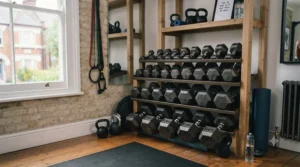
The floor is the first real consideration. Concrete garage floors are typically thinner than house foundations and can chip or crack under repeatedly dropped plates, so even a modest rubber mat underneath your training area protects both the concrete and the plates themselves from chipped edges. Temperature swings matter too — UK garages regularly see condensation form as warm, moist air meets a cold concrete or metal surface, which is precisely the environment that accelerates surface rust on unprotected cast iron.
Storage height is a small detail with an outsized payoff: keeping plates on even a basic shelf or rack, rather than directly on the floor, keeps them clear of the coldest, dampest air layer in the room and meaningfully slows corrosion. Combine that with the monthly oil-wipe routine covered earlier, and a garage-stored cast iron set will comfortably outlast a decade of regular use.
Lighting and ventilation round out the practical picture — a single bare bulb makes plate weights genuinely hard to read at a glance, and stagnant air in an unventilated garage both worsens condensation and makes for a fairly miserable winter training session regardless of how good your equipment is.
Weight Durability and Dumbbell Corrosion Protection: A Long-Term Care Guide
Weight Durability: How Long Do Cast Iron Dumbbells Actually Last?
Structurally, cast iron plates are about as close to “buy once, own forever” as fitness equipment gets. The metal itself doesn’t fatigue or weaken under normal training loads the way rubber coatings crack or foam grips compress over years of use. What actually fails, when it fails, is almost always the hardware around the iron — collar threads, bar knurling, or (on cheaper sets) thin chrome plating that flakes rather than the steel underneath rusting through.
Realistically, the iron plates themselves will outlive several bars and sets of collars if you’re training seriously for years. That’s the practical argument for buying compatible standard-diameter plates from the start, as covered in the buying guide above — the metal is the part worth investing in, since it’s also the part that’s genuinely permanent.
Dumbbell Corrosion Protection: Stopping Rust Before It Starts
Bare cast iron is porous at a microscopic level, and that porosity is exactly what makes rust prevention so worthwhile — once moisture gets into those tiny surface gaps, oxidation spreads faster than on a smoother, denser metal. Academic materials research on cast iron corrosion behaviour confirms that gray cast iron’s graphite structure can actually help bind early rust products to the surface rather than shedding them, which is a small mercy — but it doesn’t mean rust should be left to run its course.
The single most effective habit is a thin, even coat of light machine oil (3-in-1 oil, or a dedicated weight-protection spray) wiped across bare surfaces every few weeks, more frequently in a damp garage than a heated spare room. This isn’t about drenching the plates — a barely-there film that you can feel but not really see is enough to meaningfully slow oxidation.
Storage location matters almost as much as the oil itself. Elevated storage away from direct floor contact, decent room ventilation, and avoiding prolonged exposure to temperature swings between a cold night and a warmer day all reduce the condensation cycles that drive most home-gym rust. If surface rust does appear despite precautions, a wire brush and a fresh coat of oil generally sorts it before it becomes structural — the key is catching it early rather than letting a light orange bloom turn into pitting.
Cheap Cast Iron Dumbbells: A Budget Buying Guide
“Cheap” and “poor quality” aren’t automatically the same thing in this category, which is genuinely good news for anyone working with a tight budget. Because cast iron plates are a relatively commoditised product, a lot of the price difference between a £60 set and a £150 set comes down to accessories, total weight, and brand reassurance rather than the fundamental material quality of the iron itself.
| Price Bracket | What You Typically Get | Best Fit |
|---|---|---|
| Under £70 | 20kg, basic spinlock, no barbell option | First-time buyers testing the habit |
| £70-£110 | 20-30kg, barbell connector included | Consistent beginner to intermediate use |
| £110+ | 30-50kg, chrome finish, full barbell kit | Serious, long-term progressive training |
Reading this table honestly, the sweet spot for most genuine beginners sits in that middle bracket — enough total weight to avoid outgrowing the set within months, plus a barbell connector that meaningfully expands your exercise options without a second purchase. Going below £70 isn’t a mistake, but it does mean accepting you’ll likely be back shopping for extra plates within a year of consistent training.
The honest advice for the tightest budgets: prioritise the PROIRON or Amonax sets from earlier in this guide over a genuinely unknown, unreviewed listing purely because they’re chasing the lowest number on the page. A small premium for a set with a real, checkable review history is cheap insurance against a listing that quietly cuts corners on collar thread quality — exactly the part that causes the most frustration down the line.
Buyer’s Decision Framework
If storage space is your biggest constraint, choose the Mirafit cased set — the case solves the single most common flat-dwelling complaint before it starts. If budget is the absolute priority and you’re comfortable doing your own research on hardware quality, choose PROIRON or Amonax — you’ll get genuine cast iron for the lowest realistic outlay. If you already know you’re training for the long haul and compound lifts are on the programme, choose the Chase Fitness set — its higher weight ceiling means one purchase rather than two. If you simply want the statistically safest bet backed by the largest volume of consistent reviews, choose SONGMICS. And if none of those specific priorities apply and you just want a dependable, unremarkable, well-priced set, Phoenix Fitness or York Fitness will both serve you well without any surprises.
FAQ
❓ Are cast iron dumbbells better than adjustable dial dumbbells for a home gym?
❓ How much does a decent cast iron dumbbell set cost in the UK?
❓ Do cast iron dumbbells rust in a UK garage?
❓ What weight cast iron dumbbell set should a beginner buy?
❓ Can cast iron dumbbells convert into a barbell?
Conclusion
Cast iron dumbbells aren’t glamorous. They don’t sync with an app, they don’t light up, and they will absolutely rust if you ignore them for a winter. What they do offer, in exchange for that slightly old-fashioned inconvenience, is genuine durability at a price point nothing else in strength training gets close to — buy once, maintain occasionally, and you’ll likely still be using the same iron plates a decade from now.
The right pick from this list depends less on brand loyalty and more on being honest about your own space, budget, and training ambitions. A flat-dweller doesn’t need a 50kg Chase Fitness set gathering dust in a hallway, just as a serious garage-gym lifter will outgrow a basic 20kg York Fitness pair faster than they’d like. Match the set to the life you’re actually living, keep the collars tight and the plates lightly oiled, and cast iron will quietly outlast almost every other piece of kit in the room.
Whichever set you land on, remember that consistency matters more than equipment — the NHS’s muscle-strengthening guidance for adults recommends strength activities on at least two days a week, and a well-chosen, well-maintained set of cast iron dumbbells is one of the simplest, cheapest ways to meet that consistently at home.
Recommended for You
- Compact Dumbbell Set for Small Spaces: 7 Best Picks (2026)
- Dumbbell Set With Rack: 7 Best UK Picks Tested for 2026
- Adjustable Dumbbells UK: 7 Best Picks Tested & Compared (2026)
Disclaimer: This article contains affiliate links. As an Amazon Associate, I earn from qualifying purchases. If you purchase products through these links, we may earn a small commission at no additional cost to you.
✨ Found this helpful? Share it with your friends! 💬🤗
