
In This Article
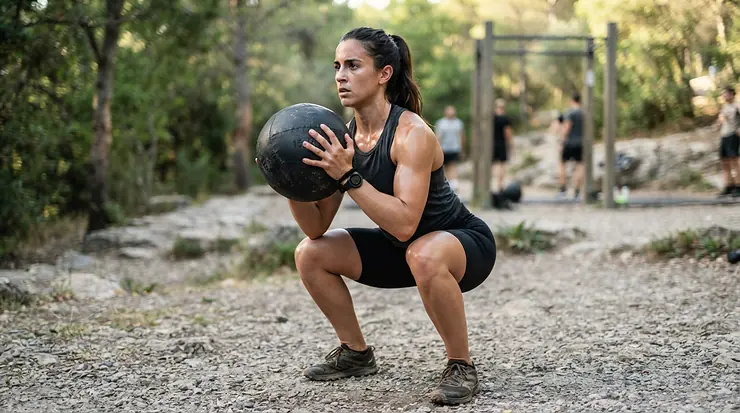
A wall ball for CrossFit is a soft-shelled, sand-filled weighted ball, usually 35-36cm across, built to be thrown at a target and caught again at the bottom of a squat. Unlike a rubber medicine ball, it gives slightly on impact, which is why you can survive 150 reps without a bruised sternum. Choosing the right wall ball for CrossFit is less about grabbing the heaviest option and more about finding one that stays catchable when your hands are slick and your quads are filing a formal complaint.
The movement is simple on paper: squat, drive, throw, catch, repeat. In practice it is brutally honest. CrossFit’s own programming for the benchmark workout Karen prescribes 150 shots with a 20lb ball to a 10ft target for men and a 14lb ball to a 9ft target for women, as laid out in CrossFit’s Karen workout tips. Those pound-based figures translate to roughly 9kg and 6kg. That is why UK buyers keep arguing over 6kg vs 9kg wall ball weights, and why the details of your ball matter more than the logo on it.
This guide covers seven real, UK-available options for the wall ball for CrossFit shopper. It also unpacks the medicine ball vs wall ball question, explains wall ball target height, shows where wall balls sit in thrusters and WOD programming, and looks at the wall ball for group fitness classes. Everything here is built from published specs, listing-level ratings and independent buying guides, not from claimed hands-on testing. The first three picks were confirmed on amazon.co.uk at the time of research. Check that a current amazon.co.uk listing exists for the others before you buy.
Quick Comparison: Wall Ball for CrossFit Picks at a Glance
| Pick | Weights | Size & Shell | Price Range | Listing Rating | Best For |
|---|---|---|---|---|---|
| FORZA Wall Balls | 3-15kg, plus half/full sets | Cross-stitched, scratch-resistant PVC, sand core | Around £30-£45 | About 4.5/5 | Best value across a full weight range |
| Core Balance Wall Ball | 3-15kg | 35cm, PVC, textured seams | Around £35-£50 | About 4.7/5 | Best all-round box and home use |
| Yes4All Wall Ball | 6-30lb | Soft leather-look shell, sand/iron core, loops | Around £40-£45 | About 4.5/5 (largest sample) | Best for exact pound-based Rx weights |
| Mirafit Classic 13″ Medicine Wall Ball | 3-12kg | About 33cm, PU leather | Check current price | Positive on-site reviews | Best for shape retention |
| UKSF Black and Red Wall Balls | 3, 6, 9, 12kg | 36cm, double-stitched vinyl | From the high £30s | Not verified | Best for classes (same size every weight) |
| BLK BOX Wall Balls | 3-15kg | Heavy-duty PVC, reinforced stitching | Check current price | Not verified | Best for high-volume commercial use |
| Core Strength Wall Balls | 3, 4, 6, 9, 12kg, plus sets | 35cm, double-stitched vinyl | Check current price | Not verified | Best for ready-made CrossFit/HYROX sets |
Looking at the comparison above, FORZA Wall Balls and Core Balance Wall Ball offer the widest weight choice in the lower price bands. Yes4All Wall Ball brings the biggest pool of listing ratings and exact pound-based Rx weights. Coaches equipping a class should note that UKSF Black and Red Wall Balls keeps every weight at an identical 36cm, a detail that sounds trivial until twelve athletes swap balls mid-WOD. Prices are indicative ranges at the time of research, so check the current price before buying.
💬 Just one click — help others make better buying decisions too!😊
Top 7 Wall Ball for CrossFit Picks: Expert Analysis
Seven balls, three jobs: budget-friendly home use, serious Rx training, and equipping a room full of people. Each entry explains what the spec sheet means in practice, not just what it says.
1. FORZA Wall Balls — widest weight range for the money
That 3kg-to-15kg spread is the headline: ten single-ball weights plus half and full sets, so you can buy one ball or kit out a small class from one listing. The cover is cross-stitched, scratch-resistant PVC around a sand-filled core with integrated loops. Sand matters because it settles and deadens the bounce, so the ball lands where you catch it rather than pinging back. The loops are a mixed blessing. They are handy for carries and grip, but some athletes find them fiddly for a clean two-handed catch.
Based on the spec comparison, this is a smart first purchase for a home gym. The half set (4, 6, 8, 10 and 12kg) covers progression from technique work to heavy shots without a second order. The listing sat at around 4.5 out of 5 at the time of research, but from a modest number of ratings, so treat it as encouraging rather than conclusive. A UK HYROX-focused buying guide also rates it as best value for race-spec training. That is a third-party opinion, not a verdict from me.
Pros:
- ✅ Ten weights plus half and full sets
- ✅ Scratch-resistant PVC cover
- ✅ Sand core reduces rebound
Cons:
- ❌ Smaller ratings sample than the biggest listings
- ❌ Loops may annoy two-handed catchers
Price sits in the £30-£45 range depending on weight. Value verdict: excellent for starters who want room to grow.
2. Core Balance Wall Ball — a 35cm all-rounder with grip seams
At the time of research this listing carried an Amazon’s Choice badge for the search “wall ball”, which signals popularity, not quality. The specs tell the better story: 35cm diameter, durable PVC shell, balanced weight distribution and textured grip seams, in weights from 3kg to 15kg. That 35cm size sits right on the usual competition dimension, so your depth perception for catches carries over when you move to a box’s balls.
The textured seams give your fingertips something to bite on when sweat arrives around rep 60. Balanced fill matters too: a lopsided ball wobbles in flight and punishes your wrists. A UK HYROX guide singles out the 9kg version for men’s Pro prep and the 4kg for women’s Open, noting the same soft, catchable shell across weights. The listing averaged around 4.7 out of 5, but the sample was small (roughly thirty ratings), so I’d call it promising rather than proven.
Pros:
- ✅ 35cm matches the typical standard
- ✅ Textured seams help with sweaty grip
- ✅ Includes 4kg and 9kg HYROX-friendly weights
Cons:
- ❌ Limited ratings so far
- ❌ PVC will scuff on rough brickwork
Expect to pay around £35-£50 depending on weight. Value verdict: strong for athletes who want one dependable ball that works for CrossFit and HYROX.
3. Yes4All Wall Ball — exact pound weights, biggest review pool
Sizing in 6lb-30lb is unusual for a UK buyer, but it is a quiet advantage. A 14lb ball is about 6.35kg and a 20lb ball is about 9.07kg, which are the true Rx weights for Karen. A metric 6kg is roughly 13.2lb, so you are about a pound light of the women’s standard. The shell is soft leather-look PVC with a sand-and-iron core and finger loops, which helps when your hands are streaming.
This listing had the largest rating pool of the seven, averaging around 4.5 out of 5 across several hundred ratings on amazon.co.uk. That is the most meaningful sample here. A US buying guide ranks it top overall for CrossFit-style home training, though it also advises weighing any ball on scales if you need exact weights for sanctioned competition. That is sensible advice for any brand.
Pros:
- ✅ Largest ratings sample of the seven
- ✅ Exact 14lb and 20lb Rx weights
- ✅ Finger loops for sweaty hands
Cons:
- ❌ Pound-only sizing clashes with kg programming
- ❌ Dearer than the budget-leaning options
Prices sit around £40-£45 at the time of research. Value verdict: the safest buy if you follow CrossFit’s pound-based standards.
4. Mirafit Classic 13″ Medicine Wall Ball — British-brand build that keeps its shape
The Mirafit range runs 3, 4, 5, 6, 7, 8, 9, 10 and 12kg, every ball about 13in (33cm) across. The shell is synthetic PU leather with a textured non-slip finish and reinforced stitching, built to absorb impact against a wall. Mirafit is upfront that these are not slam balls, and that stitched construction means they are not perfectly round, so they will not roll straight. In practice that is irrelevant mid-rep but mildly annoying when a ball wanders across the floor.
At 33cm it is slightly smaller than the 35-36cm benchmark. For lighter balls you will barely notice. At 9kg a smaller ball feels denser in the hands, which some athletes like and others find harder to catch. On Mirafit’s own site, buyers describe the balls as well made and sturdy, with one noting a 6kg ball keeping its shape perfectly. That is a small, retailer-hosted sample, so weigh it accordingly.
Pros:
- ✅ Nine weight steps from 3kg to 12kg
- ✅ Reinforced stitching and textured PU surface
- ✅ Positive on-site feedback on durability
Cons:
- ❌ Smaller than the 35-36cm norm
- ❌ Not perfectly round, so it rolls unpredictably
Price was not verified at the time of research, so check the current price. Value verdict: a good fit for technique-focused athletes and lighter loads.
5. UKSF Black and Red Wall Balls — identical 36cm size at every weight
The UKSF Black and Red Wall Balls come in 3, 6, 9 and 12kg, all at 36cm, with a vinyl outer, double stitching and a softer absorbent inner around a centrally held weight. The seller says this softer inner lets the ball “give” on a sweaty catch. That is a retailer claim, and I could not find independent review data to confirm it.
The identical size is the most useful spec. Swapping from 6kg to 9kg does not change how the ball sits in your hands or how far you need to open your fingers. For a coach, that makes progressions simpler to teach. Based on the spec sheet, it also helps if athletes of different strengths share a rack, because nobody has to recalibrate their catch. The seller lists the balls as commercial grade and warns against using them for slams, which is the right call for any stitched wall ball.
Pros:
- ✅ Same 36cm size across every weight
- ✅ Double stitching and vinyl outer
- ✅ Four clear weight steps for progressions
Cons:
- ❌ No independent reviews found
- ❌ Only four weight options
Prices start in the high £30s per ball. Value verdict: very good for coaches who value consistency over choice.

6. BLK BOX Wall Balls — built for high-volume commercial punishment
The BLK BOX Wall Balls range covers 3, 4, 6, 9, 12 and 15kg, using a heavy-duty PVC shell and reinforced stitching. The brand positions them for UK athletes and training facilities, and they are marketed for both CrossFit and HYROX use. The inclusion of a 4kg option matters: it is the women’s Open race weight at HYROX, which many ranges overlook.
Seams are where wall balls die, so reinforced stitching is the spec to care about if you are running several classes a week. The 15kg end of the range is more of a specialist strength-conditioning tool than a standard wall ball weight, and most athletes will never need it. I could not verify independent review data or a verified price for this range, so the “premium” label here reflects the brand’s own commercial positioning rather than a confirmed price tier.
Pros:
- ✅ Reinforced stitching for high-volume use
- ✅ 4kg through to 15kg options
- ✅ Marketed for CrossFit and HYROX
Cons:
- ❌ Independent reviews not verified
- ❌ Price unconfirmed at the time of research
Check the current price before committing. Value verdict: worth shortlisting if you are equipping a busy box and care about seam durability.
7. Core Strength Wall Balls — ready-made CrossFit and HYROX sets
The Core Strength Wall Balls range uses a 35cm double-stitched, scuff-resistant vinyl shell with even weight distribution, in 3, 4, 6, 9 and 12kg. The clever bit is the bundles: a CrossFit set of 3, 6 and 9kg and a HYROX set of 4, 6 and 9kg. Sets remove the guesswork, because three weights cover beginner, intermediate and Rx-level work in one purchase.
Based on the spec comparison, the HYROX set is the more flexible of the two for a general athlete, since it includes the 4kg as well as the 6kg and 9kg. The CrossFit set suits someone who wants only the three classic steps. As with UKSF Black and Red Wall Balls, the durability and grip claims come from the seller, and I could not find independent review aggregates, so treat them as promising specs rather than proven performance.
Pros:
- ✅ Pre-built CrossFit and HYROX sets
- ✅ 35cm industry-standard size
- ✅ Double-stitched, scuff-resistant shell
Cons:
- ❌ Seller-stated durability only
- ❌ Price unverified at the time of research
Check the current price. Value verdict: handy for anyone who wants a full progression sorted in one go.
Setting Up and Maintaining Your Wall Ball for CrossFit: A Practical Guide
Amazon listings tell you what a ball is. They rarely tell you how to look after it, so here is the maintenance side.
Prepare the wall. Rough brick and pebbledash chew through PVC and vinyl. A sheet of plywood or a proper wall-mounted target gives you a consistent surface. Mark the target with tape: 9ft is about 2.74m and 10ft about 3.05m.
Set your distance. Start roughly 30-45cm from the wall, then adjust until the ball returns to your chest without you reaching or backing away. If you are constantly chasing it, you are too far.
Clean it properly. Wipe with a damp cloth, avoid soaking the seams, and let it dry fully. Chalk and sweat build-up makes the surface slick, which defeats the point of a textured shell.
Store it sensibly. Keep balls out of direct sun and off damp garage floors. Rotate balls so one does not take all the abuse, and check seams monthly for fraying.
Avoid common first-30-day errors:
- Starting too heavy and ruining your squat depth
- Slamming the ball into the floor (stitched wall balls are not slam balls)
- Throwing to a target that is too high before your technique is ready
Real-World Scenarios: Matching a Wall Ball for CrossFit to Your Training
Three profiles, three different answers.
The garage beginner. You train three times a week at home on a budget of around £40-£50, with a single brick wall. The sensible choice is a 4-6kg ball from FORZA Wall Balls, because the wide range lets you add weight later. Put a plywood sheet on the wall first.
The Rx chaser. You follow CrossFit’s pound-based standards and want to hit Karen at 14lb or 20lb. Yes4All Wall Ball is the sensible pick because the pound sizing matches the prescription. The big ratings pool also means you are less likely to get a dud.
The box coach. You run classes of ten to twelve and need balls that behave identically across weights. UKSF Black and Red Wall Balls or Core Strength Wall Balls (in its set form) suit this best, since same-size or set-based buying simplifies coaching. Budget for at least a 3-6-9kg spread plus a spare or two, because balls tend to go missing the week before a benchmark.
How to Choose a Wall Ball for CrossFit: 7 Steps
- Match the weight to your standard. CrossFit’s Rx is 20lb (men) and 14lb (women). Scale down if your squat or shoulders cannot sustain large sets.
- Check the diameter. 35-36cm is the usual standard. Smaller balls feel denser and catch differently.
- Inspect the shell. PVC and vinyl are durable and cheap, while PU leather feels nicer but can cost more.
- Look at the stitching. Double or reinforced stitching extends life, because seams fail first.
- Think about grip. Textured seams or finger loops help once sweat takes over.
- Decide single or set. A set suits progression and classes. A single ball suits someone who knows their weight.
- Check the returns policy. Weights vary slightly between manufacturers, so buy somewhere you can return a ball that feels off.
Medicine Ball vs Wall Ball: What’s the Real Difference?
The medicine ball vs wall ball debate matters because the two are not interchangeable. A rubber medicine ball is small, hard and designed for rotational work or controlled throws. A wall ball is larger, softer and designed to be caught from depth. A slam ball is a dead-bounce ball built to be hurled at the floor, which is exactly what you should not do with a stitched wall ball.
| Feature | Wall Ball | Rubber Medicine Ball | Slam Ball |
|---|---|---|---|
| Feel | Soft, sand-filled | Hard, bouncy rubber | Dense, dead bounce |
| Typical Size | 33-36cm | Smaller, size varies | Varies |
| Catch from Squat | Easy | Awkward | Poor |
| Example | Core Balance Wall Ball | Mirafit Rubber Medicine Ball | Amazon Basics Slam Medicine Balls |
| Best For | CrossFit wall-ball shots | Rotational and partner work | Floor slams |
Looking at the table, the medicine ball vs wall ball question comes down to purpose. If your workouts include wall-ball shots, buy a wall ball. A rubber medicine ball will bounce unpredictably and punish your hands, and a slam ball will not return to you at all. Mirafit explicitly notes that its stitched wall balls are not meant for slams, so heed that.
6kg vs 9kg Wall Ball Weights: Which Should You Throw?
The 6kg vs 9kg wall ball weights debate usually maps onto the women’s and men’s CrossFit standards, but your own capacity is what matters.
| Factor | 6kg | 9kg |
|---|---|---|
| Approx. Pounds | 13.2lb | 19.8lb |
| Closest CrossFit Rx | Women’s 14lb | Men’s 20lb |
| HYROX Division | Men’s Open, Women’s Pro | Men’s Pro |
| Fatigue Profile | Manageable in big sets | Forces earlier breaks |
| Best For | Intermediate athletes, high-rep work | Strong athletes, Rx-level work |
On 6kg vs 9kg wall ball weights, the key point is rep economy. A 6kg ball lets most athletes string together long sets, which is the point of benchmarks like Karen. A 9kg ball forces earlier rest breaks and often exposes weak shoulders or an inefficient squat. CrossFit’s own scaling for Karen offers 14lb for men and 10lb for women as intermediate options, and 10lb and 6lb for beginners, so lighter is not a failure, it is smart programming.
If you are unsure, buy the lighter ball first. Most athletes improve faster with the weight they can use cleanly than with the one they can barely lift.
Wall Ball Target Height: 9ft, 10ft and Why It Matters
Wall ball target height is the hidden variable that changes how a workout feels. CrossFit’s standard is 10ft (about 3.05m) for men and 9ft (about 2.74m) for women. HYROX uses a target around 3m for men and 2.7m for women.
Why does the gap exist? One UK box explains in a CrossFit Roots article on wall ball target height that using a single 10ft target for everyone in the 2009 Games produced lots of missed shots. Looking at benchmark data since 2014, they found the time gap between men and women was tighter with a 9ft target for women. They kept 9ft as the women’s standard.
For your own training, wall ball target height is a scaling lever. If a 20lb ball to 10ft is too much, lower the target or drop the weight, not both at once. Keeping the same height while changing weight, or vice versa, lets you see what is actually limiting you.
Thrusters and WOD Programming: Where Wall Balls Earn Their Place
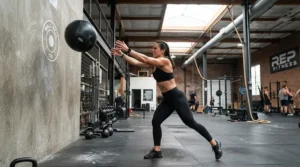
Thrusters and WOD programming overlap more than most athletes realise, because a wall ball shot is essentially a lighter thruster with a throw. Both hit quads, glutes and shoulders in one continuous drive. That is why programming both in the same session can leave you fried before the finish.
CrossFit’s own programming shows how versatile the movement is. Workout 24.3, described on CrossFit’s workout page, used ten one-minute rounds of wall walks, deadlifts and max wall-ball shots with a rest minute between rounds. It used a 14lb ball to 9ft (women) and 20lb to 10ft (men), and the programming note suggests athletes should have at least 20 seconds for wall balls in each round.
For your own thrusters and WOD programming:
- Pair wall balls with pulling or hinging movements such as rowing or deadlifts, not another squat-heavy exercise.
- Use intervals to keep shot quality high, rather than sprawling sets of ugly reps.
- If you do barbell thrusters earlier in the week, keep wall-ball volume modest the next day.
Wall Ball for Group Fitness Classes: Equipping a Room Full of Throwers
Running a wall ball for group fitness classes session is a logistics puzzle as much as a coaching one. Here is how to think it through.
Ball count. One ball per athlete is ideal, but pairs can work if the wall space is limited. Remember that a pair sharing a ball halves the volume each person gets.
Weight tiers. A 3-6-9kg spread covers most mixed-ability groups. UKSF Black and Red Wall Balls and the sets from Core Strength Wall Balls make this easier by keeping sizes consistent or bundling weights together.
Wall space. Mark targets at 9ft and 10ft, and leave enough floor between athletes that a rogue throw does not hit a neighbour.
Durability. In classes, balls take punishment daily. BLK BOX Wall Balls emphasise reinforced stitching for exactly this reason, though I could not verify independent review data.
Hygiene. Vinyl and PVC wipe down easily between sessions, which helps when several people use the same ball.
If you are building a wall ball for group fitness classes setup on a budget, a half set from FORZA Wall Balls is a practical starting point.
Common Mistakes When Buying a Wall Ball for CrossFit
- Buying too heavy. A ball you cannot rep cleanly is worse than a lighter one you can.
- Ignoring size. A 33cm ball catches differently from a 36cm one, so if you compete in other boxes, consistency matters.
- Confusing slam and wall balls. Slam balls are dead-bounce and will not catch well. Stitched wall balls should never be slammed.
- Skipping the seams. Cheap seams fail early, and a split ball is a wasted purchase.
- Forgetting the wall. The best ball in the world will not last on pebbledash.
- Ignoring pounds vs kilograms. If your programme is in pounds, Yes4All Wall Ball matches it exactly. If it is in kilograms, metric ranges are simpler.
- Chasing exact prices. Prices move often, so check current prices rather than relying on a number you saw last month.
Safety and Sensible Progression
Wall balls are low-skill, high-fatigue, which is a recipe for sloppy form late in a set. Stop a set when your squat depth collapses or your catches turn into chest bounces.
The NHS recommends adults do strengthening activities that work all the major muscle groups on at least two days a week, and advises speaking to a GP first if you have not exercised for some time or have medical conditions. You can read the full NHS physical activity guidelines for adults.
In practical terms:
- Warm up your hips, ankles and shoulders before heavy sets.
- Progress weight or reps, not both at once.
- Keep your target realistic until your technique is solid.

FAQ
❓ How much should I spend on a wall ball for CrossFit?
❓ Can I throw a wall ball for CrossFit against a brick wall at home?
❓ Do wall balls for CrossFit split or burst?
❓ How many wall balls does a group fitness class need?
❓ Where can I buy a wall ball for CrossFit in the UK?
Conclusion
Picking a wall ball for CrossFit comes down to four things: the weight you can handle cleanly, a size close to the 35-36cm standard, seams that will survive your volume, and a grip that works when you are sweating. For most home athletes, FORZA Wall Balls and Core Balance Wall Ball offer the best mix of range and value. Yes4All Wall Ball is the safest buy if you follow pound-based Rx standards and want the strongest ratings evidence. Coaches equipping a class should look hard at UKSF Black and Red Wall Balls, BLK BOX Wall Balls and Core Strength Wall Balls, while Mirafit Classic 13″ Medicine Wall Ball suits technique work and lighter loads.
On the big debates: choose 6kg unless you can string clean sets at 9kg, treat wall ball target height as a scaling lever, and respect the difference between a medicine ball and a wall ball. Pair your shots sensibly with rowing or hinging work rather than stacking them behind heavy thrusters.
✨ Ready to Start Throwing!
🔍 Take your wall ball for CrossFit training to the next level with these carefully selected products. Click on any highlighted item to check current pricing and availability. These tools will help you build the kind of engine your whole training crew will envy!
Recommended for You
- Dead Bounce Slam Ball For Home Gym: 7 Best Buys Ranked (2026)
- Rubber Medicine Ball: 7 Best Picks For UK Home Gyms (2026)
- Kettlebell Set For Progressive Overload: 7 Proven Picks (2026)
Disclaimer: This article contains affiliate links. As an Amazon Associate, I earn from qualifying purchases. If you purchase products through these links, we may earn a small commission at no additional cost to you.
✨ Found this helpful? Share it with your friends! 💬🤗
