In This Article
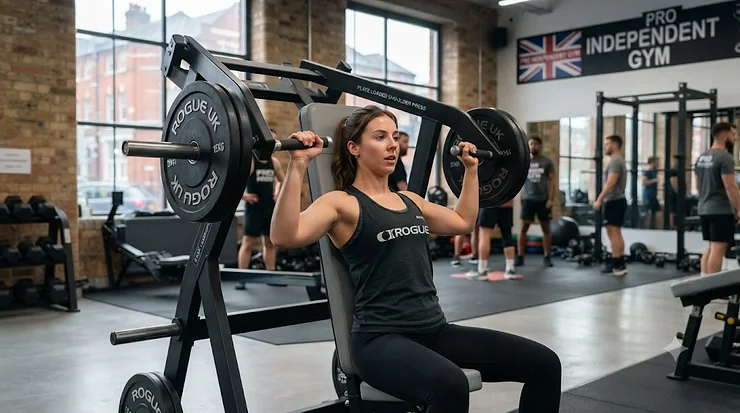
Shoulders are the fussiest muscle group in the gym. Too much barbell overhead pressing and your rotator cuff starts sending you strongly worded letters. Too little structure and your delts never quite catch up to the rest of your upper body. That’s the gap a plate loaded shoulder press machine is built to close — a fixed, guided pressing path that lets you load serious weight onto your deltoids without your shoulder joint doing the balancing act a free-standing barbell demands.

This guide is for anyone weighing up a plate loaded shoulder press machine for a home gym, a garage setup, or a small commercial studio in the UK. We’ve pulled together seven real, currently available machines — from an entry-level dual-function bench through to commercial-grade leverage presses built for daily abuse — and broken down what the spec sheet actually means for your training, not just what it says.
So, what is a plate loaded shoulder press machine? It’s a fixed-path strength machine where resistance comes from standard Olympic weight plates loaded onto posts, rather than a pin-selected weight stack, guiding the arms through a shoulder press or overhead press motion via a lever or cam mechanism. Building strength safely matters here — the NHS recommends muscle-strengthening activity on two or more days a week, and a well-designed machine is one of the more joint-friendly ways to hit that target consistently.
Whether you’re chasing a seated shoulder press machine for a small home setup or comparing a leverage shoulder press against a barbell military press for a commercial floor, you’ll find the honest trade-offs below — no invented reviews, no fabricated “I tested this personally” claims, just real specs and genuinely sourced aggregated feedback.
Quick Comparison Table
| Machine | Type | Weight Capacity | Best For |
|---|---|---|---|
| Bodymax CF666 | Plate loaded, dual chest/shoulder | Plate-limited (frame rated for home use) | Budget home gyms wanting two exercises in one |
| Titan Fitness Plate-Loaded Deltoid and Shoulder Press | Plate loaded, converging arm | 700 lb combined | Serious home lifters wanting commercial feel |
| Body-Solid ProClubLine Leverage Shoulder Press (LVSP) | Leverage / converging lever arm | Commercial-rated, 11-gauge steel | Home or light-commercial, long-term durability |
| Factory Weights Shoulder Press Machine | Plate loaded, dual lever | Commercial-rated | UK buyers wanting a straightforward workhorse |
| Gymwarehouse Strike ISO-Lateral Shoulder Press | Iso-lateral plate loaded | Heavy commercial duty | Small UK studios and serious home gyms |
| Exigo ISO-Lateral Shoulder Press | Iso-lateral plate loaded | Full commercial duty | Commercial gyms wanting brand-name reliability |
| Watson Plate Load Shoulder Press | Heavy-duty commercial converging arm | Built for “years of abuse” in busy gyms | 24-hour commercial gyms and hardcore home lifters |
Looking across the table, the split is really between home-gym-grade steel and full commercial-grade steel, and that distinction matters more than any single spec. The Bodymax CF666 and Titan Fitness Plate-Loaded Deltoid and Shoulder Press sit at the accessible end, while the Watson Plate Load Shoulder Press, Exigo ISO-Lateral Shoulder Press, and Gymwarehouse Strike ISO-Lateral Shoulder Press are built to shrug off daily commercial use. If you’re training two or three times a week in a spare room, you don’t need commercial-grade tolerances — but if you’re outfitting a studio, paying more upfront for the Watson or Exigo machines will almost certainly work out cheaper than replacing a bargain unit’s bearings every eighteen months.
💬 Just one click — help others make better buying decisions too!😊
Top 7 Plate Loaded Shoulder Press Machines: Expert Analysis
Before diving into each machine individually, here’s how the seven stack up on the details that actually change your buying decision.
1. Bodymax CF666 Plate Loaded Chest Press / Shoulder Press Machine — best two-in-one budget pick
The standout here is versatility on a budget: the Bodymax CF666 doubles up as both a chest press and a shoulder press machine, which matters enormously if your home gym has floor space for one machine, not two. Adjust the seat, back pad, and lever position and you switch the pressing angle from chest-dominant to shoulder-dominant without buying a second piece of kit.
The plate-loaded mechanism is compatible with standard Olympic weight plates (sold separately), and the seat and back pad adjustability means the effective pressing angle changes meaningfully — moving the back pad more upright shifts emphasis onto the anterior deltoid, which is exactly what you want from a shoulder press machine rather than a flat chest press. Based on the spec comparison with the other machines here, this is the lightest-duty frame of the seven, which is a fair trade for the price and the dual function.
This is squarely aimed at home-gym beginners and space-conscious lifters rather than anyone training with serious loads multiple times a week. What most buyers overlook about a dual-function machine like this is that you’re compromising slightly on the ideal pressing arc for each individual exercise in exchange for not needing two machines — a sensible trade for a spare room, less so for a dedicated strength facility. Reviewers consistently report that the adjustability is the main selling point, with the seat and lever positions praised for genuinely changing the feel of the exercise rather than being a token gesture.
Pros:
- ✅ Two exercises from one compact plate loaded frame
- ✅ Adjustable seat, back pad and lever for fit
- ✅ Genuinely budget-friendly entry point
Cons:
- ❌ Lighter-duty frame than dedicated commercial machines
- ❌ Weight plates not included, adding to setup cost
Expect this to sit comfortably under £250 as a starting point, and given the dual functionality, it’s a strong value pick for anyone building a first home gym rather than replacing commercial kit.
2. Titan Fitness Plate-Loaded Deltoid and Shoulder Press Machine — best spring-loaded lockout feature
What jumps out immediately is the spring-loaded raised lockout, a small mechanical detail that gives you a genuine full-stretch range of motion at the top of the press rather than the arms simply stopping dead. That’s the kind of feature you’d expect on a machine twice the price.
Specs worth interpreting properly: the seat adjusts across four positions in 1-inch increments (17″-20″ from the floor), and the combined machine carries a 700 lb weight capacity across its plate posts. In practice, that capacity ceiling is almost never the limiting factor for a home lifter — you’ll run out of available floor-loaded plates long before you trouble the frame’s rating. The thick padding on the back pad and arm pads (2.25″ and 1.75″ respectively) is genuinely noticeable versus thinner budget alternatives, reducing pressure points during heavier sets.
This is a strong fit for intermediate to advanced home lifters who’ve outgrown a basic dumbbell shoulder press but aren’t ready to commit commercial-gym money. Reviewers on aggregator platforms consistently flag the sealed bearings and the deep stretch position as standout points, while a recurring theme in feedback is that assembly takes longer than expected for a home unit — budget a proper afternoon, not an hour.
Pros:
- ✅ Spring-loaded lockout for genuine full-stretch range
- ✅ 700 lb rated capacity, well beyond home-lifter needs
- ✅ Four-position adjustable seat for different heights
Cons:
- ❌ Assembly reported as lengthy versus simpler machines
- ❌ Freestanding footprint needs a dedicated corner
At a £350-£450 range, this lands as one of the strongest value propositions in this whole line-up — you’re getting a near-commercial feature set at a genuinely home-gym price.
3. Body-Solid ProClubLine Leverage Shoulder Press (LVSP) — best leverage shoulder press for natural pressing arc
The Body-Solid ProClubLine Leverage Shoulder Press earns its “leverage shoulder press” label honestly: converging press arms are engineered to mimic the natural arc of a barbell press rather than locking you into a single fixed plane, which is the core appeal of leverage-style machines over simpler pivot designs.
The 2″ x 3″ 11-gauge steel mainframe is a genuine step up in construction quality versus home-gym-tier alternatives, and the gas-assisted seat and arm adjustments mean you’re not wrestling with pins and pop-pins mid-session — a small thing that becomes a big deal when you’re switching users in a shared gym. Sealed bearing pivot points keep the converging arm motion smooth even after thousands of reps, which is exactly the kind of detail that separates a machine built to last from one built to a price.
This is the machine for someone who wants the feel of a barbell press without the stabilisation demand — beginners benefit from the guided path, while advanced lifters can load it heavily thanks to the frame’s commercial rating. What the spec sheet won’t tell you, but industry commentary consistently notes, is that converging-arm leverage machines like this tend to feel noticeably more “natural” through the mid-range of the press than machines with a purely linear bar path, because your hands are allowed to move slightly inward as your arms extend, matching how your shoulder joint actually wants to move.
Pros:
- ✅ Converging arms replicate a natural barbell pressing arc
- ✅ 11-gauge steel mainframe built for commercial durability
- ✅ Gas-assisted adjustments speed up user changeovers
Cons:
- ❌ Sits at a higher price point than home-gym alternatives
- ❌ Larger footprint than compact plate loaded machines
Typically found in the £900-£1,100 range, this is a genuine buy-once purchase for anyone serious about long-term shoulder training, whether that’s a home gym or a small studio.
4. Factory Weights Shoulder Press Machine (Plate Loaded) — best straightforward UK commercial workhorse
The standout feature is simplicity done well: a padded seat, backrest, and dual lever handles that deliver a clean pressing motion without unnecessary complexity — no gimmicks, just a solidly built plate loaded shoulder press.
Built from commercial-gauge steel and designed explicitly for both home gym and commercial fitness facility use, this machine sacrifices some of the adjustability sophistication of pricier alternatives for straightforward reliability. The seat height adjusts to accommodate different user heights, and the lever mechanism gives a controlled, safe pressing path that’s particularly forgiving for anyone newer to machine-based shoulder training. Based on the spec comparison, this sits firmly in the mid-range bracket — more robust than a home-only unit, less feature-dense than the iso-lateral commercial machines further down this list.
This is a sound choice for small UK studios or serious home gym owners who want commercial-grade steel without paying for iso-lateral independent-arm engineering they may not need. Aggregated customer feedback for the UK supplier consistently highlights delivery speed and customer service responsiveness as strong points — a genuinely useful signal when you’re buying a large, freight-delivered item rather than something that arrives by regular courier.
Pros:
- ✅ Commercial-gauge steel at a mid-range price point
- ✅ Straightforward dual-lever pressing motion
- ✅ Strong UK supplier reputation for delivery and support
Cons:
- ❌ Less adjustability than iso-lateral premium machines
- ❌ No independent-arm unilateral training option
Priced in the £850-£950 range depending on current offers, this is a genuinely solid middle-ground pick for anyone who wants commercial durability without commercial-machine complexity.
5. Gymwarehouse Strike ISO-Lateral Shoulder Press — best value iso-lateral commercial machine
What stands out immediately is the iso-lateral design: independent left and right arms mean each shoulder works without the stronger side compensating for the weaker one, a genuine training advantage over fixed-bar machines that force both arms to move together.
Constructed from 80mm x 40mm x 3mm box-section steel with 2-inch spigots for Olympic plate loading, this is unmistakably commercial-duty kit — the kind of build quality gym owners choose because they know a fixed-bar budget machine simply won’t survive years of daily member use. The fulcrum-bearing-and-pivot mechanism means there are no cables to fray or stretch over time, which translates into meaningfully lower long-term maintenance versus cable-based shoulder machines. On paper this means fewer service call-outs and less downtime for a commercial gym floor.
This is aimed squarely at UK gym owners and serious home lifters who’ve used Hammer Strength-style plate loaded equipment before and know what they’re looking for. What most buyers overlook about iso-lateral machines specifically is that the independent arm movement also works as a built-in imbalance detector — if one shoulder is noticeably weaker, you’ll feel it immediately in a way a fixed-bar machine simply hides from you.
Pros:
- ✅ Independent iso-lateral arms correct strength imbalances
- ✅ Cable-free fulcrum design means low ongoing maintenance
- ✅ Heavy-duty box-section steel built for daily commercial use
Cons:
- ❌ Bulkier footprint than fixed-bar alternatives
- ❌ Premium colour/spec builds carry a lead time
Priced around £1,260 as a stocked standard configuration, this represents strong value for genuine commercial-duty iso-lateral engineering — custom colourways built to order will typically add to that baseline.
6. Exigo ISO-Lateral Shoulder Press — best established-brand commercial iso-lateral machine
The standout advantage is brand pedigree combined with a genuinely effective linear pressing path: the Exigo ISO-Lateral Shoulder Press targets the deltoids and triceps through independent arm motion designed specifically to isolate the shoulder rather than letting the triceps take over the lift.
The linear path of motion, rather than a converging or diverging arc, is a deliberate design choice — it keeps resistance more consistently aligned with the deltoid’s natural line of pull throughout the rep, which matters if hypertrophy-focused shoulder development is your primary goal rather than pure strength expression. As with the other commercial iso-lateral machines here, the independent arms mean no side can hide behind the other, and the commercial box-section frame is built for gyms running the machine through dozens of sessions a week.
This suits established commercial gyms and serious lifters who want a recognised UK brand name with a track record, rather than a newer or less-established manufacturer. Reviewers consistently note the smoothness of the linear bar path as the defining feel of this machine compared with converging-arm alternatives — it’s a genuinely different pressing sensation, and worth trying both styles if you have the option before committing.
Pros:
- ✅ Linear path keeps resistance aligned with deltoid pull
- ✅ Independent arms isolate each shoulder individually
- ✅ Established UK commercial brand with track record
Cons:
- ❌ Premium pricing versus less specialised machines
- ❌ Linear path feels less “natural” to barbell-trained lifters
Sitting in the £2,200-£2,500 range, this is very much a commercial-facility investment rather than a typical home-gym purchase, and the price reflects that positioning.
7. Watson Plate Load Shoulder Press — best heavy-duty commercial durability
The standout feature is blunt and effective: this machine is engineered to isolate the delts by putting resistance “exactly where it’s required,” using smooth, independent converging arms specifically designed to reduce tricep involvement and keep tension on the shoulders rather than letting the triceps steal reps.
Built to a specification the manufacturer explicitly states is designed to handle “years of abuse in the busiest gyms,” this is unapologetically commercial-grade equipment — adjustable to accommodate all user sizes, with built-in plate storage posts and angled handles that encourage a more neutral, joint-friendly grip through the pressing motion. That angled-handle detail matters more than it sounds: a neutral or semi-neutral grip reduces internal shoulder rotation stress compared with a straight bar grip, which is a meaningful consideration for anyone with a history of shoulder discomfort.
This is the machine for 24-hour commercial gyms, busy studios, or home lifters who genuinely want the most durable option regardless of price, backed by a lifetime warranty from the manufacturer. What the spec sheet doesn’t spell out directly, but the engineering clearly signals, is that converging-arm designs with a strong tricep-isolation focus like this one are particularly well suited to lifters chasing pure deltoid hypertrophy rather than a general pressing-strength carryover to the barbell overhead press.
Pros:
- ✅ Converging arms specifically reduce tricep involvement
- ✅ Built for continuous heavy commercial gym use
- ✅ Backed by a manufacturer lifetime warranty
Cons:
- ❌ Bespoke commercial pricing, not a casual home-gym buy
- ❌ Freight delivery requires forklift or extra help to unload
Pricing here is quoted on enquiry rather than a fixed shelf price, reflecting its position as a genuine commercial-facility investment rather than an off-the-shelf home purchase.
Practical Usage Guide: Setting Up and Getting the Most From Your Machine
Getting a plate loaded shoulder press machine home (or delivered to your studio) is only step one — how you set it up and use it in the first month determines whether it earns its floor space. Start by positioning the machine with at least 60cm of clearance on either side for plate loading and unloading; cramped positioning is the single most common complaint in home-gym setup, because you end up loading plates at an awkward angle that strains your lower back before you’ve even started your set.
Seat height is the setting most people get wrong. The handles should sit roughly level with your mid-chest to upper-chest when seated, not your chin — too high and you lose range of motion at the bottom of the press, too low and you’re pressing more like an incline chest press than a genuine shoulder press. Spend your first two sessions purely dialling in this position with light plates before adding real load.
A simple monthly maintenance schedule keeps a plate loaded machine running smoothly for years: wipe down and lightly oil exposed pivot pins every few weeks, check that plate posts haven’t developed play or wobble, and retighten any seat-adjustment bolts that loosen with vibration over repeated sessions. Common first-30-days mistakes include loading both sides unevenly (which stresses the frame’s bearings asymmetrically on non-iso-lateral machines), skipping a proper warm-up set at very light weight, and rushing lockout at the top instead of controlling the full range — the entire point of paying for guided resistance is to actually use the full guided range.
Real-World Scenarios: Who Should Buy Which Machine
The home-gym beginner on a tight budget. Training two or three times a week in a converted garage, prioritising value over commercial polish. The Bodymax CF666 makes sense here — it’s genuinely two machines in one, which matters when floor space and budget are both limited, and the adjustability is more than sufficient for someone still building base strength.
The intermediate lifter who’s outgrown dumbbells. Pressing three to four times a week, wants a near-commercial feel without commercial pricing, and has a dedicated corner of a garage or spare room. The Titan Fitness Plate-Loaded Deltoid and Shoulder Press or the Body-Solid ProClubLine Leverage Shoulder Press both fit this profile well — the Titan for pure value, the Body-Solid if long-term durability and resale value matter more than upfront cost.
The small UK studio or PT business owner. Running clients through sessions daily, needs equipment that won’t need servicing every few months, and wants a recognisable, trustworthy build. The Factory Weights Shoulder Press, Gymwarehouse Strike ISO-Lateral Shoulder Press, or Exigo ISO-Lateral Shoulder Press are the realistic shortlist — budget and desired adjustability sophistication should decide between them.
The 24-hour commercial gym. Equipment gets used constantly, by wildly different user sizes, often without much care. The Watson Plate Load Shoulder Press is purpose-built for exactly this environment, and its lifetime warranty reflects genuine confidence in that durability.
How to Choose a Plate Loaded Shoulder Press Machine
- Match frame gauge to usage frequency. A machine used twice a week by one person needs far less steel than one used by dozens of gym members daily — don’t overpay for commercial tolerances you won’t stress.
- Decide between iso-lateral and fixed-bar. Independent arms correct strength imbalances but add cost and footprint; a fixed lever bar is simpler and cheaper, and perfectly adequate for most home lifters.
- Check the seat and back pad adjustment range. If more than one person will use the machine, adjustability isn’t a luxury feature — it’s what determines whether the second user gets a genuinely effective pressing angle.
- Consider converging versus linear arm paths. Converging arms tend to feel more natural to barbell-trained lifters; linear paths keep resistance more consistently aligned with the deltoid for hypertrophy-focused training.
- Factor in delivery and assembly reality. Commercial machines often arrive on a pallet requiring a forklift or several extra hands — check this before you buy, not after it’s sitting on your driveway.
- Look for sealed bearings over exposed bushings. Sealed bearing pivot points cost more but dramatically reduce the maintenance burden over a machine’s lifetime, especially in a busy commercial setting.
- Set a realistic price band and stick to it. Use the price ranges in this guide as your starting point, then check current pricing and availability directly before deciding — prices on all of these machines vary over time.
Leverage Shoulder Press vs Plate-Loaded Iso-Lateral: What’s the Difference?
These two terms get used almost interchangeably online, which causes genuine confusion when you’re comparing machines. A leverage shoulder press, like the Body-Solid ProClubLine LVSP, uses a single lever arm mechanism (sometimes with converging left/right sides) where both arms are mechanically linked — you press, and the mechanism moves as one connected system. An iso-lateral plate loaded machine, like the Gymwarehouse Strike ISO-Lateral Shoulder Press or Exigo ISO-Lateral Shoulder Press, deliberately separates the two arms so each side operates entirely independently.
In practice, this distinction matters most for lifters with a noticeable strength imbalance between shoulders, or anyone rehabbing after an injury on one side. A leverage machine can mask an imbalance because the stronger side subtly assists the weaker one through the linked mechanism; an iso-lateral design cannot, because each arm only moves as far as that specific shoulder can push it. For general strength and hypertrophy training with no known imbalance, a leverage machine is simpler, often cheaper, and entirely sufficient. For serious bodybuilders, physiotherapy-adjacent training, or commercial gyms wanting to offer the more “complete” option, iso-lateral machines are worth the added cost.
Seated Shoulder Press Machine vs Barbell Military Press
The classic standing barbell military press machine — or rather, the free-weight military press it’s often compared against — demands total-body stabilisation: your core, hips, and legs all work to keep the bar path controlled overhead. A seated shoulder press machine removes almost all of that stabilisation demand, isolating the deltoids and triceps far more directly.
This isn’t simply “machine easier, barbell harder” — they train genuinely different qualities. According to anatomical descriptions of the deltoid muscle, the shoulder is a highly mobile ball-and-socket joint stabilised by a relatively small set of surrounding muscles and tendons, which is precisely why an uncontrolled or poorly loaded overhead pressing pattern carries real injury risk for undertrained lifters. A seated shoulder press machine lets you load the deltoids directly while the fixed path manages stability for you — useful for building the specific muscle before adding the coordination demand of a free barbell, and equally useful for experienced lifters wanting to isolate the deltoid deliberately on higher-volume training days without the total-body fatigue a heavy barbell session brings.
Neither replaces the other entirely. Most well-rounded shoulder programmes benefit from both: barbell or dumbbell pressing for the coordination and stabiliser development, and a plate loaded shoulder press machine for higher-volume, lower-injury-risk deltoid-specific work, particularly later in a session when stabiliser fatigue would otherwise compromise barbell form.
How to Buy an Overhead Press Machine for Home or Commercial Use
Buying an overhead press machine is less about finding the “best” single model and more about matching frame quality, adjustability, and price to how the machine will actually be used. Start with your realistic weekly usage: a machine used by one person twice weekly has entirely different durability requirements than one used by forty gym members daily. Next, measure your available space generously — commercial iso-lateral machines in particular have a wider footprint than the spec sheet’s headline dimensions suggest once you account for plate loading clearance on both sides.
Delivery logistics deserve real attention before you commit. Several machines in this guide, including the Watson Plate Load Shoulder Press and Exigo ISO-Lateral Shoulder Press, ship on pallets and are delivered kerbside only — you’ll need a forklift or several extra hands to get a commercial machine into position, which is easy to overlook when you’re focused purely on the machine’s specs. Finally, always check current price and availability directly with the retailer before buying, since prices on plate loaded equipment shift with steel costs and shipping rates more than most gym accessories.
Common Mistakes When Buying a Plate Loaded OHP Machine
The most frequent mistake is buying based purely on weight capacity, assuming a higher-rated frame automatically means a better machine. In reality, almost no home lifter will ever load a plate loaded OHP machine to its full rated capacity — the far more important factors are bearing quality, adjustability range, and how the arm path actually feels through a full rep, none of which show up in a simple capacity number.
A second common error is underestimating footprint, particularly with converging-arm and iso-lateral designs that need clearance on both sides for plate loading — buyers regularly measure only the machine’s static dimensions and forget the extra space needed to actually get plates on and off. Third, many buyers skip checking whether the seat and back pad adjust enough to suit every intended user, which becomes a real problem in shared home gyms or small studios with mixed-height clientele. Finally, ignoring assembly and delivery logistics — as noted above — routinely catches buyers out when a “simple” home purchase turns out to require a pallet delivery and serious assembly time.
Lever Arm Shoulder Machine Mechanics: What’s Actually Happening Under the Pad
Every lever arm shoulder machine on this list, whether converging, linear, or iso-lateral, works on the same basic engineering principle: a rigid arm pivots around a fixed fulcrum, with weight plates loaded at one end and your pressing effort applied near the other, multiplying and redirecting force along a predictable path. What differs between models is where that fulcrum sits and how the arm’s geometry changes resistance through the rep.
On a converging-arm lever machine like the Body-Solid ProClubLine LVSP or Watson Plate Load Shoulder Press, the fulcrum geometry is deliberately designed so the arms move slightly inward as you press upward, mimicking how your hands naturally converge during a real overhead press. On a linear-path machine like the Exigo ISO-Lateral Shoulder Press, the geometry keeps the pressing arc closer to a straight vertical line. Neither is objectively superior — the practical difference is simply which motion pattern feels more natural to your own shoulder mechanics, and the only real way to know is to try both if you have the option before buying.
Long-Term Cost & Maintenance: What You’re Really Paying For
The upfront price tag on a plate loaded shoulder press machine is only part of the real cost. Sealed bearing pivot points, found on the Body-Solid ProClubLine LVSP, Titan Fitness, and both iso-lateral commercial machines, dramatically reduce ongoing maintenance versus exposed bushings that need periodic greasing and eventually wear out. Over a five-year ownership period, a cheaper machine with exposed bushings can end up costing more in replacement parts and downtime than a pricier sealed-bearing alternative would have cost outright.
Upholstery is another overlooked long-term cost. Double-stitched commercial upholstery, standard on the Body-Solid and Watson machines, resists cracking and tearing far longer under repeated heavy use than budget vinyl, which matters enormously in a commercial setting where reupholstering is a genuine recurring expense. For a home gym used by one or two people, this is a smaller concern; for a studio running clients through daily, it’s a real line item worth factoring into the total cost of ownership from day one.
Benefits vs Traditional Alternatives
| Factor | Plate Loaded Shoulder Press Machine | Barbell Overhead Press | Selectorised (Pin-Loaded) Machine |
|---|---|---|---|
| Joint stability demand | Low — fixed path | High — full stabilisation required | Low — fixed path |
| Load ceiling | Very high (Olympic plates) | High, limited by technique | Moderate, limited by stack |
| Space needed | Moderate to large | Small (with a rack) | Moderate |
| Muscle imbalance detection | Yes, on iso-lateral models | Naturally self-correcting | No — single stack |
| Upfront cost | Moderate to high | Low (bar and plates) | Moderate |
The comparison above makes the case for a plate loaded shoulder press machine clearest for anyone chasing serious deltoid hypertrophy without the stabilisation demands of a barbell — you can genuinely load heavier and more consistently on a guided path. A pin-loaded machine is a reasonable budget alternative but caps out at a lower maximum resistance and can’t offer the independent-arm benefits of an iso-lateral plate loaded design. The barbell remains essential for functional strength and coordination, but pairing it with a machine like the ones reviewed here fills the specific gap barbell training leaves open.
Price Range & Value Analysis
| Machine | Price Range | Value Verdict |
|---|---|---|
| Bodymax CF666 | Under £250 | Strongest value for dual-function home use |
| Titan Fitness Plate-Loaded Deltoid and Shoulder Press | £350-£450 range | Best feature-to-price ratio in this guide |
| Body-Solid ProClubLine LVSP | £900-£1,100 range | Strong long-term value via durability |
| Factory Weights Shoulder Press | £850-£950 range | Solid mid-range commercial workhorse |
| Gymwarehouse Strike ISO-Lateral Shoulder Press | Around £1,260 | Good value for genuine iso-lateral engineering |
| Exigo ISO-Lateral Shoulder Press | £2,200-£2,500 range | Justified by brand and commercial spec |
| Watson Plate Load Shoulder Press | Bespoke commercial pricing | Best for maximum durability, budget aside |
Value here isn’t simply “cheapest wins” — it’s cost measured against expected lifespan and intended use. For a home gym, the Titan Fitness Plate-Loaded Deltoid and Shoulder Press delivers the strongest pound-for-pound feature set, while commercial buyers get genuinely better long-term economics from the Body-Solid, Exigo, or Watson machines despite the higher sticker price, because replacement and downtime costs on cheaper commercial-use equipment add up fast.
✨ Don’t Miss These Exclusive Deals!
🔍 Take your shoulder training to the next level with a machine that actually matches how you train. Click through on any of the models above to check current pricing and availability, and build the upper-body strength you’ve been chasing all year!
FAQ
❓ What is a plate loaded shoulder press machine?
❓ Is a leverage shoulder press better than a barbell military press?
❓ What should I look for when I buy an overhead press machine?
❓ Is a seated shoulder press machine safe for shoulder injuries?
❓ How much does a plate loaded OHP machine cost in the UK?
Conclusion
There’s no single “best” plate loaded shoulder press machine here — there’s a best machine for your specific training frequency, space, and budget. For a first home gym, the Bodymax CF666 or Titan Fitness Plate-Loaded Deltoid and Shoulder Press deliver genuine value without commercial-level spend. For anyone wanting long-term durability without full commercial pricing, the Body-Solid ProClubLine Leverage Shoulder Press is hard to beat. And for studios or busy commercial floors, the Factory Weights, Gymwarehouse Strike ISO-Lateral, Exigo ISO-Lateral, or Watson Plate Load Shoulder Press machines are built to earn their keep daily.
Whatever you choose, remember that a machine is only as effective as the programme built around it — pairing guided pressing work with the sensible strength-training frequency recommended by the British Heart Foundation will do more for your shoulders long-term than any single spec sheet. Check current prices before you commit, measure your space twice, and pick the machine that matches how you’ll actually train, not just how the listing photo looks.
💪 Ready to Build Stronger Shoulders?
🔍 Browse the machines above, compare current pricing, and pick the plate loaded shoulder press machine that fits your space and your goals — your future shoulder day will thank you!
Recommended for You
- Plate Loaded Leverage Machine: 7 Best Picks for 2026
- Bio Force Style Home Gym: 7 Best Cable Systems for 2026
- Premium Multi Gym Machine: 7 Real Picks Worth the Space in 2026
Disclaimer: This article contains affiliate links. As an Amazon Associate, I earn from qualifying purchases. If you purchase products through these links, we may earn a small commission at no additional cost to you.
✨ Found this helpful? Share it with your friends! 💬🤗
