In This Article
Picture this: it’s 6:30am on a Tuesday in November. Outside, it’s doing that deeply British thing where it can’t quite decide between drizzle and proper rain. The gym is a 20-minute drive away, parking costs £4, and your membership renewal just landed in your inbox. For the third year running.
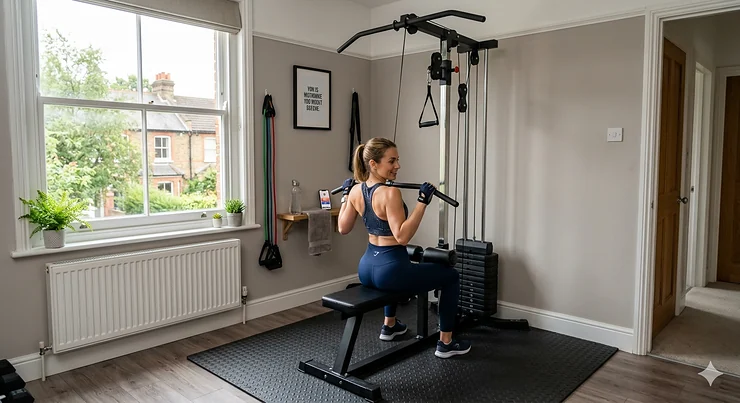
An all in one home gym suddenly looks quite sensible, doesn’t it?
What is an all in one home gym? Simply put, it’s a single piece of equipment — or a compact system — designed to replace an entire gym floor. We’re talking lat pulldowns, chest presses, cable rows, leg extensions, and more, all in one footprint. Instead of a sprawling collection of barbells, benches, and cable machines eating up your garage or spare room, you get one cohesive unit that covers every major muscle group. For most UK buyers working with terraced houses, compact flats, or the sort of garage that also needs to store a bicycle and approximately 40 boxes of “things we’ll sort out eventually,” that trade-off is extremely appealing.
The NHS recommends adults complete at least two strength-focused exercise sessions per week, and a well-chosen all in one home gym makes hitting that target genuinely convenient. No commute. No queue for the cable machine. No awkward eye contact with strangers while you grunt through your last set of rows.
This guide covers seven real products available on Amazon.co.uk, with honest assessments of what each one actually delivers — not just what the marketing copy claims. We’ve dug into the specs, the UK buyer reviews, and the practical reality of living with each machine in a British home. Let’s get into it.
Quick Comparison: Best All in One Home Gym Systems at a Glance
| Product | Weight Stack / Resistance | Footprint | Best For | Price Range (GBP) |
|---|---|---|---|---|
| Iron Lift APEX | Up to 150kg digital | Very compact | Tech-forward lifters, small spaces | £1,000–£1,400 |
| DKN Studio 7400 | 80kg weight stack | Medium (168×108cm) | Intermediate home trainers | £400–£550 |
| Fit4Home TF7080A | 68kg weight stack | Compact (168×108cm) | Beginners & budget buyers | £250–£350 |
| TRX All-in-One Suspension | Bodyweight (up to 318kg rated) | Almost none | Portability, travel, flexibility | Under £150 |
| Strongway Cable Crossover | 75kg per side (150kg total) | Large, freestanding | Serious lifters, garages | £450–£600 |
| HOMCOM Multi-Exercise Station | 45kg weight stack | Compact | Casual trainers, first-timers | £200–£280 |
| Marcy Multifunctional Station | 68–90kg weight stack | Medium | Value-seekers, mid-range training | £300–£450 |
The table above tells a clear story: if space is your primary constraint (and in most UK homes, it is), the Iron Lift APEX and HOMCOM station offer the most training per square metre. The Strongway Cable Crossover is a powerhouse, but it demands a proper garage or dedicated room — a Victorian semi’s spare bedroom simply won’t do. Budget buyers should note that the HOMCOM’s 45kg stack will feel limiting within six months if you train consistently; spending a little more on the Fit4Home TF7080A gets you an extra 23kg of progression room, which matters more than most people realise at the point of purchase.
✨ Don’t Miss These Exclusive Deals!
🔍 Take your home training to the next level with these carefully selected products. Click on any highlighted item to check current pricing and availability on Amazon.co.uk. These picks will help you find exactly what you need!
Top 7 All in One Home Gym Systems: Expert Analysis
1. Iron Lift APEX Smart Home Gym Machine
The Iron Lift APEX is what happens when someone looks at a traditional multi-gym and asks, “what if we replaced all those clanking plates with a motor and a smartphone?” The result is a compact, whisper-quiet smart system that delivers up to 150kg of digitally adjustable resistance — 75kg per side — controlled via handles and a companion app. No weight stack, no pin, no rattling. Just smooth, precise resistance at the tap of a button.
In practical terms, that 150kg ceiling handles everything from cable flyes and face pulls right through to serious compound movements. The digital resistance also means you can make genuinely small incremental adjustments — 1kg at a time if needed — which is something traditional plate-based machines simply can’t offer. For anyone following a progressive overload programme, that precision is rather valuable.
For UK buyers, the APEX’s appeal is particularly strong. It slots into a corner of a spare room without fuss, requires no wall mounting (relevant for renters who can’t drill into walls without losing a deposit), and the app-guided workouts remove the guesswork from programming. No subscription fee, which is a relief given what Tonal and Peloton charge monthly. It’s available on Amazon.co.uk and ships within 3–4 working days.
UK buyers on Amazon.co.uk have praised the near-silent operation — especially relevant in flats with downstairs neighbours — and the genuine quality of the resistance feel compared to resistance bands.
✅ Genuinely compact for the capability it offers
✅ No subscription fees, includes free app with video demonstrations
✅ Smooth, precise digital resistance with 1kg increments
❌ Premium price point — a significant investment
❌ Requires a power socket, so placement is slightly less flexible
Price range: £1,000–£1,400 — expensive, yes, but it replaces a cable machine, a functional trainer, and a rack’s worth of accessories in a footprint smaller than a chest freezer.
2. DKN Studio 7400 Compact Home Multi Gym
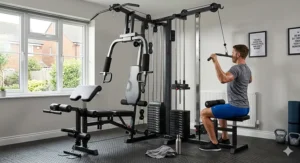
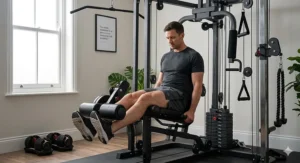
The DKN Studio 7400 is something of a quiet legend in UK home gym circles. DKN is a British-heritage fitness brand with a solid reputation, and the 7400 represents their sweet spot: genuinely capable without requiring either a second mortgage or a barn conversion to house it.
The 80kg weight stack is the headline figure, and it’s a meaningful one. Most intermediate lifters won’t max it out for years, and the double pulley system means the effective resistance at the handles is appropriately challenging from day one. The machine covers lat pulldowns, chest press, butterfly press (pec deck), seated rows, and leg extensions — that’s every major muscle group accounted for without a single cable attachment swap mid-workout, which is a nicer feature than it sounds at 7am.
Floor space is 168cm × 108cm at a height of 211cm — worth measuring before ordering, particularly if your ceiling has a light fitting in an inconvenient spot. The weight stack’s 150kg maximum user weight means it suits the vast majority of UK buyers, including those who lift heavy already. Build quality is sturdy; the pulleys operate smoothly and the seat padding is comfortable enough for extended sessions.
UK reviewers frequently note the build quality relative to price, with many commenting it feels more expensive than it is. The 2-year warranty from DKN provides reasonable peace of mind.
✅ 80kg stack offers genuine long-term progression
✅ British brand with solid warranty and UK customer support
✅ Double pulley — no mid-workout cable changes
❌ Assembly is a two-person job; budget a good couple of hours
❌ Height of 211cm can be tight in rooms with lower ceilings
Price range: £400–£550 — represents excellent value for what’s included. For the mid-range buyer, this is arguably the most sensible all in one home gym on this list.
3. Fit4Home TF7080A All in One Multi Gym Machine
The Fit4Home TF7080A occupies that useful space between “suspiciously cheap” and “proper kit.” At 68kg, the weight stack is lighter than the DKN 7400’s 80kg, but for most beginners and intermediate lifters that represents a year or more of progressive training before you’ll feel constrained. The dual cable system means you can perform different exercises simultaneously — useful if you’re training with a partner — and the included preacher curl pad is a thoughtful addition that most machines at this price omit.
What most UK buyers overlook about the TF7080A is how well it suits the typical British terraced house spare room. The same 168cm × 108cm footprint as the DKN but slightly lighter, which matters when you’re manoeuvring it up a narrow staircase (and you will be doing this alone, because your mate who promised to help has, predictably, developed a prior engagement). The machine is available on Amazon.co.uk with Prime delivery in most UK postcodes.
The seat pads are comfortable, the cable system is well-manufactured for the price, and UK reviewers consistently note that it feels more solid than the box suggests. It’s not a machine that will impress gym purists, but it will get beginners training consistently — and that’s the actual goal.
✅ Budget-friendly without cutting corners on core functionality
✅ Dual cable system — versatile exercise selection
✅ Preacher curl pad included — bicep training sorted
❌ 68kg stack will feel limiting for stronger intermediate lifters
❌ Customer service can be slow; keep assembly instructions handy
Price range: £250–£350 — a confident recommendation for anyone starting their home training journey on a sensible budget.
4. TRX All-in-One Suspension Training System
The TRX All-in-One is the wildcard on this list, and deliberately so, because the question “do I need a big machine?” deserves a genuine answer. For a significant number of UK buyers — particularly those in flats, those who travel frequently, or those who simply want to get strong without buying furniture — the answer is no.
The TRX system weighs less than a kilogram. It anchors to a door frame, a rafter, or a tree branch in the garden (assuming, inevitably, it’s not raining). From that single anchor point, you can perform over 300 exercises using your bodyweight as resistance, hitting everything from squats and rows to pikes and chest flyes. It’s safety-tested to support up to 318kg at the carabiner, which covers almost every conceivable combination of body weight and exercise angle.
Sold in the UK by TRX Training UK via Amazon.co.uk, this is the genuine article rather than a knock-off, and it comes with access to the TRX Training Club app. In practice, suspension training builds remarkable functional strength, core stability, and muscle endurance. What it won’t do is provide the same targeted hypertrophy (muscle-building) stimulus as a cable machine under load — it’s a different tool for different goals.
✅ Takes up virtually no space — ideal for flats and small homes
✅ Genuinely portable — travels in hand luggage
✅ No assembly, no installation, renter-friendly
❌ Relies on bodyweight; limited for heavier, pure strength-focused training
❌ Learning curve — technique matters more than with a guided machine
Price range: Under £150 — by some margin the most affordable route to a complete home workout. Not for everyone, but transformative for the right buyer.
5. Strongway Cable Crossover with 75KG Weight Stack
If you have a proper garage or a dedicated training space, the Strongway Cable Crossover is where the conversation gets interesting. This is a freestanding dual-pulley cable machine with 75kg on each side (150kg total), a built-in pull-up bar, integrated dip station, and a seated row position. In other words, it’s a commercial-grade training station that happens to be available on Amazon.co.uk.
The dual adjustable pulley system allows for an enormous range of exercises: cable crossovers, lat pulldowns, tricep pushdowns, face pulls, wood chops, cable curls, standing cable rows, and more. That breadth of movement is the Strongway’s real selling point — it doesn’t just replicate a multi-gym’s fixed-path exercises, it enables the cable-based functional movements that physios and strength coaches typically recommend for joint health and athletic performance.
What most buyers don’t appreciate until it arrives is the sheer size. This is not a machine for the spare room of a 1930s semi. It needs space, a solid concrete or reinforced floor for the base plates, and ideally a ceiling height of at least 240cm. For buyers with a garage who’ve been eyeing up commercial gym equipment at eye-watering prices, the Strongway represents a compelling alternative.
✅ Dual independent pulleys — enormous exercise variety
✅ Pull-up bar and dip station included — complete upper body coverage
✅ 150kg total resistance — genuine capacity for serious lifters
❌ Large footprint — unsuitable for most UK spare rooms
❌ Assembly is complex; professional installation recommended
Price range: £450–£600 — serious value for serious training space. Factor in the professional assembly cost if you’re not mechanically confident.
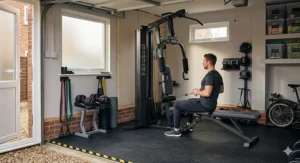
6. HOMCOM Multi-Exercise Gym Workout Station 45KG
The HOMCOM station is the entry-level pick on this list, and it serves a specific purpose well: getting someone off the sofa and into regular strength training without the faff of a complicated setup or a painful outlay. The 45kg weight stack is honest about its limitations — this isn’t a machine for experienced lifters — but for beginners or those returning to exercise after a long break, it covers the fundamental movement patterns that matter most.
Cable rows, chest press, lat pulldowns, and basic leg work are all accessible. The footprint is compact, assembly is more manageable than larger machines (a solo effort is realistic), and the overall build quality is solid for the price. HOMCOM is a brand that sells extensively in the UK via Amazon.co.uk, so Prime delivery and returns processes are straightforward — useful if you unwrap it and immediately discover your ceiling is 5cm too low.
The honest caveat: within six months of consistent training, most buyers will outgrow the 45kg stack. Think of it as a gateway machine rather than a long-term solution. That said, six months of consistent training is worth a great deal, and for that phase of the journey, the HOMCOM delivers.
✅ Most accessible price point on the list
✅ Compact and manageable for solo assembly
✅ Good starter coverage of major muscle groups
❌ 45kg stack limits long-term progression
❌ Lighter build quality relative to mid-range options
Price range: £200–£280 — the right machine if budget is the primary constraint and you’re genuinely starting from scratch.
7. Marcy Multifunctional Workout Station
Marcy is a name that’s been around British home gyms for decades, and the Multifunctional Workout Station is a solid representation of why the brand has lasted. With a weight stack in the 68–90kg range depending on configuration, the Marcy sits comfortably in the mid-tier alongside the Fit4Home TF7080A, but with a slightly broader exercise catalogue including a chest press, preacher curl station, and various cable positions.
The build is reassuringly sturdy — classic Marcy, meaning heavy steel and a no-nonsense design aesthetic that looks businesslike rather than decorative. It won’t win any awards for visual sophistication, but it’s the sort of machine that quietly gets the job done for years without drama. UK reviews consistently cite durability as the standout quality, with several buyers reporting machines that have been in service for five-plus years without significant wear.
What makes the Marcy interesting relative to its competitors is the exercise variety built into a single station. For buyers who want more than the basics but aren’t ready to commit to a cable crossover’s footprint or a smart gym’s price, it represents a genuinely thoughtful middle ground.
✅ Established brand with a long track record in UK homes
✅ Good variety of exercise stations in one unit
✅ Sturdy steel construction built for the long term
❌ Design is functional rather than attractive — takes up visual space
❌ Some configuration variants can be heavy and awkward to assemble
Price range: £300–£450 — a reliable workhorse that won’t surprise you (positively or negatively) over the years. Sometimes that’s exactly what you need.
Real UK Buyer Profiles: Which All in One Home Gym Actually Suits You?
Theory is all well and good, but let’s put some real British context on these choices. The “best” complete home gym system is the one that fits your actual life — not an idealised version of it.
The London Flat Dweller (e.g., Zone 2, a 45m² one-bedroom) Space is approximately zero, the downstairs neighbour has already complained about early morning walking, and you can’t drill into the walls without losing your deposit. The TRX All-in-One or Iron Lift APEX are your options. The TRX costs less and takes up no floor space. The APEX costs more but gives you that weighted resistance that turns bodyweight training into genuine muscle-building work. If your budget stretches, the APEX is the better long-term investment for someone who trains seriously.
The Manchester Suburb Family (3-bed semi, small garage) The garage doubles as a storage unit and possibly a workshop. You want something that fits alongside the bikes and the lawnmower, gets used by multiple family members at different fitness levels, and doesn’t require professional installation. The DKN Studio 7400 is the answer here. The 80kg stack covers teenagers, partners of varying strength levels, and your own ambitions — and the build quality means it’ll survive the damp British garage environment rather better than cheaper options.
The Serious Lifter in a Scottish New-Build (dedicated gym room, ground floor) You’ve committed the bedroom to training. You don’t want to compromise. The Strongway Cable Crossover and Iron Lift APEX both warrant serious consideration, but for the price-conscious buyer who wants traditional cable training, the Strongway offers commercial-style functionality at a fraction of what you’d pay kitting out a room with separate machines. The floor needs to be solid — ground floor is ideal, upper floors can struggle with the weight distribution.
The Returning-to-Exercise Buyer in Birmingham (budget-conscious, beginner) You haven’t trained properly in years, you’re not entirely sure you’ll stick at it, and spending £1,000 on a smart gym feels like hubris at this point. The Fit4Home TF7080A is your machine. It’s capable enough to build genuine strength for 12–18 months, affordable enough that if life gets in the way you haven’t bankrupted yourself, and the dual cable system means you’re not bored after week three.
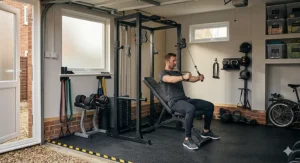
How to Set Up and Get the Most from Your All in One Home Gym in the UK
Before It Arrives
Measure twice. This sounds obvious, but the number of UK reviews mentioning “it’s bigger than I expected” suggests it isn’t obvious enough. Check ceiling height (account for the machine’s height plus 15–20cm for overhead movements), floor space, and the route from your front door to the final location — through hallways, up stairs, around corners. Most machines weigh 80–200kg and will not cooperate with wishful thinking.
For UK homes, consider the following: upstairs installations in older properties with suspended timber floors may need reinforcing or professional assessment. If in doubt, stick to ground floor placement.
Assembly
Almost every machine on this list requires assembly, ranging from “manageable solo afternoon” (HOMCOM, TRX) to “absolutely do not attempt alone” (Strongway Cable Crossover). Read reviews specifically about assembly before ordering — they’re honest in ways the instruction manuals aren’t. Having a second pair of hands for the heavier frames makes a real difference to safety and your blood pressure.
First 30 Days
Resist the urge to go heavy immediately. Learn the machine’s movement patterns first. The guided exercises in apps like Iron Lift’s companion software are genuinely useful here — they’re not just marketing padding. Start with three sessions per week covering the main compound movements: rows, presses, pulldowns, and leg work. Add isolation exercises once the fundamentals feel natural.
Ongoing Maintenance in British Conditions
This is the bit the manual definitely skips. UK garages and spare rooms can be surprisingly damp — not catastrophically, but enough to affect metal surfaces over time. Wipe down cables and pulleys after use, apply a light machine oil to any exposed steel components every few months, and check cable integrity every six months. For machines in genuinely cold garages, let the cables warm up slightly before applying maximum resistance — cold cable housing can stiffen and wear unevenly.
All in One Home Gym vs Traditional Gym Membership: A Honest UK Cost Comparison
| Traditional Gym Membership | All in One Home Gym | |
|---|---|---|
| Average monthly cost | £30–£80/month | £0 (post-purchase) |
| Year 1 total cost | £360–£960 | £200–£1,400 (purchase) |
| Year 3 cumulative | £1,080–£2,880 | £200–£1,500 |
| Year 5 cumulative | £1,800–£4,800 | £250–£1,600 (inc. maintenance) |
| Availability | Gym hours only | 24/7 |
| Waiting for equipment | Common | Never |
The maths is fairly damning for gym memberships beyond year two, and that’s before accounting for fuel costs, parking (a not-insignificant consideration in most UK town centres), and the time cost of the commute. The UK gym industry costs members an average of £40 per month, which means a mid-range all in one home gym system typically breaks even before the 18-month mark.
The counterargument — and it’s a real one — is that some people need the social environment and accountability of a commercial gym to actually exercise. A home gym only provides value if you use it. Be honest with yourself about which camp you fall into before spending anything significant.
The cost table above makes the case clearly: the all in one gym benefits compound over time in a way that monthly memberships simply cannot. Even the premium Iron Lift APEX pays for itself against a £50/month gym membership before its third year of use.
✨ Don’t Miss These Exclusive Deals!
🔍 Ready to invest in your home training? Click any highlighted product to check current pricing and availability on Amazon.co.uk — Prime members enjoy next-day delivery on most items from this list.
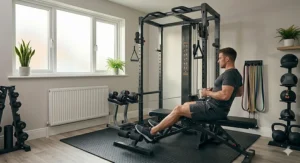
How to Choose an All in One Home Gym in the UK: 7 Criteria That Actually Matter
Buying a complete home gym system involves more decisions than the product listing suggests. Here’s how to cut through the noise.
1. Space (measure before you browse, not after) The single most important criterion for UK buyers. Note floor dimensions, ceiling height, and the access route into your home. A machine that can’t get through your hallway does not become a smaller machine by willing it.
2. Weight stack vs digital resistance Traditional weight stacks (Fit4Home, DKN, HOMCOM, Marcy, Strongway) are reliable, low-tech, and long-lived. Digital resistance (Iron Lift APEX) offers finer adjustments, silence, and a smaller footprint. Neither is universally superior — it depends on your training goals and budget.
3. Exercise variety Count the exercises the machine genuinely enables, not the exercises the marketing claims. For a total body workout machine, you need at minimum: a lat pulldown, a push movement (chest press or cable press), a pull movement (row), and a leg option. Machines that cover all four without attachment swaps are more convenient in practice.
4. Maximum resistance vs where you are now Buy for where you’ll be in two years, not where you are today. If you’re a complete beginner, 45kg feels a lot right now — but it won’t in 18 months. The Fit4Home’s 68kg or DKN’s 80kg are more future-proof for most buyers.
5. Build quality and warranty Check the warranty period (DKN offers two years; others vary) and whether the brand has UK customer support. Post-Brexit, some EU-manufactured equipment may have warranty claims handled from European offices — worth checking before purchasing.
6. Floor type and building structure Upper floors in older UK properties can be surprisingly bouncy under heavy loads. If you’re installing in an upstairs room, consider weight distribution and impact. Ground floor is always preferable for heavier stations.
7. Budget: total cost of ownership, not just purchase price Factor in delivery (some larger machines carry additional charges), assembly (professional if required), floor matting, and any accessories you’ll need. A machine quoted at £300 that needs £50 in accessories and £60 for assembly costs £410.
Common Mistakes When Buying an All in One Home Gym in the UK
Buying based on weight stack alone. A 100kg stack sounds impressive until you realise the pulley ratio means you’re lifting 50kg at the cable. Check whether the listed weight is the actual stack weight or the effective resistance at the handles — it varies between machines.
Ignoring assembly complexity. Several machines on this list require two people and several hours. If you order one on a Saturday expecting to train on Sunday, you will be disappointed. Factor assembly time into your plans.
Underestimating the footprint. The listed dimensions are typically the machine’s static footprint. You also need clearance around it for movement during exercises — typically 60–90cm on the sides you’ll be working from. A machine that fits in a room doesn’t necessarily mean you can use it comfortably in that room.
Buying a US-voltage model. This is rarer for mechanical multi-gyms but matters enormously for smart systems like the Iron Lift APEX. UK products require 230V/50Hz with a Type G plug. Machines listed on Amazon.co.uk should be UK-compatible by default, but check the product description for any “International Product” warnings, which can indicate non-UK electrical specifications.
Expecting a home gym to replace motivation. The machine does not make you use it. If your main obstacle to training is motivation rather than access, address that separately — the kit alone won’t solve it.
FAQ: All in One Home Gym UK
❓ What is the best all in one home gym for small UK spaces?
❓ Are all in one home gym machines worth the money in the UK?
❓ Do I need planning permission or building work to install a home gym in the UK?
❓ What weight stack is enough for a beginner home gym in the UK?
❓ Can I use a home gym machine in a rented property in the UK?
Conclusion: The Right All in One Home Gym for Your British Life
There isn’t a single best all in one home gym. There’s the best one for your space, your budget, your training goals, and the particular joy of never having to drive anywhere in the rain to exercise ever again.
For most UK buyers starting out, the Fit4Home TF7080A or DKN Studio 7400 represent the sweet spot — capable, reasonably compact, genuinely good value in the £250–£550 range, and built to last several years of consistent use. The TRX All-in-One remains the most accessible entry point for those with minimal space. The Iron Lift APEX is the smart choice for tech-forward buyers in small homes who want serious resistance without serious square footage. And the Strongway Cable Crossover earns its place for those lucky enough to have a proper training space and the appetite for commercial-grade kit.
Whatever you choose, measure twice, read the assembly reviews, and remember: the space efficient home gym you actually use is infinitely more valuable than the elaborate setup you aspired to. As the NHS advises, consistent strength training twice a week is the target — and having a machine at home removes every reasonable excuse for missing it.
✨ Don’t Miss These Exclusive Deals!
🔍 Ready to transform your home training? Click on any highlighted product above to check current pricing and availability on Amazon.co.uk. With Prime, most options arrive next-day — so you could be training by the weekend.
Recommended for You
- Best Smith Machine Power Rack Combo UK 2026: 7 Brilliant Picks Tested
- Best Smith Machine Under £1000 UK: 7 Expert Picks (2026)
- Best Angled Smith Machine UK 2026: 7 Top Picks Reviewed
Disclaimer: This article contains affiliate links. As an Amazon Associate, I earn from qualifying purchases. If you purchase products through these links, we may earn a small commission at no additional cost to you.
✨ Found this helpful? Share it with your mates! 💬🤗
