In This Article
If you’ve spent any time researching home gym equipment, you’ll know the internet is absolutely awash with opinions on the Smith machine. Half the fitness world swears by it; the other half thinks it’s a glorified clothes hanger. Both camps are wrong, by the way — and if you’ve landed here, you’re probably already past that argument and asking the more interesting question: should I get an angled smith machine or a vertical one, and which model is worth my money?
Good. That’s a far more productive conversation.
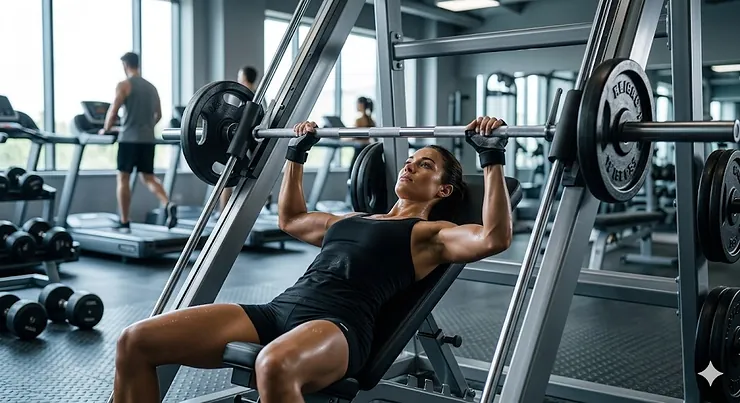
An angled smith machine — sometimes called a 7 degree smith machine or linear smith machine — features a bar path that tilts slightly backwards rather than running perfectly straight up and down. At first glance, it looks like a minor engineering detail. In practice, it changes everything about how the machine feels under load. The bar follows something closer to the natural arc your body wants to take during a press or a squat, rather than forcing you into the rigid, upright plane of a traditional vertical machine. The result? Less shoulder strain on bench press, more quad activation on squats, and a generally more comfortable lifting experience — particularly for those of us whose anatomy wasn’t designed with perfect plumb-line symmetry in mind (which is everyone).
What is an angled smith machine? Put simply, it is a guided barbell machine where the bar travels on rails set at a fixed angle — typically between 5 and 12 degrees from vertical — designed to more closely replicate the natural bar path of free-weight pressing and squatting movements. This biomechanical design reduces unnatural joint stress and improves muscle recruitment compared to a purely vertical track.
This guide covers seven real products available to UK buyers, honest biomechanics, the vertical vs angled debate settled once and for all, and everything you need to make a confident, well-informed purchase — without buying a machine that barely fits through your garage door.
Quick Comparison: Top Angled Smith Machines Available in the UK
| Product | Bar Angle | Weight Capacity | Price Range (GBP) | Best For |
|---|---|---|---|---|
| Body-Solid Series 7 (GS348B) | 7° | Up to 450 kg | £1,400–£2,000+ | Serious home gym & light commercial |
| Titanium Strength 7° Angled | 7° | Commercial-grade | £1,500–£2,200 | Dedicated training spaces |
| Aptliton Smith Machine Power Cage | ~7° | ~1,040 kg (2,300 lbs) | £450–£650 | Mid-budget all-rounders |
| Marcy MWB-1282X | Slight angle | 135 kg | £550–£750 | Beginners & home multi-gyms |
| SPORTNOW Smith Machine & Cable | 7° | ~350 kg | £320–£480 | Budget-conscious buyers |
| Phoenix Fitness Multi-Functional | 5–7° | ~250 kg | £280–£400 | First-time buyers, compact spaces |
| Strongway Multi Gym Smith Machine | 5° | 177 kg (stack) | £600–£850 | Stack-weight convenience |
The table above tells you the basics, but context matters enormously here. The Body-Solid and Titanium Strength machines are genuinely in a different league from the budget options — smoother, sturdier, and built to last longer than your enthusiasm for leg day. However, for a spare bedroom or converted garage gym in a typical British semi-detached, the mid-range models offer outstanding value without demanding you re-mortgage your flat. The critical thing with the cheaper units is to verify bar path quality and bearing type before buying — more on that in the features section below.
✨ Don’t Miss These Exclusive Deals!
🔍 Take your home gym to the next level with these carefully selected machines. Click on any highlighted product to check current pricing and availability on Amazon.co.uk. These picks will help you find exactly what you need!
💬 Just one click — help others make better buying decisions too! 😊
Top 7 Angled Smith Machines for UK Home Gyms: Expert Analysis
1. Body-Solid Series 7 Smith Machine (GS348B)
The Body-Solid Series 7 is the benchmark by which most home gym Smith machines are measured — and for good reason. Built around a precise 7-degree reversed pitch, the bar path genuinely replicates what your body does naturally during a press or squat, which matters a great deal once you start loading serious weight. The machine uses a linear ball-bearing system — the good stuff — with 20 crossmember lock-out points accessible via a simple 15-degree bar rotation. That’s not marketing fluff; in practice, it means racking the bar mid-set feels almost effortless, which is exactly what you want when training alone at home in a Manchester garage at 10pm.
The frame is constructed from heavy-duty 11 and 12-gauge steel and supports a free-weight capacity of over 450 kg — far more than most humans will ever need, but that overhead means the frame barely notices when you’re pushing 100 kg on a bench press. The GS348B can be purchased as a standalone unit or as part of the full Series 7 gym package, which adds a high/low pulley station, pec deck, adjustable bench, and lat attachment. For most UK home gym builders, the full package is the smarter buy — you’re essentially getting a complete commercial gym in one footprint.
What most UK buyers overlook is that the Series 7 package, while pricey, competes against buying a power rack, cable machine, and bench separately — costs which add up fast. The machine footprint is substantial (around 250 cm × 175 cm), so do measure your space carefully before clicking “add to basket.”
UK customers report excellent build quality and smooth bar action; the most common criticism is the lengthy and involved assembly process, which can take a full weekend for two people with basic DIY skills.
✅ Linear ball bearings for genuinely smooth bar travel
✅ 20 lock-out points — safety without compromise
✅ All-in-one system eliminates need for multiple machines
❌ Requires significant floor space
❌ Assembly is demanding — allocate a full day
At the £1,400–£2,000+ range depending on package configuration, it’s not an impulse purchase. But as a long-term investment, it’s hard to fault.
2. Titanium Strength Black Series 7° Angled Smith Machine
Titanium Strength’s 7-degree angled machine is built for those who want commercial-grade rigidity without paying for a commercial gym. The frame uses 50 × 100 mm oval tubes with a 3 mm wall thickness — genuinely robust construction that’s notably more solid than the majority of home-gym machines in the sub-£1,000 bracket. Available in the UK via Titanium Strength’s British website with interest-free financing, it’s well worth considering if you’re building a dedicated training space rather than a bedroom corner setup.
The 7-degree bar angle is precisely calibrated for biomechanical correctness, and the machine is described by users as “commercial gym smooth” in terms of bar travel. It’s ideal for users of all training levels, but it really comes into its own for experienced lifters who understand the difference between a bearing that glides and one that grudgingly slides. In a home gym context — where you’ll use this machine solo, often under near-maximal loads — that quality of motion matters more than it would in a busy commercial gym where the equipment gets serviced regularly.
Titanium Strength has a UK phone line (Monday to Sunday) and offers UK-specific delivery, which puts it ahead of US brands that ship from abroad and leave you dealing with post-Brexit import queries. Warranty conditions apply specifically to domestic use, so note that if you’re planning to use this in a professional training environment, you’ll need a different conversation with them.
✅ True commercial-grade frame construction
✅ 7-degree biomechanical bar path
✅ UK-based sales and support
❌ Premium price point — in the £1,500–£2,200 range
❌ Large dimensions require a dedicated gym space
3. Aptliton Smith Machine Power Cage
The Aptliton is one of those products that consistently punches above its price tag, and UK buyers on Amazon.co.uk seem to agree. With a claimed capacity of around 1,040 kg (2,300 lbs), a cable system, pull-up bar, T-bar, and tricep rope included in the box, it’s a genuinely comprehensive setup for the price. The bar path runs at approximately 7 degrees, and while Aptliton doesn’t make a huge deal of this in its marketing, the practical result is a pressing motion that feels noticeably more natural than vertical alternatives in the same price band.
The steel construction is solid for its class, and the included safety catches work reliably — critical when you’re pressing alone at home. What the spec sheet won’t tell you, though, is that the cable system on the Aptliton is adequate rather than exceptional. It handles lat pulldowns, cable rows, and tricep work without drama, but if you’re expecting silky-smooth functional trainer movement, you’ll want to manage expectations. For the price, it’s a strong all-rounder.
UK delivery is handled through Amazon and typically arrives via pallet courier, so ensure you have access for a larger vehicle. Assembly takes 3–5 hours for two people; the instructions are functional rather than inspired.
✅ Impressive capacity for the price bracket
✅ All-in-one setup with useful cable attachments
✅ Solid angled bar path for natural movement
❌ Cable system is competent but not premium
❌ Instructions could be clearer
Available in the £450–£650 range on Amazon.co.uk — Prime-eligible, so next-day delivery is possible, though a machine this size is more likely to arrive the following working day on a pallet.
4. Marcy MWB-1282X Smith Machine Home Gym
The Marcy MWB-1282X is an established name on Amazon.co.uk’s Smith machine listings, and it’s not hard to see why — it’s a capable all-in-one home gym with a 135 kg weight capacity, a high and low pulley system, Olympic plate compatibility, and a solid if unremarkable build. The bar path uses “ultra-glide Marcy bushings” with chrome guide rods, which is a reasonably smooth arrangement, though it doesn’t match the ball-bearing systems on pricier machines. The bar runs at a slight angle, making it more comfortable for bench pressing than a purely vertical machine, though the angle is subtler than the dedicated 7-degree designs.
The MWB-1282X is well-suited to beginners and intermediate lifters who want a competent, multi-function setup for a sensible budget. It comes with nine hook positions per side, an EZ-style lat bar, cable attachments, and four storage posts — a generous package for the price range. UK customers report that it’s reasonably straightforward to assemble and well-made for the price, though some note that it can feel slightly less rigid than they’d hoped under heavier loads above 100 kg.
What most UK buyers overlook is that the 135 kg capacity is the maximum combined load — so if you’re already pressing or squatting close to that figure, you’ll want something more substantial. For home use by most people, though, 135 kg is perfectly adequate.
✅ Excellent value all-in-one setup
✅ Widely available on Amazon.co.uk — often Prime eligible
✅ Good multi-function versatility for home training
❌ Bushings rather than ball bearings — noticeably less smooth
❌ 135 kg limit may constrain stronger lifters
Price range: £550–£750. A solid mid-range choice that’s been popular in the UK for years.
5. SPORTNOW Smith Machine & Cable Pulley System
If your budget is firmly in the lower bracket and you need an angled smith machine that doesn’t embarrass itself, the SPORTNOW is worth a look. It features a 7-degree bar angle, an adjustable weight bench included in the package, and a lat pull-down cable system — for under £480, that’s a remarkable amount of gym kit in one box. Build quality is honest for the price: the frame is steel, the welds are functional, and the bar path is acceptably smooth for home use, though you wouldn’t call it silky.
The SPORTNOW is particularly sensible for people who are genuinely uncertain whether they’ll use a Smith machine long-term — it’s enough machine to give you a proper feel for the format without a four-figure outlay. UK reviewers note that the assembly can be fiddly (set aside a full afternoon) and that the bench, while adjustable, is on the narrower side. Neither is a dealbreaker.
The 7-degree angle is the genuine highlight here: even at this price point, the bar path feels more ergonomic than vertical competitors at similar cost. For a garage gym in Leeds or a spare room in Bristol where you’re training alone three times a week, it does the job admirably.
✅ 7-degree bar angle at a budget-friendly price
✅ Includes bench — strong value package
✅ Amazon.co.uk available, often Prime eligible
❌ Build quality reflects the price — not intended for heavy commercial loads
❌ Assembly requires patience
Price range: £320–£480. A strong entry point for those new to guided barbell training.
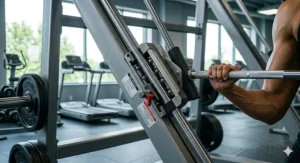
6. Phoenix Fitness Multi-Functional Smith Machine
The Phoenix Fitness machine consistently appears near the top of Amazon.co.uk’s Smith machine bestseller charts, and its popularity is partly deserved and partly a function of price. It sits at the budget end of the market — in the £280–£400 range — and delivers a guided bar system with a gentle angle (typically 5–7 degrees), a cable pulley system, and enough versatility to run a decent full-body programme. It’s not the machine for a serious powerlifter, but for someone converting a box room into a starter gym, it’s an accessible, no-nonsense option.
The Phoenix is particularly suited to first-time Smith machine buyers who want to explore guided barbell training before committing to something more substantial. The frame is lighter than the Aptliton or Marcy, and the weight capacity is more limited, but the bar path is genuinely angled and noticeably more comfortable than purely vertical alternatives. Customer reviews on Amazon.co.uk are broadly positive, with most complaints centering on the assembly process (par for the course at this price) and the lack of a weight bench included.
For compact British homes — think a terrace in Sheffield or a garden outhouse in Norwich — the Phoenix Fitness has a relatively modest footprint and can be assembled by one determined person over a long Saturday.
✅ Best-seller on Amazon.co.uk with generally positive reviews
✅ Compact enough for smaller UK homes
✅ Accessible price for first-time buyers
❌ Limited weight capacity — not suitable for advanced training
❌ Weight bench not included
7. Strongway Multi Gym Smith Machine with 177 kg Weight Stack
The Strongway is the odd one out on this list in a useful way: it comes with a built-in 177 kg weight stack, which means you’re not purchasing plates separately. For many UK buyers — particularly those without a collection of Olympic plates already — this changes the effective value calculation considerably. A decent set of Olympic bumper plates can easily add £200–£400 to the cost of any plate-loaded machine, so the Strongway’s selectorised weight system simplifies the whole operation.
The bar path features a 5-degree angle, which is subtler than the full 7-degree designs but still meaningfully more ergonomic than a vertical machine. The Strongway includes dual cable pulley, dip station, and pull-up bar, making it a well-rounded all-in-one package for home training. UK customers note the build is reassuringly solid for the price, and the selectorised weight system means workouts move quickly — no loading and unloading plates between sets.
The caveat is that selectorised stacks top out at a fixed weight, and 177 kg, while generous for most people, will constrain those who are already pushing serious numbers on compound lifts. If you expect to be bench pressing 120 kg-plus regularly, a plate-loaded machine gives you more long-term room to grow.
✅ Weight stack included — no separate plate purchase required
✅ Dual cable, dip station, pull-up bar all included
✅ 5-degree angle improves ergonomics over vertical designs
❌ Stack limit may restrict very advanced lifters
❌ Footprint is substantial — measure before buying
Price range: £600–£850 on Amazon.co.uk. A genuinely compelling package for those who want a complete, ready-to-use setup.
Setting Up Your Angled Smith Machine: A Practical UK Guide
Buying the machine is the easy part. Setting it up properly — without throwing your back out, stripping any bolts, or discovering your garage is 10 cm too short — is the challenge most manufacturers cheerfully gloss over. Here’s what actually helps.
Before delivery arrives, measure your ceiling height. Most Smith machines require between 220 cm and 240 cm of clearance. British terraced houses and older properties often have lower garage ceilings than you’d expect — 210 cm is not unusual, which rules out quite a few machines. Measure twice, order once.
For UK garage gyms, damp is the enemy. British winters are wet and persistent, and an unheated garage will experience condensation that attacks bare steel bolts, frame joints, and cable hardware surprisingly quickly. A protective wax coating on bare metal, a dehumidifier during winter months, and silicone spray on the cable system twice a year will extend the life of any Smith machine significantly. This is advice you will not find on the Amazon product page.
Assembly tip: lay all components out on the garage floor before you begin and cross-reference the parts list fully. Most assembly nightmares stem from missing a small washer or guide pin that was buried in packaging. Set aside a clear five-hour window with a friend; the instructions that come with budget machines are optimistic about the time involved.
First use: resist the temptation to load the bar heavily on day one. Run through the lock-out mechanism repeatedly with an unloaded bar to ensure it’s engaging cleanly at every position. A lock-out that skips or sticks under zero load will not improve under 80 kg. Address it before it becomes a problem.
For UK flat dwellers who are installing a machine in a converted basement or ground-floor room: consider rubber gym flooring (typically 15–20 mm thick) both for floor protection and vibration absorption. Your downstairs neighbours will thank you, and the machine will feel more stable.
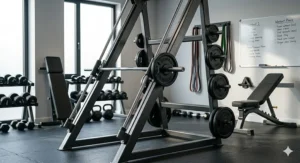
Who Should Actually Buy an Angled Smith Machine? Three UK Scenarios
Understanding biomechanics is one thing; knowing whether a specific machine suits your actual life is another. Here are three realistic UK user profiles.
Profile 1 — The Solo Home Trainer in a Birmingham Suburb James trains four times a week in his converted garage, primarily for strength and muscle. He has no spotter, a decent budget of around £700, and a garage that measures 3.5 m × 5 m. He previously trained at a commercial gym but cancelled his membership after the commute became tedious. For James, an angled smith machine is essentially the answer to the spotting problem — the safety catches give him the confidence to push close to his limits on bench press and squats without waiting for his neighbour to be free on a Tuesday evening. The Marcy MWB-1282X or the Aptliton Power Cage would suit him well; either gives him a full training system within his budget and his space.
Profile 2 — The Returning Trainee in Edinburgh Sarah is returning to training after a knee injury. Her physiotherapist has cleared her for lower body resistance work but emphasised the importance of controlled, predictable movements during the rehabilitation phase. For Sarah, the angled bar path is genuinely therapeutic: it lets her control the exact plane of movement during squats and leg press variations, reducing the variables that can aggravate a vulnerable knee. The 7-degree angle also feels kinder on the knee joint than a vertical machine, which can force an awkward forward knee position. A mid-range machine like the Strongway or SPORTNOW gives her a safe, versatile platform without a huge financial commitment while she determines her long-term training goals.
Profile 3 — The Serious Trainer Building a Permanent Home Gym Marcus has committed to building a proper home gym in his detached house in the Peak District. He has a dedicated room, a budget of £1,500–£2,000, and trains to a high standard. For Marcus, only the Body-Solid Series 7 or Titanium Strength machines make sense — both offer the commercial-grade smoothness, genuine 7-degree biomechanical design, and long-term durability that justify the investment. The Body-Solid’s full package effectively replaces an entire commercial gym in a single footprint, which is exactly what a serious home gym builder needs.
Vertical vs Angled Smith Machine: Settled, Finally
The debate between vertical and angled Smith machines has generated an extraordinary amount of online argument for something that, honestly, has a fairly clear answer. Let’s deal with it properly.
A vertical smith machine runs on a perfectly plumb rail, which means the bar moves in a straight up-and-down line regardless of your body’s natural mechanics. This is excellent for certain isolation movements — calf raises, shrugs, and some forms of lunges where you specifically want absolute rigidity in the bar path. The vertical design removes all lateral component from the movement, which can be beneficial when the whole point is to isolate a single muscle in a very controlled plane.
An angled smith machine — typically 5 to 12 degrees — does something different. When you bench press with free weights, the bar doesn’t travel in a straight vertical line; it follows a slight arc as your elbows move and your shoulder joint rotates. A 7-degree angled machine approximates this arc, making the press feel noticeably more natural. The same principle applies to squats: a slight rearward lean in the bar path lets your hips travel back more naturally, improving depth and reducing the quad-dominant, knee-forward position that pure vertical machines can force.
The practical verdict: if your Smith machine is going to be your primary strength tool — the centrepiece of your home gym for pressing and squatting — go angled. The biomechanics are simply better for those movements. If you’re adding a Smith machine as an accessory to an existing free-weight setup and want it primarily for isolation work, vertical is fine.
For most UK home gym builders working without a spotter, the angled design is the stronger default choice.
How to Choose the Right Angled Smith Machine: 7 Criteria That Actually Matter
1. Bar angle (5–12 degrees) — 7 degrees is the sweet spot, widely adopted by both budget and premium manufacturers. Machines advertising angles below 5 degrees offer minimal biomechanical benefit over vertical designs; anything above 10 degrees can feel awkward for overhead pressing movements. Verify the claimed angle is engineered into the frame, not just marketing language.
2. Bearing type — Linear ball bearings are significantly smoother than plastic bushings. Under light loads, the difference is noticeable; under heavy loads with a fatigued grip at the end of a hard set, it’s the difference between a clean lock-out and a fumble. If a machine at your price point only offers bushings, budget for the inconvenience.
3. Weight capacity — Be honest about where your strength is heading, not just where it is today. If you’re currently squatting 80 kg but expect to reach 120 kg over the next year, don’t buy a machine with a 135 kg limit. Leave headroom.
4. Lock-out points — More is better. 20 positions (as found on the Body-Solid Series 7) gives you far more flexibility than 9 positions. The more granular the adjustment, the more exercises you can set up correctly.
5. Footprint and ceiling clearance — Standard UK garage ceiling height is around 220–240 cm. Measure your exact space and compare with the machine’s height specification before ordering. This is the most common and most easily avoided mistake UK buyers make.
6. Cable and pulley quality — If the machine includes a cable system (most do), check whether the pulleys use ball bearings or nylon wheels. Ball bearings last longer and move more smoothly; nylon pulleys tend to develop friction and wear audibly over time.
7. UK availability and after-sales support — Post-Brexit, some European and American brands handle UK warranty claims differently. Confirm the brand has UK customer support, UK-based replacement parts, and a clear returns policy under the Consumer Rights Act 2015. Amazon.co.uk’s standard 30-day return policy offers a useful safety net for most of the machines on this list.
Common Mistakes UK Buyers Make When Purchasing a Smith Machine
Buying a vertical machine when they need an angled one. Plenty of affordable Smith machines on Amazon.co.uk use a vertical bar path. The listing often doesn’t emphasise this, so buyers don’t realise until the machine is assembled and the bench press feels oddly robotic. Check explicitly for bar angle before purchasing.
Underestimating assembly complexity. A machine that looks like three photographs on a product listing arrives as 47 pieces of powder-coated steel in a flatpack box. Budget time, a clear space, and ideally a second pair of hands. For the larger machines, professional assembly services are available and often worth the modest cost.
Ignoring bearing quality. “Smooth glide” is a phrase used by every Smith machine listing regardless of whether the bearings are linear ball-bearing grade or plastic bushings. Read third-party reviews specifically for mentions of bar smoothness under load.
Forgetting to budget for flooring. Rubber gym tiles (around £2–£4 per square metre for standard 20 mm interlocking tiles) are not optional for concrete garage floors — they protect both the floor and the machine’s feet, reduce vibration, and make standing barefoot in a cold garage considerably more civilised. It’s an extra £60–£120 most buyers don’t include in their initial budget.
Buying a US-spec machine. Some Smith machines listed on Amazon.co.uk ship from US-based sellers and arrive with US-spec electrics (110V) for motorised components, or with weight ratings in pounds that create confusion. Verify that weight capacities listed are in kg where relevant, and that any electrical component (some all-in-one systems include motorised aspects) is 230V compatible.

Features That Actually Matter (And a Few That Don’t)
🎯 Matters enormously: the quality of the lock-out mechanism. This is your safety system. If the hooks are imprecise, difficult to engage under fatigue, or rattle free under load, the entire purpose of the machine is compromised. Test this specifically in any video review you watch.
🎯 Matters enormously: frame gauge. 11-gauge and 12-gauge steel (found on Body-Solid and Titanium Strength) is meaningfully more rigid than the lighter-gauge frames used in budget machines. You’ll feel the difference when loading heavy plates, even if you can’t see it.
🎯 Matters: included accessories. A machine that includes a lat bar, cable handles, and weight storage posts at the same price as one that doesn’t is objectively better value — provided the accessories are usable quality rather than decorative.
🚫 Matters less than you think: the “counterbalanced bar” feature. Some premium machines include a counterbalanced bar, meaning the bar itself feels lighter when unloaded (around 5–7 kg rather than 10–15 kg). Useful for absolute beginners; largely irrelevant once you’re training with meaningful loads.
🚫 Matters less than you think: the number of colour options. Several UK gym equipment brands now offer extensive colour customisation. It’s a nice touch for a commercial setup, but for a home gym, you’re the only one looking at it — don’t pay a premium for powder-coat matching.
🚫 Matters much less than marketed: the total weight capacity figure. A machine rated at 1,000 kg is not meaningfully safer or more useful for a home trainer than one rated at 450 kg. Both are more than sufficient for any realistic home gym load. Manufacturers know that big numbers impress; don’t let impressive numbers substitute for build quality assessment.
Long-Term Cost & Maintenance in the UK
The cost of ownership extends well beyond the sticker price. Here’s what a realistic budget looks like over three years for a mid-to-high-range angled Smith machine in the UK.
A machine in the £600–£1,000 range will likely need new cable replacements after 18–24 months of regular use. Cable replacement kits cost around £15–£40 from UK fitness equipment suppliers, and swapping cables on most machines is a manageable DIY job. Budget for it.
Linear ball bearings — the good ones — are very long-lasting and rarely need replacement under normal home gym use. If you do experience roughness developing in the bar path, a drop of appropriate machine oil on the rails typically resolves it. Do this every 6 months as standard maintenance.
Rubber gym flooring: £60–£120 initial outlay, essentially permanent. Worth doing properly at the start rather than patching later.
For garage gym installations: a quality dehumidifier running during winter months costs roughly £30–£50 per year in electricity. Without it, frame rust becomes a genuine risk in the damp British climate, particularly in unheated spaces. The machine manufacturer will not cover corrosion damage under warranty, so this is your responsibility.
Total realistic 3-year cost for a £750 machine: approximately £900–£1,050 including flooring, basic maintenance, and one cable replacement. Compare this to a commercial gym membership at £35–£60 per month for three years (£1,260–£2,160) and the home gym economics become fairly compelling — particularly if more than one person in the household trains.
For the premium machines (£1,500+), maintenance costs are similar but the frame and bearing quality typically means lower frequency of issues. You’re buying reliability as much as performance.
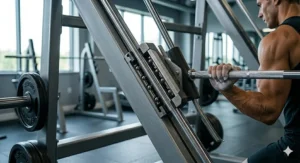
FAQ: Angled Smith Machines in the UK
❓ What is the difference between an angled and a vertical smith machine?
❓ Are angled smith machines available on Amazon.co.uk?
❓ What angle is best for a home gym smith machine?
❓ How much space do I need for a smith machine in a UK home?
❓ Can I return a smith machine bought on Amazon.co.uk if it doesn't fit?
Conclusion: The Right Angled Smith Machine for Your Situation
The angled smith machine has graduated from niche gym-science debate to mainstream home gym wisdom, and it’s easy to see why. The 7-degree bar path is a genuine, practically meaningful improvement over vertical designs for anyone doing compound pressing and squatting movements — not a marketing angle (pun entirely intended), but a biomechanical reality that your shoulders and knees will appreciate over months and years of consistent training.
For most UK home gym builders, the sweet spot sits in the £450–£850 range — machines like the Aptliton, Marcy MWB-1282X, or Strongway that offer reliable construction, a genuine angled bar path, and useful cable systems without requiring a second mortgage. If your training is serious and your space permits, the Body-Solid Series 7 or Titanium Strength machines are worth every pound of their premium price.
Whatever you choose, prioritise bearing quality, lock-out reliability, and ceiling clearance above all else. Get those three things right and the rest is details. The machine won’t make you train harder — but a good one will make you want to.
✨ Ready to Build Your Best Home Gym?
🔍 Check current pricing and availability on Amazon.co.uk for all seven machines reviewed here. Prices shift regularly, so click through to see what’s on offer today. You might find yourself pleasantly surprised.
Recommended for You
- Best Counter Balanced Smith Machine UK 2026
- Best Smith Machine for Home UK 2026: 7 Top Expert Picks
- Best Ab Bench for Home Gym UK: 7 Expert Picks (2026)
Disclaimer: This article contains affiliate links. As an Amazon Associate, I earn from qualifying purchases. If you purchase products through these links, we may earn a small commission at no additional cost to you.
✨ Found this helpful? Share it with your mates! 💬🤗
