In This Article
If you’ve been eyeing up that cramped spare bedroom or garage wondering how to fit proper strength training kit in there, a counter balanced smith machine might just be your answer. What most UK buyers overlook about these machines is how the counterbalance mechanism transforms the starting weight from a daunting 20-25 kg down to as little as 2-3 kg — rather handy when you’re easing into strength training or recovering from injury without a spotter hovering over you.
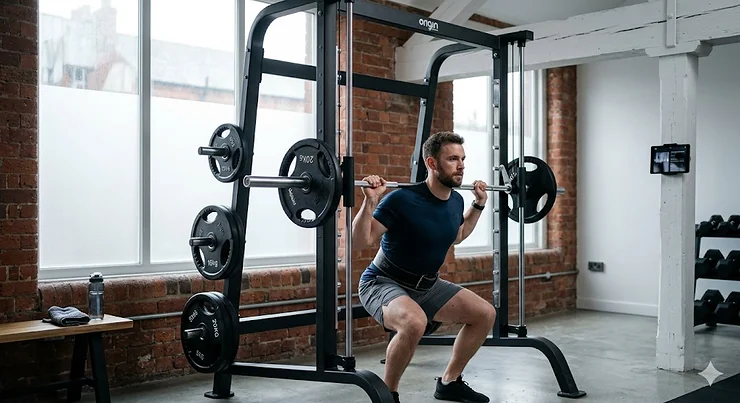
The counterbalance system works through a pulley-and-cable arrangement connected to weights that effectively offset the barbell’s mass, creating that buttery-smooth vertical movement that commercial gyms charge £50+ monthly to access. In Britain’s compact living spaces — where the average spare room barely fits a double bed, never mind a full power rack — these all-in-one units consolidate squats, bench press, shoulder press, and cable work into roughly 2 square metres of floor space.
According to recent fitness equipment trends, UK demand for home gym solutions surged post-2020 and hasn’t budged since, with counter balanced variants proving particularly popular among beginners, older lifters, and those training solo in flats without reinforced floors for dropped free weights. The NHS recommends strength training at least twice weekly for improving muscle strength, bone density, and balance — exactly what these machines facilitate from your spare bedroom. The guided motion path means you’re less likely to wobble mid-rep or knock over that stack of moving boxes you’ve been meaning to sort since 2023.
Quick Comparison Table: Top 7 Counter Balanced Smith Machines UK
| Model | Bar Weight | Price Range (£) | Best For | UK Delivery |
|---|---|---|---|---|
| Marcy SM-4033 Multi-Cage | 20 kg (standard bar) | £1,100-£1,400 | All-in-one versatility | Prime eligible |
| Bodypower Multi-Function | 15-18 kg (reduced resistance) | £900-£1,100 | Budget-conscious buyers | Free delivery £25+ |
| Strongway Multi Gym | 12-15 kg (counterbalanced) | £800-£1,050 | Compact UK homes | Standard UK delivery |
| Marcy MWB-1282X | 18-20 kg (guided system) | £550-£750 | Entry-level training | Prime eligible |
| Phoenix Multi-Functional | 16-19 kg (linear bearings) | £700-£950 | Mid-range quality | Free delivery |
| Exigo Plate-Loaded | 10 kg (counterbalanced) | £2,900-£3,500 | Commercial-grade | Professional delivery |
| Watson Counter-Balanced | 2 kg (full counterbalance) | £3,200-£4,000 | Rehabilitation/beginners | Made-to-order UK |
Analysis: The pricing spectrum here tells an interesting story about UK preferences. Under £1,000, you’re typically looking at machines with partial counterbalancing that reduce bar weight by 30-40% — perfectly adequate for most home users building strength progressively. Jump to the £3,000+ bracket and you enter commercial territory: the Exigo and Watson models reduce bar weight to just 2-10 kg, which matters enormously if you’re a physiotherapist working with post-injury clients or running circuit training classes where quick weight changes keep everyone moving. Budget buyers should note the sweet spot around £900-£1,100 delivers proper linear bearings and safety catches without the pro-level price tag.
💬 Just one click — help others make better buying decisions too! 😊
Top 7 Counter Balanced Smith Machines: Expert Analysis
1. Marcy SM-4033 Multi-Functional Cage System
The Marcy SM-4033 packs commercial gym functionality into a domestic footprint that’ll actually fit through your front door without removing the frame. What makes this stand out in the UK market is the combination of Smith machine, dual cable crossover (adjustable across 15 height positions), multi-grip pull-up bar, and landmine attachment — all in one steel cage measuring roughly 213 cm tall.
The Olympic-compatible bar glides on linear bearings with that satisfying smoothness you’d expect from kit costing twice as much. It accepts both 1-inch and 2-inch weight plates (crucial detail: many British homes still have older 1-inch sets gathering dust), and six storage pegs keep plates off your garage floor where they might roll onto the lawn mower. The dual pulley system handles everything from cable crossovers to seated rows, and the adjustable bench tilts to flat, incline, and decline positions.
In practice, this excels for UK users who’ve outgrown basic press-up routines but aren’t quite ready to join the local gym at £40-£60 monthly. The guided bar path means you can push through that final squat rep without worrying about losing balance and toppling into your partner’s bicycle. The 20 kg bar weight (standard Smith configuration, not fully counterbalanced) suits intermediate lifters; beginners might find it slightly heavy on first attempt but you adapt within a few weeks.
UK buyers frequently mention assembly taking 3-4 hours with two people, and you’ll want a ceiling height of at least 220 cm — something to check if you’re in a Victorian terrace conversion with lowered ceilings. Customer feedback notes the cable system stays smooth even after 12-18 months of regular use, though some users add a drop of 3-in-1 oil to the bearings annually in our damp climate to prevent any squeaking.
Pros:
✅ Truly all-in-one design saves massive space in UK homes
✅ Accepts both 1″ and 2″ plates (backwards compatibility)
✅ Dual cable system expands exercise options significantly
Cons:
❌ Requires substantial assembly time and ceiling clearance
❌ Bar weight not fully counterbalanced (limits beginner accessibility)
Around £1,100-£1,400 depending on retailer, with free Prime delivery typically included. For the sheer versatility crammed into one unit, it’s rather good value if your ceiling height cooperates.
2. Bodypower Multi-Function Smith Machine
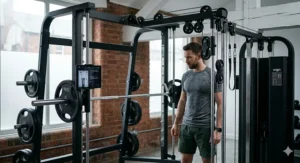
The Bodypower Multi-Function represents that budget-friendly middle ground where British pragmatism meets adequate engineering. This half-rack combo unit reduces the bar resistance through partial counterbalancing to approximately 15-18 kg — not featherweight, but noticeably lighter than standard Olympic bars, which matters when you’re starting from scratch or coming back after time off.
What this does cleverly is integrate dual adjustable pulleys that move independently, allowing natural arm movements during chest flies or unilateral work where one side needs more attention. The half-rack design means it occupies less floor space than full cages (important in British garages that also need to house bins, tools, and that folding table from 2019), whilst still providing spotter arms for bench press safety.
The frame construction uses 50mm box-section steel — not the thickest you’ll find, but perfectly stable for home use up to about 150 kg total loaded weight. Users working in converted bedrooms appreciate the relatively quiet operation; neighbours sharing walls won’t hear much beyond the occasional clank of plates being loaded. The adjustment mechanism for pulley height uses spring-loaded pins that click satisfyingly into position, though a few owners mention these can stiffen up slightly in unheated garages during British winters.
British buyers often pair this with a separate adjustable bench (not included) for the full setup. Customer reviews from UK purchasers highlight decent value for the £900-£1,100 range, with most reporting straightforward assembly in 2-3 hours. One practical note: the dual pulleys accept standard cable attachments (D-handles, rope, straight bar), but you’ll likely want to purchase a few extra attachments separately to maximise exercise variety.
Pros:
✅ Independent pulley handles suit unilateral training
✅ Compact half-rack saves precious UK floor space
✅ Quieter operation appreciated in semi-detached/terraced housing
Cons:
❌ Bench sold separately (adds £100-£200 to total cost)
❌ 50mm frame adequate but not commercial-strength
In the £900-£1,100 range with free delivery on orders over £25. A solid choice for methodical progression without breaking the bank.
3. Strongway Multi Gym Smith Machine With Weights
Strongway, the Coventry-based manufacturer, designed this Multi Gym system specifically for British home exercisers who’d rather not import American kit that arrives with wrong voltage or incompatible fittings. The built-in 90-144 kg weight stack (models vary) means you’re lifting immediately without sourcing Olympic plates — particularly useful given how expensive decent weight sets became in the UK during the 2020-2023 shortages.
The counterbalanced Smith bar reduces starting resistance to approximately 12-15 kg, noticeably lighter than standard configurations and genuinely helpful for those early sessions where form matters more than ego. The guided vertical path angles at roughly 5-7 degrees, mimicking natural squat and press movement better than perfectly vertical rails. Linear bearings on case-hardened shafts ensure smooth operation even after hundreds of sessions in damp British garages.
What UK buyers particularly appreciate is the integrated design philosophy: chest press station, lat pulldown, low row, leg extension/curl, and Smith press all share the same weight stack. No faffing about changing plates between exercises; just shift the pin and crack on. This efficiency matters when you’re training during lunch breaks or squeezing sessions around school runs.
The footprint measures roughly 180 cm x 150 cm — tighter than full power racks but you’ll still need a dedicated space. Assembly instructions include both metric measurements and sensible diagrams (unlike some American imports that assume everyone speaks torque wrench). Most owners complete setup solo in 4-5 hours, though having a second person for the initial frame assembly saves considerable swearing.
Customer feedback from British users notes the built-in weight stack stays smooth and quiet, cable routing rarely tangles, and the whole unit feels reassuringly solid under load. A few mention the leg extension/curl pad sits slightly low for taller users (over 185 cm), requiring a folded towel for comfort — minor quibble, easily solved.
Pros:
✅ Built-in weight stack eliminates need to buy Olympic plates
✅ UK-designed with British home dimensions in mind
✅ Integrated stations for efficient circuit-style training
Cons:
❌ Weight stack limits max resistance compared to plate-loaded
❌ Slightly low leg pad height for very tall users
Typically £800-£1,050 depending on weight stack size. Excellent value for all-in-one functionality with UK-friendly engineering.
4. Marcy MWB-1282X Smith Machine Home Gym
The Marcy MWB-1282X positions itself as the entry point for Brits dipping their toes into serious home strength training without committing four-figure sums. This streamlined setup combines Smith machine, high/low pulley system, and basic weight storage into a package that won’t dominate your spare room like some of the larger all-in-ones.
The bar guidance system uses reinforced runners with decent bearings that handle up to 135 kg capacity — ample for progressive overload through beginner and intermediate stages. What you’re sacrificing versus pricier models is the counterbalancing; the bar sits at standard Olympic weight (roughly 18-20 kg), which feels substantial on first attempt but encourages proper form development. The high/low pulley arrangement handles lat pulldowns, tricep extensions, and cable rows, though the weight stack isn’t included — you’re loading Olympic plates onto the weight horn, old-school style.
In British contexts, this suits users with existing weight plate collections who want guided movement and pulley options without replacing their entire setup. The frame measures approximately 140 cm wide, fitting comfortably in box rooms and converted garages without requiring structural modifications. Safety catches adjust to multiple heights, crucial when training solo and pushing personal limits.
UK customer reviews highlight straightforward assembly (2-3 hours, tools included), solid stability once properly tightened, and surprising durability given the price point. Several buyers mention using it 4-5 times weekly for 18+ months with no significant wear beyond expected cosmetic scuffing. The pulley cables occasionally need re-routing if you switch attachments frequently, but nothing that requires mechanical expertise.
What this won’t do is pamper beginners with ultra-light starting weights or provide the cable station versatility of dual-pulley systems. But for building fundamental strength on squats, bench press, and shoulder work whilst having basic cable exercises available, it’s rather sensible value.
Pros:
✅ Sensible entry price for Smith machine functionality
✅ Compact enough for typical UK spare rooms
✅ Compatible with existing Olympic plate collections
Cons:
❌ No counterbalancing (standard 18-20 kg bar weight)
❌ Plates not included (add £150-£300+ for decent set)
Around £550-£750 with Amazon Prime delivery. Thoroughly decent for methodical strength building on a budget.
5. Phoenix Multi-Functional Smith Machine
The Phoenix Multi-Functional occupies interesting middle ground in the UK market: more refined than basic models, less expensive than commercial-grade options. This unit integrates linear bearing technology that genuinely reduces friction during movement — you’ll notice the difference compared to cheaper bushings, particularly on slower eccentric phases where control matters.
The bar system reduces resistance through strategic counterweighting to approximately 16-19 kg, making it accessible for most users whilst still providing enough weight to engage muscles properly during warm-up sets. The frame construction uses heavier-gauge steel than budget alternatives, rated for both home and light commercial use (PT studios, small gyms, physiotherapy clinics). Safety catches lock positively at 18 different height positions, accommodating various exercises and user heights without requiring adjustments mid-session.
British buyers appreciate the attention to UK-specific details: metric labelling throughout, UKCA compliance markings, and customer service based in Birmingham rather than redirecting to overseas call centres. The multi-grip pull-up bar includes narrow, medium, and wide positions, whilst the dip handles attach securely without wobbling. Cable routing uses high-quality pulleys that operate smoothly even when loaded near maximum capacity.
In practice, this excels for users who’ve outgrown starter equipment and recognise quality components justify the price difference. The linear bearings genuinely improve the lifting experience compared to basic runners, particularly noticeable during high-rep sets where friction accumulates on lesser machines. Assembly takes 3-4 hours with clear instructions, though you’ll want metric Allen keys handy as some fixings use less common sizes.
Customer feedback from UK users highlights excellent stability during use, minimal maintenance requirements (occasional bearing check and cable inspection), and reassuring build quality that suggests years of reliable service. A few note the footprint requires proper measurement before ordering — at roughly 200 cm tall and 160 cm wide, it won’t squeeze into every space.
Pros:
✅ Linear bearings provide noticeably smoother operation
✅ UK-based support and UKCA compliance
✅ Suitable for home and light commercial applications
Cons:
❌ Requires careful space measurement before purchase
❌ Assembly needs patience and metric tools
Typically £700-£950 depending on included attachments. Solid mid-range choice for serious home training.
6. Exigo Plate-Loaded Counter-Balanced Smith Machine
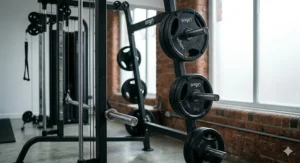
Step into commercial territory with the Exigo Plate-Loaded model, engineered for British gyms, physiotherapy clinics, and serious home setups where budget accommodates quality. This UK-manufactured unit reduces bar weight to just 10 kg through comprehensive counterbalancing — genuinely transformative for rehabilitation work, older users, or circuit training where quick weight changes keep classes flowing.
The counterbalance mechanism uses Oilite bushings and precision pulleys that operate virtually silently, crucial in PT studios with clients working nearby. Linear bearings on stainless steel guide rods deliver that commercial-smooth movement you’d find in high-end gyms charging £70+ monthly. The frame construction uses 100x50x3mm flat-sided oval tubing with lifetime warranty on main structure — build quality that suggests decades rather than years of service.
What justifies the £2,900-£3,500 investment is the attention to details that matter during actual use: adjustable safety stops that lock positively without play, six weight plate storage posts that keep Olympic discs organised and accessible, and engineering tolerances that maintain smooth operation through thousands of reps. The counterbalance system shields moving components behind gunmetal-grey panels for safety and aesthetics.
British commercial buyers — gym owners, sports clubs, rehabilitation centres — appreciate the UKCA certification and compliance with EN957/EN ISO 20957 standards. For home users with generous budgets and long-term perspective, this represents buy-it-once-cry-once philosophy where proper engineering eliminates future replacement costs.
Customer feedback from UK commercial installations highlights exceptional reliability, minimal maintenance beyond routine safety checks, and user satisfaction with the 10 kg starting weight accommodating diverse abilities. Home buyers typically mention appreciating the quality every single session, though acknowledging the substantial upfront cost requires commitment.
Pros:
✅ 10 kg bar weight perfect for rehabilitation and beginners
✅ Commercial-grade construction with lifetime frame warranty
✅ UK-manufactured with full UKCA compliance
Cons:
❌ Substantial investment (£2,900-£3,500)
❌ Professional delivery/installation typically required
In the £2,900-£3,500 range with professional delivery options. Commercial quality for those prioritising longevity and performance.
7. Watson Counter-Balanced Plate-Loaded Smith Machine
The Watson Counter-Balanced represents the pinnacle of counterbalancing technology available in the UK: the bar weighs just 2 kg after counterweights engage. Read that again — two kilograms. This opens strength training to populations traditionally excluded: frail elderly, post-surgical rehabilitation, neurological conditions affecting strength, or complete beginners who’ve never lifted anything heavier than shopping bags.
The engineering behind this involves Thomson Linear Bearings — widely regarded as the smoothest, quietest, and most durable bearings available — combined with precisely calibrated counterweights that reduce the standard 25 kg bar by 23 kg. The bar still rotates on 4 x 30mm roller bearings, making hook-offs effortless even when fully loaded. Fully welded lock pins (rather than bolted) reduce maintenance requirements and increase safety margins.
Built from 100x50mm and 70x70mm box section steel, this machine is engineered for commercial environments but increasingly appears in private physiotherapy practices and wealthy home gyms where budget permits best-in-class equipment. The frame design accommodates users from 150 cm to 195+ cm height without requiring constant adjustment between exercises.
What British buyers need to understand: this is made-to-order equipment with 4-6 week lead times from the Lincolnshire factory. You’re not clicking ‘Add to Basket’ for next-day delivery; you’re commissioning bespoke gym equipment built to order. Watson offers frame colour customisation, allowing integration with existing gym aesthetics.
Customer feedback from UK commercial installations and high-end home gyms emphasises the transformative impact of 2 kg starting weight for users who couldn’t previously engage with resistance training. Physiotherapists particularly value the ability to progress clients in tiny increments, building confidence alongside strength. The construction quality reportedly stays perfect through years of intensive use.
Pros:
✅ Revolutionary 2 kg bar weight opens training to new populations
✅ Thomson Linear Bearings deliver exceptional smoothness
✅ Made-to-order UK manufacturing with customisation options
Cons:
❌ Premium pricing (£3,200-£4,000+)
❌ 4-6 week lead time as made-to-order
Around £3,200-£4,000 with installation options available. The ultimate choice for rehabilitation, elderly users, or those demanding absolute best-in-class.
Understanding Counter Balance Mechanisms: What UK Buyers Need to Know
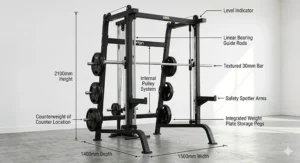
The counterbalance system inside these machines uses surprisingly straightforward physics wrapped in precise engineering. Picture a standard Olympic Smith bar weighing 20-25 kg suspended between vertical guide rails. Now attach cables to that bar, route them over pulleys at the top of the frame, and connect them to weights that pull upward with constant force. Those counterweights effectively subtract from the bar’s mass, reducing the resistance you actually lift.
A quality counterbalance mechanism includes several key components: precision pulleys (typically 75-100mm diameter) that minimise friction, aircraft-grade cables rated for thousands of cycles, Oilite bushings or linear bearings that keep counterweights tracking smoothly, and protective shrouds preventing fingers getting pinched. The engineering challenge lies in balancing reduction amount against natural feel — reduce too much and the bar feels unnaturally floaty; too little and beginners still struggle.
In Britain’s damp climate, where garages and garden rooms experience temperature swings and humidity variations, the bearing quality matters enormously. Cheap bushings corrode within months when exposed to condensation; proper Oilite or linear bearings maintain smooth operation through years of British weather. This explains why counterbalanced machines cost £200-£400 more than equivalent non-counterbalanced models — the additional components aren’t optional extras, they’re precision parts requiring proper materials and assembly.
What most UK buyers overlook is the starting weight directly impacts exercise progression strategy. With a 2 kg counterbalanced bar, you’re adding weight plates from session one, building confidence through tangible progress. With a 20 kg standard bar, complete beginners might spend weeks just mastering the empty bar movement before adding plates. Neither approach is inherently superior; it depends whether you’re rehabilitating from injury (ultra-light essential) or building strength from zero (standard weight teaches stability faster).
How to Choose Your Counter Balanced Smith Machine for UK Homes
1. Measure Your Space Accurately (Metric, Naturally)
Grab your tape measure and note ceiling height, floor space, and doorway dimensions. Most Smith machines stand 200-220 cm tall and occupy 150-180 cm width by 120-150 cm depth. Add 50 cm clearance around all sides for loading plates and safe movement. That bedroom measuring 3m x 2.5m? It’ll fit a compact model but you won’t have much room left. Garages and conservatories typically work better, assuming ceiling height cooperates.
2. Determine Your Actual Starting Strength Level
Be brutally honest here. If you can comfortably handle a 20 kg shopping bag, standard Smith bars won’t overwhelm you. If stairs leave you breathless or you’re recovering from illness/injury, seek counterbalancing that reduces bar weight to 10 kg or below. This isn’t about ego; it’s about matching equipment to capability so you actually use it rather than letting it become an expensive clothes horse.
3. Consider Long-Term Space Constraints
British property prices mean most of us aren’t expanding anytime soon. That spare room is staying a spare room. Choose equipment that accommodates future partners, visiting relatives, or eventual children without requiring removal each time. Compact multi-function units work better than sprawling systems when domestic space flexibility matters.
4. Assess UK-Specific Delivery and Assembly Factors
Large fitness equipment delivery in Britain often involves scheduling with couriers who’ll bring it to your door but not assemble it. Narrow Victorian staircases, modern apartment block lifts, terraced housing without rear access — all complicate delivery. Check product dimensions in packaging versus your access routes. Some manufacturers offer white-glove delivery with professional assembly; factor that £100-£200 cost if you’re not confident with spanners.
5. Budget for Plates, Bench, and Accessories
That £900 Smith machine is brilliant value until you realise you need £200-£300 in Olympic plates, a £150 adjustable bench, and £50-£80 in cable attachments. Always calculate total setup cost. Some packages bundle these components; others leave you sourcing them separately from various UK suppliers.
Common Mistakes When Buying Counter Balanced Smith Machines in the UK
Ignoring Ceiling Height Requirements
British homes vary wildly — Georgian townhouses with 3.5m ceilings versus modern flats with 2.3m height. Smith machines need clearance for the bar at full extension plus your height and range of motion. Measure twice, order once, or you’ll discover your £1,200 machine doesn’t fit after you’ve unwrapped it.
Underestimating British Weather Impact on Garage Equipment
That unheated garage sees 100% humidity during winter, condensation dripping from the roof, and temperature swings from -5°C to 25°C seasonally. Cheap bearings corrode within months. Cables fray faster. If you’re installing in an unheated space, prioritise stainless steel components, sealed bearings, and marine-grade cables. Or accept you’ll need to clean and maintain more frequently than someone training in a climate-controlled spare room.
Assuming American Product Specifications Apply to UK Models
American fitness sites reference different standards, measurements, and delivery expectations. That “free shipping” doesn’t help UK buyers. The voltage, plug type, and customer service differ fundamentally. Always verify you’re purchasing from UK-authorised dealers selling UK-spec equipment with proper warranties and local support.
Neglecting UKCA Marking for Commercial or Semi-Commercial Use
If you’re a personal trainer planning to use this equipment with clients, running classes from home, or setting up a small studio, UKCA marking isn’t optional — it’s legally required for commercial fitness equipment in Great Britain. Budget models typically lack certification; commercial-grade units include it. Check before purchasing if you plan any commercial application whatsoever.
Overlooking Assembly Time and Complexity
That “easy assembly” claim means different things to different manufacturers. Some UK brands provide excellent metric instructions with pre-assembled sub-units; others ship hundreds of loose bolts with incomprehensible diagrams. Read customer reviews specifically about assembly. Budget 3-5 hours even for “straightforward” models, and don’t attempt it alone unless you enjoy wrestling 30 kg steel frames.
Counter Balanced Smith Machines vs Free Weight Training: What Works for British Homes
The Smith machine versus free weights debate rages eternally in fitness circles, but in cramped British housing, practical considerations often trump theoretical ideals. Free weight training develops stabiliser muscles and natural movement patterns that Smith machines partially eliminate through guided motion. That’s undeniably true. However, free weights also require substantial floor space for safety zones, Olympic bars measuring 2.2 metres end-to-end, and ideally a spotter for heavy pressing movements.
The British Heart Foundation notes that strength training helps reduce risk of heart disease whilst improving mental wellbeing — benefits achievable whether you’re using guided machines or free weights. In a 3m x 2.5m spare room, setting up an Olympic bar for squats means you’re essentially standing in one spot with minimal clearance. Smith machines condense that footprint whilst adding cable stations and pulley options impossible with just barbells and plates. You’re trading some stabiliser muscle engagement for space efficiency and exercise variety — often a worthy compromise in British contexts.
The safety factor matters enormously when training solo in domestic settings. Free weight bench pressing alone requires careful planning, conservative weight selection, and accepting you might need to dump the bar if you misjudge your final rep. Smith machines let you twist-lock the bar at any point during movement, eliminating catastrophic failure scenarios. This psychological safety encourages pushing limits that cautious solo lifters might avoid with free weights.
For British homes specifically, the noise consideration tilts toward Smith machines. Dropping barbells onto rubber mats still creates significant sound transmission through floors and walls — your downstairs neighbour in that converted Victorian house won’t appreciate 80 kg hitting the deck at 6am. Smith machines stay whisper-quiet when used properly, reducing domestic friction.
The ideal solution, if space permits, combines both: a counterbalanced Smith machine for guided pressing and squatting plus a modest free weight section for supplementary work. But if you’re choosing one or the other in a space-constrained British home, Smith machines deliver broader exercise options in tighter footprints.
Real-World Use Case: British Home Gym Scenarios
Scenario 1: London Flat – 25 Square Metre Living Space
Sarah rents a one-bedroom flat in Zone 3 where gym memberships cost £65 monthly and opening hours don’t align with her nursing shifts. She purchased a Marcy MWB-1282X that fits in her bedroom corner, folds partially when not in use, and provides Smith press, cable pulldown, and basic rowing exercises. Total investment £700 including bench and starter plate set. After 14 months, she’s saved approximately £910 in gym fees whilst training more consistently than when relying on commercial gym access.
Scenario 2: Manchester Suburban Semi – Converted Garage
The Thompsons converted their integral garage into a home gym after their youngest started university, freeing up time and budget previously allocated to family activities. They selected the Strongway Multi Gym with built-in weight stack, eliminating plate storage issues in their 4m x 3m space. Both use it 4-5 times weekly, with Dad (62) appreciating the counterbalanced bar for shoulder work and Mum (58) using cable stations for rehabilitation following knee surgery. Total cost £1,050 split across 3+ years of projected use.
Scenario 3: Rural Shropshire – Home Physiotherapy Practice
James runs a private physiotherapy practice from a converted barn on his property. He invested in the Watson Counter-Balanced model specifically for its 2 kg starting weight, allowing progression with elderly clients and post-operative rehabilitation cases. The £3,800 cost qualifies as business equipment expense, and the UKCA certification satisfies professional insurance requirements. Client retention improved after adding resistance training to treatment protocols.
Long-Term Maintenance in British Conditions: Keeping It Smooth
British weather does peculiar things to garage-stored equipment. Here’s what actually works based on UK user experiences rather than manufacturer marketing:
Monthly Tasks:
- Wipe down guide rails with dry cloth after sessions to remove hand oils and chalk residue
- Check cable routing for fraying, particularly where cables bend around pulleys
- Inspect safety catch engagement — they should lock positively without sticking
- Lubricate linear bearings if manufacturer recommends (many are sealed and don’t require it)
Quarterly Tasks:
- Deep clean all moving parts with degreaser, particularly if garage temperatures fluctuate
- Check all bolts for tightness using torque wrench if provided in assembly specs
- Examine counterweight cables for wear or corrosion, especially in unheated spaces
- Test safety mechanisms under light load to confirm proper function
Annual Tasks:
- Professional inspection if using commercially with clients (insurance may require this)
- Replace any worn cables or frayed attachments
- Re-lubricate bushings and pivot points with marine-grade grease if in damp environment
- Check frame for any hairline cracks or stress points (rare but critical)
The single most effective maintenance habit UK users report: covering the machine with breathable fabric when not in use if stored in unheated garages. This reduces condensation contact with bearings and cables, extending component life significantly in our maritime climate.
FAQ: Counter Balanced Smith Machines UK
❓ What does counterbalance mean on a smith machine?
❓ Are counter balanced smith machines suitable for building muscle in UK home gyms?
❓ Do I need planning permission to install a smith machine in my UK garage?
❓ What's the actual bar weight on counterbalanced models available in the UK?
❓ Can counter balanced smith machines handle heavy weights for advanced UK lifters?
Conclusion: Finding Your Perfect Counter Balanced Smith Machine
The counter balanced smith machine market in the UK has matured considerably since the pandemic-era scramble for home fitness equipment. What we’re seeing in 2026 is proper choice across price brackets: sensible entry-level options around £600-£800, thoroughly capable mid-range machines at £900-£1,400, and legitimate commercial-grade equipment for those with budgets and ambitions to match.
The counterbalancing feature transforms accessibility for populations who’d struggle with standard Olympic bars — older users, rehabilitation cases, absolute beginners, or anyone training solo without spotters. In Britain’s compact housing stock, the space efficiency of combining Smith press, cable stations, and safety catches into single units makes considerably more sense than sprawling free weight setups requiring dedicated rooms.
Your choice ultimately hinges on honest assessment of space, budget, and training goals. That spare bedroom measuring 3m x 2.5m suits compact models like the Marcy MWB-1282X or Bodypower Multi-Function. Converted garages or larger spaces accommodate comprehensive systems like the Marcy SM-4033 or Strongway Multi Gym. Commercial applications or rehabilitation-focused users justify the Watson or Exigo premium models through superior engineering and ultra-light starting weights.
Whatever you select, remember that consistent training with adequate equipment beats sporadic sessions at expensive commercial gyms. The £1,000-£1,500 most quality setups cost equals roughly 18-24 months of average UK gym membership — except you own the equipment outright, train on your schedule, and never queue for equipment whilst some chap takes leisurely rest between sets whilst scrolling his phone.
✨ Don’t Miss These Exclusive Deals!
🔍 Take your strength training to the next level with these carefully selected products. Click on any highlighted item to check current pricing and availability on Amazon.co.uk. These picks will help you find exactly what you need!
Recommended for You
- Best Smith Machine for Home UK 2026: 7 Top Expert Picks
- Best Ab Bench for Home Gym UK: 7 Expert Picks (2026)
- Best Hyperextension Bench UK: 7 Expert Picks for 2026
Disclaimer: This article contains affiliate links. As an Amazon Associate, I earn from qualifying purchases. If you purchase products through these links, we may earn a small commission at no additional cost to you.
✨ Found this helpful? Share it with your mates! 💬🤗
