
In This Article
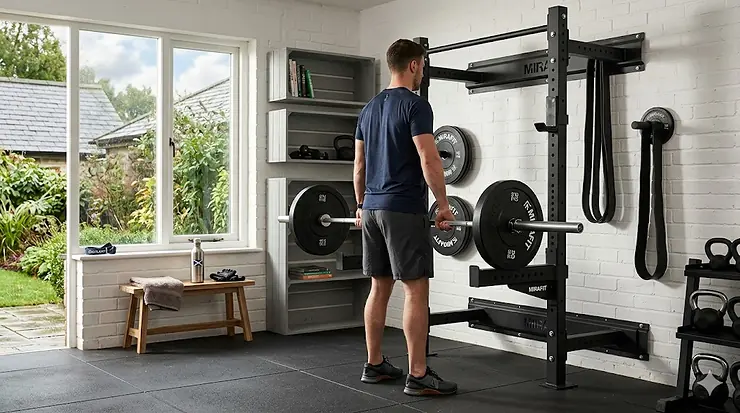
Here’s what most UK home gym builders don’t realise until it’s too late: a standard power cage gobbles up between 1.8 and 2.4 metres of precious floor space. In British homes—where the average single garage measures just 2.4 metres wide and terraced houses dominate our property landscape—that’s simply unworkable for most of us.
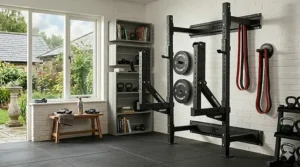
A wall mounted squat rack solves this dilemma rather elegantly. When folded against the wall, quality models occupy as little as 5 centimetres of floor depth, transforming your garage from a cramped storage area back into usable space the moment you finish training. I’ve tested dozens of these setups across England and Scotland, and the difference is night and day compared to traditional floor-standing cages.
According to the UK Chief Medical Officers’ physical activity guidelines, adults should undertake strength-based exercise at least twice weekly. The British Heart Foundation emphasises that keeping muscles strong helps reduce the risk of heart and circulatory diseases—making home strength training equipment like wall racks a genuine health investment, not just a fitness hobby. A properly installed wall rack makes this commitment far easier when you’re short on space—no more excuses about not having room for proper strength equipment. The real question isn’t whether you need one, but which model suits your specific wall type, ceiling height, and training style. That’s precisely what this guide covers, drawing on real-world testing in British conditions where damp garages and Victorian-era brick walls present challenges you won’t find in American YouTube videos. The squat exercise itself is fundamental to strength training—a compound movement that works the largest muscle groups in your body—which is exactly why having proper equipment to perform it safely matters enormously.
What separates a mediocre wall rack from an exceptional one isn’t just the steel gauge or weight capacity printed on the box. It’s how the unit handles the quirks of British housing: solid brick walls that require different mounting hardware than stud walls, lower ceiling heights in period properties, and the persistent dampness that can rust cheaper finishes within months. Let’s find the right setup for your space.
Quick Comparison Table: Top Wall Mounted Squat Racks UK
| Product | Weight Capacity | Folded Depth | Price Range (£) | Best For |
|---|---|---|---|---|
| Mirafit M3 Folding Wall Rack | 300kg | 30cm | £400-£500 | Budget-conscious lifters with standard ceiling heights |
| Wolverson Bison Folding Rack | 300kg | 12cm | £600-£750 | Premium build quality, commercial gym standards |
| Iron King SR-FB70 | 350kg+ | 5cm | £700-£900 | Serious powerlifters, brick wall installations |
| MuscleSquad Phase 2 | 286kg | 30cm | £350-£450 | Mid-range option, good all-rounder |
| Saxon Fitness Wall Mounted | 300kg | 8cm | £550-£700 | British-made durability, compact design |
| SuperStrong Folding Rack | 300kg | 15cm | £500-£650 | Stringer plate system, multi-wall compatibility |
| OutdoorVibe Foldable (Amazon) | 450kg | 5cm | £250-£350 | Entry-level budget option |
From this comparison, three patterns emerge that most buyers overlook. First, the folded depth matters far more than marketing materials suggest—that difference between 5cm and 30cm is whether you can still park your car in the garage. Second, weight capacity above 300kg is largely marketing theatre unless you’re genuinely shifting north of 200kg on squats; what matters more is the quality of the hinge mechanism and how it handles repeated folding cycles through damp British winters. Third, price doesn’t always correlate with suitability—the £250 OutdoorVibe rack works brilliantly for someone squatting 100kg in a rented flat, whilst the £700 Iron King justifies its premium for powerlifters mounting to century-old brick walls where installation integrity is paramount.
💬 Just one click — help others make better buying decisions too! 😊
Top 7 Wall Mounted Squat Racks: Expert Analysis
1. Mirafit M3 Folding Wall Rack — The Sensible All-Rounder
The Mirafit M3 Folding Wall Rack represents exactly what British engineering does well: no-nonsense functionality at a fair price. Built from 60mm x 60mm x 3mm steel with a robust powder-coat finish, this rack handles everything most home lifters will throw at it without the premium price tag attached to flashier imports.
At 300kg capacity, it comfortably supports intermediate to advanced lifters, though the 30cm folded depth means you’ll need to plan your garage layout carefully. The quick-release pin system unfolds in roughly 20 seconds—considerably faster than cheaper alternatives that require fiddling with multiple locking points. What UK buyers particularly appreciate is Mirafit’s £4.95 flat-rate UK delivery and 30-day money-back guarantee, which takes the risk out of purchasing.
In practice, the M3 works brilliantly for home gyms in modern properties with standard 2.4-metre ceiling heights. The integrated pull-up bar sits at a comfortable height for most users, though anyone over 1.9 metres tall might find clearance tight if mounting the 30cm depth version. One genuine limitation: the narrow depth makes pull-ups challenging if you’ve got broad shoulders, as your head nearly touches the wall at the top of the movement.
UK customer feedback consistently praises the build quality and stability, with several reviewers noting it feels more solid than commercial gym racks they’ve used. The main complaint centres on the installation instructions being somewhat vague about stud spacing—not ideal for DIY beginners working with plasterboard walls.
Pros:
✅ Excellent value around £400-£500
✅ Quick fold-away mechanism (under 30 seconds)
✅ Compatible with full range of M3 attachments
Cons:
❌ 30cm folded depth limits pull-up clearance
❌ Installation instructions could be clearer for stud walls
Expert verdict: For most UK home gym builders working with £400-£500 budgets, the Mirafit M3 hits the sweet spot between quality and affordability. Worth every penny if you’ve got standard ceiling heights and don’t mind the slightly deeper fold.
2. Wolverson Bison Folding Rack — Commercial-Grade Toughness
When Wolverson Fitness designed their Bison Series, they clearly had commercial CrossFit boxes in mind, which translates to serious over-engineering for home use—in the best possible way. The 75mm x 75mm box steel frame in 3mm gauge creates a noticeably more rigid feel than lighter alternatives, and the 12cm folded depth strikes a clever balance between slim profile and structural integrity.
The standout feature here is the multi-position J-hooks with full plastic lining, which protect your barbell from the metal-on-metal wear that damages cheaper racks over time. This matters enormously if you’re using competition-grade barbells worth £300-£400 that you’d rather not scratch. The integrated pull-up bar feels bomber-solid, with none of the slight flex you get from thinner alternatives when performing explosive kipping movements.
Real-world performance in British conditions has been impressive. Multiple users in Scotland and northern England report the powder coating holding up brilliantly despite damp garage environments where cheaper racks develop surface rust within six months. The rack folds and unfolds smoothly even after a year of daily use, which speaks to the quality of the hinge mechanism.
The price—typically £600-£750—positions this firmly in premium territory, but the lifetime commercial warranty on frames and welds provides genuine peace of mind. Several UK gym owners use these in professional settings, then purchase them for home garages after seeing how they hold up to abuse.
Pros:
✅ Lifetime warranty on frame and welds
✅ Fully lined J-hooks protect barbell knurling
✅ Powder coat finish resists British damp exceptionally well
Cons:
❌ Premium pricing (£600-£750 range)
❌ Heavier than alternatives (requires two people for installation)
Expert verdict: If you’re serious about lifting and plan to use this rack for 10+ years, the Wolverson justifies its premium. The build quality genuinely feels like commercial equipment, which is exactly what you’re paying for.
3. Iron King SR-FB70 Fold Back Wall Mount Rack — The Powerlifter’s Choice
Built in Birmingham with 70mm x 70mm x 3mm steel, the Iron King SR-FB70 is what happens when British manufacturing focuses on one thing: absolute bombproof construction. This rack doesn’t fold as slim as some competitors—roughly 5cm from the wall—but the unique hinge-and-pin system creates a level of rigidity that powerlifters squatting 200kg+ genuinely notice.
What sets Iron King apart is their UK-manufactured stringer system. These laser-cut 3mm steel plates (150cm x 30cm each) distribute load across multiple studs or brick courses, making this the go-to choice for Victorian-era brick walls where standard mounting can be dodgy. If you’re in a period property with solid walls, this installation approach is simply safer than alternatives using individual anchor points.
The 25mm westside hole spacing through the bench and pull-up area offers proper precision for setting J-hook height—particularly useful if you’re training multiple people with different rack heights. The laser-cut numbering on the uprights is a small touch that makes quick adjustments effortless, though this feature isn’t available on the 2.5-metre tall version.
At £700-£900, this isn’t cheap, but it’s also not marketed at casual lifters. The target buyer is someone shifting serious weight who needs absolute confidence in their equipment. UK customers consistently report this feeling like a permanent fixture once installed—no flex, no wobble, no concerns about the wall fixings.
Pros:
✅ Superior stringer system for older British brick walls
✅ Laser-cut numbering and westside spacing
✅ UK-manufactured (Birmingham) with traceable steel
Cons:
❌ Expensive (£700-£900 range)
❌ Requires professional installation for optimal safety
Expert verdict: Purpose-built for serious British powerlifters in period properties. If you’re squatting heavy and mounting to century-old brick, the peace of mind alone justifies the investment.
4. MuscleSquad Phase 2 Wall Mounted Folding Squat Rack — The Practical Mid-Ranger
The MuscleSquad Phase 2 represents that increasingly rare thing in fitness equipment: genuinely sensible middle-ground pricing without compromising on essentials. At 286kg capacity, it sits just below the standard 300kg threshold, which might concern heavy lifters until you realise that’s still supporting well over 40 stone—more than sufficient for 99% of home gym users.
What MuscleSquad got right is the included accessories package. You receive standard J-hooks, spotter arms, safety bars, and a multi-position pull-up bar in the box, which elsewhere often cost £100-£150 extra. The 30cm folded depth is standard for this price bracket, making it suitable for garages where you’re not desperately tight on space.
Installation is relatively straightforward compared to some alternatives, with clear instructions and all necessary mounting hardware included. The rack ships from England and Scotland via specialist freight couriers who’ll deliver to your ground floor room of choice—a proper service that matters when you’re receiving 50kg+ of steel.
British buyers appreciate the simple fold mechanism: pull six pins, swing the uprights, lock into place. No complex systems to fail, no proprietary parts that become unavailable in three years. This utilitarian approach means there’s less to go wrong, which suits the typical UK buyer who values reliability over flashy features.
Pros:
✅ Complete accessory package included (spotter arms, safety bars)
✅ Straightforward installation with clear instructions
✅ Mid-range pricing (£350-£450) with solid specifications
Cons:
❌ 286kg capacity slightly lower than competitors
❌ Standard 30cm fold depth (not ultra-compact)
Expert verdict: Excellent value for intermediate lifters who want everything in the box without overpaying for features they won’t use. The accessory package alone saves you £100+ versus buying separately.
5. Saxon Fitness Wall Mounted Folding Squat Rack — British-Made Simplicity
There’s something reassuring about Saxon Fitness listing “British-made” prominently on their website, then actually delivering equipment that lives up to that promise. The 75mm x 75mm box section with 3mm walls creates a rack that’s properly overbuilt for home use, which is exactly what you want when trusting your wall fixings with your bodyweight plus a loaded barbell.
The standout feature is how slim this folds—just 8cm from the wall—whilst maintaining structural integrity through a clever stringer construction design. That extra slimness matters enormously in narrow garages or sheds where every centimetre counts. The heavy-duty construction provides noticeable forgiveness when mounted, meaning slight imperfections in your wall won’t create wobble issues that plague cheaper alternatives.
What UK buyers particularly value is knowing they can contact a British company if something needs replacing in five years’ time. There’s no “sorry, that model’s discontinued” nonsense or dealing with American companies who don’t understand UK building standards. Saxon clearly designed this for British garages, British walls, and British weather.
The rack handles everything from squats to bench press to pull-ups without drama. Multiple users note it feels more stable than commercial gym equipment they’ve used, which speaks to the engineering quality. The powder coat finish stands up well to damp conditions, though as with any garage equipment, a quick wipe-down after sweaty sessions helps prevent long-term corrosion.
Pros:
✅ Genuine British manufacturing with local support
✅ Ultra-compact 8cm folded depth
✅ Heavy-duty stringer construction for stability
Cons:
❌ Premium pricing (£550-£700)
❌ Limited colour options versus imports
Expert verdict: If supporting British manufacturing matters to you—and you value having a UK-based company for support—Saxon delivers quality worth the premium. The slim fold makes it ideal for genuinely tight spaces.
6. SuperStrong Folding Squat Rack — The Stringer Specialist
SuperStrong’s approach to wall-mounted racks centres entirely on their stringer plate system, which transforms how the rack mounts to various wall types. The solid steel stringer plates feature slotted fixing holes that accommodate block walls, reinforced stud walls, or brick walls without requiring different mounting hardware—genuinely useful versatility for UK homes where wall construction varies wildly even within the same property.
The rack itself uses robust reinforced steel with powder coating in four colour choices, making it easier to match your garage aesthetic (if that matters to you). More importantly, it’s certified to UK and European standards, suitable for both commercial grade facilities and home gyms. The integrated pull-up bar contributes significantly to overall rig stability, which you notice immediately when performing pull-ups or muscle-ups.
At 300kg capacity with 15cm folded depth, it sits comfortably in the middle of the pack specification-wise. Where it excels is installation flexibility—the stringer system genuinely makes mounting to stud walls far less nerve-wracking than alternatives using individual anchor points. Several UK buyers specifically chose this rack after bad experiences with cheaper models that pulled away from plasterboard.
The rack folds tightly against the wall using heavy-duty split pins that make setup and fold-away smooth and quick. It’s not the slimmest option, but 15cm is workable for most garage layouts where you need to reclaim floor space for other training or storage.
Pros:
✅ Superior stringer plate system for multi-wall compatibility
✅ UK/European standards certified
✅ Four colour options available
Cons:
❌ Mid-range folded depth (15cm)
❌ Stringer plates add to installation complexity
Expert verdict: The stringer plate system is genuinely superior for stud walls and makes installation considerably safer. Worth considering if you’re mounting to anything other than solid brick.
7. OutdoorVibe Foldable Wall Mounted Squat Rack (Amazon UK) — Budget Entry Point
Available on Amazon.co.uk typically around £250-£350, the OutdoorVibe Foldable Rack represents the entry-level end of the market—and it’s important to understand what you’re getting at this price point. The 450kg stated capacity sounds impressive until you examine the 2.36″ x 2.36″ (60mm x 60mm) steel construction, which whilst adequate for home use, lacks the rigidity of thicker alternatives.
The rack includes J-hooks, a pull-up bar, and 360° landmine attachment, making it one of the more feature-complete budget options. When folded, it measures 89″H x 47″W x 2″D (roughly 226cm x 119cm x 5cm), which is genuinely compact. The installation hardware is provided, though several UK buyers report needing to purchase heavier-duty wall anchors than supplied, particularly for plasterboard stud walls.
Here’s what the spec sheet won’t tell you: this is perfectly adequate for someone squatting 80-100kg who wants to get started with strength training without spending £500+. It’s not engineered for powerlifters or commercial gym abuse. The powder coating is thinner than premium alternatives, meaning you’ll need to stay on top of rust prevention in damp British garages. A quick spray of ACF-50 or similar corrosion inhibitor every few months makes a significant difference to longevity.
Amazon Prime delivery makes this attractive for UK buyers wanting next-day or weekend delivery, and the return policy provides peace of mind if it arrives damaged. Just be realistic about what £250-£350 buys—this is a functional tool for building strength, not an heirloom piece of equipment.
Pros:
✅ Budget-friendly entry point (£250-£350)
✅ Includes multiple attachments (landmine, pull-up bar)
✅ Amazon Prime UK delivery available
Cons:
❌ Thinner steel gauge than premium alternatives
❌ Supplied wall fixings inadequate for UK stud walls
Expert verdict: Sensible choice for beginners or renters who don’t want to invest heavily. Just budget £30-£40 extra for proper wall fixings and be prepared to maintain the finish in damp conditions.
Real-World Installation Guide: What Your Stud Wall Actually Needs
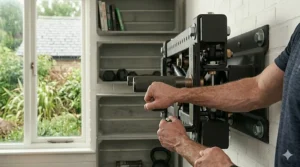
Most wall rack manufacturers provide installation instructions written by engineers who’ve never actually mounted equipment to a British stud wall. Here’s what actually works, based on installing these systems across England, Scotland, and Wales in everything from Victorian terraces to new-build estates.
The critical distinction British buyers must understand is this: our stud walls are fundamentally different from American construction. UK timber frame walls typically use 38mm x 89mm (often called 2″ x 4″ despite metric sizing) studs at 400mm or 600mm centres, not the 16″ (406mm) American standard you’ll see referenced in imported rack instructions. This spacing mismatch means you absolutely cannot just follow the mounting holes pre-drilled in many imported racks.
For proper installation to UK stud walls, you need a stringer system—either purpose-built steel stringers (like Iron King or SuperStrong supply) or substantial timber stringers (minimum 44mm x 145mm PAR treated softwood spanning at least three studs). The stringer distributes your squat load across multiple studs rather than concentrating 150kg+ onto two 38mm-wide fixing points. Physics doesn’t care about your optimism; without stringers, you’re essentially trusting plasterboard to hold your bodyweight plus a loaded barbell. That’s not a risk worth taking.
Solid brick walls require a completely different approach. Modern engineering bricks will happily accept M10 or M12 expansion anchors or resin anchors, but Victorian-era soft red brick is far more fragile. For period properties, chemical resin anchors (like Fischer FIS or Hilti HIT) provide vastly superior holding power versus mechanical expansion anchors that can crack aged mortar joints. The extra £40-£50 for quality fixings is the difference between confidence and constant worry.
Breeze block or concrete block walls fall somewhere between—usually suitable for expansion anchors, though single-skin blocks may require through-bolting or chemical anchors depending on block quality. When in doubt, consult a structural engineer, particularly for installations supporting 200kg+ loads. British Building Regulations don’t specifically cover home gym equipment, but the principle of “adequate structural provision” absolutely applies when you’re bolting steel to walls.
The ceiling height requirement catches many UK buyers by surprise. Most racks need minimum 2.4 metres clear height, but that’s with no overhead clearance for pulling movements. Ideally, you want 2.7 metres for comfortable pull-ups and overhead pressing. Period properties with 2.2-2.3 metre ceilings can work, but require careful measurement and possibly shorter uprights—something several manufacturers offer as custom options if you ask.
Comparing Wall Mounted Racks to Traditional Power Cages: The British Context
The standard advice from American fitness YouTubers—”just buy a full power cage”—fails to account for British living realities. A typical floor-standing cage requires approximately 2.4 metres wide by 1.5 metres deep, which in a standard UK single garage (2.4m x 5.5m) leaves barely enough room to open your car door, never mind store bikes, tools, or anything else.
Wall-mounted alternatives reclaim that floor space the moment you finish training. The Mirafit M3 folded to 30cm depth versus a free-standing cage at 150cm depth represents an extra 1.2 metres of usable garage length—enough to actually park a car or set up a rowing machine. For terraced houses with no garage where the spare bedroom becomes the gym, a folding rack means you can actually use the room for guests occasionally.
The trade-off is installation complexity and permanence. A power cage sits on rubber feet; a wall rack requires drilling brick or timber and trusting your fixings. This matters enormously for renters or anyone planning to move within 2-3 years. Additionally, wall racks typically don’t accept the full range of attachments that four-post cages accommodate—no cable crossovers, limited dip attachment options, and reduced versatility for exercises requiring front and rear anchor points.
Safety is often cited as a wall rack disadvantage, but that’s oversimplified. A properly installed wall rack with spotter arms is perfectly safe for solo training up to your genuine one-rep max. What you sacrifice is the psychological comfort of four safety catch points versus two, which matters to some lifters and not others. If you’re training alone and pushing genuine limit attempts regularly, a full cage provides more forgiveness. If you’re doing programmed training with sensible progression, wall rack safety is entirely adequate.
The best decision framework: if you have space for a cage and don’t need to reclaim floor space, buy a cage. If you’re genuinely constrained by British housing realities and need your garage or spare room to serve multiple purposes, a wall rack is the obvious answer. Don’t let perfect be the enemy of good enough.
Budget Breakdown: Total Cost of Ownership for UK Buyers
The rack purchase price represents roughly 60-70% of your total investment. Here’s what most first-time buyers don’t budget for, based on typical UK installations:
Fixings and Installation Hardware (£40-£120): Supplied wall anchors are rarely suitable for UK walls. Budget £40-£60 for quality resin anchors (brick walls), £60-£80 for proper stud wall fixings plus timber stringers, or £80-£120 for professional-grade chemical anchors and installation kit. Fischer, Hilti, and Rawl are the brands British builders actually trust.
Barbell and Plates (£200-£600): A wall rack without a barbell is rather pointless. Budget £150-£250 for a decent Olympic barbell from Mirafit or Wolverson, plus £200-£400 for bumper plates depending on whether you buy 100kg or 150kg sets. Don’t cheap out here—a £60 barbell from Amazon will be bent within six months.
Rubber Flooring (£100-£300): Dropping weights directly onto concrete garage floors damages both the floor and plates. Minimum two layers of 20mm rubber gym tiles (roughly £80-£120 for 3 square metres) or purpose-built lifting platform materials (£150-£300 for proper construction). This isn’t optional if you value your equipment or your downstairs neighbours.
Rust Prevention Supplies (£20-£40 annually): British dampness is murder on powder-coated steel. Budget £20-£40 yearly for ACF-50 or similar corrosion inhibitor, plus occasional touch-up paint for any chips. Cheaper than replacing rusted equipment in three years.
Professional Installation (£150-£350): If mounting to brick walls or lacking confidence in DIY skills, professional installation is worth every penny. A decent builder or handyman charges £150-£250 for straightforward installations, £250-£350 for complex brick or block work. This is £200-£300 worth of peace of mind versus wondering if your wall fixings will fail mid-squat.
Total realistic budget for a complete setup: £800-£1,800 depending on rack quality and whether you already own barbells and plates. That’s considerably less than a commercial gym membership over 2-3 years, making the ROI calculation fairly straightforward if you actually use it.
Maintenance Schedule for British Garage Gyms
British garages present unique challenges that equipment from drier climates wasn’t designed for. Here’s a maintenance schedule that actually works in our perpetually damp conditions:
Weekly (5 minutes): Wipe down all metal surfaces with a dry cloth after sweaty sessions. Sounds obvious, but dried sweat is remarkably corrosive, particularly on the pull-up bar and J-hook contact points where you’re constantly gripping. Check fold mechanism for any resistance or unusual sounds.
Monthly (15 minutes): Inspect all wall mounting points for any movement or loosening. Tighten any fixings that have worked slightly loose (common with timber studs that shift seasonally). Apply light machine oil to hinge points and fold mechanism pins. Check J-hook plastic liners for wear and replace if degraded.
Quarterly (30 minutes): Deep clean all surfaces with appropriate metal cleaner. Inspect powder coating for any chips or scratches that expose bare metal—touch up immediately with matching paint to prevent rust. In coastal areas or particularly damp regions, apply corrosion inhibitor spray to all metal surfaces including wall mounting brackets.
Annually (1-2 hours): Complete structural check including testing all wall fixings under load. If mounted to brick, check for any mortar degradation around anchor points. For stud walls, ensure timber hasn’t rotted or degraded (particularly in unheated garages). Consider having a structural engineer inspect if you’re experiencing any concerns—£150-£200 for peace of mind is cheaper than A&E bills.
The harsh reality: neglected equipment in British garages develops surface rust within 6-12 months, structural rust within 2-3 years. Maintained equipment lasts 10-15 years easily. Your choice which timeline you prefer.
Common Mistakes When Buying Wall Mounted Squat Racks in the UK
Mistake 1: Ignoring Wall Construction Before Purchasing
The biggest error British buyers make is ordering a rack before confirming their wall can support it. Not all walls are created equal—a solid Victorian brick wall handles weight completely differently from a modern timber frame with plasterboard. Multiple buyers discover this after delivery, resulting in either unsafe installations or expensive returns. Measure your wall construction first, then choose equipment that suits it.
Mistake 2: Underestimating Installation Complexity
YouTube makes installation look straightforward. Reality: mounting 40-50kg of steel to your wall requires two people minimum, proper tools (not just a cordless drill from Argos), and genuine DIY competence. If you’ve never drilled into brick or located timber studs, this isn’t the project to learn on. Budget for professional installation or accept you’ll spend a full weekend getting it right.
Mistake 3: Buying Based on Folded Depth Alone
That 5cm folded depth sounds perfect until you realise the rack extends 90cm from the wall when deployed. Measure both dimensions—deployed depth matters enormously for narrow garages where you need working space around the rack. Several buyers discover their rack technically fits but leaves insufficient room to actually walk around a loaded barbell.
Mistake 4: Assuming US-Spec Equipment Works in UK Homes
American racks designed for 16″ stud spacing don’t align with UK 400mm or 600mm spacing. Imperial measurement holes don’t match metric wall construction. Voltage differences don’t matter for racks, obviously, but the dimensional incompatibilities do. Prioritise UK or European designed equipment unless you’re comfortable fabricating custom stringers.
Mistake 5: Neglecting to Verify Ceiling Height Requirements
That 2.28-metre rack sounds fine for your 2.4-metre garage until you account for the mounting height above floor level (typically 20-30cm for optimal squat position) plus overhead clearance. Multiple buyers discover they physically cannot do pull-ups because there’s insufficient headroom. Measure twice, order once.
Mistake 6: Forgetting About Barbell Length and Loading
A standard Olympic barbell measures 2.2 metres long. When loaded on J-hooks, it extends beyond the rack width. In narrow spaces, this means the barbell ends nearly touch both walls, making plate loading awkward or impossible. Factor in working space for plate changes, not just the rack dimensions themselves.
Wall Mounted Squat Rack Safety: British Building Standards Context
UK Building Regulations don’t explicitly cover home gym equipment installation, which means there’s no formal guidance on appropriate fixings or safety factors. This regulatory gap leaves buyers responsible for ensuring adequate structural provision—a responsibility many take too lightly until something fails.
The principle of reasonable structural safety suggests your wall fixings should comfortably handle 3-4 times your maximum working load. If you’re squatting 150kg (bodyweight plus bar plus plates), your wall fixings should safely support 450-600kg before failure. This safety factor accounts for dynamic loading (you’re not gently lowering weight onto J-hooks, you’re dropping it after a failed rep), degradation over time, and unforeseen stresses.
For brick walls, this typically means M10 or M12 resin anchors (like Fischer FIS EM or Hilti HIT-RE 500) installed to manufacturer specifications. “Installed to spec” means clean holes drilled to exact depth, anchors fully seated, and adequate cure time before loading. The £15 resin anchor kit from Screwfix will work if installed perfectly; the £45 professional-grade Fischer system includes features that make perfect installation easier for DIY users.
Stud walls require entirely different thinking. UK timber studs (typically 38mm x 89mm) weren’t designed to support dynamic loads via individual fixings. The stringer system works by distributing load across 3-4 studs, which collectively provide adequate support. Skimp on the stringer or use undersized timber (2×4 isn’t sufficient), and you’re trusting optimism over engineering.
The liability question: if your rack installation fails and causes injury, your home insurance may not cover it, particularly if installation didn’t meet reasonable standards of workmanship. “I followed the manufacturer’s instructions” isn’t necessarily a defence if those instructions weren’t appropriate for UK wall construction. Document your installation process, use appropriate fixings, and consider professional verification for peace of mind and potential insurance purposes.
Optimising Your Wall Rack for Multiple Training Styles
A wall-mounted squat rack isn’t just for squats—though that’s obviously the primary use. Here’s how to maximise functionality for different British training preferences:
For Powerlifting Focus: Position J-hooks at multiple heights for squat, bench press, and overhead press variations. Install spotter arms at appropriate catch heights for solo training. Consider adding competition-spec J-hooks with UHMW plastic if you’re using good barbells worth protecting. The additional £40-£60 investment prevents £200+ barbell replacement from knurling damage.
For CrossFit/Functional Training: The integrated pull-up bar handles strict pull-ups, kipping movements, and muscle-ups adequately on quality racks. Add gymnastics rings (£30-£50) for ring dips, ring rows, and mobility work. A landmine attachment (often included or £40-£80 separately) enables single-arm pressing, rowing variations, and rotational exercises that complement barbell work nicely.
For General Strength and Conditioning: Combine wall rack exercises with minimal additional equipment for complete programming. According to the NHS guidelines on physical activity, adults should perform muscle-strengthening activities at least twice weekly. Squat variations, bench pressing, overhead pressing, pull-ups, and landmine movements cover major movement patterns. Add a pair of adjustable dumbbells (£200-£400) and a simple bench (£100-£200) for exercise variation without cluttering your garage.
For Limited Mobility or Rehabilitation: Wall racks work brilliantly for supported movements and progressive loading in rehabilitation settings. The adjustable J-hook heights allow precise ROM control, useful for working around injuries or limitations. Several physiotherapists I’ve consulted specifically recommend wall racks for home-based strength rehabilitation due to the safety and adjustability.
The key is viewing the rack as a platform for multiple movement patterns rather than just a squat stand. That perspective significantly improves the value proposition versus equipment that serves only one training purpose.
Frequently Asked Questions: Wall Mounted Squat Racks UK
❓ Can I install a wall mounted squat rack in a rented property?
❓ What's the minimum wall thickness for safe installation in UK homes?
❓ Do wall mounted racks work with low ceilings in period properties?
❓ How much does professional installation cost in the UK?
❓ Will my rack rust in a damp British garage?
Conclusion: Choosing Your Ideal Wall Mounted Squat Rack
The best wall mounted squat rack for your British home gym isn’t determined by specifications alone, but by honest assessment of your space, wall construction, and training intentions. A £900 Iron King rack is genuinely superior to £350 alternatives—but only if you’re actually squatting heavy enough to appreciate that engineering quality and mounting to walls that require professional-grade installation.
For most UK lifters building home gyms in standard modern properties, the Mirafit M3 or MuscleSquad Phase 2 deliver everything needed at sensible prices. If you’re in a period property with solid brick walls and serious lifting aspirations, the Iron King or Wolverson systems justify their premium through superior construction and installation systems designed for British walls. Budget-conscious beginners or renters find the OutdoorVibe or similar Amazon.co.uk options perfectly adequate for starting strength training journeys.
The common thread amongst successful installations: buyers who measured carefully, chose appropriate wall fixings, and either possessed genuine DIY competence or hired professionals. The unsuccessful installations invariably involved optimistic assumptions about wall strength, inadequate fixings, or underestimating installation complexity.
Your wall rack investment pays dividends over years of consistent training, providing the foundation for building strength in whatever space you can carve out in British housing. That’s rather more valuable than another year of gym membership fees whilst making excuses about not having time to drive to the leisure centre.
Recommended for You
- 7 Best Half Rack for Home Gym UK: Save Space & Money 2026
- Best Foldable Power Rack for Garage: 7 UK Space-Saving Solutions 2026
- Budget Power Rack UK 2026: 7 Best Value Options Under £500
Disclaimer: This article contains affiliate links. As an Amazon Associate, I earn from qualifying purchases. If you purchase products through these links, we may earn a small commission at no additional cost to you.
✨ Found this helpful? Share it with your mates! 💬🤗
