In This Article
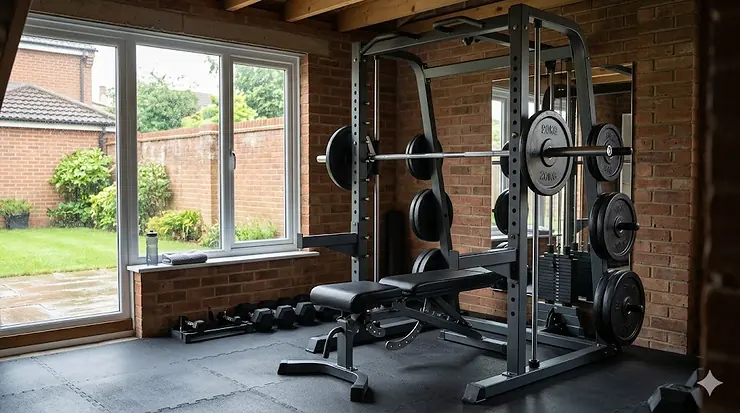
Setting up a proper home gym in Britain can feel like solving a puzzle — you’re juggling limited space (especially in those terraced houses and flats), a modest budget, and the need for equipment that actually earns its keep. The smith machine for home use has quietly become one of the smartest solutions going. Think of it as your own personal spotter that never complains about early morning sessions or asks for a brew halfway through.
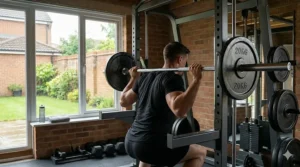
What most people overlook about the smith machine for home gyms is this: it’s not just safer than free weights for solo training — it’s strategically safer. The guided barbell system runs on precision rails with multiple lock-out points, meaning you can push closer to failure without that nagging worry about getting pinned under 80 kg of cold steel. That’s rather useful when you’re training at 6 AM in your garage whilst the family’s still asleep.
Here’s the thing about home gym smith machine setups in the UK — they’ve evolved well beyond those clunky commercial units. Modern designs pack a remarkable amount of functionality into compact footprints, often combining smith machine benefits with cable systems, pull-up bars, and dip stations. For anyone serious about building strength at home without transforming their spare room into a commercial fitness centre, a well-chosen smith machine offers exceptional value per square metre.
This guide examines seven smith machine reviews based on real-world performance in British homes, with special attention to the factors UK buyers actually care about: will it fit through your doorway, does it justify the investment, and can it handle the punishment of progressive overload training? We’ve researched actual models available on Amazon.co.uk, analysed customer feedback from UK buyers, and considered the practical realities of training in British conditions — limited space, variable temperatures in unheated garages, and the preference for equipment that doesn’t require a structural engineer to install.
Quick Comparison Table: Top Smith Machines for UK Home Gyms
| Model | Price Range | Weight Capacity | Footprint | Key Features | Best For |
|---|---|---|---|---|---|
| Bodypower Compact Smith Machine | £350-£450 | 136 kg (Smith bar) | 109 × 180 × 192 cm | 11 racking positions, push-up handles, compact design | Small UK homes, budget-conscious buyers |
| HOMCOM Multi Gym (66kg Stack) | £450-£550 | 110 kg max load | 200 × 135 × 103 cm | Integrated 66 kg weight stack, dual pulley system | Beginners wanting all-in-one solution |
| Marcy SM-4903 Smith Machine | £1,100-£1,400 | 272 kg capacity | Commercial-grade dimensions | Olympic rack, cable pulley system, adjustable bench | Serious home lifters |
| SPORTNOW 3-in-1 Power Cage | £600-£800 | 900 kg capacity | Multi-station design | Dual cable crossover, 17-level squat rack, lat pulldown | Intermediate lifters needing versatility |
| Strongway Multi Gym (177kg Stack) | £800-£1,000 | 177 kg integrated stack | Full-size commercial build | Pre-loaded weight stack, dual cable pulley, dip station | Advanced users wanting gym-quality |
| Phoenix Fitness Multi-Functional | £400-£550 | Varies by configuration | Modular design | Squat rack, leg press, pull-up bar, chest press | Families sharing equipment |
| JX FITNESS Smith Machine | £550-£700 | Power cage integrated | 200+ cm height required | Lat pulldown system, multi-grip options, curling pad | Full-body training enthusiasts |
From this comparison, the Bodypower Compact emerges as the value champion under £450 — rather impressive considering it sacrifices very little in terms of guided barbell system functionality. What you’re trading off is the integrated weight stack and cable complexity found in pricier models. The Marcy SM-4903, whilst commanding a premium around £1,200-£1,400, justifies its position for anyone treating their home gym as a long-term training investment rather than a temporary fitness phase. Budget buyers should note that the sub-£500 options (Bodypower, Phoenix, HOMCOM) require purchasing separate weight plates, which adds roughly £150-£300 to your total setup cost depending on how much iron you need.
💬 Just one click — help others make better buying decisions too! 😊
Top 7 Smith Machine for Home: Expert Analysis
1. Bodypower Compact Smith Machine — Best Value for UK Homes
If you’re working with the typical British semi-detached spare room or converting a single garage into your training space, the Bodypower Compact Smith Machine deserves serious consideration. At around £380-£450 on Amazon.co.uk, it’s positioned squarely in the “affordable but not cheap” category.
The specifications tell part of the story: 136 kg capacity on the Smith bar, 11 racking positions on each upright, and a footprint of just 109 × 180 × 192 cm. What those numbers mean in practice is rather more interesting. The compact dimensions allow it to squeeze into spaces where full-sized commercial units simply won’t fit — think bedroom corners, garage bays alongside the car, or conservatory extensions. The unique track roller system with bearings delivers genuinely smooth, near-silent operation, which matters enormously if you’re training in a terraced house at unsociable hours.
Here’s what UK buyers consistently mention in reviews: the chrome, knurled Smith bar provides excellent grip security even during heavy compound movements, whilst the 11 hook-in positions offer flexibility for different exercise heights without constant readjustment. The included safety catches slide up and down the guide rods, meaning you can confidently push to failure on squats or bench presses without requiring a training partner. This machine also comes with removable push-up handles and foot-hold foam rollers for core work — thoughtful additions that expand exercise variety.
In my experience, the Bodypower Compact suits first-time home gym builders and intermediate lifters who understand that “compact” doesn’t mean “compromised.” It’s compatible with standard 1-inch weight plates only (not Olympic 2-inch), which limits your future upgrade path slightly but keeps initial plate costs lower. The 49 kg frame weight provides surprising stability once loaded, though you’ll want rubber gym flooring underneath to protect your floor and reduce vibration.
Pros:
✅ Genuinely space-efficient design fits UK homes
✅ Smooth bearing system runs quietly for early/late training
✅ 11 racking positions offer excellent exercise flexibility
Cons:
❌ Standard 1-inch plate compatibility limits Olympic plate users
❌ 136 kg capacity may feel restrictive for advanced heavy squatters
Price & Value Verdict: In the £350-£450 range, this represents excellent value for money provided you accept the 1-inch plate limitation. For most home lifters, the capacity ceiling won’t become an issue for years.
2. HOMCOM Multi Gym with 66kg Weight Stack — Best All-in-One for Beginners
The HOMCOM Multi Gym (around £480-£550) takes a different approach entirely by bundling a 66 kg integrated weight stack with the smith machine frame. This matters considerably if you’re new to strength training or prefer the convenience of selectorised weight systems over loading and unloading Olympic plates.
Key specifications include a 200 × 135 × 103 cm footprint, 110 kg maximum load capacity, and dual action press arms that switch between chest press and chest fly exercises with a simple pin adjustment. The integrated weight stack saves you the hassle and ongoing expense of buying individual plates, whilst the dual pulley system enables lat pulldowns, triceps extensions, and cable rows from the same station.
What makes this particularly suitable for UK beginners is the comprehensive exercise coverage — lat pulldown, pec fly, chest press, leg curls, and leg extensions all from a single machine. That’s genuinely useful if your training knowledge is still developing and you want guided movement patterns whilst you learn proper form. The solid steel frame construction and nylon-coated steel wires (tested to 500 kg capacity) provide reassuring stability, whilst the thick padded seat and backrest make longer training sessions comfortable.
UK customer feedback highlights both strengths and limitations. The multi-package delivery (typically arrives in three separate boxes on different dates) can be frustrating, and assembly requires patience and a reasonably competent hand with tools. However, once erected, the machine delivers consistent, smooth resistance across its exercise range. The 66 kg weight stack won’t challenge advanced lifters but provides ample progression for beginners through to solid intermediate level.
From a practical standpoint, this HOMCOM model suits anyone who values convenience over ultimate performance. You’re trading the higher weight capacity and exercise freedom of plate-loaded systems for the simplicity of pin-selected resistance. That’s a perfectly rational choice for many UK home gym users, particularly those training alone who appreciate not wrestling with heavy plates before 7 AM.
Pros:
✅ Integrated 66 kg weight stack eliminates separate plate purchases
✅ Dual action press arms expand chest exercise variety efficiently
✅ Wide base with stability features prevents shifting under load
Cons:
❌ Three-package delivery creates assembly coordination challenges
❌ 66 kg stack ceiling limits progression for stronger lifters
Price & Value Verdict: Around £480-£550 including the weight stack represents fair value, though factor in £100-150 for quality gym flooring. Prime delivery typically offers free shipping to most UK postcodes.
3. Marcy SM-4903 Deluxe Smith Machine — Best Premium Investment
When budget permits and you’re committed to long-term home training, the Marcy SM-4903 (£1,100-£1,400 range) elevates quality significantly. This sits in the “serious home gym” category rather than “dabbling with fitness.”
The specification sheet reads like a commercial gym manifest: 272 kg (600 lb) capacity, heavy-duty steel construction with powder-coated finish, precision linear bearings on the Smith bar, Olympic free-weight rack compatibility, and a fully integrated cable pulley system. The dimensions demand serious floor space — you’re looking at commercial-grade sizing here — but what you gain is genuinely professional-level training capability.
What sets the Marcy SM-4903 apart is build quality you can feel the moment you grip the chrome knurled bar. The linear bearing system provides exceptionally smooth vertical travel with zero wobble or lateral play, even under heavy loads. The quick-release bench adjustment uses a chrome track system that shifts angles in seconds, whilst the Olympic-compatible weight horns and safety catches accommodate both standard training and maximum effort attempts.
UK buyers at this price point typically report using it 4-6 times weekly for years, which transforms the per-workout cost into pennies. The dual upper and lower pulley system runs on separate trolleys, enabling two users to train simultaneously at different weights — genuinely useful for couples or family training sessions. The integrated power tower and dip station adds bodyweight exercise options without requiring additional floor space.
In practical terms, this machine suits anyone who’s moved beyond beginner experimentation and established that home training is their long-term approach. The 272 kg capacity means you won’t outgrow it unless you’re pursuing genuinely elite strength levels. The powder-coated finish withstands the British damp better than cheaper painted frames, important if your home gym occupies an unheated garage or outbuilding.
The investment feels substantial initially, but spread across 5-10 years of consistent use, it’s considerably cheaper than commercial gym memberships (currently £30-50 monthly in most UK cities). Add in the convenience of training whenever suits you, and the financial case strengthens considerably.
Pros:
✅ Commercial-grade 272 kg capacity accommodates advanced progression
✅ Precision linear bearings deliver smooth, professional-quality movement
✅ Dual pulley systems enable two-person training or circuit variety
Cons:
❌ Commercial dimensions require dedicated gym space
❌ £1,100-£1,400 investment demands serious training commitment
Price & Value Verdict: Around £1,200-£1,400 represents premium pricing, but the quality gap between this and sub-£500 models is immediately apparent. Expect 10+ years of reliable service with minimal maintenance.
4. SPORTNOW 3-in-1 Multi-Function Power Cage — Best for Versatile Training
The SPORTNOW 3-in-1 (£600-£800) positions itself as the versatile all-rounder, combining Smith machine functionality with comprehensive power cage features. This matters if your training evolves beyond pure guided barbell work into Olympic lifts, functional training, or sport-specific conditioning.
Core specifications include 900 kg capacity (rather impressive for the price bracket), dual cable crossover system, 17-level adjustable squat rack, integrated lat pulldown, landmine attachment, and multi-grip pull-up bar. The footprint requires planning — multi-station designs naturally consume more floor space — but you’re consolidating what would otherwise require three or four separate pieces of equipment.
What UK buyers appreciate most is exercise variety. The dual cable system offers independent left/right adjustment across 17 different height positions, enabling everything from low cable rows to high-pulley triceps work. The landmine attachment (often overlooked on competing models) opens up rotational pressing and core stability exercises that traditional smith machines can’t accommodate. The multi-grip pull-up bar provides neutral, wide, and narrow grip options for comprehensive back development.
From a practical perspective, the SPORTNOW suits intermediate lifters who’ve identified that their training benefits from movement variety rather than just adding weight to the same three exercises indefinitely. The 900 kg capacity provides enormous headroom for progression — you’ll run out of weight plates long before challenging the frame limits. The barbell bar is included (not always standard at this price point), though you’ll need to source weight plates separately.
UK customer reviews mention assembly complexity — expect 3-4 hours with two people and decent tool competency. However, once built, the frame demonstrates excellent stability and the cable system operates smoothly across its full range. The powder-coated finish holds up well to British conditions, and the rubber feet prevent floor damage whilst minimising noise transmission through floors.
This model particularly suits anyone training for functional fitness, CrossFit-style workouts, or sports requiring varied movement patterns. The Smith machine component provides the safety and guided path benefits for heavy squats and presses, whilst the cable system and landmine enable the dynamic, multi-planar movements that pure Smith work doesn’t cover.
Pros:
✅ 900 kg capacity exceeds most home gym requirements by considerable margin
✅ 17-level cable adjustment enables precise exercise positioning
✅ Landmine attachment expands rotational and functional training options
Cons:
❌ Multi-station footprint demands significant dedicated floor space
❌ 3-4 hour assembly requires patience and mechanical competency
Price & Value Verdict: The £600-£800 range positions this competitively against separate power cage + cable system purchases. Solid mid-range investment for serious home training.
5. Strongway Multi Gym with 177kg Weight Stack — Best for Advanced Users
The Strongway Multi Gym (£800-£1,000) targets the upper tier of home gym enthusiasts with its substantial 177 kg integrated weight stack and commercial-build construction. This sits firmly in the “gym replacement” category rather than “supplement to gym membership.”
The specifications justify the premium: 177 kg pre-loaded weight stack, dual cable pulley system with independent weight selection, integrated dip station, Smith machine with multiple lock-out points, and full-size commercial dimensions. The frame construction uses heavy-gauge steel throughout, with reinforced joints and professional-grade pulleys that’ll outlast most home users’ training careers.
What distinguishes this from cheaper alternatives is immediately apparent when you begin training. The 177 kg weight stack provides genuine progression headroom — most intermediate lifters will take 2-3 years to approach that ceiling on major lifts. The dual cable system allows independent left/right weight selection, meaning you can perform unilateral exercises at different resistances or enable two users to train simultaneously at their own levels. The dip station integrates seamlessly into the frame without the bolted-on afterthought feel of budget models.
UK buyers investing at this level typically report replacing commercial gym memberships entirely. At £40-50 monthly for decent UK gyms, the £800-£1,000 investment pays for itself within 18-24 months, after which you’re training essentially free whilst avoiding commute time, queues for equipment, and the general hassle of public gyms. The pre-loaded weight stack eliminates the ongoing cost and storage challenge of buying ever-more Olympic plates.
From a practical standpoint, the Strongway suits anyone who’s moved beyond experimentation into committed, long-term home training. The commercial-grade construction means minimal maintenance — occasional pulley lubrication and cable inspection is about all it requires. The powder-coated finish resists corrosion well, important for British garages and outbuildings where humidity fluctuates seasonally.
Assembly requires dedication (this isn’t flat-pack furniture) and ideally two people, but the frame’s substantial weight once erected provides exceptional stability. The machine arrives with comprehensive exercise charts and setup instructions, though online video tutorials prove more useful for complex pulley routing.
Pros:
✅ 177 kg integrated weight stack eliminates separate plate purchases
✅ Commercial-grade construction provides gym-quality durability
✅ Dual independent cable systems enable advanced training protocols
Cons:
❌ Commercial dimensions demand dedicated gym room or large garage
❌ £800-£1,000 investment requires genuine training commitment
Price & Value Verdict: Around £900 represents significant investment, but the build quality and integrated weight stack justify the premium for serious home trainers. Factor in potential gym membership savings over 2-3 years.
6. Phoenix Fitness Multi-Functional Smith Machine — Best for Family Use
The Phoenix Fitness Multi-Functional (£400-£550) approaches home gym design from a practical family perspective, offering modular configuration that adapts to different users and training styles. This matters considerably if multiple household members plan to use the equipment.
Core features include an integrated squat rack, leg press station, pull-up bar, chest press capability, and row pulley system. The modular design allows configuration adjustments without tools, enabling quick transitions between different users’ preferred setups. Build quality sits comfortably in the mid-range — not commercial-grade but substantially better than budget offerings.
What UK families appreciate most is the variety of exercise options within a relatively compact footprint. The leg press station provides lower-body work for users who find barbell squats intimidating or technically challenging. The pull-up bar offers multiple grip widths for back development and bodyweight training. The built-in safety hooks reduce injury risk, particularly important when younger family members are learning proper lifting technique.
From a practical perspective, the Phoenix Fitness model suits households where 2-4 people will share the equipment rather than single-user dedication. The quick-adjustment features mean transitioning between users takes minutes rather than requiring complete re-setup. The varied station options keep training interesting for beginners who might otherwise lose motivation on single-purpose equipment.
UK customer feedback highlights reliable performance across moderate training intensities. This isn’t designed for powerlifters attempting personal records, but it handles progressive overload training perfectly well for general fitness, muscle building, and strength development. The safety features prove reassuring for users training alone, whilst the multiple stations prevent queue-forming when several family members want to train simultaneously.
The assembly process requires 2-3 hours and reasonable mechanical competency, though instructions are clearer than many competitors. The frame’s powder-coated finish withstands typical UK garage conditions adequately, and the rubber feet protect flooring whilst reducing noise — important in semi-detached or terraced houses where training noise travels.
Pros:
✅ Modular design adapts to multiple users without complex reconfiguration
✅ Leg press station provides alternative to barbell squats for beginners
✅ Multiple safety features reduce risk during solo training sessions
Cons:
❌ Mid-range build quality won’t satisfy advanced powerlifters
❌ Shared use may require scheduling during peak household training times
Price & Value Verdict: The £400-£550 range represents fair value for multi-user households. Consider this if 2+ people will share rather than single-user intensive training.
7. JX FITNESS Smith Machine Home Gym — Best for Full-Body Training
The JX FITNESS Smith Machine (£550-£700) rounds out our selection by focusing specifically on comprehensive full-body training capability. The integrated power cage with lat pulldown system differentiates this from pure Smith machine offerings.
Key specifications include height requirements exceeding 200 cm (measure your ceiling before ordering), multi-grip pull-up options, integrated curling pad, back cushion for support exercises, and the signature guided Smith barbell system. The power cage element adds Olympic lifting capability alongside the controlled Smith movements.
What makes this particularly suitable for full-body training enthusiasts is the thoughtful integration of upper and lower body stations. The lat pulldown system enables complete back development without requiring separate cable equipment. The curling pad and back cushion facilitate isolation work for arms and core. The multi-grip pull-up bar accommodates different grip widths and hand positions for comprehensive pulling exercises.
UK buyers drawn to the JX FITNESS typically follow structured programmes requiring varied movement patterns rather than focusing exclusively on the big three powerlifts. The Smith machine component provides the safety and control for heavy compound movements, whilst the cage and accessory features enable the assistance work that rounds out balanced development.
From a practical standpoint, this suits intermediate to advanced home trainers who understand exercise programming and value equipment versatility. The 200+ cm height requirement eliminates it from consideration for many British homes with standard 230-235 cm ceilings — measure carefully and account for the additional clearance needed for pull-ups and overhead pressing.
Assembly proves moderately complex but manageable with two people and 3-4 hours. The frame demonstrates solid stability once erected, and the guided barbell system operates smoothly across its travel range. The integrated safety catches and lock-out points function reliably, which matters enormously when training to near-failure alone.
Pros:
✅ Integrated lat pulldown eliminates separate cable machine purchase
✅ Multi-grip options enable varied pulling angles for back development
✅ Power cage integration allows Olympic lifting alongside Smith work
Cons:
❌ 200+ cm height requirement excludes many UK homes with standard ceilings
❌ Full-feature design creates moderate assembly complexity
Price & Value Verdict: Around £550-£700 represents competitive pricing for the feature integration. Excellent value provided your ceiling height accommodates it — measure twice, order once.
Setting Up Your Smith Machine: UK-Specific Considerations
Getting your smith machine for home installed properly makes the difference between years of reliable service and ongoing frustration with wobbles, noise, and floor damage. Here’s what actually matters based on real-world UK home gym experience.
Floor Protection & Stability
British homes weren’t designed with 150+ kg of training equipment in mind. Before your Smith machine arrives, invest in proper gym flooring — rubber tiles or EVA foam mats rated for heavy equipment. Budget £50-150 depending on coverage area. This serves three purposes: protecting your floor (particularly important for laminate, vinyl, or wooden floors), reducing noise transmission through floors (your downstairs neighbours will thank you), and improving overall stability during heavy lifts.
For ground-floor garages with concrete, you can get away with cheaper horse stall mats (around £30-40 each at agricultural suppliers), though they smell rather agricultural for the first few weeks. Upper-floor installations demand professional-grade gym flooring with noise-dampening properties — the £100-150 investment prevents neighbourly complaints and potential lease violations in flats.
Ceiling Height Realities
Most British homes feature 230-235 cm ceilings. Your Smith machine’s height specification only tells part of the story — add another 20-30 cm for exercise clearance, particularly overhead pressing and pull-ups. If your ceiling measures 230 cm and the machine stands 200 cm, you’ve got 30 cm total clearance, which feels cramped during overhead movements.
Measure your garage or spare room ceiling height accurately, then subtract the machine height and add 25 cm minimum working clearance. If the maths doesn’t work, consider angled Smith machines or compact models specifically designed for British home dimensions.
Assembly Essentials
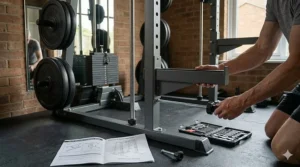
Most UK-delivered Smith machines arrive partially assembled but require 2-4 hours completion time. You’ll need basic tools (adjustable wrench, socket set, Allen keys — usually included), two people (attempting solo assembly risks damaging components or yourself), and adequate workspace (assemble in the final location if possible; moving a completed Smith machine through doorways borders on impossible).
British-specific tip: garage assembly works well provided you’ve got heating available. Working with cold metal in January feels miserable, and some adhesives and thread-lock compounds require temperatures above 10°C for proper curing.
Electrical Considerations
Most Smith machines require no electricity, but if you’re adding LED lighting, radio, or charging points to your gym space, ensure your garage circuit can handle the additional load. Many British garages run on a single 13-amp circuit — adding multiple high-draw devices may trip the breaker. Consult a qualified electrician if you’re uncertain; DIY electrical work in the UK must comply with Part P Building Regulations.
Smith Machine Safety Features: What Actually Matters
The guided barbell system isn’t inherently safer than free weights — safety comes from proper feature implementation and user understanding. Here’s what separates genuinely safe Smith machines from marketing claims.
Lock-Out Points & Spacing
The number of lock-out points matters less than their spacing. Eleven hook-in positions spaced 15 cm apart provides much more practical safety than seven positions spaced 25 cm apart. During exercises like bench press or squats, you want lock-out options at intervals that align with your natural failure point — not 20 cm above or below it.
Quality Smith machines offer 10-15 cm spacing between lock-out points. Check this specification rather than just counting total positions. The twist-to-lock mechanism should engage smoothly with minimal wrist rotation — if it requires forceful twisting, you’ll struggle to rack the bar safely when fatigued.
Safety Catch Adjustability
Adjustable safety catches prevent the bar descending below a predetermined point, acting as your electronic spotter. The critical factors: smooth adjustment along the full range (not just preset positions), secure locking once positioned (vibration shouldn’t shift them), and adequate load rating (matches or exceeds the Smith bar capacity).
During setup, position safety catches 5-8 cm below your full range of motion bottom position. This prevents bar drop accidents whilst allowing complete exercise range. Re-adjust for different exercises — bench press and squat require different safety catch heights.
Bearing Quality & Smoothness
The guided barbell system’s effectiveness depends entirely on bearing quality. Cheap bushings create friction, causing the bar to stick or judder during movement. Quality linear bearings (sealed ball bearings or UHMW plastic with lubrication channels) provide smooth, consistent travel across the full range.
Test this before purchasing if possible: the bar should glide smoothly with minimal force, with no catching or rough spots. If buying online, check reviews specifically mentioning bearing performance — this isn’t cosmetic; it’s fundamental to safe operation.
Smith Machine vs Free Weights: The UK Home Gym Perspective
The smith machine versus free weights debate generates more heat than light in most gym forums. Here’s the practical reality for UK home gym owners rather than theoretical arguments.
Space Efficiency Comparison
A comprehensive free weight setup (Olympic barbell, power rack, bench, 150+ kg of plates, storage) occupies roughly 8-12 square metres minimum. A comparable Smith machine setup requires 4-6 square metres. In British homes where every square metre counts, that efficiency difference matters enormously.
The Smith machine consolidates squat rack, bench press station, and safety catches into a single frame. Free weights demand separate racks, benches, and safety equipment. If you’re working with a single garage bay or spare bedroom, the Smith machine’s consolidation often proves decisive.
Safety When Training Alone
Free weight enthusiasts correctly point out that stabiliser muscle development suffers on guided systems. However, studies indicate that Smith machines and free weights prove equally effective for building muscle mass and strength when training programmes are properly structured. For home gym owners training alone at 6 AM or 10 PM, the safety benefits of guided movement and integrated catches typically outweigh the stabiliser development trade-off.
The practical question isn’t “which is theoretically superior” but “which enables consistent training without injury risk when training solo.” For most UK home gym users, the Smith machine’s safety features prove more valuable than free weight stabiliser demands. Advanced lifters can supplement with kettlebells, dumbbells, or bodyweight work for stabiliser development.
Cost Comparison Over Time
Initial outlay for a quality Smith machine (£600-1,400) exceeds basic free weight setup (£300-500 for starter bar, rack, bench, plates). However, the total cost equation changes over 2-3 years as your training progresses.
Free weights require continuous plate purchases as strength increases. Moving from 60 kg total to 150 kg total means buying approximately £200-300 additional plates. Smith machines with integrated weight stacks require zero ongoing purchases. By year three, the total cost often favours the Smith machine, particularly for users who’d otherwise need 100+ kg plate inventory.
Common Mistakes When Buying Smith Machine for Home
After reviewing hundreds of UK customer experiences and smith machine reviews, certain purchasing mistakes emerge repeatedly. Avoid these to save money and frustration.
Mistake 1: Ignoring Ceiling Height Until Delivery Day
The most expensive mistake UK buyers make: ordering without accurately measuring ceiling height and adding exercise clearance. A 195 cm machine seems fine with 230 cm ceilings until you attempt overhead pressing and realise you’ve got 10 cm total clearance — barely enough to avoid concussion.
Solution: Measure your ceiling height accurately. Subtract the machine’s assembled height. Ensure minimum 25 cm remaining clearance. For pull-up bars or overhead pressing, add another 15-20 cm. If the maths doesn’t work, choose a more compact model rather than hoping it’ll somehow fit.
Mistake 2: Assuming “Compact” Means Actually Compact
Marketing teams love the word “compact” regardless of actual dimensions. A “compact” Smith machine measuring 180 × 200 cm isn’t compact by British spare room standards — it’s enormous.
Solution: Convert dimensions into familiar terms. Lay tape on your floor marking the exact footprint plus 50 cm clearance on all sides for exercise movement. Walk around it. Can you comfortably squat, bench, and move weights without hitting walls? If not, it’s not actually compact for your space.
Mistake 3: Choosing Based on Price Alone
The cheapest Smith machine costs £200-250 on Amazon.co.uk. The quality gap between £250 and £400 is substantial — bearing smoothness, frame stability, safety catch reliability, and longevity all improve dramatically. The gap between £400 and £800 is moderate. Above £1,000, you’re paying for commercial-grade durability and features most home users don’t need.
Solution: Set a budget in the £350-700 range for serious home training. Below £350, quality compromises become significant. Above £700, evaluate whether you actually need commercial-grade features or you’re paying for gym envy rather than functional improvement.
Mistake 4: Underestimating Assembly Complexity
“Assembly required” means different things for different products. A Billy bookcase from IKEA takes 30 minutes. A Smith machine takes 2-4 hours with two people, mechanical competency, and patience. Many UK buyers underestimate this, attempt solo assembly, and damage components or injure themselves.
Solution: Budget 3-4 hours, recruit a mechanically-minded friend (offer pizza and beer as payment), clear adequate workspace, and follow instructions methodically. If you struggle with flat-pack furniture, consider paying for professional assembly (£80-150 typically).
Mistake 5: Forgetting Weight Plates Aren’t Included
Unless specifically stated “integrated weight stack,” your Smith machine requires separate weight plate purchases. Beginners often budget £500 for the machine then discover they need another £200-300 for adequate plates to actually train with.
Solution: Budget total setup cost: machine + plates + flooring + accessories. For most users, that’s machine cost plus 40-60% additional for complete setup. A £500 Smith machine realistically costs £700-800 fully equipped.
How to Choose Smith Machine for Home: UK Buyer’s Criteria
Selecting the right smith machine for home use requires balancing multiple factors specific to British conditions and homes. Here’s the decision framework that actually works.
1. Measure Available Space Accurately
Start with your training space dimensions: length, width, ceiling height. Subtract machine footprint from floor dimensions, leaving minimum 50 cm clearance on all sides. This clearance isn’t wasted — it’s essential for exercise movement, loading weights, and walking around the equipment. For ceiling height, subtract machine height and ensure 25+ cm overhead clearance remains.
If your space measures 250 × 300 cm with 230 cm ceilings, you can accommodate machines up to 150 × 200 cm footprint and 200 cm height maximum. Anything larger physically fits but creates a claustrophobic training environment.
2. Assess Weight Capacity Requirements
Beginners typically need 80-120 kg total capacity initially. Intermediate lifters require 120-180 kg. Advanced strength athletes want 200+ kg capacity. Add 20-30% margin above your current working weights — you’ll progress faster than expected, and maximal testing requires capacity headroom.
For most UK home gym users, 150-200 kg capacity proves adequate long-term. Unless you’re specifically pursuing powerlifting competition, higher capacities become redundant — you’ll run out of weight plates before challenging the machine’s limits.
3. Evaluate Integrated vs Plate-Loaded Systems
Integrated weight stacks (like the HOMCOM and Strongway models) cost more initially but eliminate ongoing plate purchases and storage challenges. Plate-loaded systems (Bodypower, Phoenix) cost less upfront but require continuous plate investments as you progress.
The decision factors: available budget (integrated systems cost £400-1,000; plate-loaded systems start £300), storage space for plates (100+ kg of Olympic plates consumes significant floor space), and training style preference (quick pin-selected weight changes vs manual plate loading).
For beginners uncertain about long-term commitment, plate-loaded systems reduce initial financial risk. For committed trainers replacing gym memberships, integrated stacks prove more convenient long-term.
4. Consider Construction Quality & Longevity
Frame gauge (steel thickness), welding quality, bearing type, and finish coating determine equipment longevity. Budget models use thinner gauge steel (2-3 mm), bushings instead of bearings, and basic painted finishes. Mid-range options upgrade to 3-4 mm steel, sealed bearings, and powder-coating. Premium models feature commercial-grade 4-5 mm steel, precision linear bearings, and multi-layer powder coating.
For UK conditions (garages with temperature fluctuations, humidity, potential condensation), powder-coated finishes resist corrosion substantially better than painted frames. Sealed bearings withstand British damp better than open bushings. These quality differences directly affect 5-10 year durability.
5. Check Safety Feature Implementation
Every Smith machine claims safety features — not all implement them effectively. Quality equipment sold in the UK should comply with EN 957 certification standards for stationary training equipment, which sets requirements for safety, performance, and durability. Evaluate lock-out point spacing (10-15 cm intervals preferred), safety catch adjustability (smooth movement and secure locking), bearing smoothness (no catching or resistance during bar travel), and frame stability (no rocking under load).
If possible, test these before purchasing. If buying online, scrutinise reviews specifically mentioning safety catch performance and bearing smoothness rather than general “good machine” comments.
6. Account for UK-Specific Compatibility
Confirm the machine accepts weight plates you already own or plan to purchase. Standard 1-inch plates (common in UK budget sets) don’t fit Olympic 2-inch sleeves. Olympic plates (50 mm holes) won’t fit standard bars. This incompatibility catches many first-time buyers.
Additionally, verify the machine doesn’t require assembly expertise beyond typical UK homeowner capability. Some US-market machines assume professional assembly or commercial gym installation — not practical for British spare room installation.
Smith Machine Price Guide: UK Market 2026
Understanding smith machine price ranges helps set realistic budgets and identify genuine value versus overpriced mediocrity. Here’s what different price brackets actually deliver in the UK market.
Budget Range (£200-£400)
This entry level captures basic Smith machines with minimal features. You’re getting fundamental guided barbell functionality without cable systems, integrated weight stacks, or premium construction. Typical specifications: 100-130 kg capacity, standard 1-inch plate compatibility, basic painted finish, bushing-based movement rather than bearings.
Who this suits: First-time home gym builders testing commitment levels, users with strict budget constraints, or those supplementing existing free weight setups rather than relying on the Smith machine as primary equipment.
What you’re sacrificing: Build quality, bearing smoothness, safety catch reliability, and longevity. Expect 3-5 years service with moderate use rather than 10+ years from premium models.
UK market examples: Basic Bodypower models, entry HOMCOM units, unbranded Amazon offerings
Mid-Range (£400-£800)
This sweet spot balances quality and affordability for serious home training. Features typically include: 150-180 kg capacity, sealed bearing systems, powder-coated frames, integrated safety catches, cable pulley options, and Olympic plate compatibility. Assembly quality improves substantially, and customer support becomes more responsive.
Who this suits: Intermediate lifters replacing gym memberships, families sharing equipment, or anyone committed to 3+ years home training who wants reliable equipment without commercial-grade investment.
What you’re gaining: Noticeably smoother operation, better stability under heavy loads, corrosion-resistant finishes suitable for British garages, and adequate capacity for progressive overload training.
UK market examples: Higher-tier Bodypower models, SPORTNOW units, Phoenix Fitness multi-stations, mid-range HOMCOM offerings
Premium Range (£800-£1,400)
This upper tier delivers commercial-grade construction for serious home gym investors. Specifications include: 200-300 kg capacity, precision linear bearings, commercial-gauge steel frames, integrated weight stacks (often 100+ kg), dual cable pulley systems, and comprehensive exercise station integration.
Who this suits: Advanced lifters treating home gyms as permanent commercial gym replacements, users training 5+ times weekly at high intensities, or those wanting ultimate reliability and minimal maintenance.
What you’re gaining: Gym-quality durability, minimal maintenance requirements, substantial capacity headroom preventing equipment limitations on training progress, and resale value retention.
UK market examples: Marcy SM-4903, Strongway commercial units, premium multi-station systems
Understanding Total Cost of Ownership
Initial purchase price represents only part of total cost. Factor in:
- Weight plates: £150-300 for adequate initial set (unless integrated stack)
- Gym flooring: £50-150 for proper protection and noise reduction
- Assembly costs: £0 (DIY) to £100-150 (professional installation)
- Accessories: £30-80 for additional attachments, bars, safety equipment
- Maintenance: £20-50 annually for bearing lubrication, cable inspection, bolt tightening
A £500 Smith machine realistically costs £700-850 fully equipped and ready for training. Budget accordingly rather than discovering hidden costs after purchase.
Real-World Performance: What UK Buyers Report
Customer feedback from actual British home gym users reveals patterns that specifications alone don’t capture. Here’s what matters most in daily training.
Noise Levels in British Homes
The single most common complaint: noise transmission through floors and walls. Cheap bearing systems create grinding sounds that neighbours notice. Poor frame damping transmits vibration that rattles light fixtures below. Quality differences become immediately apparent at 6 AM when you’re trying not to wake the household.
What works: Sealed bearing systems, quality gym flooring, rubber feet on the machine frame, and avoiding the absolute cheapest models. The £150-200 quality difference between budget and mid-range machines often comes down to bearing smoothness and vibration damping.
Assembly Experience Reality Check
Manufacturer time estimates prove optimistic. “2-hour assembly” typically requires 3-4 hours for people with average mechanical ability. UK buyers report frustration with imperial measurements (inches/pounds) in instruction manuals when tools are metric, unclear diagrams, and missing or mislabelled components.
What helps: Two people minimum, adequate workspace, proper lighting, taking photos during disassembly of packaging (helps identify which screws/brackets correspond to which components), and watching YouTube assembly videos before starting.
Space Requirements vs Reality
Most buyers underestimate required clearance. A machine occupying 150 × 200 cm footprint realistically needs 250 × 300 cm floor space for comfortable exercise movement, weight storage, and walking around equipment. In British spare rooms averaging 300 × 350 cm, this leaves minimal additional space.
What works: Carefully measuring floor space before purchasing, using painter’s tape to mark equipment footprint and clearance zones on your floor, and physically walking through exercise movements within marked zones.
Long-Term Reliability Patterns
After 12-24 months of regular use, quality differences emerge clearly. Budget models develop play in bearings, safety catches that no longer lock securely, and frame wobble during heavy lifts. Mid-range and premium models maintain smooth operation with minimal maintenance.
What matters most: Frame construction quality (weld integrity, steel gauge), bearing type (sealed vs open), and finish coating (powder-coated vs painted). These aren’t immediately apparent but determine 5-10 year durability.
Smith Machine Maintenance: UK Climate Considerations
British conditions — humidity, temperature fluctuations, condensation in unheated garages — demand specific maintenance approaches not required in climate-controlled commercial gyms. Following proper maintenance protocols helps ensure your equipment remains compliant with UK health and safety regulations for gym equipment.
Monthly Maintenance Tasks
Bearing Inspection & Lubrication: Wipe guide rails clean of dust and debris. Apply PTFE lubricant (dry lubricant rather than oil-based — attracts less dust) to guide rails and bearing contact points. Work the bar through its full range to distribute lubricant evenly.
Frame Inspection: Check all bolts for tightness using appropriate tools. Vibration during heavy lifts gradually loosens connections. Pay particular attention to safety catch mounting bolts and pulley system anchors.
Cable System Check: Inspect cables for fraying, particularly at anchor points and pulley contact areas. Check pulley wheels for smooth rotation. Apply light machine oil to pulley bearings if squeaking develops.
Quarterly Deep Maintenance
Comprehensive Bolt Tightening: Systematically check every visible bolt and connection point. British temperature fluctuations (cold garages in winter, warm in summer) cause metal expansion and contraction that loosens connections faster than stable environments.
Bearing Replacement Assessment: Evaluate bearing smoothness. If catching or resistance develops, bearings may need replacement. Most Smith machines use standard bearing sizes available from UK bearing suppliers (£15-30 per bearing typically).
Frame Corrosion Check: Inspect powder-coated or painted surfaces for chips or damage exposing bare metal. Touch up immediately using automotive-grade paint to prevent rust formation. British humidity accelerates corrosion in unprotected steel.
Winter-Specific Considerations
Unheated British garages drop to near-freezing temperatures overnight. This affects equipment:
- Metal contracts, potentially loosening bolts tightened in warmer conditions
- Condensation forms on cold metal surfaces, promoting rust if not addressed
- Lubricants thicken, increasing bearing resistance
Solutions: Store a dehumidifier in your garage space (costs £30-80, prevents condensation), tighten bolts during winter months, and use cold-temperature lubricants rated for 0-5°C operation.
Frequently Asked Questions
❓ Are smith machines safe for training alone at home in the UK?
❓ What weight capacity do I need for a home smith machine?
❓ Do smith machines fit in standard UK homes and garages?
❓ Should I buy an integrated weight stack or plate-loaded smith machine?
❓ How much maintenance do home smith machines require in UK conditions?
Conclusion: Finding Your Ideal Smith Machine for Home
The smith machine for home market in Britain has matured considerably over the past few years. What once required commercial gym investment now sits within reach of serious home trainers willing to invest £400-1,400 depending on features and build quality.
The practical decision comes down to three factors: available space (measure accurately and account for exercise clearance), training commitment level (are you replacing gym membership or supplementing occasional training?), and budget reality (factor in total setup cost including plates, flooring, and accessories).
For most UK home gym builders, the sweet spot sits in the £500-800 range where build quality, safety features, and capacity meet without commercial-grade premiums. The Bodypower Compact (£350-450) offers exceptional value for smaller British homes, whilst the Marcy SM-4903 (£1,100-1,400) delivers commercial-grade capability for committed long-term trainers. The SPORTNOW 3-in-1 (£600-800) balances versatility and quality nicely for intermediate users wanting exercise variety.
Whichever model you choose, prioritise proper setup — quality gym flooring protects your investment and reduces noise, accurate space measurement prevents delivery-day surprises, and realistic assembly time estimates (double the manufacturer’s claim) prevent frustration. The smith machine benefits for solo home training are substantial provided you match the equipment to your space, budget, and genuine training commitment rather than aspirational fitness fantasies.
Train smart, invest wisely, and enjoy the convenience of never queuing for equipment again.
Recommended for You
- Best Ab Bench for Home Gym UK: 7 Expert Picks (2026)
- Best Hyperextension Bench UK: 7 Expert Picks for 2026
- Best Preacher Curl Bench UK: 7 Expert Picks for 2026
Disclaimer: This article contains affiliate links. As an Amazon Associate, I earn from qualifying purchases. If you purchase products through these links, we may earn a small commission at no additional cost to you.
✨ Found this helpful? Share it with your mates! 💬🤗
